
Bay Area
Al Attles’ Tribute Hall of Fame Celebration

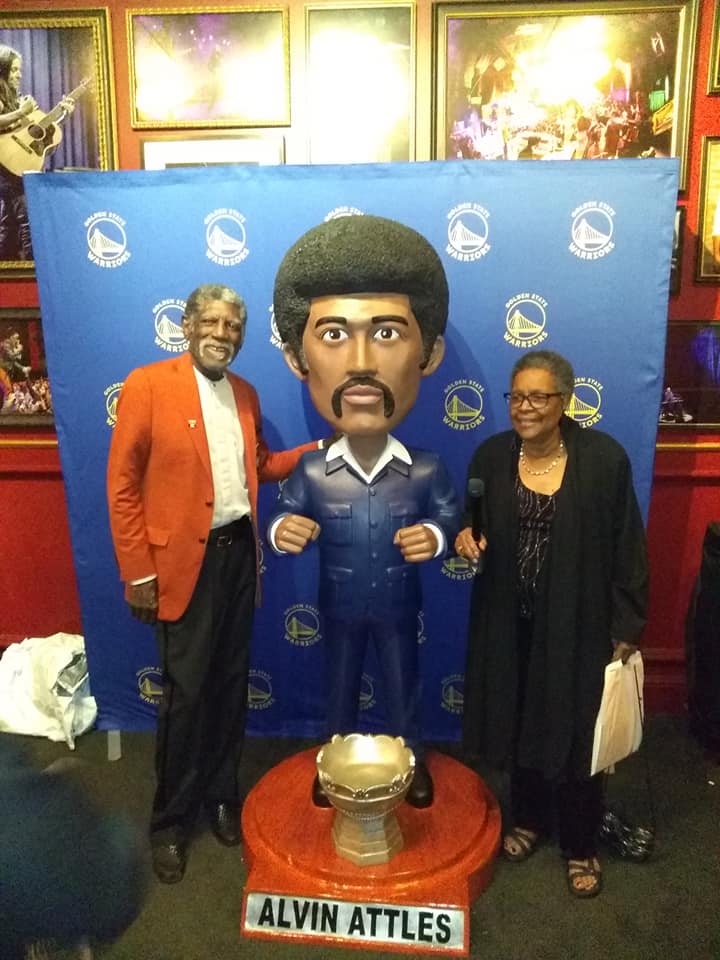
More than 500 fans, friends and supporters attended the Al Attles Tribute Hall of Fame Celebration in Berkeley at the UC Theater on Dec. 22. The event honored Attles for his contributions to the world of basketball.
Attles joined the then-Philadelphia Warriors in 1960, becoming one of the first African-American coaches in the NBA 1969–70 season. Attles guided the Rick Barry-led Warriors to the 1975 NBA championship over the heavily favored Washington Bullets, making him only the second African-American coach to win an NBA title. Attles coached the Warriors until 1983, worked as the Warriors’ general manager and is the longest-serving coach in Warriors history.
The recipient of the John W. Bunn Lifetime Achievement Award in 2014, he was chosen as a member of the Naismith Memorial Basketball Hall of Fame, Class of 2019.
A ‘who’s who’ in the sports community was in attendance, including Golden State Warriors legend Chris Mullin, Golden State Warriors Ambassador Adonal Foyle and former NBA player Antonio Davis.
Mullin provided the welcome and musical performances included the Bay Area’s own Kev Choice and Mistah F.A.B. Guests joined Pete Escovedo and his band including his son Juan and Peter Michael.
Mistah F.A.B., Mullin, Foyle and Davis all spoke of the great influence Al Attles had on their lives and careers.
“He’s a great man and I’ve learned a lot from him,” said Foyle. “From the time I was a kid, Al Attles was an inspiration to me and so many kids,” said Mistah F.A.B.
Video tributes from a variety of celebrities also paid homage to Attles as a great man on and off the field.
Golden State Warriors star player, Steph Curry, along, with his wife, Ayesha Curry, were presented the Al Attles Community Leaders Award. The duo recently launched its non-profit Eat. Learn. Play Foundation to benefit underserved youth.
The Community Leader Award was also presented to Walter J. Haas of Coaching Corps for his commitment to using the transformative power of coaching to uplift thousands of youth. Oakland Director of Parks, Recreation and Youth Development J. Nicholas Williams was honored for his dedication to improving the quality of life of all citizens by engaging the community in preserving and expanding the department’s facilities and programs.
“Tonight is the beginning of many new things being created for the community,” said Shawn Granberry, president of HipHopTV. “If we don’t build it, who will?”
The evening paved the pathway for ACE, the Al Attles Center for Excellence to optimize the lives of underserved youth. ACE also introduced developments to be created through its new partnerships. Jason Kidd’s elementary school teacher Lori Perenon spoke of the new developments to come, including programming for the newly remodeled Willie Keyes Youth center.
Earlier in the year, Kidd along with the Oakland Park and Recreation Department teamed to remodel the center. “Funds we are raising tonight are building programming for youth to last for generations so that they have support,” said Perenon. The remodeled center had other collaborators including Jesse Jackson’s Operation Push and HipHopTV.
“It’s wonderful to be a part of ensuring the kids in the community I grew up in, West Oakland, will still have the same outlets, mentoring and programming to give them the best outcomes in life,” said Antonio Davis who once participated in activities at the Willie Keyes Youth Center as a child.
“Tonight is such an honor. I am grateful to everyone and so appreciative of the love and I wouldn’t be here today without the love and support of my family,” said Al Attles with his wife Wilhelmina Rice.
“Having such an accomplished father is a blessing and I am grateful for everyone that helped make this night so special,” said Attles son, Al Attles, III.
Other guests included Terry Ellis of En Vogue, Arif Khatib, Michelle Lewis, Lionel Bea, Dave Clark, and son David Clark.
To support the ACE visit www. GoAce.org










Activism
Oakland Post: Week of September 30 – October 6, 2026
The printed Weekly Edition of the Oakland Post: Week of September 30 – October 6, 2026

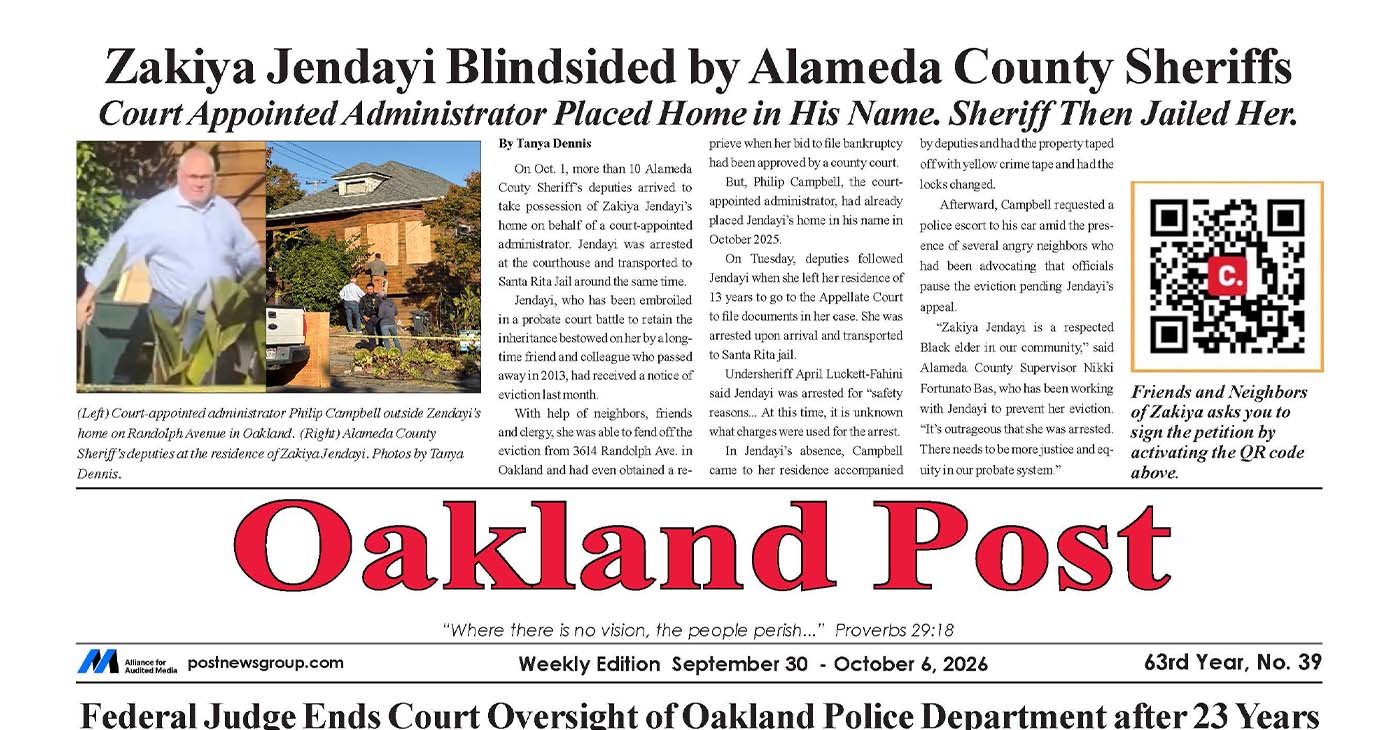
To enlarge your view of this issue, use the slider, magnifying glass icon or full page icon in the lower right corner of the browser window.


Activism
Oakland Post: Week of September 23 – 29, 2026
The printed Weekly Edition of the Oakland Post: Week of September 23 – 29, 2026

To enlarge your view of this issue, use the slider, magnifying glass icon or full page icon in the lower right corner of the browser window.
Activism
Oakland Post: Week of September 16 – 22, 2026
The printed Weekly Edition of the Oakland Post: Week of September 16 – 22, 2026

To enlarge your view of this issue, use the slider, magnifying glass icon or full page icon in the lower right corner of the browser window.



Listening as a Lifeline: A Doula’s Witness to Black Maternal Health

New Protections for Ticket Buyers: Gov. Newsom Signs Assemblymember Isaac Bryan’s Bill

‘We Don’t Talk Trash — We Pick Up Trash!’

Zakiya Jendayi Arrested, Locked Out of Home by Sheriff’s Deputies

Oakland Post: Week of September 30 – October 6, 2026

Asm. Corey Jackson Announces Launch of 24-Hour Childcare in His District

IN MEMORIAM: The Rev. Leon “Sonny” Clark, Longtime Orange County Pastor and Community Leader, Dies at 72

Poll: Becerra Widens His Lead Over Hilton; Californians Split on Wealth Tax

From Historic Memories to New Possibilities: Oakland Celebrates Coliseum 60

County Office of Education Says OUSD Finances Are Getting Healthier, Materially Stronger

LIVE FREE Sunday Dinner Brings Faith, Fellowship and Civic Conversation to Oakland

Remembering Chauncey Bailey as Student Journalists Face Threats to Truth-Telling

BLACspace Cooperative Invites Bay Area to Experience Oakland’s Black Cultural Ecosystem Through a BLAC Map Tour + Party

In Wake of Death on Doorstep, Williams Chapel Baptist Church Calls for Better Care, Funding for Unhoused

Oakland Centenarian Nuna McKee Honored!

Standoff for Justice: Our Homes Are Worth Fighting For

Oakland Post: Week of August 26 – September 1, 2026

Frontier Airlines’ Return to Oakland Airport Brings Flights, Jobs and Opportunity

Gubernatorial Candidate Steve Hilton Blasts California New Tire Rules; Newsom Hits Back

Chef Sharon Lee Blends Culinary Excellence, Education and Empowerment

Jackie Wright Champions Bay Area Stories, Filmmakers and Cultural Institutions

Misnamed ‘Parent’ PAC Seeks to Influence Oakland School Board Elections

Oakland Coliseum Project Opens Door for Small Businesses to Build Bigger

Big City Mayors Ask for “Yes” Vote on Housing Bond Measure; Conservatives Say “No”

Gov. Newsom’s Latest Appointees Include Sacramento Advocate for Formerly Incarcerated Students; State’s New Tech Chief

Longtime BWOPA Member Brendalyn Goodall Appointed to California Workforce Development Board

Gov. Newsom Signs Law Shielding Immigration Aid Workers From Doxing Threats

Secretary of State Shirley N. Weber Urges Californians to Vote Early as Voter ID Battle Intensifies

Oakland Post: Week of September 2 – 8, 2026

IN MEMORIAM: Dolly Parton Dead at 80 — How She Built a Legacy of Love and Earned Her Place in Black Culture

The Conversation With Al McFarlane 6/23/26

Media Monday 6/22/26

LIVE! ASK ALMA! — TUES. 6.23.26 7PM EST

Car Buying Secrets: 4 Hidden Checks Before You Sign!

Is This 550 HP Charger Worth YOUR Money? AutoNetwork Review

Celebrating Juneteenth – Frederick Douglass on education and resistance

LIVE! — ASK ALMA! — TUES. 6.19.26 7PM EST

Hyundai Ioniq 5 Parking, Safety, and 360 View #shorts

2025 Ioniq 5 New Wiper & Powerful Performance! #shorts

Electric SUV Range: Is 259 Miles Enough? #shorts

EV Charging: How Fast Can You Charge an Electric Vehicle? #shorts

Biometric Cooling… Messaging Seats…Come on! 2025 Infiniti QX80 Autograph 4WD

Charged Up: Witness the Magic of a Fully Electric Car! #shorts

Range Rover Sport PHEV Included…: See What’s Inside This Luxury SUV! #shorts

Invisible Hood View: Perfect Parking with X-Ray Vision! #shorts
-
 Community3 weeks ago
Misnamed ‘Parent’ PAC Seeks to Influence Oakland School Board Elections
-
 Activism4 weeks ago
Oakland Post: Week of September 2 – 8, 2026
-

 Community3 weeks ago
Richmond Tiny House Village Farm & Garden Set to Open Gates on Sept. 26
-

 Activism3 weeks ago
Oakland Post: Week of September 9 – 15, 2026
-

 Black History3 weeks ago
Latest Massacre in Haiti Reveals Cruelty U.S. Deportations
-

 Black History3 weeks ago
OPINION: Nolan Wells’ Death One of Several Signifying Racial Terror Lives on in U.S. South
-

 Community3 weeks ago
Democratic Clubs Interview Candidates for Oakland School Board
-

 Business2 weeks ago
Mayor Lee Announces $1 Million Kaiser Permanente Grant for Pilot Program to Address Homelessness, Clean Up Public Spaces throughout Oakland
