
Opinion
Resistance to the Idea of Reparations May Be Simply Psychological


Part I
The newly wide-ranging discussion of reparations is being stimulated by the recognition of the 400th anniversary of the introduction of kidnapped captive Africans at the birth of the American colonies (1619) to later become the United States (1776).
This new/old discord has been re-enlivened. The call to be “repaired” from the damage caused by white enslavement has been openly and covertly rejected woth a resounding ‘no’ by most of the white population and some misguided and memetically infected Black people.
The reason why may be found within my own dictum in Black psychology that “power is the ability to define reality and to have other people respond to it as if it were their own.” It is also the thinking of the great Black psychologist, Dr. Bobby Wright.
Dr. Wright suggested that the ideology of white supremacy is supported by a pathological fear and hatred of blackness; and, by implication, the rejection of the idea of reparations for Black people may be found in the racist core of the white American psyche.
In utilizing diagnostic categories found in white psychology (mis-labeled as general psychology), Dr. Wright notes that many white people suffer from a “psychopathic personality disorder.” He notes that a psychopath is an individual who is constantly in conflict with other persons or groups; is unable to experience guilt; is completely selfish, callous and has a total disregard for the rights of others; has an inflated sense of self-worth; is manipulative, and refuses to accept responsibility .
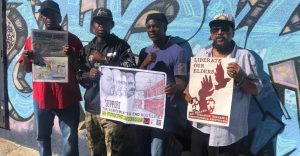
He argues that in relationship to Black people, white people have historically reflected most, if not all, of these attributes, ergo a Psychopathic Racial Personality Disorder.
This psychopathic condition was, in fact, created by white people. One must remember that, for most of modern history, the entire known world held Africa in high regard as the place of high civilization.
Yet, strangely enough, with the onset of the age of Enlightenment and Exploration (invasion) came the advent of the American slave trade (racially based commercial human trafficking) and the need to redefine the meaning of Africa and people of African ancestry (think: “power is the ability to define reality”).
The cancerous idea of white superiority and Black inferiority was not accidental, genetically ascribed nor divinely ordained. It was created and socially constructed. Though endemic to American life and living, several sources can be identified as contributing to white psychopathic disorder and mental madness.
The United Daughters of the Confederacy (UDC)
The establishment of the United Daughters of the Confederacy (UDC) in 1894 (less than one generation after the end of the Civil War) signals the beginning of a premeditated attempt to change the narrative and create the indelible story of African savagery and White honor and dignity.
Growing to about 17,000 members at the turn of the century (1900), by World War I, the UDC had over 100,000 white women as members. What is important to note is that the UDC’s mission and purpose was to “Tell of the glorious fight against the greatest odds a nation ever faced, [so] that their hallowed memory should never die.”
They even went so far as to create a commemorative Southern Cross of Honor medallion and distributed almost 80,000 to Confederate veterans. It is important to note that the secessation of the Southern states was an act of treason. Power is the ability to define reality and the UDC attempted to “redefine” treachery as honorable and the “Lost Cause” (the right to murder and enslave Black people) was lauded as the genteel South with ‘happy’ slaves; and to identify Confederate soldiers as deserving unquestionable respect.
The UDC’s goal to preserve white supremacy was masked (redefined) and strategically supported by the erection of monuments to honor the Confederacy; to publish biographies and history textbooks about major southern figures (aka traitors); to influence educational curriculum; and to immortalize the heroism and valor of the KKK and the Southern way of life.
The Association of Black Psychologists, Bay Area Chapter (ABPsi-Bay Area) is committed to providing the Post Newspaper readership with monthly discussions about critical issues in Black Mental Health. The ABPsi-Bay Area is a healing resource. We can be contacted at (bayareaabpsi@gmail.com) and readers are welcome to join with us at our monthly chapter meeting, every third Saturday at the West Oakland Youth Center from 10:00 a.m. – 12:00 p.m.
Wade Nobles, PhD is co-founder and past President, The ABPsi, Professor Emeritus, Africana Studies and Black Psychology, SFSU.








Activism
Oakland Post: Week of September 9 – 15, 2026
The printed Weekly Edition of the Oakland Post: Week of September 9 – 15, 2026

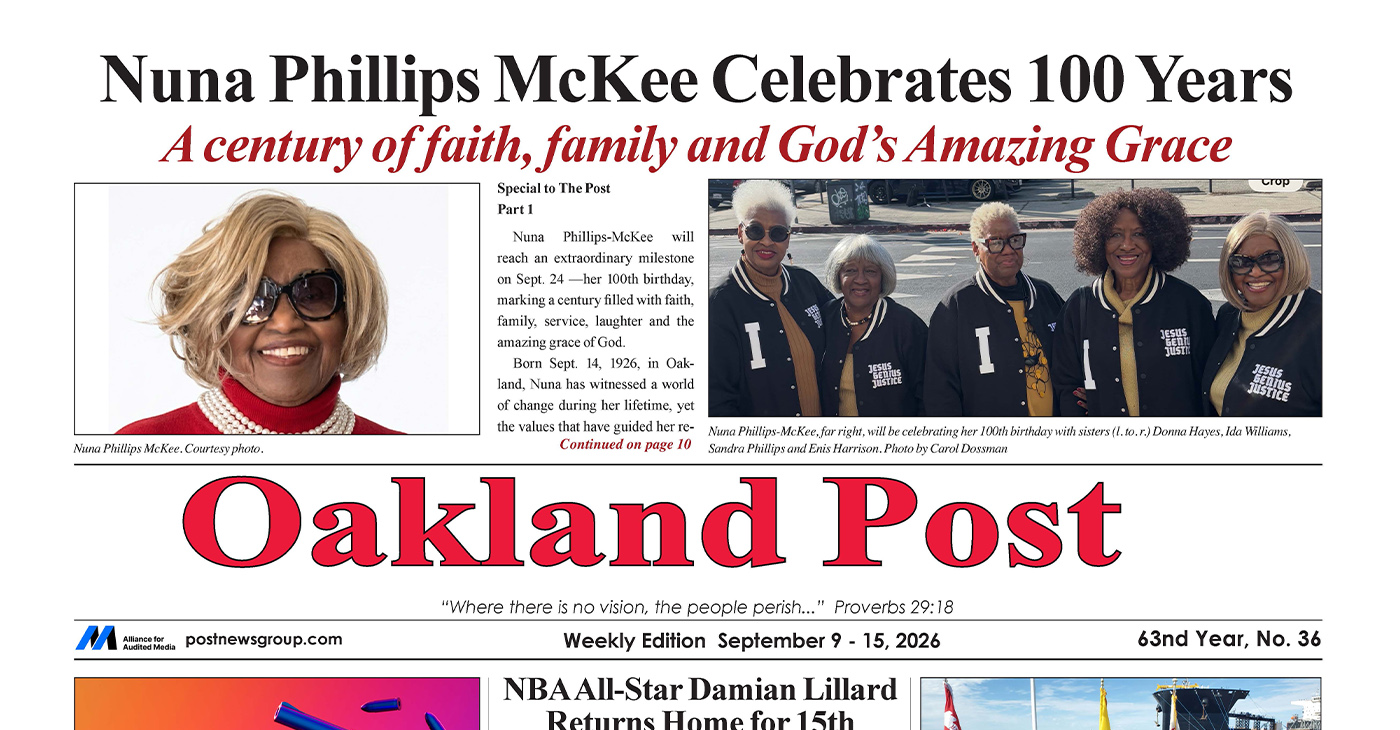
To enlarge your view of this issue, use the slider, magnifying glass icon or full page icon in the lower right corner of the browser window.

Activism
Oakland Post: Week of September 2 – 8, 2026
The printed Weekly Edition of the Oakland Post: Week of September 2 – 8, 2026
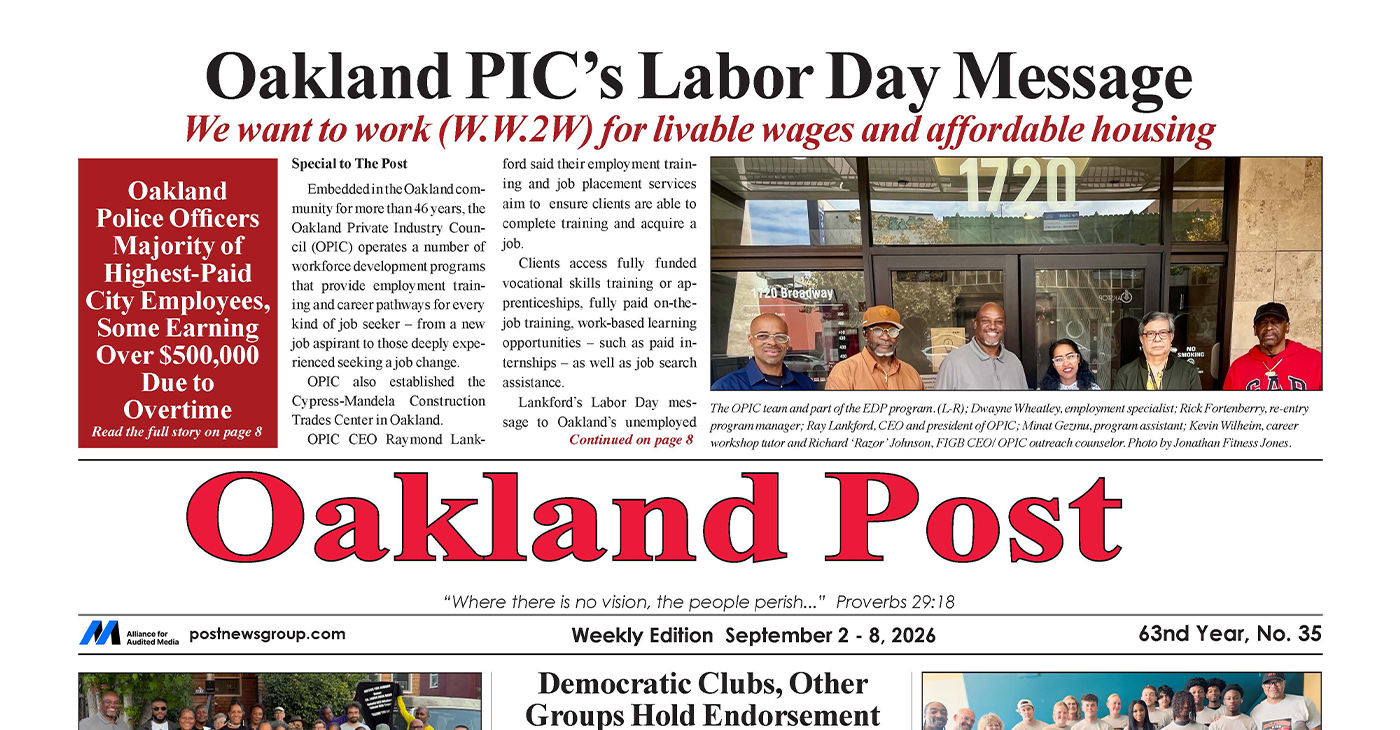
To enlarge your view of this issue, use the slider, magnifying glass icon or full page icon in the lower right corner of the browser window.
Activism
Oakland Post: Week of August 26 – September 1, 2026
The printed Weekly Edition of the Oakland Post: Week of August 26 – September 1, 2026
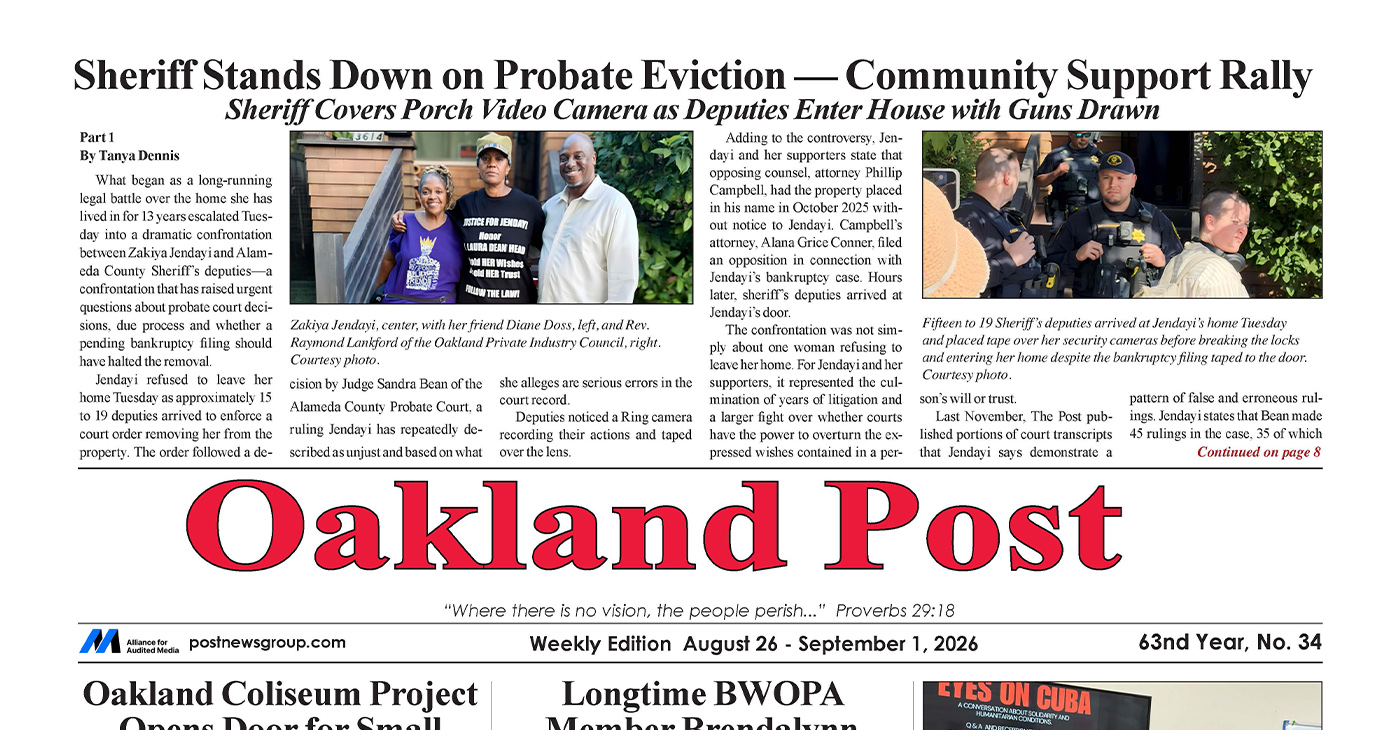
To enlarge your view of this issue, use the slider, magnifying glass icon or full page icon in the lower right corner of the browser window.


Port of Oakland, Army Corps Sign Historic Harbor Design Agreement

Democratic Clubs Interview Candidates for Oakland School Board

Nuna Phillips-McKee Celebrates 100 Years: ‘A Century of Faith, Family and God’s Amazing Grace!’

D.A. Ursula Jones Dickson: Terminix to Pay $3.15 Million Over Illegal Disposal of Pesticides, Customer Records

REPORT: Community Level Policy Is Impacting Homelessness and Drug Abuse in California
OPINION: AI Needs to Know Who Is the Boss
Goldi-Locs and Two (or Three) Bears in the Forest in California Hills

Election Watch 2026: 85% of Eligible Voters in California Are Registered

Don’t Let scammers Crash Your School Year

BOOK REVIEW — Curved Air: A Biography of Sickle Cell Anemia and the Quest to Cure the First Molecular Disease

California’s Legal Cannabis Market Hits $8 Billion as State Touts Progress on Fighting Drugs, Crime

Blacks and Latinos Clash Over LA’s Barrio Run; Mayor Karen Bass Calls for Dialogue Across Racial, Neighborhood Lines

Asm. Smallwood-Cuevas’s Bill Repealing ‘Racist’ CalWORKs ‘Man-in-the-House’ Rule Clears Legislature

Asm. Smallwood-Cuevas’s Bill Repealing ‘Racist’ CalWORKs ‘Man-in-the-House’ Rule Clears Legislature

‘Ready to See These Bills Become Law’: Sen. Weber’s Package of 15 Bills Advance to Gov. Newsom’s Desk

Department of Homeland Security Demands California Secretary of State Shirley N. Weber Scrub Voter Rolls

New Judge Could Decide if Karmelo Anthony Gets a New Trial

“The Power to See Threats Sooner”: Gov. Newsom, Safety Officials Showcase California’s Investments in Hi-Tech Wildfire Prevention

Alpha Kappa Alpha Sorority, Inc. Celebrates New North Atlantic Regional Director

California Sen. Padilla Joins Colleagues to Introduce Bill Imposing Term Limits on Supreme Court Justices

Less Affluent School Districts, Including Sacramento City, Face Threat of State Takeover

Car Wash Workers Cope with Lingering Impacts of ICE Raids

Oakland Post: Week of July 29 – August 4, 2026

How Oakland’s Courtsmith is Scaling its Business and Local Impact

ESSAY: California Can Close Its Colorectal Cancer Gap

Oakland Post: Week of August 5 – 11, 2026

As Part of Your Back-to- School Checklist, Vaccinate

Oakland ‘Port Serves as a Powerful Engine for Good Jobs and Economic Development

Gov. Newsom Signs New Affordable Housing Legislation

Gov. Newsom Announces $109.6 Million in Funding for 278 Supportive Homes in Bakersfield, Contra Costa, Sacramento and Fresno

The Conversation With Al McFarlane 6/23/26

Media Monday 6/22/26

LIVE! ASK ALMA! — TUES. 6.23.26 7PM EST

Car Buying Secrets: 4 Hidden Checks Before You Sign!

Is This 550 HP Charger Worth YOUR Money? AutoNetwork Review

Celebrating Juneteenth – Frederick Douglass on education and resistance

LIVE! — ASK ALMA! — TUES. 6.19.26 7PM EST

Hyundai Ioniq 5 Parking, Safety, and 360 View #shorts

2025 Ioniq 5 New Wiper & Powerful Performance! #shorts

Electric SUV Range: Is 259 Miles Enough? #shorts

EV Charging: How Fast Can You Charge an Electric Vehicle? #shorts

Biometric Cooling… Messaging Seats…Come on! 2025 Infiniti QX80 Autograph 4WD

Charged Up: Witness the Magic of a Fully Electric Car! #shorts

Range Rover Sport PHEV Included…: See What’s Inside This Luxury SUV! #shorts

Invisible Hood View: Perfect Parking with X-Ray Vision! #shorts
-
 Community4 weeks ago
Four Candidates, Including Incumbent Barbara Lee, Qualify for Oakland Mayor’s Race
-

 Commentary2 weeks ago
Standoff for Justice: Our Homes Are Worth Fighting For
-

 Business2 weeks ago
Gubernatorial Candidate Steve Hilton Blasts California New Tire Rules; Newsom Hits Back
-

 Activism2 weeks ago
Oakland Post: Week of August 26 – September 1, 2026
-

 Education2 weeks ago
Gov. Newsom’s Latest Appointees Include Sacramento Advocate for Formerly Incarcerated Students; State’s New Tech Chief
-

 Business2 weeks ago
Frontier Airlines’ Return to Oakland Airport Brings Flights, Jobs and Opportunity
-

 Community2 weeks ago
Big City Mayors Ask for “Yes” Vote on Housing Bond Measure; Conservatives Say “No”
-

 Business2 weeks ago
Oakland Coliseum Project Opens Door for Small Businesses to Build Bigger
