
Opinion
Opinion: Moral and Ethical Issues of Reparations

Summarizing the familiar patterns of some white people’s responses to racial discomfort as White Fragility has resonated for many people that responded to last week’s column.
The sensibility is so familiar because whereas our personal narratives vary, we are all swimming in the same racial water.
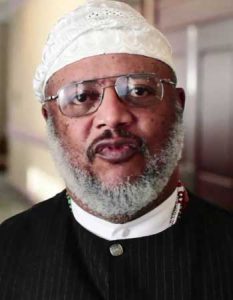
Dr. Wade Nobles
Dr. Wade Nobles, an Oakland psychologist, uses fish as a metaphor of the slave trade in which Western man is depicted as a saltwater fish and Eastern man (Africans) is a freshwater fish that is captured and forced to swim in an alien saltwater culture. The fish can swim but the salt irritates their sensibilities and reddens their eyes.
The salty water represents W.A.S.P/Individualism.
However, African Americans and all nonwhite folks are fresh-water fish whose vision has been irritated by the salt because they have been forced to adapt.
The Right Rev. Eugene Taylor Sutton, bishop of the Episcopal Diocese of Maryland, testified at Congresswoman Sheila Jackson Lee’s committee at the same hearing as filmmaker and seminarian Katrina Browne in June.
Sutton addressed the theological, political and economic complexity and intersectionality of the morality of reparations.
Sutton said Americans should avoid quick emotional responses to the word ‘reparations,’ because it could divide us and create resentment and suspicion.

He said just the term reparations accentuates the pains of the inherited mess of slavery that has long plagued this country.
There was an ominous judgment day tone to his words when he said, “None of us caused this brokenness, but all of us have a moral responsibility to fix it.
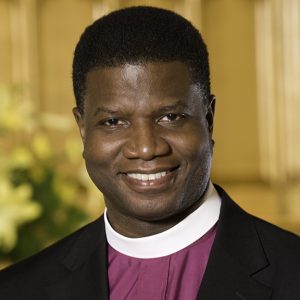
Bishop Sutton
“For generations the bodies of Black people did not belong to themselves but were bred, used and sold for the purpose of attaining wealth. Our nation prospered from that evil, and many of our institutions- including, sadly, the church, profited as well.
Sutton told Congress that moral leaders must be committed to repairing our “broken foundation.”
The economic and theological questions intersect, and Browne lived in a house on the corner of Seminary Avenue and Ill-Gotten Gain$ Boulevard (pun intended).
While theologians debate the moral issues of right and wrong and while they rhetorically ask, “What must I do to be saved?” I will focus on the economic, political and legal issues of reparations as I have for the past 30 years.
As the great writer Victor Hugo said, “Nothing is as powerful as an idea whose time has come.” The reparations issue is “woke,” and the time has come to examine the founding documents down the streets of government from Ms. Browne’s childhood lemonade stand.
While the whole world watches, my city of Oakland is again in the vanguard of the fight for justice and equity with its newly formed Department of Race and Equity. That new department is under the supervision of the city administrator and the mayor with the limitations of the budget and finances.
Oaktown, the seat of the Alameda County government, is the cultural hub of several ethnic and racial groups that seek the review and removal of some of the past actions of government and private cultural entities…
Unlike the early debates over the definition of “Black Power” in 1966, which often excluded whites, the reparations debate is open to all Americans.
Reparations is a struggle for the “Soul” of our beloved nation.
It is ‘all-hands-on-deck’ time.
It’s ‘repair the ship of state’ time.
Its reform and discard institutions time.
Let us think nationally but act locally to examine our local governments to find the hidden obstacles.

To enlarge your view of this issue, use the slider, magnifying glass icon or full page icon in the lower right corner of the browser window.

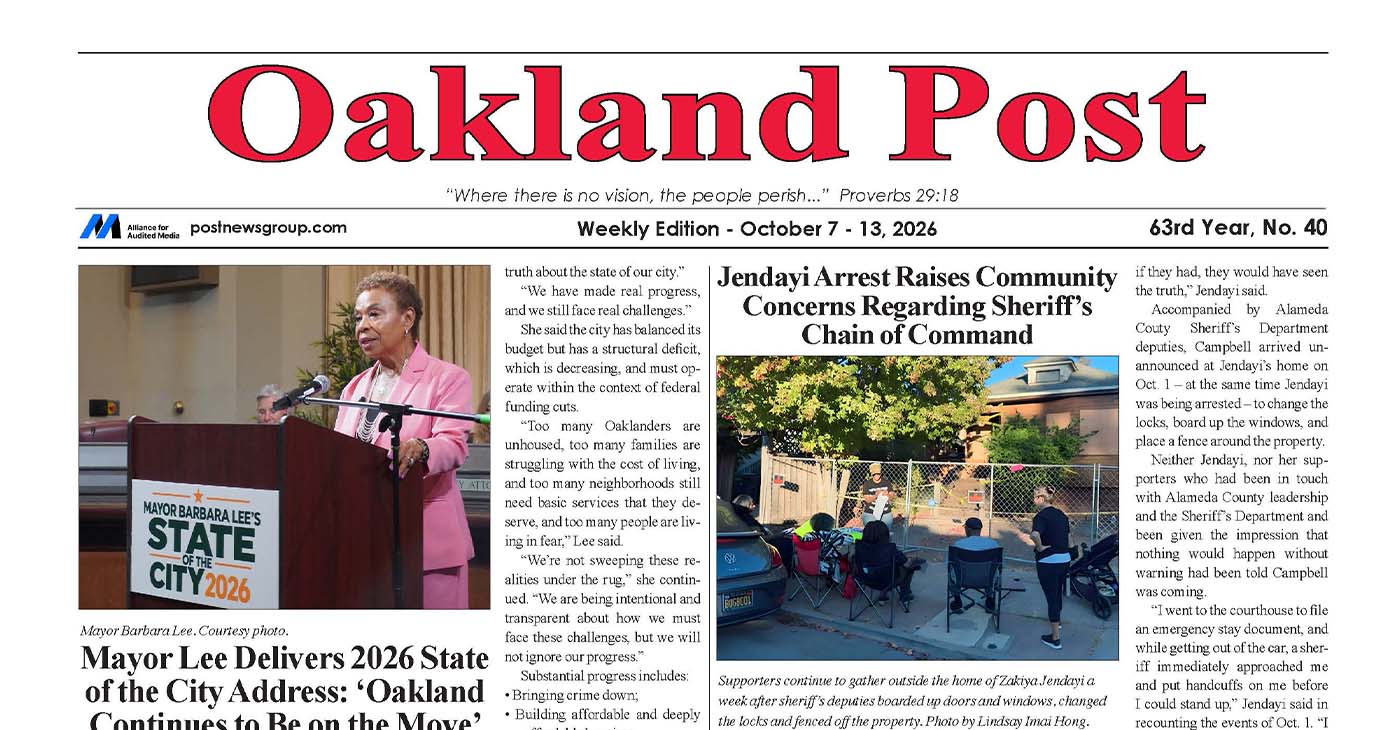
To enlarge your view of this issue, use the slider, magnifying glass icon or full page icon in the lower right corner of the browser window.
Activism
Oakland Post: Week of September 30 – October 6, 2026
The printed Weekly Edition of the Oakland Post: Week of September 30 – October 6, 2026

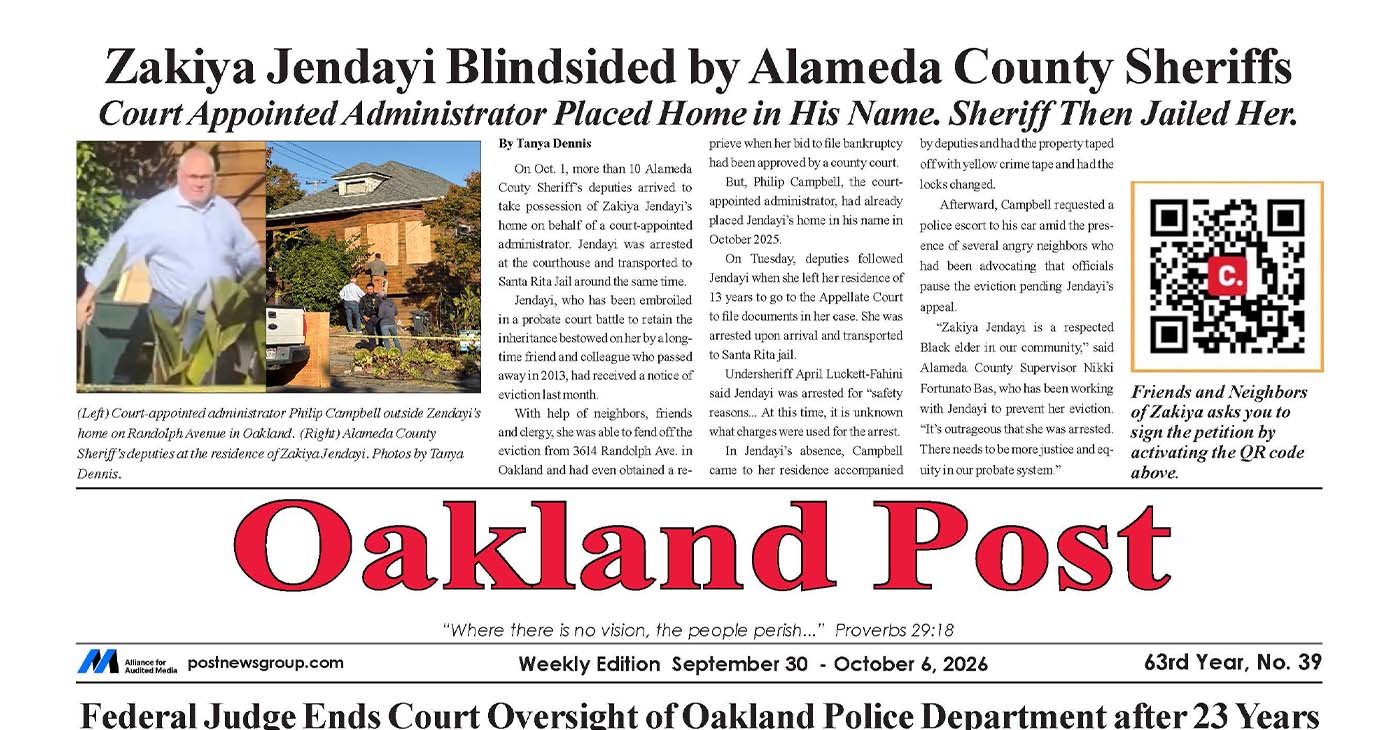
To enlarge your view of this issue, use the slider, magnifying glass icon or full page icon in the lower right corner of the browser window.



Mayor Barbara Lee Holds Special State of the City Address in Deep East Oakland

Practitioners of African Traditional Spirituality Offer Ancestral Reverence Ritual Oct. 31

It’s Time to Lose Weight Before the Holidays

Trader Vic’s Returns to Its Oakland Roots

Oakland Coal Terminal Backed by Trump Would Be Bigger, Dirtier Than Promised, Says Report

Opponents Smear Effective African American Transit Director as Election Nears

Oakland Post: Week of October 14 – 20, 2026

OP-ED: The Black Church Writes AI’s Next Chapter

OP-ED: The Black Church Writes AI’s Next Chapter

WCCUSD Joins Statewide Organic School Food Purchasing Cooperative

Democrats, Community Groups Back Measure EE to Change How Oakland Is Governed

Four Tips to Help You Plan a Holiday “Staycation”

Veterans Housing Project Proposed for South Richmond
PRESS ROOM: Transformative Justice Coalition 2026 Voting Rights Champion Awards Reception ‘Yesterday Is Today: The Battle For Voting Rights

Mayor Lee Delivers 2026 State of the City Address: ‘Oakland Continues to Be on the Move’

Misnamed ‘Parent’ PAC Seeks to Influence Oakland School Board Elections

Poll: Becerra Widens His Lead Over Hilton; Californians Split on Wealth Tax

Oakland Post: Week of September 9 – 15, 2026

County Office of Education Says OUSD Finances Are Getting Healthier, Materially Stronger

Listening as a Lifeline: A Doula’s Witness to Black Maternal Health

Richmond Tiny House Village Farm & Garden Set to Open Gates on Sept. 26

Latest Massacre in Haiti Reveals Cruelty U.S. Deportations

Mayor Lee Announces $1 Million Kaiser Permanente Grant for Pilot Program to Address Homelessness, Clean Up Public Spaces throughout Oakland

OPINION: Nolan Wells’ Death One of Several Signifying Racial Terror Lives on in U.S. South

Zakiya Jendayi Arrested, Locked Out of Home by Sheriff’s Deputies

BLACspace Cooperative Invites Bay Area to Experience Oakland’s Black Cultural Ecosystem Through a BLAC Map Tour + Party

Oakland Post: Week of September 16 – 22, 2026

Doulas Are Helping Black California Moms Navigate Pregnancy–Even as High Mortality Rates Persist

Democratic Clubs Interview Candidates for Oakland School Board

Oakland People’s Arms Embargo Coalition Demands End to Military Shipments Thru Oakland

The Conversation With Al McFarlane 6/23/26

Media Monday 6/22/26

LIVE! ASK ALMA! — TUES. 6.23.26 7PM EST

Car Buying Secrets: 4 Hidden Checks Before You Sign!

Is This 550 HP Charger Worth YOUR Money? AutoNetwork Review

Celebrating Juneteenth – Frederick Douglass on education and resistance

LIVE! — ASK ALMA! — TUES. 6.19.26 7PM EST

Hyundai Ioniq 5 Parking, Safety, and 360 View #shorts

2025 Ioniq 5 New Wiper & Powerful Performance! #shorts

Electric SUV Range: Is 259 Miles Enough? #shorts

EV Charging: How Fast Can You Charge an Electric Vehicle? #shorts

Biometric Cooling… Messaging Seats…Come on! 2025 Infiniti QX80 Autograph 4WD

Charged Up: Witness the Magic of a Fully Electric Car! #shorts

Range Rover Sport PHEV Included…: See What’s Inside This Luxury SUV! #shorts

Invisible Hood View: Perfect Parking with X-Ray Vision! #shorts
-
 Economy4 weeks ago
Poll: Becerra Widens His Lead Over Hilton; Californians Split on Wealth Tax
-
 Business4 weeks ago
County Office of Education Says OUSD Finances Are Getting Healthier, Materially Stronger
-
 Black History3 weeks ago
Listening as a Lifeline: A Doula’s Witness to Black Maternal Health
-
 Lead Story3 weeks ago
Zakiya Jendayi Arrested, Locked Out of Home by Sheriff’s Deputies
-
 Art4 weeks ago
BLACspace Cooperative Invites Bay Area to Experience Oakland’s Black Cultural Ecosystem Through a BLAC Map Tour + Party
-
 Black History4 weeks ago
Doulas Are Helping Black California Moms Navigate Pregnancy–Even as High Mortality Rates Persist
-
 Business4 weeks ago
From Historic Memories to New Possibilities: Oakland Celebrates Coliseum 60
-
 Community4 weeks ago
Asm. Corey Jackson Announces Launch of 24-Hour Childcare in His District
