
Opinion
Opinion: Trump’s Racist Behavior is Infamous and Long Standing

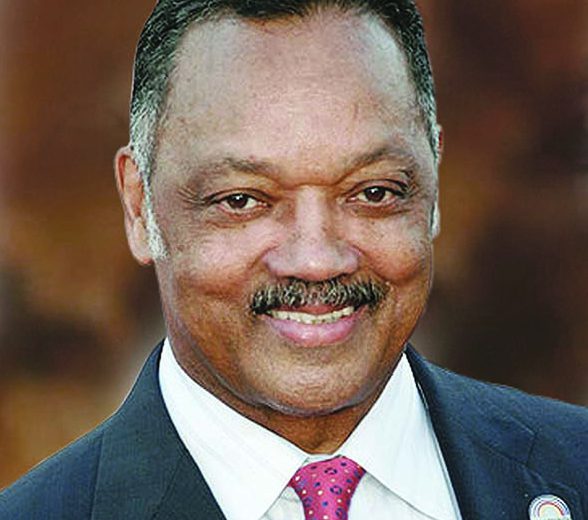
There he goes again. On Sunday, just before he headed off to his golf club in Sterling, Virginia, Donald Trump once more played the race card. It wasn’t enough that he was terrorizing millions of undocumented fathers, mothers and children with the threat of sweeping raids, mass roundups and deportations. This time, he turned his attention to four popularly elected Democratic first-term legislators of color, suggesting that they “go back” to the “totally broken and crime-infested places from which they come.”
This vile racist trope was aimed at Rep. Ayanna Pressley, who was born in Cincinnati, Rep. Rashida Tlaib, who was born in Detroit, Rep. Alexandra Ocasio- Cortez, who was born in New York and Rep. Ilhan Omar, who was born in Somalia and became a U.S. citizen as a teenager. Trump smeared them as alien or not real Americans. They are, in fact, popularly elected leaders of the country.
Trump assailed them while pretending to come to the defense of House Speaker Nancy Pelosi. Pelosi immediately called him out:
“When @realDonaldTrump tells four American congresswomen to go back to their countries, he reaffirms his plan to ‘Make America Great Again’ has always been about making America white again,” Pelosi tweeted. “Our diversity is our strength and our unity is our power.”

As condemnations poured in for his racist jibes, Trump — as is his pattern — did not apologize. Instead he escalated, accusing the four legislators of “racist hatred” and calling on them to apologize. He criticized Democrats for coming to the defense of the congresswomen, who he claimed are “very unpopular and unrepresentative.” So unpopular and unrepresentative that they were literally popularly elected to represent their districts.
Trump’s racist behavior is infamous and longstanding, from his discriminatory record as a real estate developer, his libels of the Central Park Five, his false “birther” attacks on Barack Obama, his defense of pro-Nazi demonstrators in Charlottesville, his dismissal of so-called “s—hole countries, to his libel of Mexican immigrants as “rapists,” and his call for a ban on Muslims.
Trump uses charged racist rhetoric and posturing to distract us from the chaos and corruption of his administration and his own crimes and misdemeanors. It isn’t surprising that this latest outburst comes on the eve of the public testimony of Special Counsel Robert Mueller before the House Judiciary Committee.
Trump appears to have a particular animus for strong women of color, whether it is Rep. Maxine Waters, the four first-term legislators, national political reporters like CNN’s April Ryan and Abby Phillip or PBS correspondent Yamiche Alcindor. He smears them as “a loser” or “stupid” or for “having low intelligence.”
Trump’s racial jibes are an insult to his office and to the country. Even if we have come to expect it from him, we cannot become inured to it. America is a diverse country; a politician who uses race to divide us for political gain is spewing a poison that weakens us all. It is simply pathetic that Republicans have, with rare exceptions, once more remained silent in the face of Trump’s provocations. We know what Trump is — and the ugliness and division that he wields as a club. The question now is what are Republicans? Their silence suggests that they either embrace the president’s cynical racism or are too cowed to stand up for basic decency.
Trump has the biggest megaphone in the country, if not the world. But America is a better country than he seems to think. Trump clearly believes he and his party profit politically from fanning racial divisions. In 2020, we can demonstrate that he is wrong.
(You can write to the Rev. Jesse Jackson in care of this newspaper or by email at jjackson@rainbowpush.org. Follow him on Twitter @ RevJJackson.)

Activism
Oakland Post: Week of September 9 – 15, 2026
The printed Weekly Edition of the Oakland Post: Week of September 9 – 15, 2026


To enlarge your view of this issue, use the slider, magnifying glass icon or full page icon in the lower right corner of the browser window.

Activism
Oakland Post: Week of September 2 – 8, 2026
The printed Weekly Edition of the Oakland Post: Week of September 2 – 8, 2026
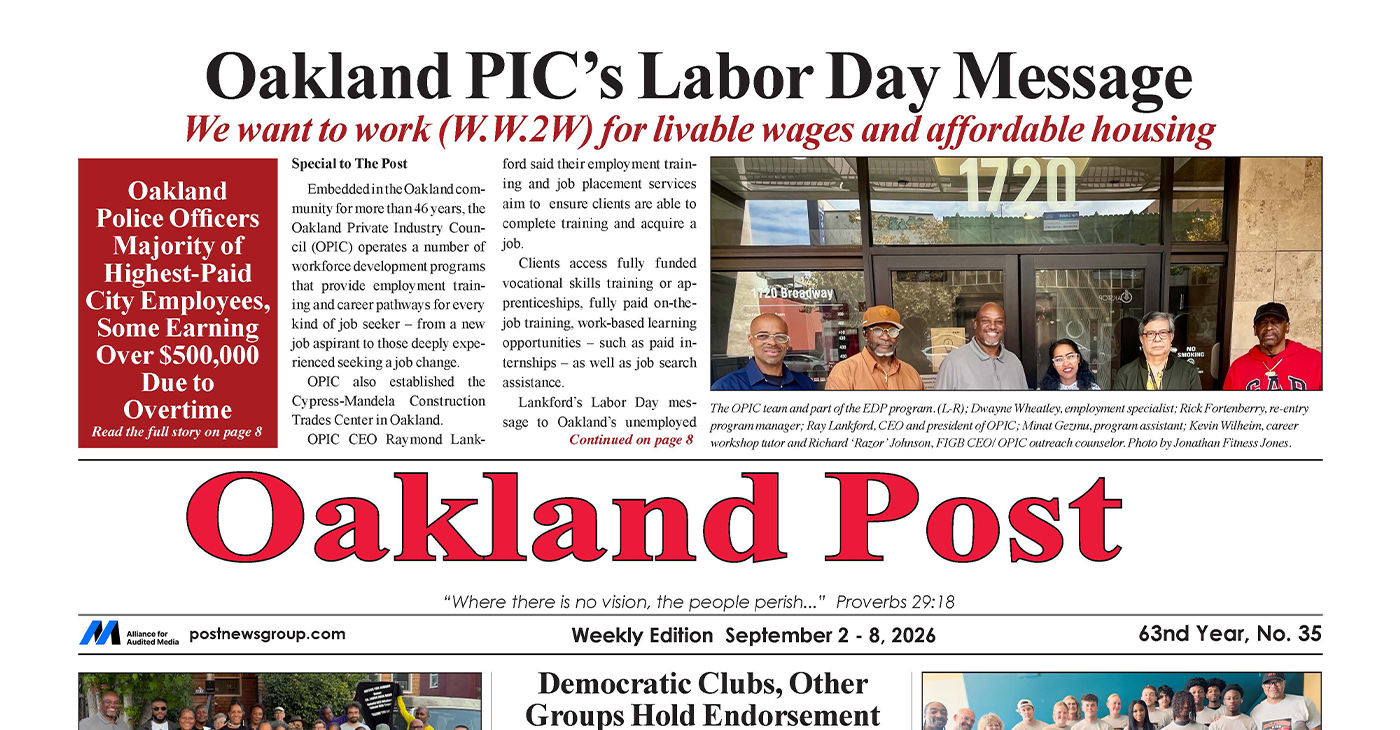
To enlarge your view of this issue, use the slider, magnifying glass icon or full page icon in the lower right corner of the browser window.
Activism
Oakland Post: Week of August 26 – September 1, 2026
The printed Weekly Edition of the Oakland Post: Week of August 26 – September 1, 2026
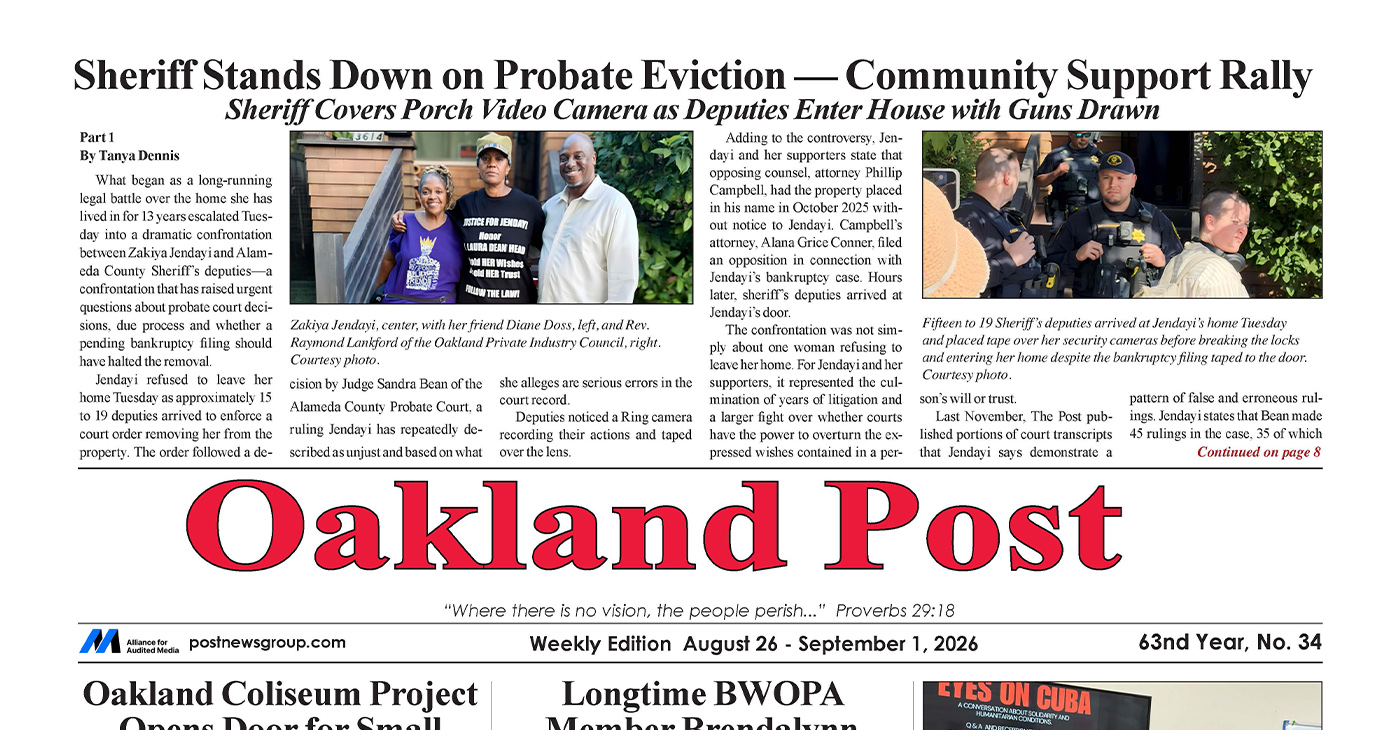
To enlarge your view of this issue, use the slider, magnifying glass icon or full page icon in the lower right corner of the browser window.



Port of Oakland, Army Corps Sign Historic Harbor Design Agreement

Democratic Clubs Interview Candidates for Oakland School Board

Nuna Phillips-McKee Celebrates 100 Years: ‘A Century of Faith, Family and God’s Amazing Grace!’

D.A. Ursula Jones Dickson: Terminix to Pay $3.15 Million Over Illegal Disposal of Pesticides, Customer Records

REPORT: Community Level Policy Is Impacting Homelessness and Drug Abuse in California
OPINION: AI Needs to Know Who Is the Boss
Goldi-Locs and Two (or Three) Bears in the Forest in California Hills

Election Watch 2026: 85% of Eligible Voters in California Are Registered

Don’t Let scammers Crash Your School Year

BOOK REVIEW — Curved Air: A Biography of Sickle Cell Anemia and the Quest to Cure the First Molecular Disease

California’s Legal Cannabis Market Hits $8 Billion as State Touts Progress on Fighting Drugs, Crime

Blacks and Latinos Clash Over LA’s Barrio Run; Mayor Karen Bass Calls for Dialogue Across Racial, Neighborhood Lines

Asm. Smallwood-Cuevas’s Bill Repealing ‘Racist’ CalWORKs ‘Man-in-the-House’ Rule Clears Legislature

Asm. Smallwood-Cuevas’s Bill Repealing ‘Racist’ CalWORKs ‘Man-in-the-House’ Rule Clears Legislature

‘Ready to See These Bills Become Law’: Sen. Weber’s Package of 15 Bills Advance to Gov. Newsom’s Desk

Department of Homeland Security Demands California Secretary of State Shirley N. Weber Scrub Voter Rolls

New Judge Could Decide if Karmelo Anthony Gets a New Trial

“The Power to See Threats Sooner”: Gov. Newsom, Safety Officials Showcase California’s Investments in Hi-Tech Wildfire Prevention

Alpha Kappa Alpha Sorority, Inc. Celebrates New North Atlantic Regional Director

California Sen. Padilla Joins Colleagues to Introduce Bill Imposing Term Limits on Supreme Court Justices

Less Affluent School Districts, Including Sacramento City, Face Threat of State Takeover

Car Wash Workers Cope with Lingering Impacts of ICE Raids

Oakland Post: Week of July 29 – August 4, 2026

How Oakland’s Courtsmith is Scaling its Business and Local Impact

ESSAY: California Can Close Its Colorectal Cancer Gap

Oakland Post: Week of August 5 – 11, 2026

As Part of Your Back-to- School Checklist, Vaccinate

Oakland ‘Port Serves as a Powerful Engine for Good Jobs and Economic Development

Gov. Newsom Signs New Affordable Housing Legislation

Gov. Newsom Announces $109.6 Million in Funding for 278 Supportive Homes in Bakersfield, Contra Costa, Sacramento and Fresno

The Conversation With Al McFarlane 6/23/26

Media Monday 6/22/26

LIVE! ASK ALMA! — TUES. 6.23.26 7PM EST

Car Buying Secrets: 4 Hidden Checks Before You Sign!

Is This 550 HP Charger Worth YOUR Money? AutoNetwork Review

Celebrating Juneteenth – Frederick Douglass on education and resistance

LIVE! — ASK ALMA! — TUES. 6.19.26 7PM EST

Hyundai Ioniq 5 Parking, Safety, and 360 View #shorts

2025 Ioniq 5 New Wiper & Powerful Performance! #shorts

Electric SUV Range: Is 259 Miles Enough? #shorts

EV Charging: How Fast Can You Charge an Electric Vehicle? #shorts

Biometric Cooling… Messaging Seats…Come on! 2025 Infiniti QX80 Autograph 4WD

Charged Up: Witness the Magic of a Fully Electric Car! #shorts

Range Rover Sport PHEV Included…: See What’s Inside This Luxury SUV! #shorts

Invisible Hood View: Perfect Parking with X-Ray Vision! #shorts
-

 Community4 weeks ago
Four Candidates, Including Incumbent Barbara Lee, Qualify for Oakland Mayor’s Race
-

 Commentary2 weeks ago
Standoff for Justice: Our Homes Are Worth Fighting For
-

 Business2 weeks ago
Gubernatorial Candidate Steve Hilton Blasts California New Tire Rules; Newsom Hits Back
-

 Activism2 weeks ago
Oakland Post: Week of August 26 – September 1, 2026
-

 Education2 weeks ago
Gov. Newsom’s Latest Appointees Include Sacramento Advocate for Formerly Incarcerated Students; State’s New Tech Chief
-

 Business2 weeks ago
Frontier Airlines’ Return to Oakland Airport Brings Flights, Jobs and Opportunity
-

 Community2 weeks ago
Big City Mayors Ask for “Yes” Vote on Housing Bond Measure; Conservatives Say “No”
-

 Business2 weeks ago
Oakland Coliseum Project Opens Door for Small Businesses to Build Bigger
