
Government
GOP, Not Russia, is Greater Threat to Free Elections


 We all have heard about WikiLeaks and Russian interference in the 2016 election. The report of Special Counsel Robert Mueller has once more put that on the front pages. Too often lost in the furor, however, is the far more damaging TrikiLeaks — the tricks and laws used to suppress the vote by partisans, largely Republicans here at home.
After the Supreme Court’s right-wing gang of five gutted key sections of the Voting Rights Act in Shelby v. Holder, Republican-controlled states immediately ramped up efforts to create obstacles for voting, particularly for people of color. They mandated specific forms of state ID, made it harder for students to vote, eliminated same-day registration, reduced early voting days, closed polling booths in African American neighborhoods leading to long delays, purged voters from the rolls, perfected partisan gerrymandering and more. In some cases, as in North Carolina, their discriminatory intent was so public that the laws were overturned in federal court, but in most places, the new barriers were in place in 2016.
Did it make a difference? Voting rights expert Ari Berman says, “absolutely.” Overall 14 states had new restrictions in place, passed since the Shelby decision. Look at Wisconsin. Trump won by 22,000 votes. In Wisconsin, 300,000 African American voters didn’t have the newly required strict photo ID. Black voter turnout in Milwaukee declined by 51,000 votes from 2012, while as Lawyers Committee President Kristen Clarke noted, voter turnout rates were depressed across the state.

Now we’re headed into 2020. Republican bastions like Texas, Tennessee and Arizona witnessed surges of Democratic support in 2018. Not surprisingly, they are launching new efforts to suppress the vote. In Texas, the secretary of state announced a plan to purge 95,000 people from the voter rolls because they weren’t citizens. Independent research then demonstrated that in Harris County, which includes Houston, 60 percent of the 30,000 people on the list had received citizenship long ago. Some of the supposed research was 25 years old. Once more citizens had to go to court to try to stop the suppression.
In Texas, state lawmakers are also moving to add criminal penalties for people who improperly fill out voter registration forms, an effort to intimidate nonprofit groups that work to register people to vote. In Arizona, Republicans are making it harder to cast an early ballot. In Tennessee, GOP lawmakers are pushing legislation to fine voter registration groups that submit incomplete forms, even by mistake, up to $10,000. Tequila Johnson, co-founder of the Equity Alliance that focuses on registering people of color, called them out: “We have never seen a bill like this on the floor, until we dared to register 86,000 black and brown people to vote. This screams racism.”
Much, much more attention should be paid to this battle. Happily, the new Democratic majority in the House of Representatives has made voting rights a priority. Rep. Elijah Cummings (D-MD.), chair of the House Oversight Committee, has launched an investigation of voter suppression in Georgia in 2018, where the victor, Brian Kemp, oversaw the election as secretary state. And, as Cummings detailed, 1.4 million people were purged from the voting rolls from 2012 to 2016, 53,000 — 80 percent of them people of color — had their registrations put on hold; 214 polling places were shuttered, contributing to lines of more than four hours in heavily black precincts.
Some states, happily, are moving to make voting easier and more accessible. Florida citizens passed a historic referendum restoring the right to vote for felons who have paid their debt to society. (Now, Republicans in the legislature are trying to undermine that initiative). Automatic Voting Registration laws have passed in several states. More states are providing longer times for early voting, adding voting booths to reduce long lines and more. Cases to rollback partisan gerrymandering have been successful in federal courts — and now are headed to the Supreme Court. The Brennan Center reports that bills that expand voting rights have seen some movement in 35 states, while those restricting rights have moved in 10 states.
What’s clear is that interference with our elections and with the right to vote will come far more from the efforts of domestic politicians than it will come from whatever mischief the Russians plan. It is revealing that the Trump White House has little to say about Russians. It is even more telling that the Justice Department is absent without leave in the fight against voter suppression at home. The right to vote — the most basic right of a democracy — is still contested in too many states — and must be fought, state by state, by citizens of conscience.

Activism
Oakland Post: Week of June 3 – 9, 2026
The printed Weekly Edition of the Oakland Post: Week of June 3 – 9, 2026


To enlarge your view of this issue, use the slider, magnifying glass icon or full page icon in the lower right corner of the browser window.

Activism
Oakland Post: Week of May 27 – June 2, 2026
The printed Weekly Edition of the Oakland Post: Week of May 27 – June 2, 2026

To enlarge your view of this issue, use the slider, magnifying glass icon or full page icon in the lower right corner of the browser window.
Activism
Oakland Post: Week of May 20 – 26, 2026
The printed Weekly Edition of the Oakland Post: Week of May 20 – 26 2026
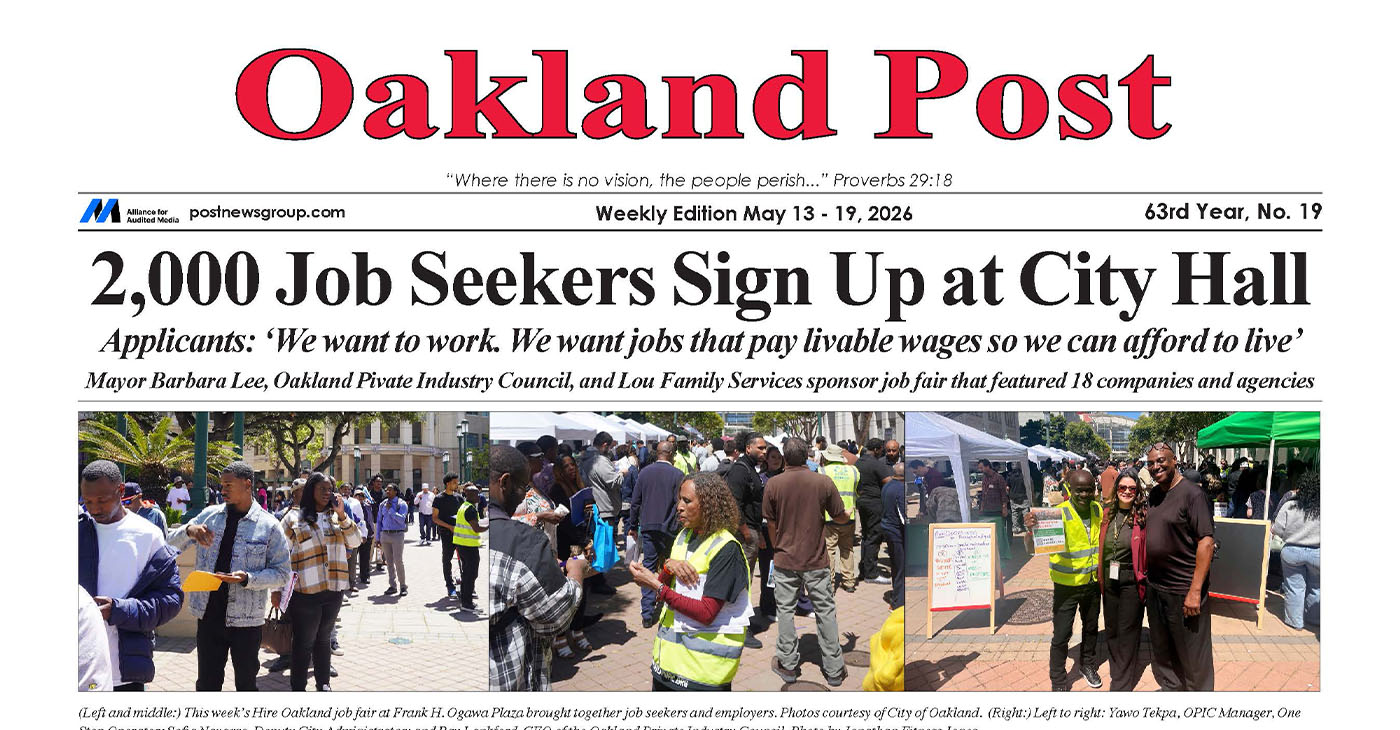
To enlarge your view of this issue, use the slider, magnifying glass icon or full page icon in the lower right corner of the browser window.

WORK FROM HOME
Home-based business with potential monthly income of $10K+ per month. A proven training system and website provided to maximize business effectiveness. Perfect job to earn side and primary income. Contact Lynne for more details: Lynne4npusa@gmail.com 800-334-0540


Oakland Director Boots Dazzles Once Again in ‘I Love Boosters’

After 10-Year Wait, Fillmore Heritage Center Reopens in San Francisco

COMMENTARY: Black Music is the Sound of Black Freedom: Let Us Reclaim Both This Juneteenth

Oakland Post: Week of June 3 – 9, 2026

Study: Waiting Lists for Child Care Assistance Nearly Doubled

Venus Williams Calls a Sabalenka Exit a Tragedy

COMMENTARY: Using Art, Healing, And Community to Transform Mental Health Dialogue

Uptown Music Theatre Summer Camp Returns to Inspire the Next Generation of Performers

5 Cleveland Police Officers Injured, Gunfire Erupts During East Side Pursuit

15-YEAR-OLD COLUMBUS GIRL DIES, Community Mourns as Authorities Urge Water Safety Awareness

Let’s Talk Karmelo Anthony!

2026 World Cup is Here and Atlanta is Ready For It

COMMENTARY: What Andrew Young Reminded Me About Baltimore

COMMENTARY: When Politics Intersects with Professional Sports

K4: Crucial Driving Advice BEFORE You Buy! #shorts

Book Review: Books for College-Bound Students

Against All Odds: Mary Jackson’s Journey to NASA Engineer

Q&A with Steven Bradford: Why He Wants Your Vote for California Insurance Commissioner

OPINION: The Fire of Oakland’s Justin Jones

The Marin City Flea Market Is Back

California Launches Free Diaper Program for Newborns Statewide

The Ladies of Delta Sigma Theta Hold Day of Advocacy at the Capitol in Sacramento

EBMUD Enshrines the Legacy of its First Black Board Member William ‘Bill’ Patterson

Oakland Mayor Pushes Charter Overhaul to Clarify Roles in City Government, Increase Accountability and Improve Service Delivery

Oakland Post: Week of May 6 – 12, 2026

OP-ED: Small Businesses Need Minnesota to Act on Pass-Through Tax Policy

Mayor Barbara Lee Declares ‘Delroy Lindo Day,’ Presents Acclaimed Actor with Key to the City

Snoop Dogg Celebrates 10 Til’ Midnight at the Compound

2026 Lucid Air Grand Touring Review — Is This $136K EV Sedan Worth It?

Rep. Kamlager-Dove Introduces Bill to Protect Women in Custody After Reports Detailing Miscarriages and Neglect

Hyundai Ioniq 5 Parking, Safety, and 360 View #shorts

2025 Ioniq 5 New Wiper & Powerful Performance! #shorts

Electric SUV Range: Is 259 Miles Enough? #shorts

EV Charging: How Fast Can You Charge an Electric Vehicle? #shorts

Biometric Cooling… Messaging Seats…Come on! 2025 Infiniti QX80 Autograph 4WD

Charged Up: Witness the Magic of a Fully Electric Car! #shorts

Range Rover Sport PHEV Included…: See What’s Inside This Luxury SUV! #shorts

Invisible Hood View: Perfect Parking with X-Ray Vision! #shorts

AI Is Reshaping Black Healthcare: Promise, Peril, and the Push for Improved Results in California

ESSAY: Technology and Medicine, a Primary Care Point of View

Sanctuary Cities

The RESISTANCE – FREEDOM NOW

STATE OF THE PEOPLE: Freddie

ECONOMIC BOYCOTT DAY!!!!!

I told You So
-
 Advice4 weeks ago
Book Review: Books for College-Bound Students
-
 Arts and Culture4 weeks ago
Against All Odds: Mary Jackson’s Journey to NASA Engineer
-
 Bay Area4 weeks ago
Q&A with Steven Bradford: Why He Wants Your Vote for California Insurance Commissioner
-
 Activism4 weeks ago
OPINION: The Fire of Oakland’s Justin Jones
-
 Alameda County4 weeks ago
The Marin City Flea Market Is Back
-
 Activism4 weeks ago
California Launches Free Diaper Program for Newborns Statewide
-
 Activism4 weeks ago
The Ladies of Delta Sigma Theta Hold Day of Advocacy at the Capitol in Sacramento
-
 Activism4 weeks ago
EBMUD Enshrines the Legacy of its First Black Board Member William ‘Bill’ Patterson
