
Opinion
Opinion: To Help Venezuela, The U.S. Must Use Diplomacy, Not a Military Coup

The United States is pushing for an overthrow of the government of Venezuela. The Trump administration has denounced Nicolas Maduro as a “dictator,” dismissing the 2018 election, which the opposition boycotted. Instead of a good neighbor policy or a policy of non-intervention, the Trump administration has set out intentionally to overthrow the regime.
Long before Trump, the United States was a bitter opponent of the Hugo Chavez regime. The fact that Chavez was wildly popular and freely elected made no difference. He represented a revolution that embraced Fidel Castro’s Cuba and implemented plans to redistribute wealth and empower the poor. In 2002, when the Venezuelan military moved to overthrow Chavez, an official in the Bush administration reportedly met with the coup leaders. The coup attempt was frustrated, however, when Venezuelans rose up in mass against the plotters.
Now with Chavez gone, the current president Nicolas Maduro unpopular, the economy a mess — in significant degree because the price of oil is near record lows — the Trump administration is apparently orchestrating another attempt.
It has continued to ratchet up pressure. It has imposed brutal sanctions on Venezuela, making a bad situation far worse, all the while blaming the government for the misery. Trump has openly threatened a “military option” for Venezuela. His bellicose national security adviser, John Bolton, boasted that “The troika of tyranny in this hemisphere — Cuba, Venezuela and Nicaragua — has finally met its match.”
The New York Times reported that Trump administration officials met with Venezuelan military officers who were considering a coup attempt.
Then, Juan Guaido, an obscure politician from a right-wing party, declared himself interim president, claiming that he had that right as head of the National Assembly. The U.S. immediately recognized Guaido, and right-wing governments across the region did the same.
Trump then named Elliott Abrams, infamous for committing perjury before Congress over the Iran-Contra fiasco, and for championing vicious military and paramilitary repression across Central America, as special envoy for Venezuela. Sen. Marco Rubio (R-Florida) pumped up demands for intervention, growing so rabid that he tweeted a gruesome picture of the murder of Libya’s Qaddafi as a prediction of Maduro’s fate.
Bolton admitted that he was “in conversation with major American [oil] companies now,” stating that “it would make a difference if we could have American companies produce the oil in Venezuela. We both have a lot at stake here.”
Now Venezuela has been hit with a power blackout, taking out electricity, phone service and Internet. In Forbes Magazine, an expert details how easily this could be done by the U.S. in a cyber first-strike.
The U.S. has a long and shameful history of intervention in this hemisphere, too often aligning itself with rapacious elites and the military against the vast majority. In the ’50s, the CIA overthrew a popularly elected government in Guatemala. After the Cuban revolution, the U.S. launched an invasion, terrorist attacks, economic sabotage and boycott, and assassination attempts to get rid of Castro. In 1973, the U.S. embraced the brutal Chilean dictator Augusto Pinochet when he led the overthrow of the popularly elected government of Salvador Allende. As recent as 2009, Secretary of State Hillary Clinton endorsed the overthrow of the elected government of Honduras, a disaster that has resulted in bands of desperate Hondurans seeking refuge in this country.
Now Trump and his bellicose advisers seem intent on adding another chapter to this shameful history. There is another way. Instead of starving the Venezuelans into submission, we should be engaging with them. Instead of seeking to control their oil, we should recognize their national sovereignty. Instead of fanning coup attempts, we should be leading international negotiations to seek a diplomatic settlement that might lead to new elections.
Nicolas Maduro is far from blameless, but no one nominated the United States to decide who should govern Venezuela. Fomenting regime change — by a soft coup, by economic sabotage, by fostering a military revolt — is likely to lead to more violence and more suffering.
It is time for Congress to step up — to investigate exactly what the Trump administration is doing overtly and covertly, and to call for a return to diplomacy before it is too late.

Activism
Oakland Post: Week of July 22 – 28, 2026
The printed Weekly Edition of the Oakland Post: Week of July 22 – 28, 2026


To enlarge your view of this issue, use the slider, magnifying glass icon or full page icon in the lower right corner of the browser window.

Activism
Oakland Post: Week of July 15 – 21, 2026
The printed Weekly Edition of the Oakland Post: Week of July 15 – 21, 2026
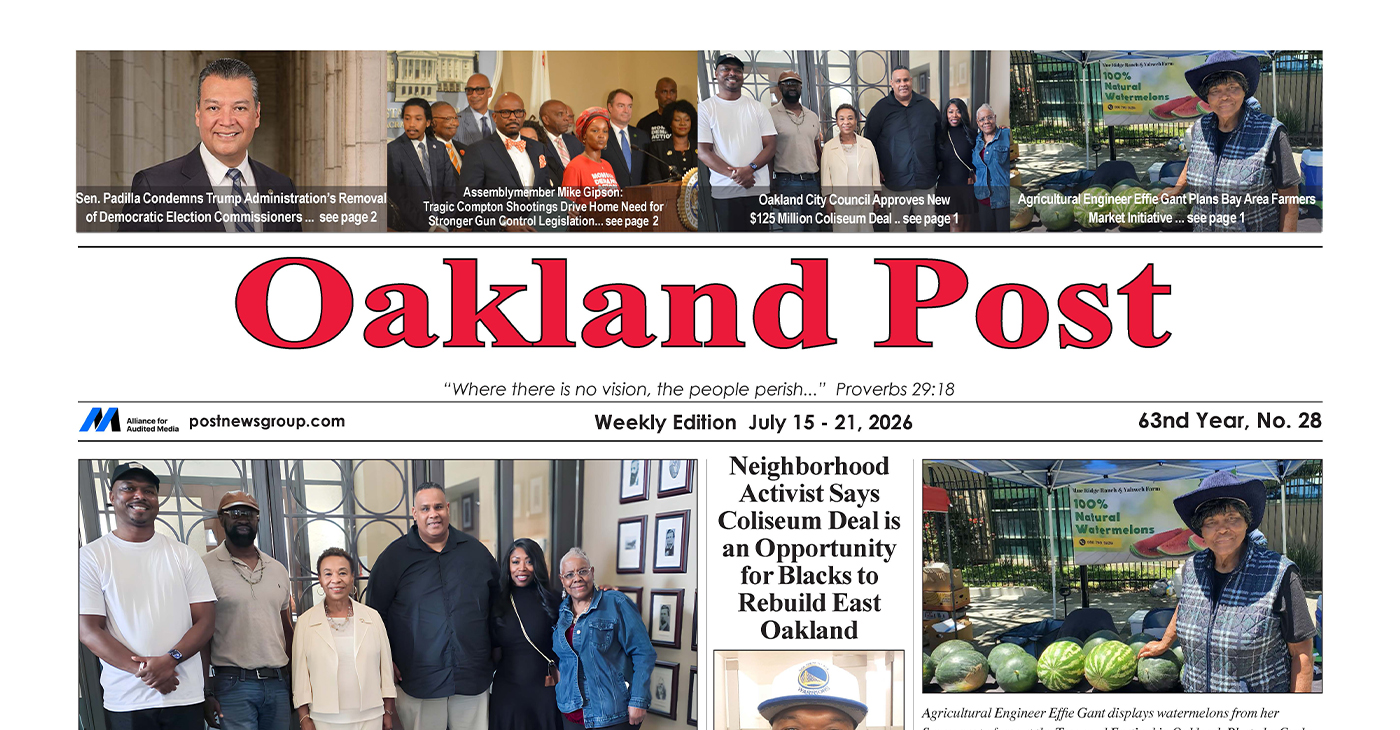
To enlarge your view of this issue, use the slider, magnifying glass icon or full page icon in the lower right corner of the browser window.
Activism
Oakland Post: Week of July 8 – 14, 2026
The printed Weekly Edition of the Oakland Post: Week of July 8 – 14, 2026
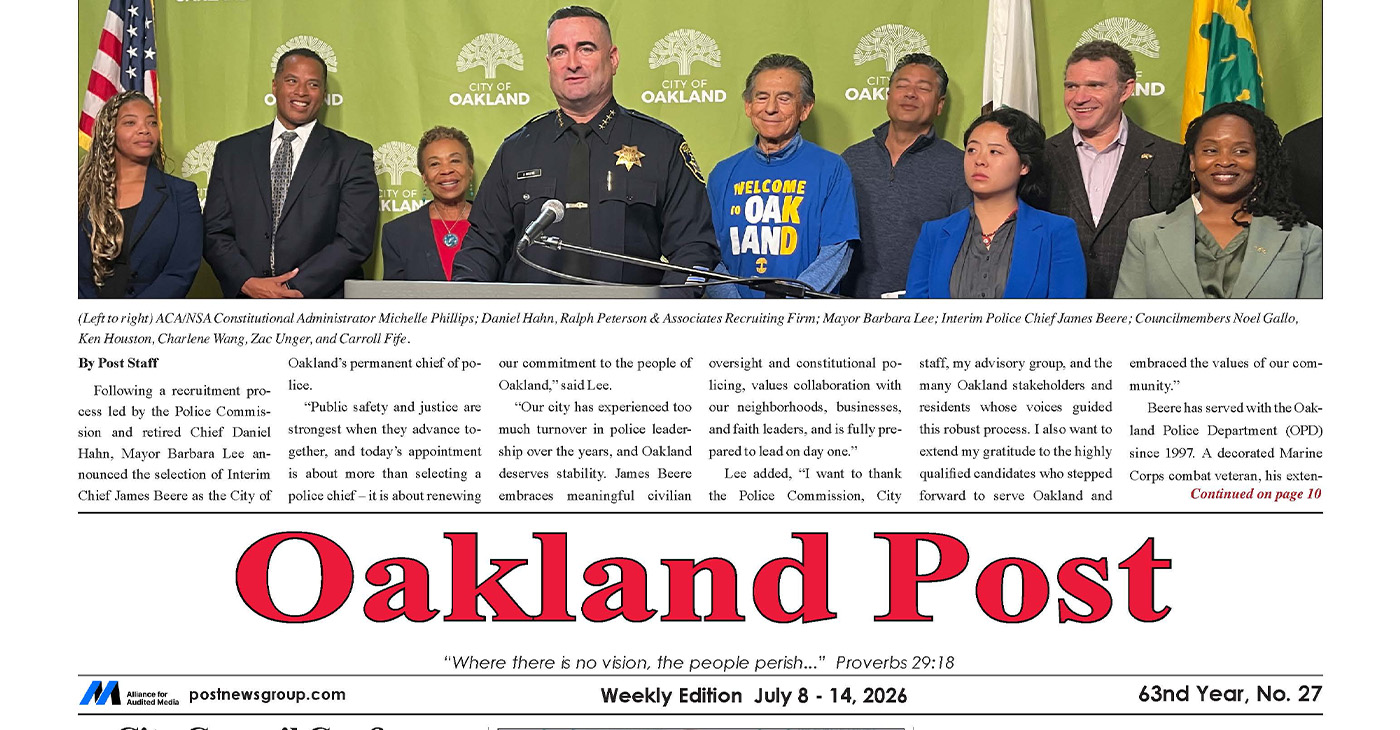
To enlarge your view of this issue, use the slider, magnifying glass icon or full page icon in the lower right corner of the browser window.

WORK FROM HOME
Home-based business with potential monthly income of $10K+ per month. A proven training system and website provided to maximize business effectiveness. Perfect job to earn side and primary income. Contact Lynne for more details: Lynne4npusa@gmail.com 800-334-0540


Oakland Post: Week of July 22 – 28, 2026

Fed Court to Decide Landmark First Amendment Case

Jordan Walker Leads Call for More Black Youth in Baseball

How Black WNBA Players Became Collateral Damage in the Caitlin Clark Culture War

NAACP Announces $20m Voter Registration Drive at National Convention in Chicago

Starting This Summer, California Car Buyers Can Get an Instant $3500 Off the Cost of Electric Vehicles

Surveillance Pricing Fight: State Senate Debates Bill Banning Retailers from Using AI to Set Prices Based on a Buyer’s Profile

Oakland Children’s Hospital Workers and Patients Rally for Pediatric Medical Care

Opinion: When Politicians Start Sanitizing One Chapter of History, They’re Coming After The Whole Book

Beyond Politics: California Legislators Across Party Lines Celebrate Lori Wilson at 50

NPRC to Meet with California Attorney General’s Office on to Urge Guardianship Reform

Mount Zion MBC, Church of Jesus Christ of Latter-day Saints Partner to Bring 29,000 Meals to Alameda County

Councilmember Houston Helps Deter Trend to Award Contracts to Suburban Companies

Rep. Garamendi, House Democrats Demand Trump Administration Abandon Illegal Plans to Dismantle Civil Rights, Special Ed Offices

Council Gives Approval for $125 Million Oakland Coliseum Sale to AASEG
Oakland Children’s Hospital Workers and Patients Rally for Pediatric Medical Care
Mount Zion MBC, Church of Jesus Christ of Latter-day Saints Partner to Bring 29,000 Meals to Alameda County
Surveillance Pricing Fight: State Senate Debates Bill Banning Retailers from Using AI to Set Prices Based on a Buyer’s Profile

IN MEMORIAM: Oakland Dance Legend Reginald Ray-Savage, 67

Saving Black Mothers Starts Outside the Hospital

Gov. Gavin Newsom Signs Law Streamlining Affordable Housing Rules

Oakland Celebrates $125 Million Coliseum Sale

NPRC Heads to Washington to Elevate Adult Guardianship Reform at National Whistleblower Summit
Starting This Summer, California Car Buyers Can Get an Instant $3500 Off the Cost of Electric Vehicles


Agricultural Engineer Effie Gant Plans Bay Area Farmers Market Initiative

The Part of Buying a Home That No Real Estate Show Ever Prepares You For

Oakland Post: Week of June 17 – 23, 2026

Oakland Post: Week of July 1 – 7, 2026

NCBW-OBAC Champions Black Women Entrepreneurs at Business en Blaque Expo

The Conversation With Al McFarlane 6/23/26

Media Monday 6/22/26

LIVE! ASK ALMA! — TUES. 6.23.26 7PM EST

Car Buying Secrets: 4 Hidden Checks Before You Sign!

Is This 550 HP Charger Worth YOUR Money? AutoNetwork Review

Celebrating Juneteenth – Frederick Douglass on education and resistance

LIVE! — ASK ALMA! — TUES. 6.19.26 7PM EST

Hyundai Ioniq 5 Parking, Safety, and 360 View #shorts

2025 Ioniq 5 New Wiper & Powerful Performance! #shorts

Electric SUV Range: Is 259 Miles Enough? #shorts

EV Charging: How Fast Can You Charge an Electric Vehicle? #shorts

Biometric Cooling… Messaging Seats…Come on! 2025 Infiniti QX80 Autograph 4WD

Charged Up: Witness the Magic of a Fully Electric Car! #shorts

Range Rover Sport PHEV Included…: See What’s Inside This Luxury SUV! #shorts

Invisible Hood View: Perfect Parking with X-Ray Vision! #shorts
-
 Business2 days ago
Oakland Children’s Hospital Workers and Patients Rally for Pediatric Medical Care
-
 Business2 days ago
Mount Zion MBC, Church of Jesus Christ of Latter-day Saints Partner to Bring 29,000 Meals to Alameda County
-
 Business2 days ago
Surveillance Pricing Fight: State Senate Debates Bill Banning Retailers from Using AI to Set Prices Based on a Buyer’s Profile
-
 Black History6 days ago
Saving Black Mothers Starts Outside the Hospital
-
 Business4 days ago
Gov. Gavin Newsom Signs Law Streamlining Affordable Housing Rules
-
 Black History1 week ago
Oakland Celebrates $125 Million Coliseum Sale
-
 Community1 week ago
NPRC Heads to Washington to Elevate Adult Guardianship Reform at National Whistleblower Summit
-
 Business2 days ago
Starting This Summer, California Car Buyers Can Get an Instant $3500 Off the Cost of Electric Vehicles
