
Education
Report Calls for Pressuring School Districts to Turn Over School Sites to Charter Groups


Political opposition to charter schools has been growing, both locally and nationally.
A recent report produced by a pro-charter school policy organization says that the continued rapid expansion of charter schools in the Bay Area, including Oakland, has been significantly undercut by the shortage of affordable facilities in a region notorious for out-of-control real estate prices.
To counter the slowdown, the report proposes passing state laws to “require or incentivize” school districts to close or “consolidate” public school properties and turn them over to charter school operators.
The growth rate of Bay Area charters, which reached a highpoint of 18.2 percent in 2012-2013, has fallen to an estimated 3.8 percent in 2017-2018.
The 25-page report, “The Slowdown in Bay Area Charter School Growth: Causes and Solutions,” was released in January by Center on Reinventing Public Education (CRPE). The research was funded by the Silicon Schools Fund and supported by the California Charter Schools Association, National Alliance for Public Charter Schools and National Association of Charter School Authorizers.
Among the report’s proposals:
- Tighten the state law, called Prop. 39, which requires school district to provide space in public schools for charters that ask for it.
“Prop. 39 helps, but it doesn’t help enough,” the report said. New regulations, for example, could modify the current year-to-year lease agreements “allowing or requiring a multiyear Prop. 39 lease;”
- Offer districts “consolidation grants” to close facilities and maximize use of classrooms at fewer school sites;
Require a district to “house charter students” before it is allowed to go to the voters to pass a school bond to build or renovate school facilities. An aggressive step would be to require districts to pay a tax to the state “as long as the district fails to consolidate or close under-enrolled district schools.” - Even more aggressively, the state could take “building ownership rights away from districts that fail to manage them efficiently.”
“The state could simply require that districts that fail to reduce costs responsibly get out of the property ownership business by having the state assume ownership, by placing the buildings into a third-party trust, or by establishing a cooperative to which charter schools have equal rights.”
An additional factor slowing charter growth may have to do with intensifying political backlash, nationally and locally, against charters, according to the report.
“Teacher unions…have stepped up their resistance strategies and are increasingly coordinating opposition campaigns,” the report said. Further, “school districts have become adept at limiting charter growth by blocking access to facilities.”
Contributing to the backlash is “the perceived (negative) fiscal impact of charter schools on local districts,” the report said.
In Oakland, there are currently about 14,000 students enrolled in 43 charter schools, compared with over 36,000 students in 86 district schools.
This means that about 39 percent of the total students in public schools attend charters, costing the district about $100 million a year in lost revenue, according to district figures.
To counter the political “backlash” against charters, pro-charter organizations – like GO Public Schools in Oakland the California Charter Schools Association (CCSA) – are involved in charter advocacy and “running successful campaigns for school board races.”
The CCSA spent more than $12 million on candidates for school board and other races in 2016 and 2017, the report said.
The proposals backed by Oakland-based charter organizations are less blatantly argued than those of their state and national counterparts, but their goals are the same.
They want to close public schools so charters can acquire school real estate and students.
Utilizing the rhetoric of school reform, local charter groups have written that Oakland has 30-35 too many public schools and have recommended closing schools as way to improve the quality of education and strengthen the district’s precarious finances.
Trish Gorham, president of the Oakland Education Association (OEA), the teachers union, told the Oakland Post that she found the report similar to other charter plans to undermine public education.
“The only thing surprising is how blatant it is,” she said.
“This is the kind of playbook that charter school supporters are following to privatize public education,” she said. “Oakland has been their target for a long time.”
“The bottom line is they need more space, and the only way to do that is to close more public schools,” Gorham continued. “That has to be watched. We are not going to close schools just to give the property to charter schools.”
Adding to the school district’s difficulties in maintaining its independence and solvency, charter organizations are deeply embedded in Oakland, and the district and school board, therefore, finds it difficult to disentangle itself, according to Kim Davis of Parents United for Public Schools.
“We’re very interlaced with these charter folks,” going back to 2003, she said.
There are four main pro-charter organizations in Oakland: Educate78, GO Public Schools and its affiliated organizations, the Rogers Family Foundation and the Oakland Public Education Fund, which has its office in the district’s headquarters.
Additionally, the California Charter Schools Association plays a major role in the city, especially at election time.








Black History
NAACP Announces $20m Voter Registration Drive at National Convention in Chicago
GARY CRUSADER — The NAACP announced a $20 million voter registration campaign at its 117th annual convention in Chicago. The campaign aims to register between six and 10 million voters who did not participate in the last two elections.

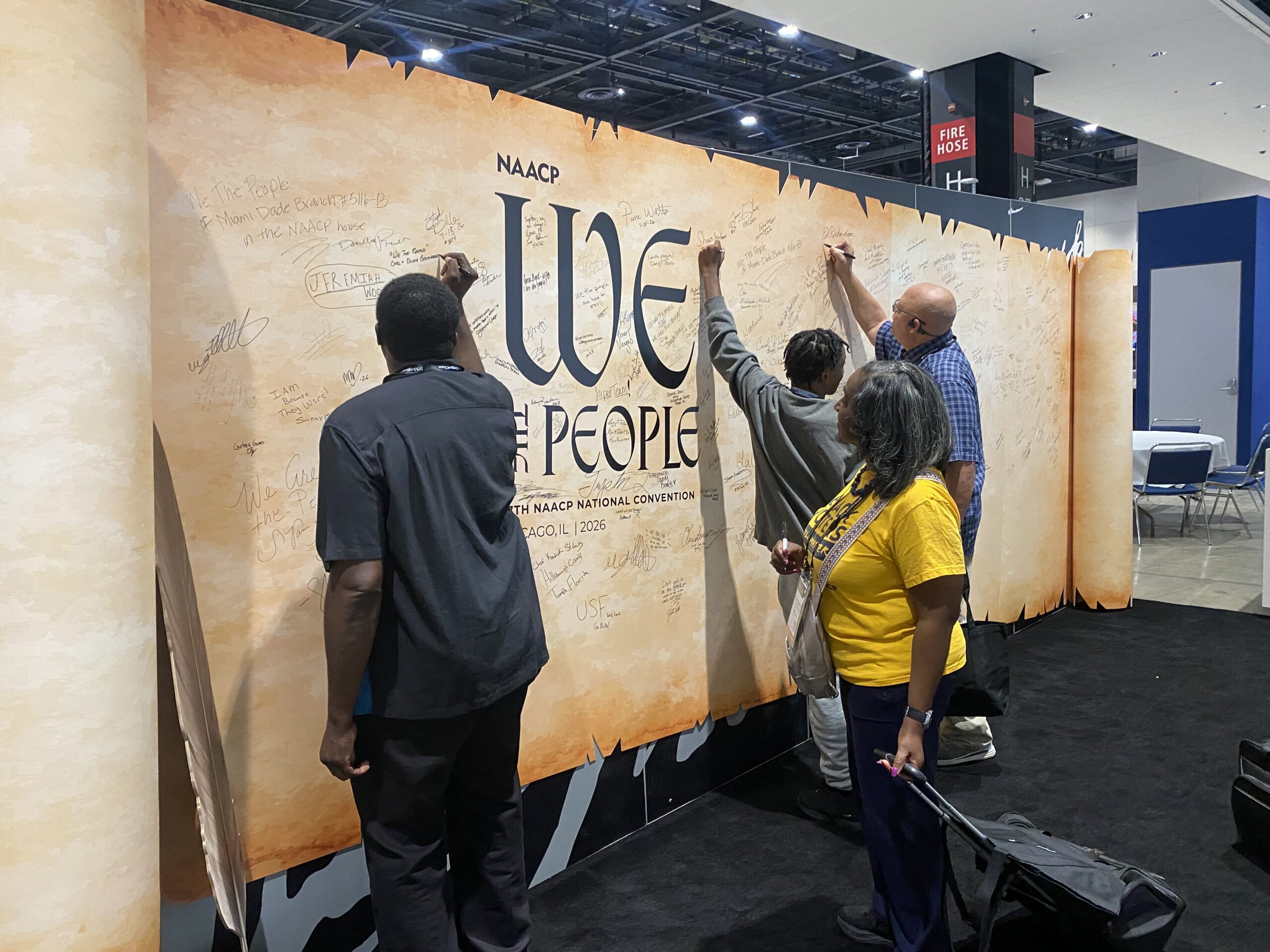
With just over three months before the midterm elections, the NAACP at its 117th annual convention in Chicago announced an unprecedented $20 million voter registration campaign ahead of the midterm elections.
The announcement kicked off the NAACP’s national convention at McCormick Place where thousands of visitors and delegates participated in workshops and seminars that stressed the organization’s theme of “We the People” and purpose of educating Blacks about their constitutional rights.
Throughout the week-long convention, vendors sold merchandise, media organizations held onsite interviews in “The HUB,” and visitors signed a massive “We the People” mural.
Governor J.B. Pritzker and Mayor Brandon Johnson were among the dignitaries who reinforced the NAACP’s message during the convention’s opening plenary.
Black voting rights have been under attack in the last several months when Louisiana, Tennessee, Alabama and Florida gutted historic Black congressional districts after the U.S. Supreme Court ruled such districts were unconstitutional and were no longer needed in modern times despite protections under the Voting Rights Act of 1965.
The NAACP, the nation’s oldest civil rights organization, is concerned those decisions will roll back political and economic gains Blacks have made in the last six decades.
NAACP Board Chairman Leon Russell told the opening session that the NAACP would undertake a $20 million voter registration and mobilization drive “to motivate six million to 10 million voters” who did not cast ballots in the last two elections to do so.

As part of the campaign, the NAACP plans to recruit “tens of thousands of volunteers to join the crusade to turn out millions of us this November.”
The plan will target voters in 14 states and 33 congressional districts, with the full list expected to be disclosed later.
“We must move 60 percent or more of all eligible voters to the polls,” Russell said.
The NAACP has a history of leading voter registration drives in Black neighborhoods across America.
In his speech, Pritzker said, “In Washington and across the country, extremists holding high office are working to erase Black history rather than learn from it, to take away voting rights instead of strengthening them, to divide us rather than unite us,” he said.
He added, “These are not simply disagreements over policy. These are challenges to the very idea that democracy belongs to all of us. Challenges to the very idea that we are all created equal.”
Pritzker said the phrase “We the People” reflects America’s ongoing effort to expand equality, noting that the nation’s founding ideals initially excluded enslaved people, women and other groups.
Mayor Brandon Johnson said, “For 117 years this incredible organization has helped bend the arc of history towards justice. And not because progress was inevitable, but because ordinary people made the extraordinary decision to organize, advocate and refuse to accept injustice as the reigning form of governance. That work has never been easy, and today it remains as urgent as it has ever been.
“Across this country we are witnessing wicked efforts to undermine fundamental rights, weaken Democratic institutions, and to turn neighbors against one another.
“We see attempts to silence the truth and erase our history and convince people that somehow division is stronger than solidarity. But history has taught us something very different. Every time people have been told to accept injustice, they have risen together to reject it. “
During Trump’s second term in office, the NAACP has filed more than 70 lawsuits to stop his grasping and often unconstitutional moves to grab total power.
Pritzker said “Illinois has been at the forefront of the struggle for freedom and equality” ever since Jean Baptiste Point du Sable, a non-white, was the first permanent resident of what is now Chicago, Pritzker noted.
Pritzker also said Illinois also gave the nation the crusading African American journalist Ida B. Wells, and it elected more African American members of Congress than any other state. He said Illinois gave the nation the late civil rights leader Jesse Jackson and “a young community organizer” who eventually went from Chicago to the White House, Barack Obama.
“But such progress is not inevitable,” the governor warned. “It requires people willing to sacrifice. None of this is by accident. It is because Black America shows up, reminding us of the painful part of our history while giving us hope for the future.”
Based on reporting by Gary Crusader.

Black History
Opinion: When Politicians Start Sanitizing One Chapter of History, They’re Coming After The Whole Book
OAKLAND POST — The White House recently released a report criticizing the Smithsonian for supposedly promoting “anti-White activism” and other ideological sins. Buried inside is something even more troubling. The report argues Americans shouldn’t think of the Chinese Exclusion Act of 1882 primarily as a racist law. Instead, we’re told it was about national security.

I came to Winnipeg to perform my one-man show, 69, Emil Amok: Anchorman—The News Made Me Do It.
I didn’t expect to leave with another lesson about America.
It came over dim sum.
After the show, Shirley—a Chinese Canadian—and her friend Chris, a Sri Lankan-Mauritian Canadian—insisted on taking me to a restaurant in Winnipeg’s Chinatown.
A Filipino American. A Chinese Canadian. A Sri Lankan-Mauritian Canadian.
The United Nations, if it served dumplings.
Then Shirley told me about her father.
He arrived from China at 14 years old, speaking no English. The school put him in second grade just to learn the language. Once he caught up, they skipped him to ninth grade.
Two years later, he was working.
He opened a restaurant.
It burned down.
He opened another.
Eventually he bought a café in rural Manitoba serving chop suey, burgers, steaks and fries.

The Good Way Café became the place everybody gathered. Rock and roll played from the jukebox until midnight.
Her father, Arthur Mar, built a business, employed people and became part of his community.
Sound familiar?
It should.
It’s the same immigrant story Americans love to celebrate.
Until politics gets involved.
Because before Arthur Mar could build anything, Canada made him pay a $500 Chinese head tax—a fortune in the 1920s.
When that didn’t keep enough Chinese out, Canada passed its own Chinese Exclusion Act.
Different country.
Same racism.
Canada has spent decades admitting what it did.
The Trump administration wants America to do the opposite.
The White House recently released a report criticizing the Smithsonian for supposedly promoting “anti-White activism” and other ideological sins.
Buried inside is something even more troubling.
The report argues Americans shouldn’t think of the Chinese Exclusion Act of 1882 primarily as a racist law.
Instead, we’re told it was about national security.
Funny how those two words have always been available whenever politicians want to discriminate against somebody.
Black Americans have heard that song before.
Slave patrols became public safety.
Jim Crow became states’ rights.
Mass incarceration became law and order.
Same melody.
Different verse.
History has a way of putting racism in a respectable suit.
When politicians begin sanitizing one chapter of history, they’re coming after the whole book.
Communities of color don’t have identical histories.
But we recognize familiar tactics.
About the Author
Emil Guillermo is an award-winning journalist, commentator and comic monologist. He performs “69, Emil Amok: Anchorman—The News Made Me Do It” at the Winnipeg Fringe Festival, July 16–26.
Get Tix: https://www.winnipegfringe.com/performer-detail.aspx?kw=Emil+Amok+Productions
Follow him at YouTube.com/@emilamok1.
Community
Rep. Garamendi, House Democrats Demand Trump Administration Abandon Illegal Plans to Dismantle Civil Rights, Special Ed Offices
OAKLAND POST — “The law is clear: Congress created OCR and OSERS and Congress alone can eliminate them. The use of Interagency Agreements to accomplish your ‘final mission’ – to eliminate the Department in all but name – is counter to the will of Congress and rests on questionable legal ground. Even Congressional Republicans have expressed reservations and attempted to keep money appropriated to the Department within the Department, rather than being outsourced through IAAs…,” the members of Con

Congressman John Garamendi (CA-08) joined 85 House Democrats this week calling on the Department of Education to immediately abandon its plan to transfer the Office of Special Education and Rehabilitative Services (OSERS) to the Department of Health and Human Services (HHS) and the Office for Civil Rights (OCR) to the Department of Justice (DOJ).
In their letter, the members argued that the Trump Administration’s plan to dismantle OCR and OSERS through Interagency Agreements (IAAs) is unlawful because Congress established both offices and only Congress has the authority to eliminate them or alter their responsibilities.
“The law is clear: Congress created OCR and OSERS and Congress alone can eliminate them. The use of Interagency Agreements to accomplish your ‘final mission’ – to eliminate the Department in all but name – is counter to the will of Congress and rests on questionable legal ground. Even Congressional Republicans have expressed reservations and attempted to keep money appropriated to the Department within the Department, rather than being outsourced through IAAs…,” the members of Congress wrote.
The members also warned that transferring OCR and OSERS functions would weaken services for students, families, and individuals with disabilities because DOJ and HHS are ill-equipped to carry out the offices’ core functions.
“The movement of OCR and OSERS also disrespects the very people who rely on those services. Specifically, these moves effectively segregate special education from the rest of the education system, moving it to an agency that has indicated it intends to treat disabilities as a health issue to be remedied, against the wishes of groups that advocate on behalf of disabled children and their families. Such action is particularly concerning given the inaccurate and harmful comments from the HHS Secretary regarding children diagnosed with autism.
“Comments such as these will leave those relying on special education services fearful about whether their rights will be upheld and their needs met. Regarding OCR, given the sensitive nature of many of the cases it handles, victims may be hesitant to seek support knowing the investigation will be run by the nation’s primary law enforcement agency. Such delays may cause cases of discrimination to fester and worsen while sending the wrong message to vulnerable communities,” concluded the members.
In February, the Government Accountability Office (GAO) reported that the Department of Education paid OCR investigators up to $38 million not to work.
In April, the Senate HELP Committee released a report that in 2025, OCR reached zero resolution agreements involving sexual harassment, sexual violence, seclusion or restraint, racial harassment, or discriminatory school discipline — despite more than 2,700 pending cases.

WORK FROM HOME
Home-based business with potential monthly income of $10K+ per month. A proven training system and website provided to maximize business effectiveness. Perfect job to earn side and primary income. Contact Lynne for more details: Lynne4npusa@gmail.com 800-334-0540


Oakland Post: Week of July 22 – 28, 2026

Fed Court to Decide Landmark First Amendment Case

Jordan Walker Leads Call for More Black Youth in Baseball

How Black WNBA Players Became Collateral Damage in the Caitlin Clark Culture War

NAACP Announces $20m Voter Registration Drive at National Convention in Chicago

Starting This Summer, California Car Buyers Can Get an Instant $3500 Off the Cost of Electric Vehicles

Surveillance Pricing Fight: State Senate Debates Bill Banning Retailers from Using AI to Set Prices Based on a Buyer’s Profile

Oakland Children’s Hospital Workers and Patients Rally for Pediatric Medical Care

Opinion: When Politicians Start Sanitizing One Chapter of History, They’re Coming After The Whole Book

Beyond Politics: California Legislators Across Party Lines Celebrate Lori Wilson at 50

NPRC to Meet with California Attorney General’s Office on to Urge Guardianship Reform

Mount Zion MBC, Church of Jesus Christ of Latter-day Saints Partner to Bring 29,000 Meals to Alameda County

Councilmember Houston Helps Deter Trend to Award Contracts to Suburban Companies

Rep. Garamendi, House Democrats Demand Trump Administration Abandon Illegal Plans to Dismantle Civil Rights, Special Ed Offices

Council Gives Approval for $125 Million Oakland Coliseum Sale to AASEG
Oakland Children’s Hospital Workers and Patients Rally for Pediatric Medical Care
Mount Zion MBC, Church of Jesus Christ of Latter-day Saints Partner to Bring 29,000 Meals to Alameda County
Surveillance Pricing Fight: State Senate Debates Bill Banning Retailers from Using AI to Set Prices Based on a Buyer’s Profile

Saving Black Mothers Starts Outside the Hospital

IN MEMORIAM: Oakland Dance Legend Reginald Ray-Savage, 67

Gov. Gavin Newsom Signs Law Streamlining Affordable Housing Rules

Oakland Celebrates $125 Million Coliseum Sale
Starting This Summer, California Car Buyers Can Get an Instant $3500 Off the Cost of Electric Vehicles

NPRC Heads to Washington to Elevate Adult Guardianship Reform at National Whistleblower Summit


Agricultural Engineer Effie Gant Plans Bay Area Farmers Market Initiative

The Part of Buying a Home That No Real Estate Show Ever Prepares You For

Oakland Post: Week of June 17 – 23, 2026

Oakland Post: Week of July 1 – 7, 2026

NCBW-OBAC Champions Black Women Entrepreneurs at Business en Blaque Expo

The Conversation With Al McFarlane 6/23/26

Media Monday 6/22/26

LIVE! ASK ALMA! — TUES. 6.23.26 7PM EST

Car Buying Secrets: 4 Hidden Checks Before You Sign!

Is This 550 HP Charger Worth YOUR Money? AutoNetwork Review

Celebrating Juneteenth – Frederick Douglass on education and resistance

LIVE! — ASK ALMA! — TUES. 6.19.26 7PM EST

Hyundai Ioniq 5 Parking, Safety, and 360 View #shorts

2025 Ioniq 5 New Wiper & Powerful Performance! #shorts

Electric SUV Range: Is 259 Miles Enough? #shorts

EV Charging: How Fast Can You Charge an Electric Vehicle? #shorts

Biometric Cooling… Messaging Seats…Come on! 2025 Infiniti QX80 Autograph 4WD

Charged Up: Witness the Magic of a Fully Electric Car! #shorts

Range Rover Sport PHEV Included…: See What’s Inside This Luxury SUV! #shorts

Invisible Hood View: Perfect Parking with X-Ray Vision! #shorts
-
 Business2 days ago
Oakland Children’s Hospital Workers and Patients Rally for Pediatric Medical Care
-
 Business2 days ago
Mount Zion MBC, Church of Jesus Christ of Latter-day Saints Partner to Bring 29,000 Meals to Alameda County
-
 Business2 days ago
Surveillance Pricing Fight: State Senate Debates Bill Banning Retailers from Using AI to Set Prices Based on a Buyer’s Profile
-
 Black History6 days ago
Saving Black Mothers Starts Outside the Hospital
-
 Business4 days ago
Gov. Gavin Newsom Signs Law Streamlining Affordable Housing Rules
-
 Black History1 week ago
Oakland Celebrates $125 Million Coliseum Sale
-
 Business2 days ago
Starting This Summer, California Car Buyers Can Get an Instant $3500 Off the Cost of Electric Vehicles
-
 Community1 week ago
NPRC Heads to Washington to Elevate Adult Guardianship Reform at National Whistleblower Summit
