
News
Black Workers Receive Only 9 Percent of Hours on City- Funded Building Projects


A new City of Oakland report showd that during the past two years African American workers obtained a little over 9 percent of journeyman and apprentice hours on city-funded projects, though African Americans make up 28 percent of Oakland’s population.
The 34-page report, dated Jan. 10, 2018, shows that African Americans received 9.31 percent of the 659,544.32 hours worked on projects during the two-year period. Gross wages paid for the hours worked were $24,146,750.09.
The Oakland Post obtained the report, covering 2015 to 2017, after filing a California Public Records Act request.
Asians received 1.6 percent, Caucasians 20.09 percent, Hispanics 57.17 percent and Native Americans 0.07 percent of the work. The report does not break down journeyman and apprentice hours by ethnicity, though African American workers tend to be concentrated in the lower paid apprentice positions.
“We still have a tremendous disparity across ethnicities in the hiring on these city-funded projects,” said Brian Beveridge of OaklandWORKS.
“Based on other things we know, this reflects disparities in the building trades,” he said. High number of workers on sites are Latino, he said, which represents increased Latino membership in the Laborers Union and a few others, but the building trades unions overall remain segregated.

Among affiliated Building Trades unions are Laborers, Carpenters, Electrical Workers,Operating Engineers, Plasterers and Glazers.
The Building and Construction Trades Council of Alameda County has so far been unwilling to release information on the racial and ethnic composition of member unions.
“We would like to see a greater effort on the part of all the building trade unions to recruit from all ethnicities and get more balance in their membership,” said Beveridge. “We’re a union town and we support collective bargaining,” he said. “But we’re not seeing equity in hiring on publically funded projects. The solution can’t all be put on contractors. The trade unions have to play a role.”
Margaret Gordon, West Oakland Environmental Indicators Project co-director, told the Post that the failure of the building trades to hire and retain Black workers was the result of racism in the unions and economic obstacles to working in the building trades.
“Internal racism in the unions is a root cause,” she said.
In addition, the lack of retention of Black workers who do obtain apprenticeship positions often has to with the workers not having do the “resources to get from one job to the next job.”
“They can’t work if they don’t have the money for the tools, gas money, a reliable car, being able to buy lunch, pay for childcare, all those day-to-today things.”
A number of workers do not complete their apprenticeships, and there is little financial incentive to builders to reach their apprenticeship hour goals, Gordon said. “They pay liquidated damages, which is only. 1.5 times the person’s hourly wage. That needs to be need fixed. Liquidated damages should be 10 times a person’s hourly wages.”
The policy of the Army Base project establishes a flat rate of $20 per shortfall hour and is not tied to the wages that would have been paid to the worker.
Gordon said the participation of African Americans as apprentices and journeymen has been in decline since the construction projects in the wake of the Cypress freeway collapse in 1989.
“Those numbers have never recovered,” she said.
By the Oakland Post’s deadline, neither Mayor Libby Schaaf nor Andreas Cluver, secretary-treasurer of the Building and Construction Trades Council, replied to requests for comment.










Business
OPINION: 57,000 Empty Apartments and Not a Word of Apology – City Limits
BLACKPRESSUSA NEWSWIRE — “Short-term rental income was, for many of these families, not a luxury. It was the margin between keeping the house and losing it. Local Law 18 closed that door, and the people who closed it are now waving away 57,000 empty apartments as statistical noise.”

Every indicator in New York City’s housing market is pointing in the wrong direction.
Rents are at historic highs. Foreclosure notices are climbing in Black and brown neighborhoods that never fully recovered from the last crisis. Deed theft, the predatory stripping of generational wealth from families who built their equity over decades, continues to devastate communities from Brownsville to Jamaica.
On top of all these factors, there were more than 57,000 rent-stabilized apartments sitting completely empty as of April last year. That number grew by 8,000 units in a single year, with the sharpest increases hitting Brooklyn and Queens hardest.
Brooklyn and Queens. My neighborhoods. Your neighborhoods.
You would think that news of 57,000 empty affordable apartments in the middle of a housing emergency would produce outrage, emergency hearings, and demands for accountability. Instead, New Yorkers got a collective shrug from opinion leaders.
Read that again: 57,000 families could be housed in those apartments. Households currently paying market rent, doubled up, couch-surfing, or one missed paycheck away from the street could have relief. And silence from the city’s housing leadership, activists, and coalitions.
In my experience as chair of the Subcommittee on Affordable Housing in the Assembly, that is not advocacy. That is surrender.
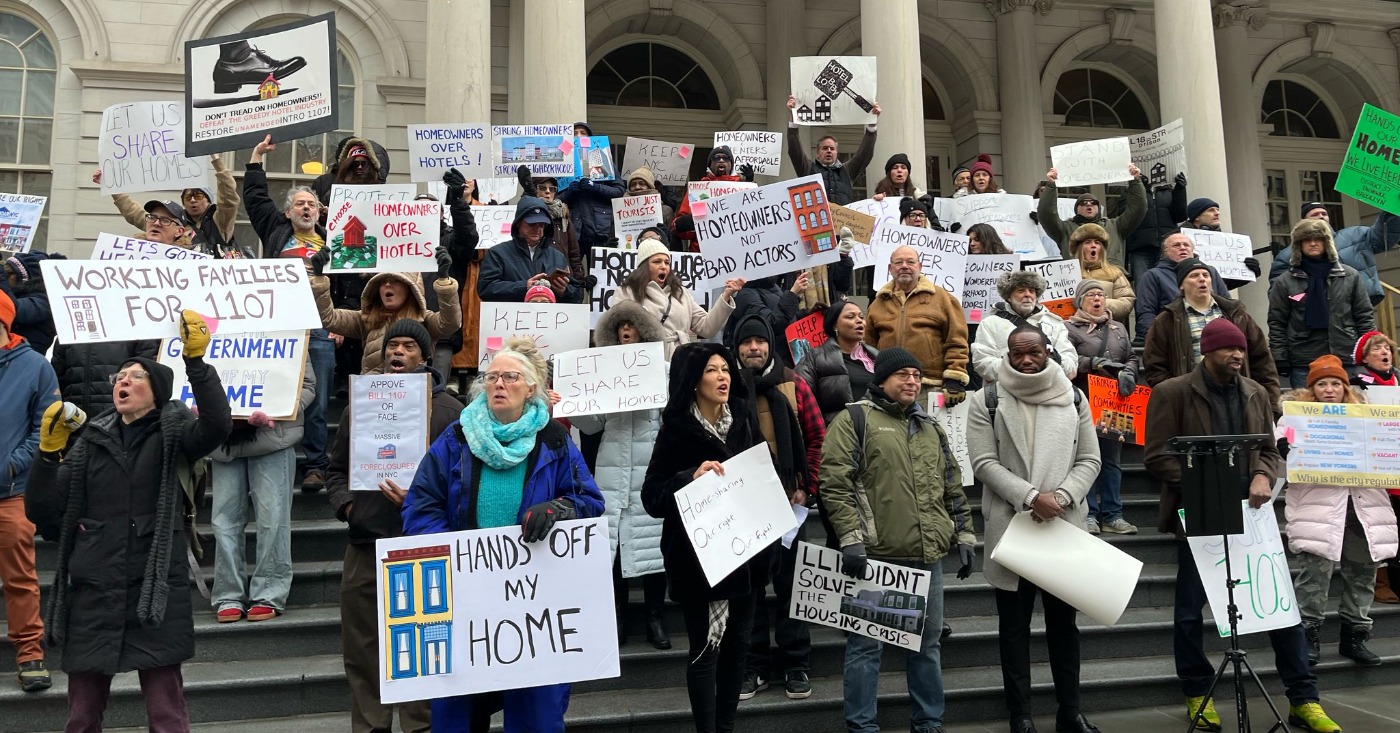
These are the same voices, the same institutions, the same political class that successfully lobbied to effectively ban short-term rentals in New York City through Local Law 18. At its peak, Airbnb had roughly 20,000 listings in New York City, nearly a third the number of apartments currently sitting vacant and padlocked in the rent-stabilized system. The campaign against those listings was relentless, loud, and wrapped in the language of affordability and housing justice.
Where is that energy now?
Where are the press conferences about landlords warehousing stabilized units while families sleep in shelters? Where is the legislation with teeth? Where is the outrage that was apparently plentiful when a Black homeowner in Bed Stuy wanted to rent out her spare bedroom to make ends meet?
Because that is exactly who Local Law 18 hit hardest. Not the corporate bad actors. Not the hedge funds. The struggling homeowner, disproportionately Black, disproportionately in Brooklyn and Queens, who used their home as a small economic engine to survive in a city that grows more expensive by the month.
Those families were told their activity was destabilizing the housing market. Those families were fined, delisted, and legislated out of a livelihood. And now we learn that 57,000 stabilized units are sitting empty while rents spiral and foreclosures mount, and the response from housing advocates is essentially: that’s just how big numbers work.
This is not sound policy. This is politics. And the communities paying the price know the difference.
I have spoken with homeowners across Central Brooklyn who are barely holding on. They bought their homes, sometimes one generation removed from the Great Migration, and they have watched the equity they built become both their greatest asset and their greatest vulnerability. Predatory lenders, deed theft schemes, and rising property taxes all circle that equity like wolves.
Short-term rental income was, for many of these families, not a luxury. It was the margin between keeping the house and losing it. Local Law 18 closed that door, and the people who closed it are now waving away 57,000 empty apartments as statistical noise.
Everyone in this fight knows what needs to happen but will not say it out loud: Local Law 18 needs reform. Common sense reform. The kind that distinguishes between an investor running a ghost hotel and a homeowner renting a room. The kind that actually targets bad actors instead of penalizing the most economically vulnerable property owners in the city.
I hear it in private conversations with elected officials, with housing attorneys, with planners. The consensus is there. The political will is not, because the same advocacy groups and political donors who pushed the original law are still in the room, and nobody wants to take their call.
What this moment requires is courage, not calculation.
Every month that passes with 57,000 empty stabilized apartments is a month of families in crisis, of shelter costs ballooning, of neighborhoods destabilizing. Every month that Local Law 18 remains unreformed is another month a Black homeowner in Flatbush or Hollis faces impossible choices that wealthier New Yorkers simply never have to make.
You cannot ban the small and ignore the large. You cannot mobilize armies of lobbyists against a homeowner’s spare bedroom while shrugging at tens of thousands of warehoused affordable units. You cannot claim to stand for housing justice and then tell 57,000 families worth of empty apartments that the math just works out this way.
The hypocrisy has to stop. Politics have to give way to people. And the officials and advocates who have the power to fix this, who know what needs to be done, have to decide which side they are actually on.
Because from where I stand, in the communities I have served for decades, it is very clear who is being left out in the cold.
Dr. Annette Robinson is a former member of both the State Assembly and City Council in Brooklyn.

Commentary
NPRC Elder Justice Symposium Invites Community to Join Effort to Protect Alameda County Elders
“Two of our most vulnerable populations are elders and the disabled, and many times that combination resides in one individual,” said Tanya Dennis, lead facilitator of NPRC. “At our symposium, NPRC will bring decision makers and elders together in one space for a day to develop strategy and policy to protect and empower.”

The National Probate Reform Coalition (NPRC) will host an Elder Justice Symposium on Friday, Sept. 25, from 9 a.m. to 5 p.m. at Oakland City Hall, bringing elders, families, advocates, policymakers and community leaders together to address elder abuse, financial exploitation and problems within probate and conservatorship systems.
The symposium is designed to inform and empower the community while developing strategies and policies to better protect Alameda County’s vulnerable elders and disabled residents.
“Two of our most vulnerable populations are elders and the disabled, and many times that combination resides in one individual,” said Tanya Dennis, lead facilitator of NPRC. “At our symposium, NPRC will bring decision makers and elders together in one space for a day to develop strategy and policy to protect and empower.”
Dennis said NPRC has drafted proposed legislation intended to make conservatorship a true last resort by adding safeguards before and after a petition is filed. Proposals include mandatory private mediation before entering probate and placement of an ombudsman in probate proceedings to advocate for the rights and interests of prospective or current conservatees.
The coalition also wants stronger protections for elders’ estates and assets, arguing that money accumulated over a lifetime should be preserved for elders, families and intended beneficiaries rather than unnecessarily depleted by court-related expenses.
NPRC meets monthly through Zoom and has expanded into a national coalition because elder abuse, financial exploitation and guardianship and conservatorship concerns extend well beyond Alameda County.
“Members share horror stories of being isolated from their parents and children, many times physically abused and overmedicated; seeing estates drained for court costs, and assets that parents spent decades saving to leave a legacy depleted instead and going to strangers,” said Venus Gist, an NPRC co-facilitator and former victim of the probate system. Gist said she spent more than $80,000 trying to protect her parents’ estate.
“Eighty thousand dollars is nothing compared to the people in our group losing millions and having to sell their businesses and homes to pay court fees,” she said.
The symposium will also examine forms of elder exploitation including telephone scams, bank fraud, identity theft, family financial abuse and exploitation by trusted individuals. Participants will learn to recognize warning signs involving caregivers, financial professionals, health and social service workers, attorneys and guardians.
NPRC is seeking a California lawmaker willing to champion legislation that strengthens elder protections and increases accountability in the conservatorship process.
The symposium follows Supervisor Nate Miley’s 23rd Annual Healthy Living Festival on Thursday, Sept. 24, at the Oakland Zoo. The free event for adults 55 and older will feature health screenings, vaccinations, nearly 100 community resource booths, lunch, entertainment and complimentary zoo admission for eligible attendees.
Dennis said the two events offer a comprehensive two-day focus on elder well-being.
“The health fair will cover the physical care of our elders, and the next day NPRC’s symposium will cover the mental and social health,” Dennis said. “Together, we are offering a comprehensive two days of care for Alameda County elders.”
Both events are free, and advance registration is recommended because space is limited. Community members, elders, families, advocates and public officials are encouraged to participate. Breakfast and lunch will be served at both events.
For registration: Sign-up is required via Supervisor Nate Miley’s Eventbrite page NPRC registration is https://www.eventbrite.com/e/elder-justice-symposium-tickets-1998385423597?aff=oddtdtcreator

Commentary
Episode 4: Grow Stronger After 50
INDIANAPOLIS RECORDER — Episode 4 of the Second Half of Life Podcast features hosts Thomas Griffin and Andrea McGordon in conversation with Joel Hungate, Assistant Vice President of Strategy & Integrated Wellbeing at Hancock Health. Hungate, a biomedical engineer, health adventurer, and Netflix-featured survivalist, discusses reinvention, personal reflection, confidence, and building lasting health beyond age 50.
Strength doesn’t disappear when you turn 50- it evolves. Just as growth is a lifelong journey, becoming stronger happens every day. The second half of life is not the beginning of decline; it is the horizon of a stronger, healthier, more confident, and happier version of yourself.
In Episode 4 of the Second Half of Life Podcast, hosts Thomas Griffin and Andrea McGordon sit down with Joel Hungate, Assistant Vice President of Strategy & Integrated Wellbeing at Hancock Health, biomedical engineer, health adventurer, and Netflix-featured survivalist, for a compelling conversation on reinvention, personal reflection, confidence, and building lasting health after 50.
Drawing from his professional expertise and extraordinary life experiences, Joel challenges many of the myths surrounding aging and demonstrates that the years after 50 can be filled with purpose, adventure, and renewed strength.
The Door Doesn’t Shut at Your Second Half
One of the most memorable moments from the conversation came when Joel Hungate shared a simple yet profound truth:
“The door doesn’t shut at 50.”
Far too many people believe that once they reach the second half of life, opportunities begin to disappear. Joel offers a refreshing perspective, reminding viewers that age does not determine potential. Instead, the years after 50 present an opportunity to reflect on your experiences, redefine your purpose, and confidently pursue new goals.
Whether you’ve always wanted to travel, learn a new skill, improve your health, or simply become the best version of yourself, your second half is not a limitation; it’s an invitation.
Watch the first short clip here:https://drive.google.com/file/d/1uTp_tFVgb55Ux1GWmQnLRHp2YTVdl68k/view?usp=drivesdk
Find a Version of Strength Training That Works for You
When people hear the words strength training, many immediately picture lifting heavy weights in a gym. Joel Hungate believes strength looks different for everyone.
You don’t need an expensive fitness membership to become stronger. Walking after dinner, climbing stairs, carrying groceries, hiking with friends, cycling, resistance exercises, or simply staying physically active can all help build strength and preserve independence as you age.
Joel encourages people 50 and over to find a form of movement they genuinely enjoy because consistency not intensity, is what transforms health over time. One practical habit he recommends is taking a walk after dinner, a simple routine that benefits both physical health and overall wellbeing.
Watch the second short clip here:https://drive.google.com/file/d/188dzfMoEbNOxzjXxde2-j4xochFL8lHQ/view?usp=drivesdk
A Way Out of the Frailty Epidemic
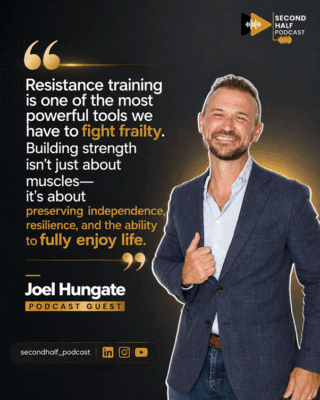
Frailty has become one of the greatest health challenges affecting those over 50, yet many people don’t realize that it is not an inevitable part of aging.
During the conversation, Joel explains how maintaining muscle strength, staying active, and making intentional lifestyle choices can significantly reduce the risk of frailty while supporting healthy weight management.
Rather than accepting weakness as a normal part of growing older, he challenges listeners to adopt habits that preserve mobility, resilience, and independence for years to come.
If you’ve ever wondered how to stay strong and capable well into your later years, this conversation offers practical insights that could change the way you think about aging.
Watch the third short clip here:https://drive.google.com/file/d/13BJIGBE68IsEoA3sVaAT8UIBEpepq6A7/view?usp=drivesdk
Eating Better Isn’t the Goal for a Healthy You- Here’s What Is
One of Joel’s most thought-provoking statements during the episode was:
“When we think health is an end goal, it never works.”
Health is not a destination that we eventually arrive at, it is a lifelong journey shaped by daily decisions.
Joel explains that while nutritious eating is important, lasting health is built through a combination of purposeful movement, meaningful relationships, quality sleep, continual learning, and embracing new adventures. Healthy living is about creating a lifestyle that allows you to enjoy life, not simply following another diet.
This refreshing perspective encourages viewers to shift their focus from chasing perfection to building sustainable habits that support long-term wellbeing.
Watch the fourth short clip here:https://drive.google.com/file/d/1PjaysWUmBOTQunVBqQb6KcgKPHEUL5qM/view?usp=drivesdk
More Than a Conversation- A Blueprint for Living Stronger

Episode 4 of the Second Half of Life Podcast is more than an inspiring discussion- it is a practical guide for anyone determined to thrive after 50.
Joel Hungate shares expert insights, personal experiences, and actionable advice that challenge outdated beliefs about aging. His message is clear: strength doesn’t fade with age unless we stop investing in it.
If you’re ready to eliminate the fear of frailty, build lasting confidence, and embrace the adventure that awaits in the second half of life, this episode is one you won’t want to miss.
Watch the full episode now and discover how to grow stronger after 50.
For more, visit indianapolisrecorder.com.
The post Episode 4: Grow Stronger After 50 appeared first on Indianapolis Recorder.
Based on reporting by Indianapolis Recorder.

WORK FROM HOME
Home-based business with potential monthly income of $10K+ per month. A proven training system and website provided to maximize business effectiveness. Perfect job to earn side and primary income. Contact Lynne for more details: Lynne4npusa@gmail.com 800-334-0540


OPINION: 57,000 Empty Apartments and Not a Word of Apology – City Limits

Oakland Protesters Rally to Defend Haitian Immigrants and TPS

First 5 Alameda County Celebrates First Year of Measure C’s Implementation

From Palestine to Oakland: Seeds for Liberation Examines Shared Struggles for Freedom

NABJ Convention Brings Black Journalists, Civic Leaders Together in Atlanta

At Sacramento Summit, Becerra Discusses Policy; Uses “Family” Metaphor to Frame Case for National Political Unity

$5 Billion Coliseum Vision Puts Oakland Jobs, Businesses at Center

Gov. Newsom Nominates 3 Black Women Judges to Serve on State Courts of Appeal

Oakland Observes Black August with Block Parties, Film Showings, Workshops

NPRC Elder Justice Symposium Invites Community to Join Effort to Protect Alameda County Elders
Episode 4: Grow Stronger After 50
Episode 4: Grow Stronger After 50

Four Candidates, Including Incumbent Barbara Lee, Qualify for Oakland Mayor’s Race

Oakland Observes Black August with Block Parties, Film Showings, Workshops

Oakland Post: Week of August 12 – 18, 2026

Department of Homeland Security Demands California Secretary of State Shirley N. Weber Scrub Voter Rolls

New Judge Could Decide if Karmelo Anthony Gets a New Trial

Oakland Children’s Hospital Workers and Patients Rally for Pediatric Medical Care

“The Power to See Threats Sooner”: Gov. Newsom, Safety Officials Showcase California’s Investments in Hi-Tech Wildfire Prevention

Alpha Kappa Alpha Sorority, Inc. Celebrates New North Atlantic Regional Director

Surveillance Pricing Fight: State Senate Debates Bill Banning Retailers from Using AI to Set Prices Based on a Buyer’s Profile

Mount Zion MBC, Church of Jesus Christ of Latter-day Saints Partner to Bring 29,000 Meals to Alameda County

California Sen. Padilla Joins Colleagues to Introduce Bill Imposing Term Limits on Supreme Court Justices

Less Affluent School Districts, Including Sacramento City, Face Threat of State Takeover

Car Wash Workers Cope with Lingering Impacts of ICE Raids

Starting This Summer, California Car Buyers Can Get an Instant $3500 Off the Cost of Electric Vehicles

COMMENTARY: You Are Already Paying for the AI Boom

California Bill Would Let Abuse Victims Use Trauma as Legal Defense for Violent Crime

Fed Court to Decide Landmark First Amendment Case

Gov. Gavin Newsom Signs Law Streamlining Affordable Housing Rules

The Conversation With Al McFarlane 6/23/26

Media Monday 6/22/26

LIVE! ASK ALMA! — TUES. 6.23.26 7PM EST

Car Buying Secrets: 4 Hidden Checks Before You Sign!

Is This 550 HP Charger Worth YOUR Money? AutoNetwork Review

Celebrating Juneteenth – Frederick Douglass on education and resistance

LIVE! — ASK ALMA! — TUES. 6.19.26 7PM EST

Hyundai Ioniq 5 Parking, Safety, and 360 View #shorts

2025 Ioniq 5 New Wiper & Powerful Performance! #shorts

Electric SUV Range: Is 259 Miles Enough? #shorts

EV Charging: How Fast Can You Charge an Electric Vehicle? #shorts

Biometric Cooling… Messaging Seats…Come on! 2025 Infiniti QX80 Autograph 4WD

Charged Up: Witness the Magic of a Fully Electric Car! #shorts

Range Rover Sport PHEV Included…: See What’s Inside This Luxury SUV! #shorts

Invisible Hood View: Perfect Parking with X-Ray Vision! #shorts
-
 Featured2 weeks ago
Department of Homeland Security Demands California Secretary of State Shirley N. Weber Scrub Voter Rolls
-
 #NNPA BlackPress3 weeks ago
New Judge Could Decide if Karmelo Anthony Gets a New Trial
-
 Business4 weeks ago
Oakland Children’s Hospital Workers and Patients Rally for Pediatric Medical Care
-
 Environment2 weeks ago
“The Power to See Threats Sooner”: Gov. Newsom, Safety Officials Showcase California’s Investments in Hi-Tech Wildfire Prevention
-
 Black History3 weeks ago
Alpha Kappa Alpha Sorority, Inc. Celebrates New North Atlantic Regional Director
-
 Business4 weeks ago
Surveillance Pricing Fight: State Senate Debates Bill Banning Retailers from Using AI to Set Prices Based on a Buyer’s Profile
-
 Business4 weeks ago
Mount Zion MBC, Church of Jesus Christ of Latter-day Saints Partner to Bring 29,000 Meals to Alameda County
-
 Featured2 weeks ago
California Sen. Padilla Joins Colleagues to Introduce Bill Imposing Term Limits on Supreme Court Justices
