
Transportation
DDOT, Residents at Odds over Bike Lanes
WASHINGTON INFORMER — A meeting scheduled for next month between the District Department of Transportation (DDOT) and those living along a stretch of Alabama Avenue in Southeast could potentially actualize what some residents said they’ve long yearned: a direct say in traffic safety measures in their neighborhood.

By Sam P. K. Collins

A meeting scheduled for next month between the District Department of Transportation (DDOT) and those living along a stretch of Alabama Avenue in Southeast could potentially actualize what some residents said they’ve long yearned: a direct say in traffic safety measures in their neighborhood.
For some, newly installed bike lanes between the 1800 and 2000 blocks of Alabama Avenue don’t reflect the needs of elderly residents who, despite losing their vehicles in hit-and-runs, have enjoyed the benefits of parking just feet from, and sometimes in front of, their home.
Several people, including an elderly woman with limited mobility who requested anonymity, said adjusting to the change has been a constant struggle.
“I don’t see what kind of safety the bike lane is making. DDOT made things more dangerous,” said the elder, a 32-year resident of the 1900 block of Alabama Avenue. She recalled enduring minor inconveniences to avoid parking on side streets, like carpooling and sharing a parking space with a neighbor who works during the night.
“I go to choir rehearsal and come right back,” she said.
The woman stressed that she and her neighbors never received notification that their portion of Alabama Avenue, near Giant and Turner Elementary School, would eventually change.
“At this point, DDOT needs to remove those bike lanes,” she said. “If we had known about it, maybe we could have fought it.”
A DDOT spokesperson described the newly installed bike lanes as part of a larger safety improvement project intended to slow traffic along a four-mile stretch of Alabama Avenue frequented by schoolchildren. Future additions, said to have been discussed during community meetings, in emails and in flyers over the past two years, include highly visible crosswalk markings, pedestrian refuge islands and enhanced stop and speed limit signs.
ANC Commissioner Cheryl Moore (SMD 8E02) and other residents living between the 1800 and 2000 block of Alabama Avenue have rebuffed DDOT’s assertion that they had widely notified affected parties about the impending changes. Moore, elected in January, recounted recent conversations with her predecessor, and between DDOT officials and residents about the communication lapses. Since mid-May, when they first walked outside to construction signs and workers in neon vests, some residents have racked up hundreds of dollars in parking tickets.
Councilmember Trayon White (D-Ward 8) has been outspoken about the ongoing situation, addressing a June 13 community meeting at Bellevue William O. Lockridge Library and engaging DDOT Director Jeff Marootian on other occasions regarding the issue.
“I’m concerned about our senior citizens not being able to get inside their homes,” White told The Informer. “DDOT has been very disrespectful in ignoring the community. I want action to come out of the meeting because the residents are fed up. I’m trying to figure out how bike lanes equate to safety. We expected to see speed bumps and stop signs.”
Data from the Brookings Institution’s Metropolitan Policy Program shows that communities located east of the Anacostia River — often with a lower concentration of Metro stations over several miles, more children and people walking longer distances, and wider streets — experienced the highest rate of pedestrian fatalities. Since 2013, five people — four pedestrians and a motorist — have died in crashes along Alabama Avenue. Recent fatalities elsewhere, specifically that of Abdul Seck on 16th and V streets Southeast in April, have shed light on the issue of pedestrian safety in Ward 8.
In response to Seck’s death, and out of frustration with what he considered DDOT’s insufficient safety upgrades to that area, lifelong Southeast resident Ronald Thompson Jr. and a friend painted highly visible crosswalks at the intersection of 16th and V streets in early May.
Thompson, a community safety advocate, recalled attending one of DDOT’s community engagement meetings at THEARC later that month. He said DDOT, just as they had done in endeavoring to improve 16th and V streets, dropped the ball in unveiling a plan for Alabama Avenue that didn’t reflect pressing community needs, including safe modes of public transportation and fewer lanes.
That error, for Thompson, made residents skeptical about embracing opportunities for positive change.
Thompson predicted the upcoming meeting would further determine how residents of Ward 8 see their relationship with the local power structure, in an era where bike lanes signify displacement.
“For a variety of reasons, DDOT has been forced to reengage stakeholders who have the ability to put pressure on folks and shake some things up,” he said. “I’m not always a fan of DDOT, but I want to see safe streets in my community. If DDOT doesn’t reengage, it makes it hard for me to defend them to my neighbors. The same way that we went out and painted a crosswalk, someone could scrub a bike lane.”
This article originally appeared in the Washington Informer.














Business
Port of Oakland, Army Corps Sign Historic Harbor Design Agreement
OAKLAND POST — Oakland Port Commission President Stephanie Dominguez Walton called the agreement a historic milestone that will support thousands of jobs. “Today marks a historic occasion for the Port as we sign the inaugural Design Agreement for the Turning Basin Widening Project, which will keep Oakland competitive,” said Walton.

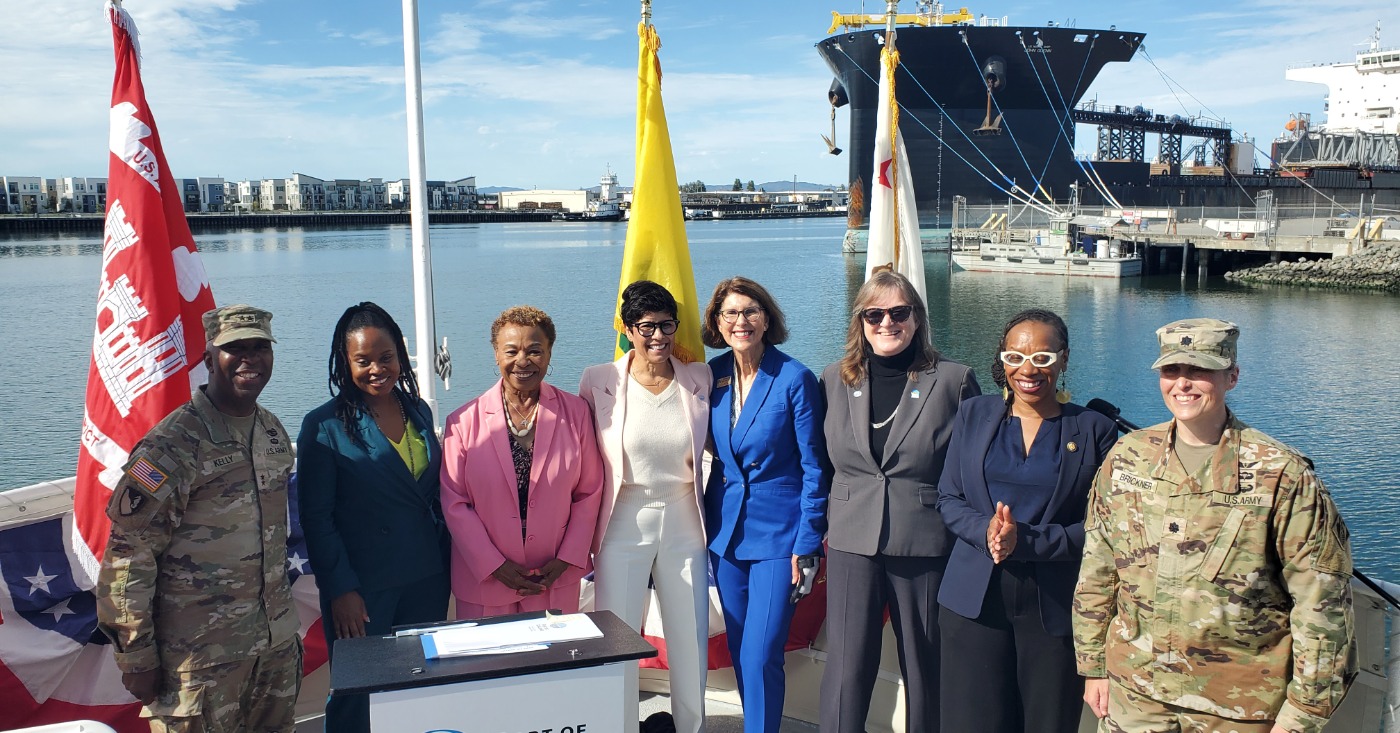
A $642 million project designed to accommodate larger cargo ships and strengthen the Port of Oakland’s position as a major Pacific trade gateway moved a significant step closer to construction on Aug. 27.
The U.S. Army Corps of Engineers (USACE) San Francisco District and the Port of Oakland commemorated the signing of the inaugural Design Agreement for the Oakland Harbor Turning Basins Widening Project during a ceremony aboard the USS Potomac, the presidential yacht once used by President Franklin D. Roosevelt.
The project will widen the Port’s Inner and Outer Harbor turning basins, allowing today’s increasingly larger and longer vessels more space to safely maneuver and turn around. The current basins are narrow, creating delays and operational inefficiencies.
Oakland Port Commission President Stephanie Dominguez Walton called the agreement a historic milestone that will support thousands of jobs.
“Today marks a historic occasion for the Port as we sign the inaugural Design Agreement for the Turning Basin Widening Project, which will keep Oakland competitive,” said Walton.
The agreement advances the project into its preconstruction engineering and design phase following years of planning and collaboration.
Lt. Col. Virginia Brickner, commander of the USACE San Francisco District, said the signing represented tangible progress toward construction.
“We are moving forward. We are showing progress,” Brickner said.
Major General Jason Kelly, USACE Deputy Commanding General for Civil and Emergency Operations, said dredging is critical for maritime dominance, supply chains, and economic competitiveness.
“Dredging sustains our national economic infrastructure,” he said. “The future demands more, the taxpayer deserves more, and together we’re going to deliver.”
For U.S. Representative Congresswoman Lateefah Simon (D-CA-12), the Port project will support jobs beyond its completion. “This will impact workers and businesses, and every shipping container represents multiple jobs.”
Oakland Mayor Barbara Lee described Oakland as a gateway to international markets and spoke on earlier efforts to deepen Oakland’s shipping channel to 50 feet. While serving in the California Legislature, Lee helped bring together labor, business, environmental advocates and Port officials to resolve disputes surrounding dredging and environmental protections.
“We want the Port to remain competitive economically,” Lee said, excited about both protecting the environment and generating sustainable jobs in the region. “We want to make sure that we create good-paying union jobs, and that the Port continues to not just survive, but thrive.”
Port of Oakland Executive Director Kristi McKenney said economic growth is dependent on investments in the Oakland Harbor’s infrastructure.
“This investment and staying competitive will fuel our economy for years to come,” said McKenney.
The Port of Oakland, with its partners, supports more than 98,000 regional jobs and $174 billion in annual economic activity. The Port oversees the Oakland Seaport, the Oakland San Francisco Bay Airport (OAK), and nearly 20 miles of waterfront, including Jack London Square.

Business
Gubernatorial Candidate Steve Hilton Blasts California New Tire Rules; Newsom Hits Back
Newsom defended the regulations Aug. 19, citing the commission’s projected savings for consumers. “I think it was a good choice,” said Newsom. “Save a billion dollars a year in fuel. Talk about an affordability agenda, that makes sense to me.”
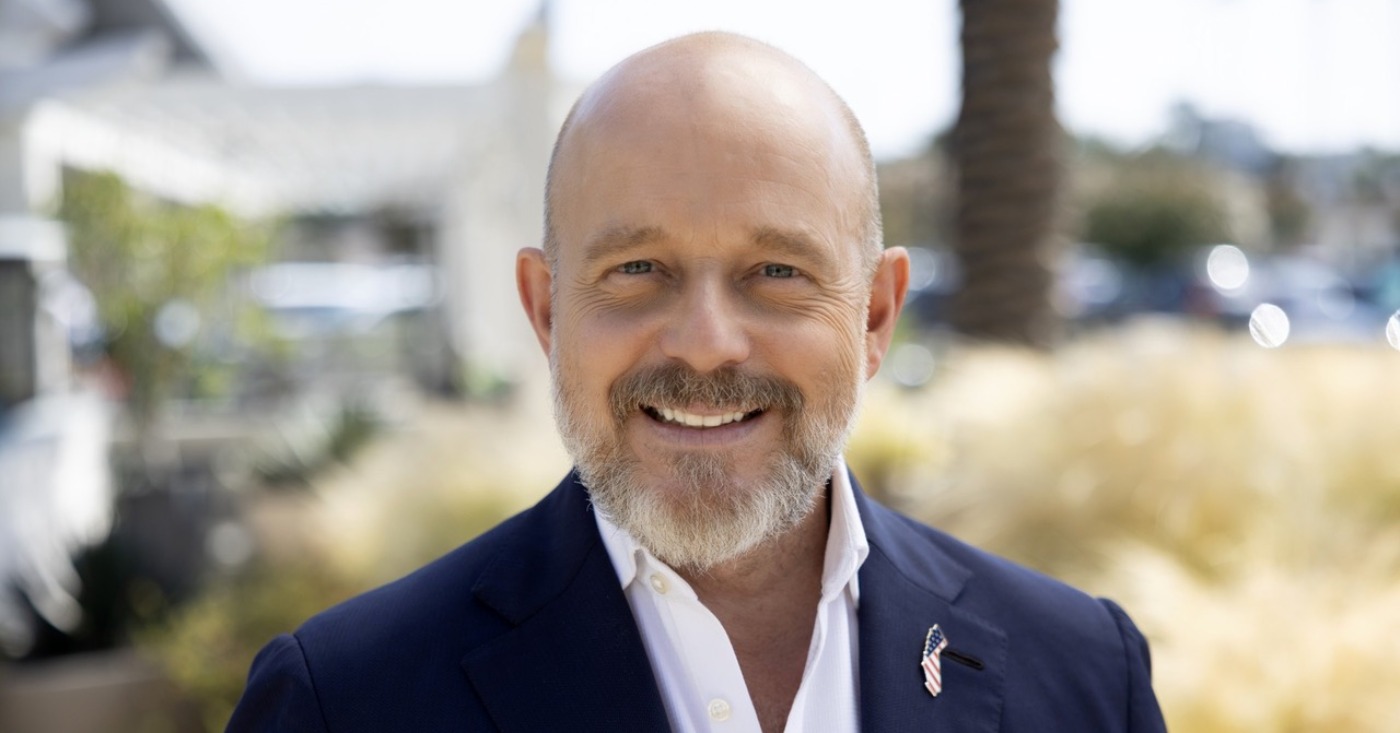
Republican gubernatorial candidate Steve Hilton is criticizing California’s new replacement-tire efficiency standards, arguing they will limit consumer choice and increase costs for drivers.
Gov. Gavin Newsom, however, says the regulations will save consumers money.
Hilton protested the standards Aug. 20 outside the California Energy Commission in Sacramento, where he and supporters chanted, “Hands off our tires.” The commission unanimously approved the regulations Aug. 17, making California the first state to adopt energy-efficiency standards for replacement tires.
“We are done with these bureaucrats and these politicians in our state, making everything so insanely expensive,” Hilton said at the protest.
Hilton said that, if elected governor, he would eliminate or defund the Energy Commission. His opposition to the tire standards is part of his broader criticism of California’s high cost of living.
Newsom defended the regulations Aug. 19, citing the commission’s projected savings for consumers.
“I think it was a good choice,” said Newsom. “Save a billion dollars a year in fuel. Talk about an affordability agenda, that makes sense to me.”
The Replacement Tire Efficiency Program sets limits on rolling resistance, which measures how much energy a tire requires to move along a road. Tires with lower rolling resistance can improve a gasoline-powered vehicle’s fuel economy or extend an electric vehicle’s driving range.
The first phase will take effect in 2029, setting a maximum rolling resistance of 9.1 newtons per kilonewton. A stricter limit of 7.2 newtons per kilonewton will take effect in 2033.
The Energy Commission says the standards will ensure that replacement tires are, on average, at least as energy efficient as those installed on new vehicles. The agency estimates the regulations will save Californians nearly $1 billion annually in gasoline and electricity costs while reducing carbon dioxide emissions by two million metric tons a year.
Some tire manufacturers, however, have raised concerns about the effect on prices and product availability. Goodyear estimates that about 70% of replacement tires currently sold in California would not meet the 2033 standard and argues that the regulations could increase costs for consumers.
The Energy Commission estimates the standards will add about $1.50 to the cost of each tire during the first phase and $6.50 per tire beginning in 2033. The commission projects that a driver with a gasoline-powered vehicle could save about $179 in fuel costs over the life of a set of tires meeting the 2033 standard.
The regulations exempt several specialty products, including competition, winter, used, retreaded, motorcycle and certain off-road tires.
Business
Frontier Airlines’ Return to Oakland Airport Brings Flights, Jobs and Opportunity
The inaugural celebration brought together elected officials, airport executives and Frontier Airlines leadership. Participants included U.S. Representative Lateefah Simon (D-CA-12), Oakland Mayor Barbara Lee, Port of Oakland Board President Stephanie Dominguez Walton, Port of Oakland Executive Director Kristi McKenney and Frontier Airlines Vice President of Public and Consumer Affairs Tyri Squyres.
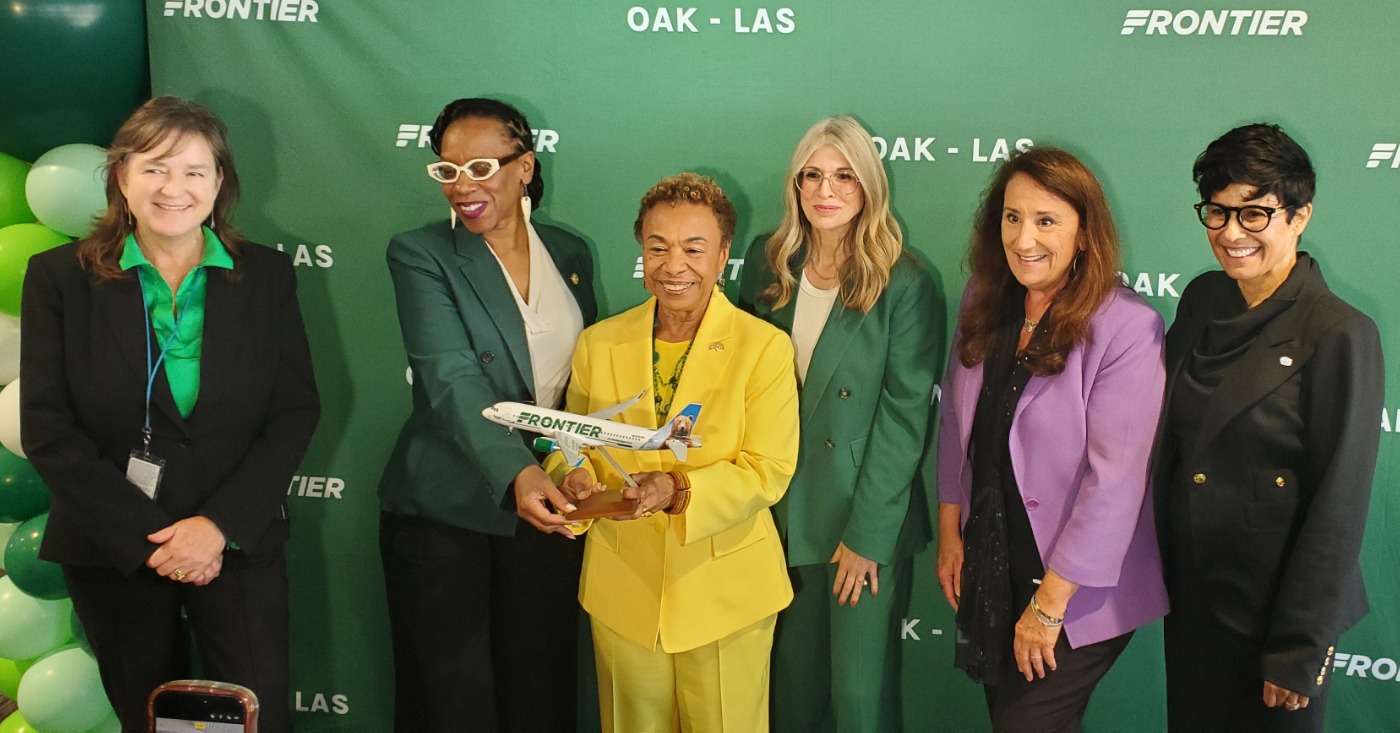
Oakland San Francisco Bay Airport welcomed Frontier Airlines back on Aug. 20, with a ribbon-cutting celebration marking the launch of new nonstop service between Oakland and Las Vegas.
The celebration, held in Terminal 1, highlighted Frontier’s return to the East Bay airport after last serving OAK in 2023.
The airline’s new Las Vegas service expands travel choices for Bay Area passengers headed to one of the airport’s most popular destinations.
The new route is scheduled to operate 11 times weekly, including daily service, strengthening connections between Oakland and Las Vegas for both leisure and business travelers.
The inaugural celebration brought together elected officials, airport executives and Frontier Airlines leadership. Participants included U.S. Representative Lateefah Simon (D-CA-12), Oakland Mayor Barbara Lee, Port of Oakland Board President Stephanie Dominguez Walton, Port of Oakland Executive Director Kristi McKenney and Frontier Airlines Vice President of Public and Consumer Affairs Tyri Squyres.
“We’re excited to restart our service in Oakland,” said Squyres. “The early reaction and response have been great.”
“I’m so glad to have Frontier back,” said McKenney. “I appreciate the partnership we have. We work on it every day with our airlines, community, and our leadership. As your public agency, that’s what we’re here for; to create jobs and opportunities for our community.”

Dominguez Walton also chimed in.
“Today we are celebrating the inaugural flight from OAK to Las Vegas on Frontier Airlines. Oakland is the best way to and from the Bay,” she said.
Squyres highlighted the economic impact.
“Oakland is a critical gateway for the Bay Area moving nearly 10 million travelers each year. OAK is driving local and regional growth keeping the City of Oakland moving forward, moving ahead and also competitive,” she said. “Expanding travel opportunities means not only more options for residents but also opening more high-quality jobs. And when travelers arrive through OAK, they directly support our neighborhoods, businesses, hotels, restaurants, and our cultural attractions.”
Simon broke down what the airline’s reopening means to Oaklanders.
“It’s the grandmother heading to the family reunion at a price she can afford. It’s the small business owner who gets to go to the industry tradeshow and be back by dinner. And it’s the family being able to come from Nevada to get excellent cancer care at our Children’s Hospital at a price they can afford,” she said.
Oakland San Francisco Bay Airport serves as the primary airport for much of the East Bay and provides connections to the region through highways and BART. Operated by the Port of Oakland, the airport is part of a broader transportation and economic network that also includes the Oakland seaport and approximately 20 miles of East Bay waterfront.
According to the Port of Oakland, its operations and business partners support nearly 100,000 regional jobs and generates nearly $175 billion in economic impact.
Simon also emphasized the flights’ potential to create well-paying jobs in the local community.
“More flights means more work for real people in the community, in East Oakland. We know aviation work is steady, and it pays well. It’s work that brings in good labor jobs and prevailing wages.”



OP-ED: Proposition 44 Would Put a Price on Trust

OP-ED: Proposition 40: It’s Time to Play Chess, Not Checkers

Listening as a Lifeline: A Doula’s Witness to Black Maternal Health

New Protections for Ticket Buyers: Gov. Newsom Signs Assemblymember Isaac Bryan’s Bill

‘We Don’t Talk Trash — We Pick Up Trash!’

Zakiya Jendayi Arrested, Locked Out of Home by Sheriff’s Deputies

Oakland Post: Week of September 30 – October 6, 2026

Asm. Corey Jackson Announces Launch of 24-Hour Childcare in His District

IN MEMORIAM: The Rev. Leon “Sonny” Clark, Longtime Orange County Pastor and Community Leader, Dies at 72

Poll: Becerra Widens His Lead Over Hilton; Californians Split on Wealth Tax

From Historic Memories to New Possibilities: Oakland Celebrates Coliseum 60

County Office of Education Says OUSD Finances Are Getting Healthier, Materially Stronger

LIVE FREE Sunday Dinner Brings Faith, Fellowship and Civic Conversation to Oakland

Remembering Chauncey Bailey as Student Journalists Face Threats to Truth-Telling

BLACspace Cooperative Invites Bay Area to Experience Oakland’s Black Cultural Ecosystem Through a BLAC Map Tour + Party

Standoff for Justice: Our Homes Are Worth Fighting For

Oakland Post: Week of August 26 – September 1, 2026

Frontier Airlines’ Return to Oakland Airport Brings Flights, Jobs and Opportunity

Jackie Wright Champions Bay Area Stories, Filmmakers and Cultural Institutions

Gubernatorial Candidate Steve Hilton Blasts California New Tire Rules; Newsom Hits Back

Chef Sharon Lee Blends Culinary Excellence, Education and Empowerment

Misnamed ‘Parent’ PAC Seeks to Influence Oakland School Board Elections

Oakland Coliseum Project Opens Door for Small Businesses to Build Bigger

Big City Mayors Ask for “Yes” Vote on Housing Bond Measure; Conservatives Say “No”

Gov. Newsom’s Latest Appointees Include Sacramento Advocate for Formerly Incarcerated Students; State’s New Tech Chief

Oakland Post: Week of September 2 – 8, 2026

Longtime BWOPA Member Brendalyn Goodall Appointed to California Workforce Development Board

Gov. Newsom Signs Law Shielding Immigration Aid Workers From Doxing Threats

Secretary of State Shirley N. Weber Urges Californians to Vote Early as Voter ID Battle Intensifies

Oakland Post: Week of September 9 – 15, 2026

The Conversation With Al McFarlane 6/23/26

Media Monday 6/22/26

LIVE! ASK ALMA! — TUES. 6.23.26 7PM EST

Car Buying Secrets: 4 Hidden Checks Before You Sign!

Is This 550 HP Charger Worth YOUR Money? AutoNetwork Review

Celebrating Juneteenth – Frederick Douglass on education and resistance

LIVE! — ASK ALMA! — TUES. 6.19.26 7PM EST

Hyundai Ioniq 5 Parking, Safety, and 360 View #shorts

2025 Ioniq 5 New Wiper & Powerful Performance! #shorts

Electric SUV Range: Is 259 Miles Enough? #shorts

EV Charging: How Fast Can You Charge an Electric Vehicle? #shorts

Biometric Cooling… Messaging Seats…Come on! 2025 Infiniti QX80 Autograph 4WD

Charged Up: Witness the Magic of a Fully Electric Car! #shorts

Range Rover Sport PHEV Included…: See What’s Inside This Luxury SUV! #shorts

Invisible Hood View: Perfect Parking with X-Ray Vision! #shorts
-
 Community4 weeks ago
Misnamed ‘Parent’ PAC Seeks to Influence Oakland School Board Elections
-
 Activism4 weeks ago
Oakland Post: Week of September 9 – 15, 2026
-

 Community4 weeks ago
Richmond Tiny House Village Farm & Garden Set to Open Gates on Sept. 26
-

 Black History4 weeks ago
Latest Massacre in Haiti Reveals Cruelty U.S. Deportations
-

 Black History4 weeks ago
OPINION: Nolan Wells’ Death One of Several Signifying Racial Terror Lives on in U.S. South
-

 Business3 weeks ago
Mayor Lee Announces $1 Million Kaiser Permanente Grant for Pilot Program to Address Homelessness, Clean Up Public Spaces throughout Oakland
-

 Community4 weeks ago
Democratic Clubs Interview Candidates for Oakland School Board
-
 Business2 weeks ago
County Office of Education Says OUSD Finances Are Getting Healthier, Materially Stronger
