
Entertainment
Locol, Home of Revolutionary Fast Food

Oaklanders have welcomed a new restaurant, Locol – Revolutionary Fast Food, located at 2214 Broadway near Grand Avenue.
Now In its second month, the restaurant offers healthy fast and affordable entrees for breakfast, lunch and dinner. The restaurant was listed last month at one of Food and Wine’s 2016 Restaurants of the Year.
Step into Locol, and guests are greeted by hip hop music, an energetic staff and a wall covered with a larger-than-life, black and white photo featuring an African American bicyclist.
Locol’s menu features green smoothies, BBQ turkey burgers, collard greens, ice cream sundaes, corn bread and more. The brain child of Roi Choy and Daniel Patterson, Locol was just an idea a year ago, and now the duo boasts two sites within six months, one in Watts in Los Angeles and the other in Oakland.
Choi recruited his friend Dan “Bam” Deocampo to run the two locations as the community liaison and regional manager.
“Offering the community whole, delicious and affordable foods has been our goal and also employing locals – to date about 30 employees,” said Deocampo.
“At our first Bay Area location in Oakland, we have hired locals of east and west Oakland with a focus in three areas; students and youth, low wage fast food workers who have been union busted out of work and the previously incarcerated, re-entry folks,” said Deocampo.
Locol has plans to open a location in West Oakland at 35th and Market this year, which will feature a café-style setting serving coffee and pastries. Another spot in East Oakland on East 14th Street is on the horizon.
Deocampo says the company’s ultimate goal is to tackle areas in East and West Oakland that are considered, “food deserts,” where communities are without grocery stores or fresh affordable foods.
“In our communities, we typically feed ourselves pre-packaged food, fast and affordable, and we don’t want to change that model, we just want to change what’s inside that model,” he said.
Growing up Watts in a working class family where his mother juggled three jobs Deocampo says he can relate to the modern lifestyle of fast foods. “My mother never had time to cook and understandably so, but instead of changing the culture of how we eat, we take the culture in which we eat and change the ingredients to green based, organic and farm raised meats.”
Deocampo, an Oakland resident for six years, considers himself an artist and community organizer who promotes change in the midst of gentrification, homelessness and joblessness. “Society tells us that you can’t raise the minimum wage to $15 an hour, that prices can’t be affordable and food can’t be accessible,” he said. “Well, we are proving this theory is not true. We pay way above the current minimum wage, and our price points are very low.”
Deocampo says menu items in Oakland are all under $7 and $6 in Watts. “Our model empowers the community, and we plan to expand very quickly to Detroit, Atlanta, Ferguson, MO and Newark, New Jersey.”
For information visit www.WeLocol.com


Activism
Oakland Post: Week of July 22 – 28, 2026
The printed Weekly Edition of the Oakland Post: Week of July 22 – 28, 2026
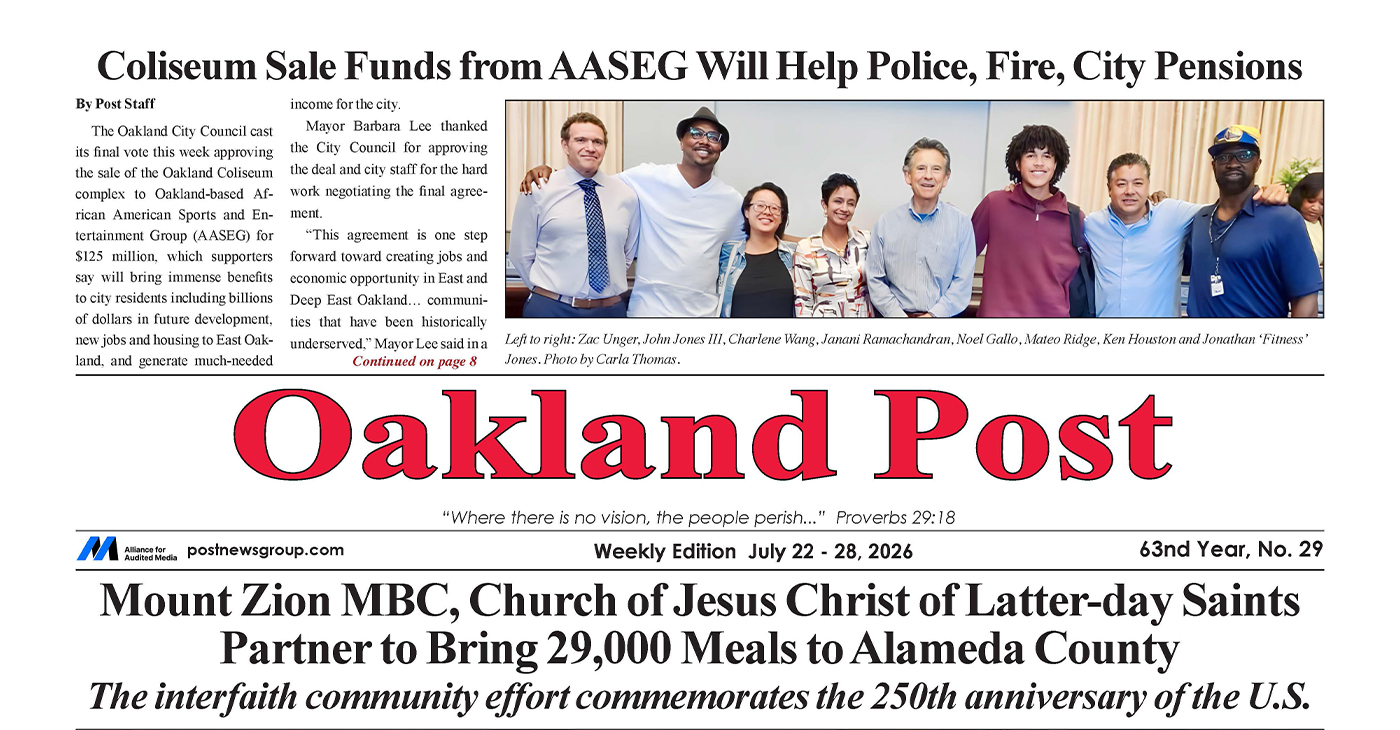
To enlarge your view of this issue, use the slider, magnifying glass icon or full page icon in the lower right corner of the browser window.
Black History
How Black WNBA Players Became Collateral Damage in the Caitlin Clark Culture War
AFRO-AMERICAN – WASHINGTON — Caitlin Clark, a WNBA player, has been weaponized against Black women, leading to federal government involvement. A letter signed by 11 Republican lawmakers, led by Texas Rep. August Pfluger, was sent to WNBA Commissioner Cathy Engelbert, threatening a Department of Justice investigation into the league due to concerns that fouls against Clark “may be racially motivated.


(Black Press USA Newswire) – Caitlin Clark is more than a WNBA player; she has become a tool of weaponization against Black women. And now the federal government is involved.
Led by Texas Rep. August Pfluger, 11 Republican lawmakers signed a letter to WNBA Commissioner Cathy Engelbert, threatening to have the Department of Justice investigate the league because fouls against Clark “may be racially motivated.”
“As Commissioner, you have an obligation to ensure that every player competes in a safe and professional environment, both on and off the court, free from violence, discrimination, or retaliation. If discrimination or retaliation is occurring and creating a hostile work environment, we support any appropriate investigation by the Department of Justice, the Department of Labor, or the Equal Employment Opportunity Commission. If true, such conduct could constitute violations of federal civil rights laws,” the letter stated.
The letter creates a false narrative and is irresponsible and dangerous.
Stephanie Christmas, a former women’s basketball player at Georgia Southern University, has remained a WNBA fan since its inaugural season in 1997. Christmas has never seen politicians use their platforms to sway the league’s direction.
“If you want only one player to play the game, that’s not basketball anymore,” Christmas shared. “I don’t think that they should be putting any legislation in place. They are making it worse for the players and the WNBA game.”

The people who are using Clark as a tool couldn’t care less about what occurs in between the lines of a basketball court. Statistically, Clark is a decent shooter and above-average passer, but she lacks offensive efficiency and is a liability on defense. Her most staunch defenders are not basketball enthusiasts; instead, they view Clark as a symbol to further their hatred for Black women.
Every moment of discomfort Clark appears to face on the court becomes an opportunity for her supporters to unleash vile and racist language against the alleged perpetrator. If Clark is fouled hard, engages in trash talk with an opponent, or receives what she views as an unfair call by a referee, her defenders are incited to unleash their wrath.
During a tightly contested match between Clark’s Indiana Fever and Phoenix Mercury in June, the Mercury’s Alyssa Thomas and Clark were on the court battling for a loose ball. Thomas’ arm briefly pressed against Clark’s neck during the scramble, but no foul was called. Following the game, Thomas was issued a flagrant one and suspended for one game by WNBA officials. The play triggered Clark’s supporters, and they aimed racial slurs and death threats at Thomas. Thomas responded by calling out WNBA commissioner Engelbert for not protecting athletes in the league.
“We still have yet to hear anything from Cathy. It’s no surprise,” Thomas shared in a press conference after her suspension. “You can see what’s being said on social media. It’s unfortunate, but as usual, she remains silent. That’s unfortunate when our lives are being threatened.”
It was only after Thomas’ statement that Engelbert responded to the threats sparked by Clark’s supporters.
“The WNBA vehemently condemns any and all forms of hate,” Engelbert said in a statement. “The safety and well-being of everyone in our community is always the league’s top priority. We are aware of Alyssa Thomas’ comments, and what she and her teammates have experienced is completely unacceptable and not representative of the WNBA community.”
Weeks later, Chelsea Gray of the Las Vegas Aces faced racial animus following a simple foul call that went against Clark. While driving to the basket, Gray was fouled on the arm by Clark, who collapsed to the ground and held her stomach as if she was in pain. Clark yelled at the referee, claiming that Gray had hit her, but video replay proved that Gray never initiated contact with Clark.
But an otherwise normal basketball play led to Gray enduring racial slurs and harassment. Following the game, Gray reposted a screenshot on Instagram of a man using a racial slur against her, and she wrote, “People act like we make this s— up.”
The post went viral, and the man, who worked for Hilton Grand Vacations, was fired within days.
Gray responded to the ordeal in a press conference, revealing that she and other WNBA players have faced ongoing harassment.
“Enough is kind of enough,” Gray said. “These messages are not the first time. It’s not. There was other stuff, too. I just decided to share that one. This time I got fed up with it, and I just decided to share it. And maybe I don’t share the other ones, but I know people will think twice.”
Clark never asked to become a symbol for those who aim hatred at Black women, but is she doing enough to distance herself from the position?
She issued a statement after hearing of the harassment Thomas experienced. “The harassment, the hate. None of that is OK,” Clark said. “There should never be a question of character, as I’ve always stood up here and said that, and that’s truly what I believe; that’s how I was raised. So, none of that is okay, and I don’t want anyone to experience that.”
It’s similar to another statement Clark made in 2025 after Angel Reese faced racial slurs while playing against the Fever in Indianapolis. “There’s no place for that in our game, there’s no place for that in society,” Clark said. “Certainly, we want every person who comes into our arena, whether player or fan, to have a great experience. I appreciate the league doing that. I appreciate that the Fever organization has been at the forefront of that.”
A competitive moment between Clark and Reese during the 2023 NCAA Championship game sparked a cultural division that followed both players to the WNBA. Their star power has coincided with the league’s recent emergence, but the overall success continues to be marred by the divisiveness initiated by Clark’s supporters.
“I would like for to have addressed her fans,” Christmas said. “Her fans are making threats, and they’re making racist comments. And it’s only racial coming from her fans. They don’t even really love the game. They just love her and then try to make it about race. At some point. I would like to see her stand against her fans when she sees them attacking some people that are on the court.”
Beyond her polarizing fanbase, Clark has also been accused of presenting herself as a victim and throwing tantrums on the court when things don’t go her way. During a recent game against the Golden State Valkyries, Clark used her hand to create distance while driving for a layup against the Valkyries’ Kiah Stokes. Clark fell to the ground after the layup and began berating referee Gerda Gatling while yelling, “Give me a f—-g call! I got fouled five times!” Replay video revealed that Stokes initiated no contact, and Gatling showed restraint by not giving Clark a technical foul.
The clip of Clark’s tantrum went viral, and she faced backlash online for her negative attitude.
“Caitlin Clark is a liar and the most dangerous type of white woman,” @mama4obama wrote on X. “One whose lies get Black women death threats. She wasn’t even touched and should have been thrown out of the game for the way she behaved toward the ref.”
“The Caitlin Clark experience serves as a microcosm of America’s divided socio-political atmosphere.”
The Caitlin Clark experience serves as a microcosm of America’s divided socio-political atmosphere. She has been chosen as a figurehead for hatred and division while her Black colleagues on the court remain prime targets.
It’s become an inescapable stain for a league that fought for years to garner interest and respect.
The opinions expressed in this commentary are those of the writer and not necessarily those of the AFRO.
The post How Black WNBA players became collateral damage in the Caitlin Clark culture war appeared first on AFRO American Newspapers.
Based on reporting by Afro-American – Washington.

Commentary
Free Back-to-School Summer Family and Community Event Is Coming to Richmond
OAKLAND POST — Why is the film important? In 2025, the National Assessment of Educational Progress (NAEP) reported standardized test reading score results of six selected student groups: African American/Black, American Indian/Alaska Native, Asian, Hispanic, Two or More Races, and White.

Boost African American and Black student literacy skills this school year by attending the 2026 ‘Right-To-Read’ film viewing on Saturday, Aug. 8, from 9:00 a.m. to 11:30 a.m. An award-winning documentary exposing the literacy crisis impacting many African American and Black students in our public schools.
In the words of the film’s director, “It’s a game changer.” After the audience views this eye-opening film, our experienced panelists will provide information to parents, guardians, and advocates on how to help children become proficient readers, close the literacy gap, and share why literacy matters.
Here is an example of a comment by a past attendee: “Excellent experience!” “The panel was amazing!”
Why is the film important? In 2025, the National Assessment of Educational Progress (NAEP) reported standardized test reading score results of six selected student groups: African American/Black, American Indian/Alaska Native, Asian, Hispanic, Two or More Races, and White.
Sadly, African American/Black students ranked last in fourth-grade reading scores and 5th in eighth-grade reading scores. So, what’s the big deal? According to NAEP, just 10 points can mean a grade-level difference between two students in the same class!
THE MORNING ALSO INCLUDES: A Backpack Giveaway, Fun Activities for Kids, Breakfast, Lunch, Prizes, and Materials!
To be sure, some African American/Black students are thriving in public schools, but far too many are not – as the data reveals. By watching this inspiring film and hearing from panelists, WCCUSD parents, guardians, and advocates can give children a jumpstart on the 2026-2027 school year. Every child deserves the opportunity to succeed!
This event is sponsored by the Oakland Eastbay Alliance of Black Educators (OEABE), in partnership with Easter Hill United Methodist Church and United Women of Faith.
Pre-register by July 29 at www.oeabe.org. Space is limited. Inquiries can be emailed to oeabe.info@gmail.com. Event location is 3911 Cutting Blvd, Richmond.
About the Author
Carol Lee Tolbert, M.A., M. Ed., is a former School Board Trustee, Education Consultant, and Vice President of OEABE.

WORK FROM HOME
Home-based business with potential monthly income of $10K+ per month. A proven training system and website provided to maximize business effectiveness. Perfect job to earn side and primary income. Contact Lynne for more details: Lynne4npusa@gmail.com 800-334-0540


Oakland Post: Week of July 22 – 28, 2026

Fed Court to Decide Landmark First Amendment Case

Jordan Walker Leads Call for More Black Youth in Baseball

How Black WNBA Players Became Collateral Damage in the Caitlin Clark Culture War

NAACP Announces $20m Voter Registration Drive at National Convention in Chicago

Starting This Summer, California Car Buyers Can Get an Instant $3500 Off the Cost of Electric Vehicles

Surveillance Pricing Fight: State Senate Debates Bill Banning Retailers from Using AI to Set Prices Based on a Buyer’s Profile

Oakland Children’s Hospital Workers and Patients Rally for Pediatric Medical Care

Opinion: When Politicians Start Sanitizing One Chapter of History, They’re Coming After The Whole Book

Beyond Politics: California Legislators Across Party Lines Celebrate Lori Wilson at 50

NPRC to Meet with California Attorney General’s Office on to Urge Guardianship Reform

Mount Zion MBC, Church of Jesus Christ of Latter-day Saints Partner to Bring 29,000 Meals to Alameda County

Councilmember Houston Helps Deter Trend to Award Contracts to Suburban Companies

Rep. Garamendi, House Democrats Demand Trump Administration Abandon Illegal Plans to Dismantle Civil Rights, Special Ed Offices

Council Gives Approval for $125 Million Oakland Coliseum Sale to AASEG
Mount Zion MBC, Church of Jesus Christ of Latter-day Saints Partner to Bring 29,000 Meals to Alameda County
Oakland Children’s Hospital Workers and Patients Rally for Pediatric Medical Care
Surveillance Pricing Fight: State Senate Debates Bill Banning Retailers from Using AI to Set Prices Based on a Buyer’s Profile

Saving Black Mothers Starts Outside the Hospital

IN MEMORIAM: Oakland Dance Legend Reginald Ray-Savage, 67

Gov. Gavin Newsom Signs Law Streamlining Affordable Housing Rules

Oakland Celebrates $125 Million Coliseum Sale


NPRC Heads to Washington to Elevate Adult Guardianship Reform at National Whistleblower Summit

The Part of Buying a Home That No Real Estate Show Ever Prepares You For

Agricultural Engineer Effie Gant Plans Bay Area Farmers Market Initiative

Oakland Post: Week of June 17 – 23, 2026

Oakland Post: Week of July 1 – 7, 2026

NCBW-OBAC Champions Black Women Entrepreneurs at Business en Blaque Expo

Ferry Fares to Increase July 1 as Ridership Hits Record Highs

The Conversation With Al McFarlane 6/23/26

Media Monday 6/22/26

LIVE! ASK ALMA! — TUES. 6.23.26 7PM EST

Car Buying Secrets: 4 Hidden Checks Before You Sign!

Is This 550 HP Charger Worth YOUR Money? AutoNetwork Review

Celebrating Juneteenth – Frederick Douglass on education and resistance

LIVE! — ASK ALMA! — TUES. 6.19.26 7PM EST

Hyundai Ioniq 5 Parking, Safety, and 360 View #shorts

2025 Ioniq 5 New Wiper & Powerful Performance! #shorts

Electric SUV Range: Is 259 Miles Enough? #shorts

EV Charging: How Fast Can You Charge an Electric Vehicle? #shorts

Biometric Cooling… Messaging Seats…Come on! 2025 Infiniti QX80 Autograph 4WD

Charged Up: Witness the Magic of a Fully Electric Car! #shorts

Range Rover Sport PHEV Included…: See What’s Inside This Luxury SUV! #shorts

Invisible Hood View: Perfect Parking with X-Ray Vision! #shorts
-
 Business21 hours ago
Mount Zion MBC, Church of Jesus Christ of Latter-day Saints Partner to Bring 29,000 Meals to Alameda County
-
 Business20 hours ago
Oakland Children’s Hospital Workers and Patients Rally for Pediatric Medical Care
-
 Business17 hours ago
Surveillance Pricing Fight: State Senate Debates Bill Banning Retailers from Using AI to Set Prices Based on a Buyer’s Profile
-
 Black History5 days ago
Saving Black Mothers Starts Outside the Hospital
-
 Business3 days ago
Gov. Gavin Newsom Signs Law Streamlining Affordable Housing Rules
-
 Black History1 week ago
Oakland Celebrates $125 Million Coliseum Sale
-
 Community1 week ago
NPRC Heads to Washington to Elevate Adult Guardianship Reform at National Whistleblower Summit
-
 Business4 days ago
The Part of Buying a Home That No Real Estate Show Ever Prepares You For
