
News
Lawsuit Against Income-based Bail System Hits Roadblock

A federal judge ruled this week against a class action lawsuit to overturn San Francisco’s bail bond system because –typical of bail systems throughout the country – it keeps people awaiting trial in jail simply because they do not have money.
While federal Judge Yvonne Gonzalez Rogers said the lawsuit’s concerns about the inequities of the bail bond system might have merit, decisions on bail are made by Superior Court judges, who are state officials. And states generally can’t be sued without the state consenting, which California has not granted in this case.
Judge Gonzalez, speaking at the court hearing Tuesday in Oakland, there is “no preliminary injunction this court can order. I understand the big picture, you may have something here, but you have not articulated it… There needs to be a legal avenue to get there.”
She gave the plaintiffs a month to submit another written motion.
The lawsuit is centered on Riana Buffin, 19, and Crystal Patterson, 29. Both were arrested in San Francisco for felony charges in October and were told by officials they could leave jail if they could post bail.
Buffin worked at the Oakland International Airport, supporting her family with her income. Because she was not able to afford 10 percent of $30,000, he stayed in jail and lost her job.

Patterson’s bond was set at $150,000. She went to a bail bond company, and with help from friends was able to gather $1,500 upfront and agreed to later pay $15,000 in full with interest.
Both cases were not pursued by the District Attorney, yet Patterson is still liable for $15,000 to the bail bond company. Had Patterson been able to afford the entire $150,000 upfront, she would have received her money back after all court appearances.
The lawsuit was filed by the organization Equal Justice Under the Law, which has also filed eight other cases like this throughout the US.
“We’re asking for an injunction against San Francisco for using cash bail,” said Phil Telfeyan, founder of the organization.
Cities in Louisiana, Mississippi, Alabama, Missouri, have reformed their bail laws due the lawsuits. The U.S. District Court for the Southern District of Mississippi has held the use of money bail violates the Equal Protection Clause.
“All of the nine lawsuits we’ve filed dealing with this bail issue are based on the Equal Protection Clause in the 14th Amendment. So it’s front and center in all of these lawsuits,” said Telfeyan.
The Constitution states: “No State shall make or enforce any law which shall abridge the privileges or immunities of citizens of the United States; nor shall any State deprive any person of life, liberty, or property, without due process of law; nor deny to any person within its jurisdiction the equal protection of the laws.”
Telfeyan argues that holding people who cannot pay bail is unconstitutional, “San Francisco has a wealth based detention system. All arrestees are free to leave the jail as long as they can pay for it. It’s sort of pay for freedom scheme that obviously benefits the wealthy.”
If someone is charged with a federal crime, a federal judge will look at flight risk, and potential threat to the community to determine whether someone can be released. But on the state level, the decision is solely based on whether or not someone can afford bail, said Telfeyan.
Ross Mirkarimi, former Sheriff of San Francisco, endorsed the lawsuit. In an affidavit, he said, “I agree that the use of monetary conditions to detain pretrial defendants penalizes indigent arrestees solely based on their wealth status. The notion that someone’s freedom depends on the amount of money they have is anathema to equality and justice.”
According to Telfeyan, Mirkarimi estimates that it costs around $60,000 a year to incarcerate someone, while pretrial supervision only costs as little as two to three thousand dollars per year.
“Pretrial service agencies are able to get anywhere from 90 percent to virtually 100 percent of people to court by things like text messages, or a phone call. And these statistics are from people who never post bail,” said Telfeyan.


Activism
Oakland Post: Week of September 30 – October 6, 2026
The printed Weekly Edition of the Oakland Post: Week of September 30 – October 6, 2026
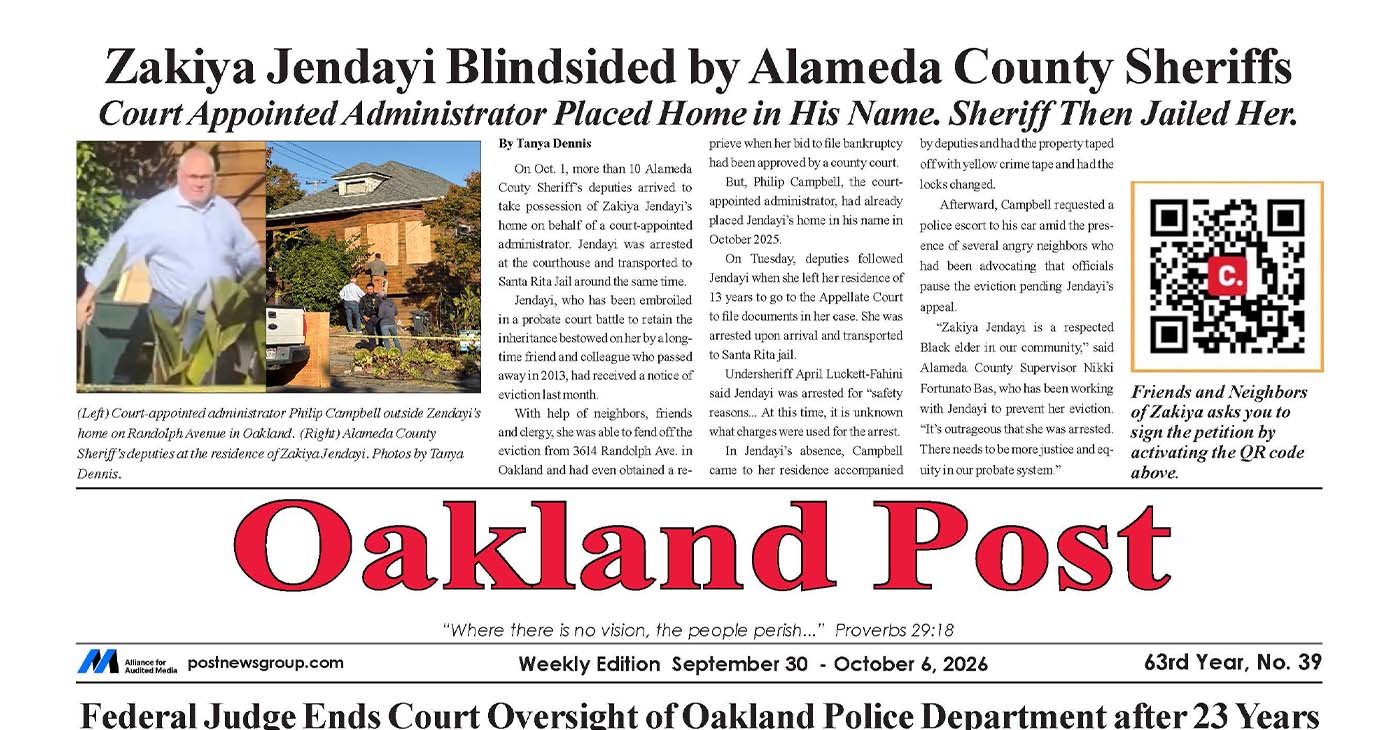
To enlarge your view of this issue, use the slider, magnifying glass icon or full page icon in the lower right corner of the browser window.
Activism
Oakland Post: Week of September 23 – 29, 2026
The printed Weekly Edition of the Oakland Post: Week of September 23 – 29, 2026

To enlarge your view of this issue, use the slider, magnifying glass icon or full page icon in the lower right corner of the browser window.

Activism
Oakland Post: Week of September 16 – 22, 2026
The printed Weekly Edition of the Oakland Post: Week of September 16 – 22, 2026

To enlarge your view of this issue, use the slider, magnifying glass icon or full page icon in the lower right corner of the browser window.


OP-ED: Proposition 44 Would Put a Price on Trust

OP-ED: Proposition 40: It’s Time to Play Chess, Not Checkers

Listening as a Lifeline: A Doula’s Witness to Black Maternal Health

New Protections for Ticket Buyers: Gov. Newsom Signs Assemblymember Isaac Bryan’s Bill

‘We Don’t Talk Trash — We Pick Up Trash!’

Zakiya Jendayi Arrested, Locked Out of Home by Sheriff’s Deputies

Oakland Post: Week of September 30 – October 6, 2026

Asm. Corey Jackson Announces Launch of 24-Hour Childcare in His District

IN MEMORIAM: The Rev. Leon “Sonny” Clark, Longtime Orange County Pastor and Community Leader, Dies at 72

Poll: Becerra Widens His Lead Over Hilton; Californians Split on Wealth Tax

From Historic Memories to New Possibilities: Oakland Celebrates Coliseum 60

County Office of Education Says OUSD Finances Are Getting Healthier, Materially Stronger

LIVE FREE Sunday Dinner Brings Faith, Fellowship and Civic Conversation to Oakland

Remembering Chauncey Bailey as Student Journalists Face Threats to Truth-Telling

BLACspace Cooperative Invites Bay Area to Experience Oakland’s Black Cultural Ecosystem Through a BLAC Map Tour + Party

Standoff for Justice: Our Homes Are Worth Fighting For

Oakland Post: Week of August 26 – September 1, 2026

Frontier Airlines’ Return to Oakland Airport Brings Flights, Jobs and Opportunity

Gubernatorial Candidate Steve Hilton Blasts California New Tire Rules; Newsom Hits Back

Chef Sharon Lee Blends Culinary Excellence, Education and Empowerment

Jackie Wright Champions Bay Area Stories, Filmmakers and Cultural Institutions

Misnamed ‘Parent’ PAC Seeks to Influence Oakland School Board Elections

Oakland Coliseum Project Opens Door for Small Businesses to Build Bigger

Gov. Newsom’s Latest Appointees Include Sacramento Advocate for Formerly Incarcerated Students; State’s New Tech Chief

Big City Mayors Ask for “Yes” Vote on Housing Bond Measure; Conservatives Say “No”

Longtime BWOPA Member Brendalyn Goodall Appointed to California Workforce Development Board

Oakland Post: Week of September 2 – 8, 2026

Gov. Newsom Signs Law Shielding Immigration Aid Workers From Doxing Threats

Secretary of State Shirley N. Weber Urges Californians to Vote Early as Voter ID Battle Intensifies

IN MEMORIAM: Dolly Parton Dead at 80 — How She Built a Legacy of Love and Earned Her Place in Black Culture

The Conversation With Al McFarlane 6/23/26

Media Monday 6/22/26

LIVE! ASK ALMA! — TUES. 6.23.26 7PM EST

Car Buying Secrets: 4 Hidden Checks Before You Sign!

Is This 550 HP Charger Worth YOUR Money? AutoNetwork Review

Celebrating Juneteenth – Frederick Douglass on education and resistance

LIVE! — ASK ALMA! — TUES. 6.19.26 7PM EST

Hyundai Ioniq 5 Parking, Safety, and 360 View #shorts

2025 Ioniq 5 New Wiper & Powerful Performance! #shorts

Electric SUV Range: Is 259 Miles Enough? #shorts

EV Charging: How Fast Can You Charge an Electric Vehicle? #shorts

Biometric Cooling… Messaging Seats…Come on! 2025 Infiniti QX80 Autograph 4WD

Charged Up: Witness the Magic of a Fully Electric Car! #shorts

Range Rover Sport PHEV Included…: See What’s Inside This Luxury SUV! #shorts

Invisible Hood View: Perfect Parking with X-Ray Vision! #shorts
-
 Community4 weeks ago
Misnamed ‘Parent’ PAC Seeks to Influence Oakland School Board Elections
-

 Activism4 weeks ago
Oakland Post: Week of September 9 – 15, 2026
-

 Community4 weeks ago
Richmond Tiny House Village Farm & Garden Set to Open Gates on Sept. 26
-

 Black History4 weeks ago
Latest Massacre in Haiti Reveals Cruelty U.S. Deportations
-

 Black History4 weeks ago
OPINION: Nolan Wells’ Death One of Several Signifying Racial Terror Lives on in U.S. South
-

 Business2 weeks ago
Mayor Lee Announces $1 Million Kaiser Permanente Grant for Pilot Program to Address Homelessness, Clean Up Public Spaces throughout Oakland
-

 Community4 weeks ago
Democratic Clubs Interview Candidates for Oakland School Board
-
 Uncategorized2 weeks ago
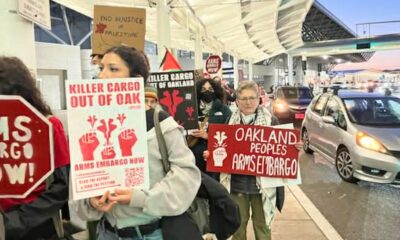
Oakland People’s Arms Embargo Coalition Demands End to Military Shipments Thru Oakland
