
Commentary
FILM REVIEW: What Men Want
NNPA NEWSWIRE — Twenty minutes into it, the outrageous sight-gag sex scenes, flippant dialogue and over-the-top performances yank the old premise firmly into the 21st century with a brand of humor fans of Bridesmaids will enjoy. There isn’t one subtle comic turn in this entire film. That gives Henson a chance to show her Tiffany Haddish side, which is more than willing to do anything to make viewers laugh.

By Dwight Brown, NNPA News Wire Film Critic

Taraji P. Henson in What Men Want from Paramount Pictures and Paramount Players.
It’s about time Taraji P. Henson, after a string of B-movies (Proud Mary, Acrimony), rocked a bonafide comedy. On talk shows her innate sense of humor is evident. On the big screen (Hidden Figures, The Curious Case of Benjamin Button) and small one (Empire) she’s built a solid, award-winning rep in drama. Now she’s digging into ribald humor and has surrounded herself with the right producers (Girls Trip), director (Adam Shankman, The Wedding Planner, Hairspray), screenwriters (Tina Gordon, ATL; Peter Huyck, Veep) cast and crew. If most of the ingredients are right, the cake will turn out just fine.
The source material for this flagrant, shameless comedy is What Women Want (2000), directed by Nancy Meyers and starring Mel Gibson. (Remember the days when he was loved?). He played a chauvinistic advertising executive who, after a freak head injury, could hear what women thought. He used that advantage to rally against a female exec who got a promotion he wanted. In the process he learned life lessons. Hold that thought.

Fast forward 19 years. Ali Davis (Henson) is a top agent at an elite sports management firm. She drives a Porsche (leased), has an overly-attentive assistant (Josh Brener, The Front Runner), whom she treats like a dog and a bevy of girlfriends (Tamala Jones, Wendi McLendon-Convey, Phoebe Robinson) she counts on for moral support. Ali needs all those trappings if she is to survive the constant stream of disappointments and derision she encounters with her male peers at Summit Worldwide Management.

Josh Brener and Taraji P. Henson in What Men Want from Paramount Pictures and Paramount Players.
The source of Ali’s biggest frustration is that she can’t make partner and is constantly over-looked by her boss Nick (Brain Bosworth, former Seattle Seahawk), who stifles her: “You don’t connect well with men. You do well in your lane. Stay in your own lane.” Even though she handles top star athletes like Lisa Leslie and Serena Williams, her achievements are marginalized by her colleagues.
The agency is trying to land the next big basketball draft pick, a skinny talented young player named Jamal Barry (Shane Paul McGhie). That’s the easy part. He’s managed by his pushy, stage-dad, health-freak father Joe “Dolla” Barry (Tracy Morgan), who is a pain in the ass. That’s the difficulty. The agent who signs Barry will be the next hot shot at Summit. Can Ali take the crown?
What Women Want, was a genteel, safe romantic comedy. What Men Want, is not. Twenty minutes into it, the outrageous sight-gag sex scenes, flippant dialogue and over-the-top performances yank the old premise firmly into the 21st century with a brand of humor fans of Bridesmaids will enjoy. There isn’t one subtle comic turn in this entire film. That gives Henson a chance to show her Tiffany Haddish side, which is more than willing to do anything to make viewers laugh.
Tucked into the debauchery are moral-to-the-story subplots that are somewhat touching. Ali’s romance with the hunky bartender Will (Aldis Hodge, Straight Outta Compton) involves his young son Ben (Auston John Moore) and Ali’s selfish deceit. Her egocentric antics test her friendship with her girlfriends. And, the way she treats her assistant Brandon, who is gay, goes from patronizing and vile to dehumanizing. Ali’s got issues. Lots. And when she’s being introspective, she admits it: “Winning doesn’t matter if you’re a horrible person.”

Erykah Badu and Taraji P. Henson in What Men Want from Paramount Pictures and Paramount Players.
The inciting incident that changes her trajectory comes when she meets a weird psychic named Sister (Erykah Badu) who gives her a cup of a magical, drug-laden tea. The mysterious potion, along with a head injury, makes Ali hear what men are thinking. As she hones this new talent, she picks up the hidden feelings of her fellow workers (no wonder they never invite her to their weekly poker game), her assistant (he really wants a promotion) and even her supportive dad (Richard Roundtree).
The script was developed by writers whose wheelhouse is sitcoms, so this modern tale is told in broad strokes. If you’re looking for a demented and sophisticated comedy (The Favourites), look elsewhere. Every situation here is meant to make the targets (urban and female audiences) laugh until they lose bladder control.
Initial scenes lack the kind of dazzling cinematography (Jim Denault) audiences expect from a motion picture, making sets and exterior scenes look like they belong on a TV show. Certainly, Shankman’s unimaginative direction (too many scenes are shot in rooms, offices, cars) lacks the style and creativity top feature film directors display.
The better tech elements belong to: Sekinah Brown’s (Ride Along) costume design; Emma E. Hickox’s (Kinky Boots) judicious editing, which after a few initial slow scenes, makes the footage breeze by in 1hr and 57min; Brian Tyler’s (Iron Man 3) fun musical score is aided greatly by a hip playlist with vibrant songs like Jill Scott’s very upbeat and cool tune “Golden.”
Tracy Morgan is clearly in his element as the dodo-brain dad. Can’t tell how much of his dialogue is based on the script or improvised, but fair to say he’s never been funnier. The girlfriend trio is quite humorous. SNL’s Pete Davidson milks laughs as a lecherous officer worker. Hodge may be the new Morris Chestnut. And it is a gift whenever Richard Roundtree appears in a film.

Taraji P. Henson, Auston Moore and Aldis Hodge in What Men Want from Paramount Pictures and Paramount Players.
Back to Henson. Given the chance, in a decently thought-out and developed comedy, she ups her game. Her Ali is manic and bossy with her assistant (bordering on distasteful), deceitful with her paramour, insensitive to her gal pals and able to stand up to the brutal, self-entitled co-workers who play her for a wuss. The scattered string of emotions and feelings don’t stump Henson. She towers over all the other cast members with her bravura performance.
Except, the scenes in which she deals with the very enigmatic Sister. Somewhere hidden under a gigantic wig that would even embarrass Diana Ross, lurks the very shrewd and hysterical Erykah Badu, who portrays the psychic who launches Ali’s outer and inner trek to salvation. Smug, ethereal, dizzy and flaky as a pothead, the “Tyrone” singer displays an astute comic nature that equals Henson’s.
Girls Trip is the alpha raunchy female comedy. What Men Want is not as strong. But it grazes that high standard thanks to Taraji P. Henson’s over-the-top performance.
Visit NNPA News Wire Film Critic Dwight Brown at DwightBrownInk.com and BlackPressUSA.com.






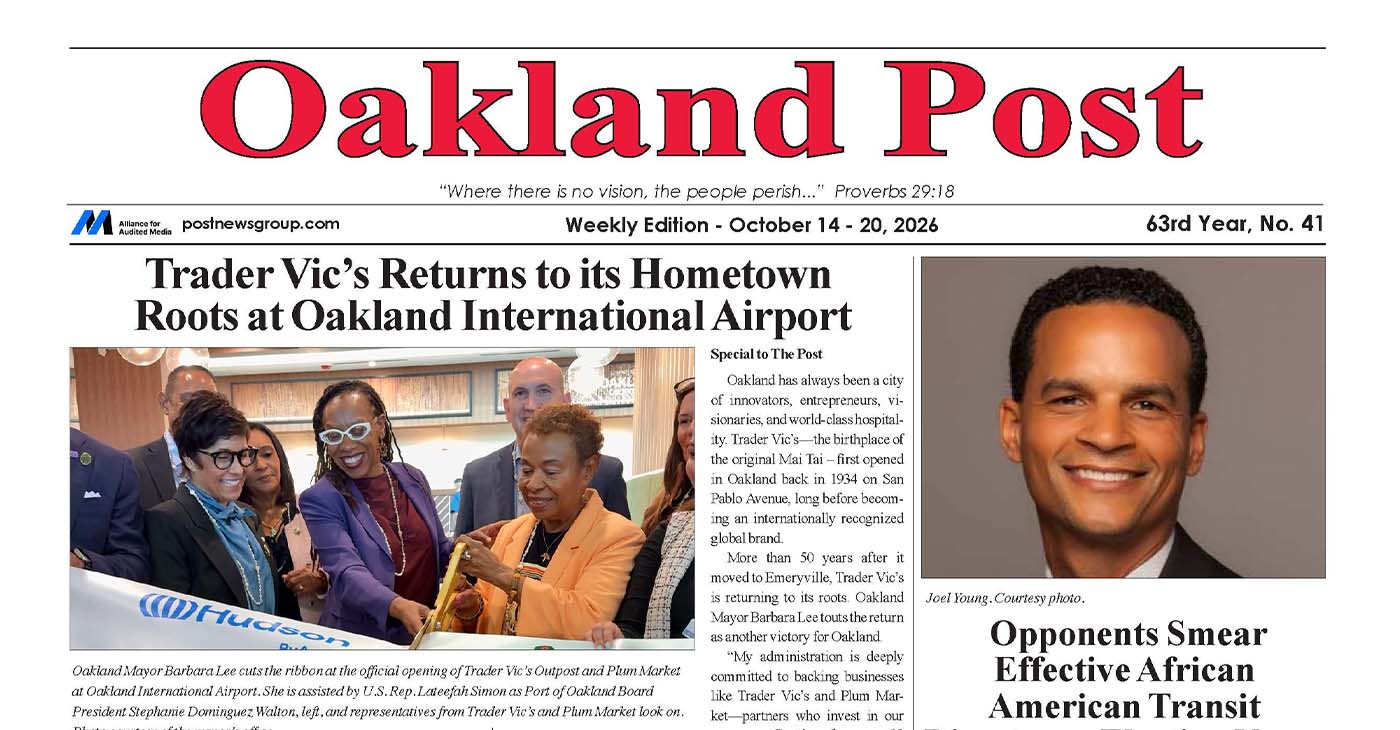
To enlarge your view of this issue, use the slider, magnifying glass icon or full page icon in the lower right corner of the browser window.
Black History
OP-ED: The Black Church Writes AI’s Next Chapter
BLACKPRESSUSA NEWSWIRE — I implore my fellow faith leaders to use these tools. Start now and use them with wisdom. We count on each and every one of you to make sure our communities help write the next chapter of this story. This rapid change is not as unfamiliar as it may sound. My first understanding of AI came from using a calculator for the first time in grade school. We did not call it AI, but it was a tool that helped me work through mathematical equations hours more efficiently.


For generations, the Black church has stood strong in our communities through every historical change this country has experienced. During the civil rights movement and in recent times, faith leaders have helped uplift Black sanctuaries to register voters, keep food pantries open for people in need, and sit with families in hospital rooms in their most desperate moments. When our people faced new trials, they could always look to our faith leaders and the church to lean in to help us be included in these transformative changes.
Artificial intelligence is the latest revolutionary change to impact our society, and much like other transformations before us, underserved communities often get left behind.
I was recently featured in a report entitled “Faith, Community & AI” and it found that people send ChatGPT more than 70 million messages a week about religion. Nearly 22 million involve studying sacred texts, and 16 million ask about religious practices and holy days. Our members make up part of those numbers. They bring questions of faith to these tools every day.
Pastors have noticed, and according to a September 2025 Lifeway Research survey of 1,003 Protestant pastors, 42 percent said they use or experiment with AI in ministry. I count myself among them.
I write my sermons by hand, through prayer and study. When I finish a draft, I ask ChatGPT this question: “Where might this sermon become unclear or difficult to follow for someone early in their walk of faith?” It shows me gaps in my preparation, like where I incorrectly assumed everyone would know the context of who the Pharisees were. Then, change comes from my own pen, not the robot. The tool helps me reach the person in the back pew while the message still comes from me.
If I could have my wish, our whole community would take a similar posture. We must use these tools, understand them, and most importantly be present to help shape them if we want to be included in the coming change.
I implore my fellow faith leaders to use these tools. Start now and use them with wisdom. We count on each and every one of you to make sure our communities help write the next chapter of this story. This rapid change is not as unfamiliar as it may sound. My first understanding of AI came from using a calculator for the first time in grade school. We did not call it AI, but it was a tool that helped me work through mathematical equations hours more efficiently.
It starts with training; there is no involvement without understanding. Free AI trainings have begun in our churches and community centers across the nation. Every faith leader should sign up and, when possible, encourage members of your congregations to join you. By learning how to use AI, we can better understand what it can do, make up our own minds about its impact, and have a say in how it shapes our communities.”
Next, we must be at the tables where the builders of these tools make decisions. Presence is the first step toward understanding, and that gap is only bridged through a coordinated effort. How can any tool serve a community well if that community is not part of the conversation? Our traditions, needs, and concerns must be accounted for, and Black faith leaders are already making that happen. OpenAI’s recent Faith report states plainly that AI should never become an arbiter of religious truth. I fully intend to hold the company to its word, and the most effective way I can do that is from inside.
I will close with this––we must diligently protect what only the church can give. A believer in Seoul, Korea quoted in the report warned, “if you pour every struggle into a private chat, your pastor and your friends may never learn you need help.” A chatbot will not sit with a grieving family or pray with you at two in the morning. As we adopt this technology, it is up to us to ensure it keeps people connected to each other and to their church.
Rev. Dr. Adolphus Lacey is senior pastor of Bethany Baptist Church in Brooklyn, New York.

Black History
OP-ED: The Black Church Writes AI’s Next Chapter
BLACKPRESSUSA NEWSWIRE — I implore my fellow faith leaders to use these tools. Start now and use them with wisdom. We count on each and every one of you to make sure our communities help write the next chapter of this story. This rapid change is not as unfamiliar as it may sound. My first understanding of AI came from using a calculator for the first time in grade school. We did not call it AI, but it was a tool that helped me work through mathematical equations hours more efficiently.

For generations, the Black church has stood strong in our communities through every historical change this country has experienced. During the civil rights movement and in recent times, faith leaders have helped uplift Black sanctuaries to register voters, keep food pantries open for people in need, and sit with families in hospital rooms in their most desperate moments. When our people faced new trials, they could always look to our faith leaders and the church to lean in to help us be included in these transformative changes.
Artificial intelligence is the latest revolutionary change to impact our society, and much like other transformations before us, underserved communities often get left behind.
I was recently featured in a report entitled “Faith, Community & AI” and it found that people send ChatGPT more than 70 million messages a week about religion. Nearly 22 million involve studying sacred texts, and 16 million ask about religious practices and holy days. Our members make up part of those numbers. They bring questions of faith to these tools every day.
Pastors have noticed, and according to a September 2025 Lifeway Research survey of 1,003 Protestant pastors, 42 percent said they use or experiment with AI in ministry. I count myself among them.
I write my sermons by hand, through prayer and study. When I finish a draft, I ask ChatGPT this question: “Where might this sermon become unclear or difficult to follow for someone early in their walk of faith?” It shows me gaps in my preparation, like where I incorrectly assumed everyone would know the context of who the Pharisees were. Then, change comes from my own pen, not the robot. The tool helps me reach the person in the back pew while the message still comes from me.
If I could have my wish, our whole community would take a similar posture. We must use these tools, understand them, and most importantly be present to help shape them if we want to be included in the coming change.
I implore my fellow faith leaders to use these tools. Start now and use them with wisdom. We count on each and every one of you to make sure our communities help write the next chapter of this story. This rapid change is not as unfamiliar as it may sound. My first understanding of AI came from using a calculator for the first time in grade school. We did not call it AI, but it was a tool that helped me work through mathematical equations hours more efficiently.
It starts with training; there is no involvement without understanding. Free AI trainings have begun in our churches and community centers across the nation. Every faith leader should sign up and, when possible, encourage members of your congregations to join you. By learning how to use AI, we can better understand what it can do, make up our own minds about its impact, and have a say in how it shapes our communities.”
Next, we must be at the tables where the builders of these tools make decisions. Presence is the first step toward understanding, and that gap is only bridged through a coordinated effort. How can any tool serve a community well if that community is not part of the conversation? Our traditions, needs, and concerns must be accounted for, and Black faith leaders are already making that happen. OpenAI’s recent Faith report states plainly that AI should never become an arbiter of religious truth. I fully intend to hold the company to its word, and the most effective way I can do that is from inside.
I will close with this––we must diligently protect what only the church can give. A believer in Seoul, Korea quoted in the report warned, “if you pour every struggle into a private chat, your pastor and your friends may never learn you need help.” A chatbot will not sit with a grieving family or pray with you at two in the morning. As we adopt this technology, it is up to us to ensure it keeps people connected to each other and to their church.
Rev. Dr. Adolphus Lacey is senior pastor of Bethany Baptist Church in Brooklyn, New York.


Mayor Barbara Lee Holds Special State of the City Address in Deep East Oakland

Practitioners of African Traditional Spirituality Offer Ancestral Reverence Ritual Oct. 31

It’s Time to Lose Weight Before the Holidays

Trader Vic’s Returns to Its Oakland Roots

Oakland Coal Terminal Backed by Trump Would Be Bigger, Dirtier Than Promised, Says Report

Opponents Smear Effective African American Transit Director as Election Nears

Oakland Post: Week of October 14 – 20, 2026

OP-ED: The Black Church Writes AI’s Next Chapter

OP-ED: The Black Church Writes AI’s Next Chapter

WCCUSD Joins Statewide Organic School Food Purchasing Cooperative

Democrats, Community Groups Back Measure EE to Change How Oakland Is Governed

Four Tips to Help You Plan a Holiday “Staycation”

Veterans Housing Project Proposed for South Richmond
PRESS ROOM: Transformative Justice Coalition 2026 Voting Rights Champion Awards Reception ‘Yesterday Is Today: The Battle For Voting Rights

Mayor Lee Delivers 2026 State of the City Address: ‘Oakland Continues to Be on the Move’

Misnamed ‘Parent’ PAC Seeks to Influence Oakland School Board Elections

Oakland Post: Week of September 2 – 8, 2026

Oakland Post: Week of September 9 – 15, 2026

Richmond Tiny House Village Farm & Garden Set to Open Gates on Sept. 26

Poll: Becerra Widens His Lead Over Hilton; Californians Split on Wealth Tax

County Office of Education Says OUSD Finances Are Getting Healthier, Materially Stronger

Latest Massacre in Haiti Reveals Cruelty U.S. Deportations

OPINION: Nolan Wells’ Death One of Several Signifying Racial Terror Lives on in U.S. South

Mayor Lee Announces $1 Million Kaiser Permanente Grant for Pilot Program to Address Homelessness, Clean Up Public Spaces throughout Oakland

BLACspace Cooperative Invites Bay Area to Experience Oakland’s Black Cultural Ecosystem Through a BLAC Map Tour + Party

Democratic Clubs Interview Candidates for Oakland School Board

Zakiya Jendayi Arrested, Locked Out of Home by Sheriff’s Deputies

Oakland Post: Week of September 16 – 22, 2026

Oakland People’s Arms Embargo Coalition Demands End to Military Shipments Thru Oakland

Two Looming Threats Every Alameda County Elder Should Know About

The Conversation With Al McFarlane 6/23/26

Media Monday 6/22/26

LIVE! ASK ALMA! — TUES. 6.23.26 7PM EST

Car Buying Secrets: 4 Hidden Checks Before You Sign!

Is This 550 HP Charger Worth YOUR Money? AutoNetwork Review

Celebrating Juneteenth – Frederick Douglass on education and resistance

LIVE! — ASK ALMA! — TUES. 6.19.26 7PM EST

Hyundai Ioniq 5 Parking, Safety, and 360 View #shorts

2025 Ioniq 5 New Wiper & Powerful Performance! #shorts

Electric SUV Range: Is 259 Miles Enough? #shorts

EV Charging: How Fast Can You Charge an Electric Vehicle? #shorts

Biometric Cooling… Messaging Seats…Come on! 2025 Infiniti QX80 Autograph 4WD

Charged Up: Witness the Magic of a Fully Electric Car! #shorts

Range Rover Sport PHEV Included…: See What’s Inside This Luxury SUV! #shorts

Invisible Hood View: Perfect Parking with X-Ray Vision! #shorts
-
 Economy3 weeks ago
Poll: Becerra Widens His Lead Over Hilton; Californians Split on Wealth Tax
-
 Business3 weeks ago
County Office of Education Says OUSD Finances Are Getting Healthier, Materially Stronger
-
 Business4 weeks ago
Mayor Lee Announces $1 Million Kaiser Permanente Grant for Pilot Program to Address Homelessness, Clean Up Public Spaces throughout Oakland
-
 Art3 weeks ago
BLACspace Cooperative Invites Bay Area to Experience Oakland’s Black Cultural Ecosystem Through a BLAC Map Tour + Party
-
 Lead Story2 weeks ago
Zakiya Jendayi Arrested, Locked Out of Home by Sheriff’s Deputies
-
 Activism4 weeks ago
Oakland Post: Week of September 16 – 22, 2026
-
 Uncategorized4 weeks ago
Oakland People’s Arms Embargo Coalition Demands End to Military Shipments Thru Oakland
-
 Community4 weeks ago
Two Looming Threats Every Alameda County Elder Should Know About
