
Crime
Activists Push for Death Penalty Reform
NEW ORLEANS DATA NEWS WEEKLY — Community members, organization leaders, and former Angola inmates gathered to discuss issues.

By Morgan Jackson
Community members, organization leaders, and former Angola inmates gathered to discuss issues regarding the death penalty in New Orleans at Café Istanbul in the Healing Center on Jan. 28, 2019. There are currently 67 people on Louisiana’s Death Row; 73 percent of which are African-American or Hispanic.
“If there was ever an example of why you shouldn’t have the death penalty, Willy Frances the famous Louisiana Case, would be the perfect example,” said Michael Cahoon, the organizer for the Promise of Justice Initiative. “A 16-year-old boy was convicted, had to be executed twice because he was so small, he could not fit in the electric chair. That should be enough right there, but it still persists.”
Cahoon joined Laverne Thompson, the wife of former inmate, John Thompson, and Jerome Morgan, who was placed in solitary confinement in the Louisiana State Penitentiary in Angola to advocate for repealing the death penalty.
Justice & Beyond, a New Orleans-based association of community leaders and organizations that come together to discuss challenging problems hosted this event to educate the public on injustices facing the incarcerated and prisoners facing the death penalty. Racial disparities also exist when examining who received the death penalty, the advocates said.
“Conditions in the East Baton Rouge Parish Prison produce a death rate of 300 percent higher than the national average, mostly due to inadequate Mental Health Care and inhumane treatment of the prisoners that are held there,” Cahoon said.
It is also an expensive burden on the state. “The death penalty takes an immense amount of resources for such a small number of people. Since 2000, we have spent $155 million on our death penalty, which has yielded two executions,” Cahoon added.
Executions cost millions of dollars to perform, experts said. Studies show that executions also do not result in a drop in the crime rate.
“The first study done in Louisiana on whether or not the death penalty prevents violent crime was done in 1833,” Cahoon said. “States that have gotten rid of the death penalty; crime has actually gone down,” Cahoon added. This shows that there is no relation between the death penalty and crime.
“John Thompson was the sixth Louisiana Death Row exoneree in 2003,” said Laverne Thompson, his wife. On May 8, 1985, John Thompson was sentenced to death row on two separate crimes: murder and carjacking. An investigator found evidence that had never been disclosed 30 days before his execution – the bloodstain of one of the carjacking victims. The blood was found not to be Thompson’s. A prosecutor admitted to intentionally suppressing evidence. In 2002, he had a retrial based on deliberate government misconduct and was sent home in 2003. Unfortunately, in October 2017 he died of a heart attack.
Most of the people on death row are wrongfully convicted and serve time based on a crime they never committed, activists said. Since Thompson’s exoneration in 2003, five other men have had their innocence discovered.
“I was incarcerated during the time John was released and I remember hearing the news and being encouraged and motivated; I felt like John was a hero,” Morgan said. Not many people are released from death row and hearing the news of someone being released brought a sense of hope to Morgan. Morgan was wrongfully arrested at the age of 17 and sentenced to die in Angola for the rest of his natural life for the second-degree murder of Clarence Landry III.
After Morgan’s release he wrote a book with two other inmates titled, “Unbreakable Resolve,” and he is now working on another book, “Go to Jail: Confronting the System of Oppression,” which discusses his experiences in solitary confinement.
Residents who attended the public forum shared personal experiences fighting for loved ones caught up in the Criminal Justice System.
“Numerous members of my family have been slaughtered in the City of New Orleans; my spirit is broken. Our justice system is a big racist killer,” said Eloise Williams, a member of Mark Louis Williams and Victims of Homicide. “I haven’t been behind any bars, but I am incarcerated,” Williams added.
This article originally appeared in the New Orleans Data News Weekly.











Activism
Oakland Post: Week of September 23 – 29, 2026
The printed Weekly Edition of the Oakland Post: Week of September 23 – 29, 2026
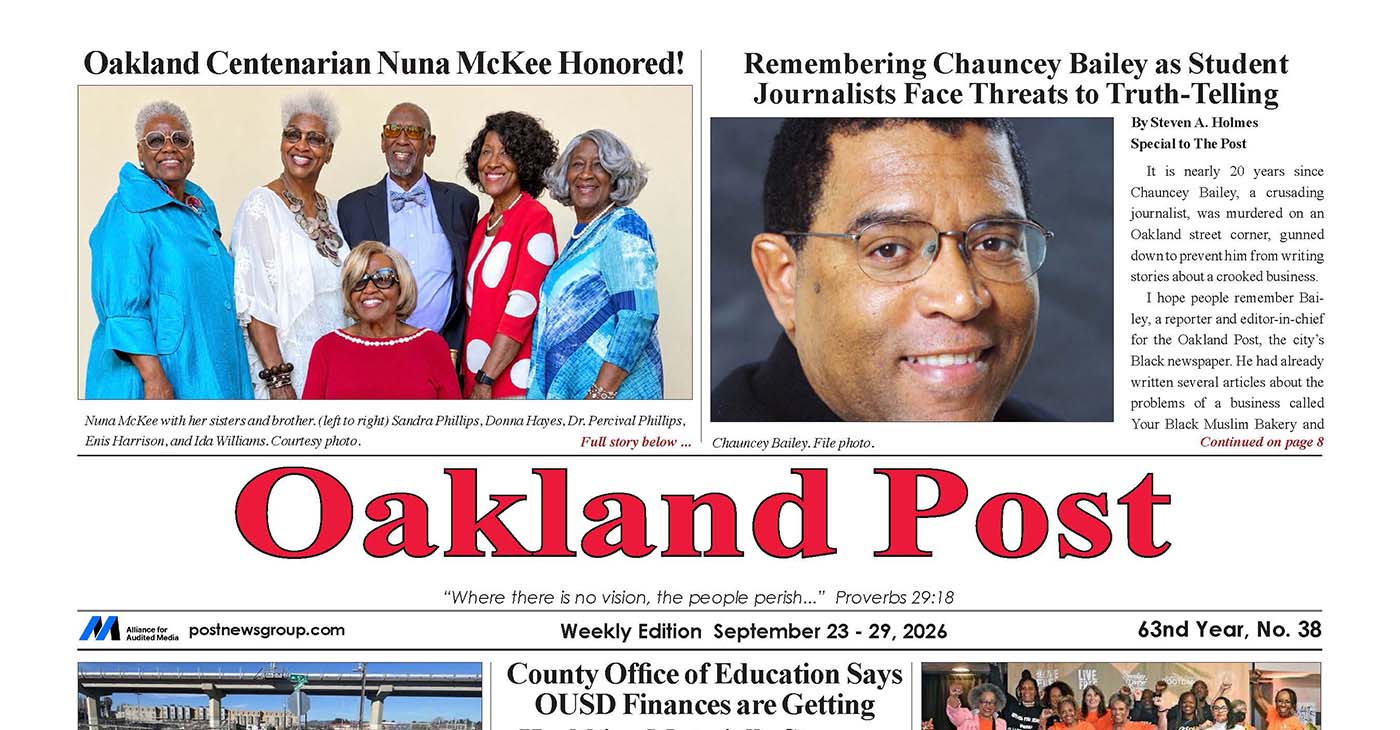
To enlarge your view of this issue, use the slider, magnifying glass icon or full page icon in the lower right corner of the browser window.
Community
Assemblymember LaShae Sharp-Collins’s Bill Would Pause Law Enforcement’s Use of Shock Gloves Pending Study
The device at the center of the debate is known as the G.L.O.V.E., an acronym for Generated Low Output Voltage Emitter. U.S. Immigration and Customs Enforcement awarded a $16.7 million contract for 6,000 pairs of the gloves, which are designed to deliver an electric shock through an officer’s hand.

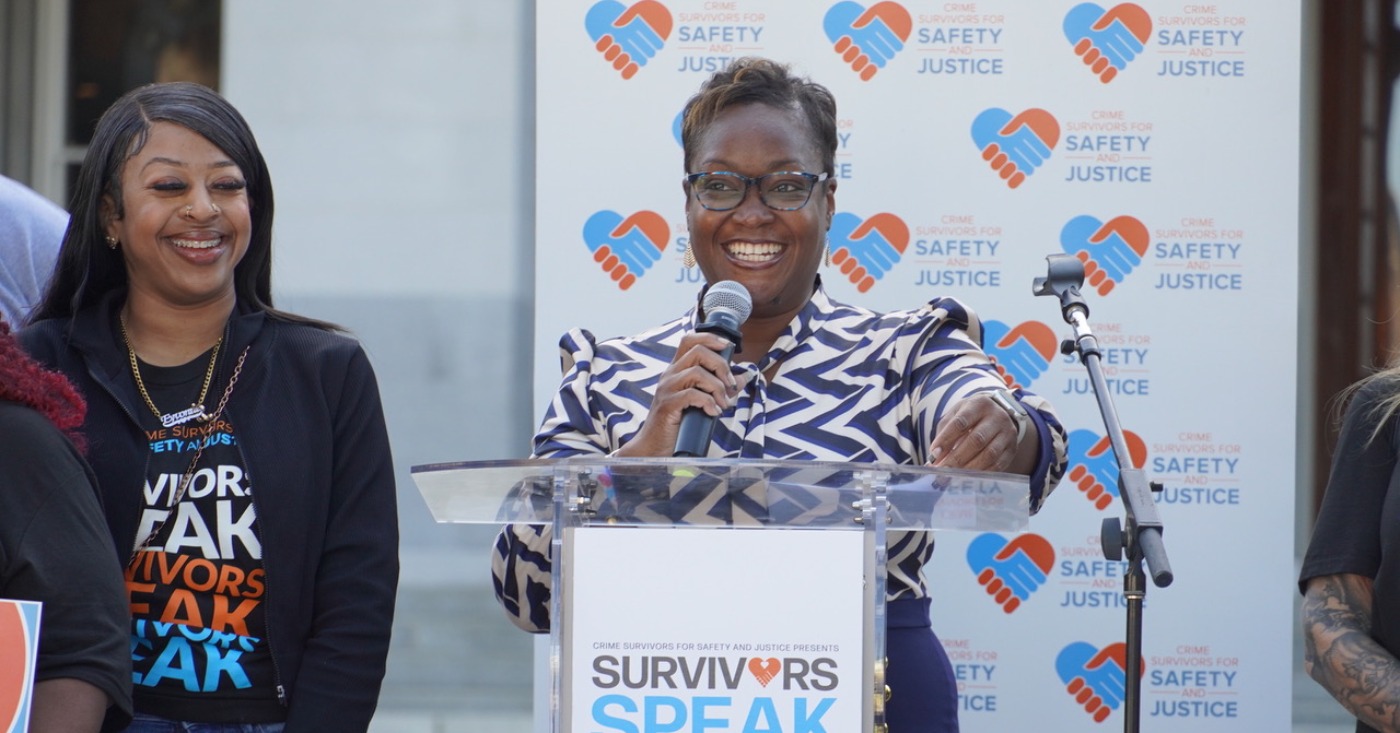
A bill temporarily prohibiting law enforcement agencies from using electric shock gloves in California is awaiting action by Gov. Gavin Newsom.
Assembly Bill (AB) 2760, authored by Assemblymember LaShae Sharp-Collins (D-San Diego), passed the Senate 29-9 on Aug. 31. The Assembly concurred in Senate amendments the same day on a 55-16 vote.
The bill would prohibit state, local and federal law enforcement agencies from using wearable electroshock devices in California until Jan. 1, 2030. It would also bar agencies from using state funds to purchase the devices and require them to update their use-of-force policies accordingly.
Traditional handheld devices, including tasers and stun guns, are exempt.
Newsom has until Sept. 30 to sign or veto the bill. If he takes no action, it will become law without his signature.
Sharp-Collins introduced the measure after reviewing information indicating that the devices could cause serious injury or death if used without adequate safeguards and training.
“AB 2760 draws a line that public safety technology must be proven safe and accountable before it is employed. Not after someone is killed or injured,” said Sharp-Collins, a member of the California Legislative Black Caucus (CLBC).
“Our commitment is to protect our communities, especially the most vulnerable. That is what AB 2760 is about and that is what AB 2760 will do,” Sharp-Collins told her colleagues.
The device at the center of the debate is known as the G.L.O.V.E., an acronym for Generated Low Output Voltage Emitter. U.S. Immigration and Customs Enforcement awarded a $16.7 million contract for 6,000 pairs of the gloves, which are designed to deliver an electric shock through an officer’s hand.
During the Assembly debate, Assemblymember Rhodesia Ransom (D-Stockton), also a CLBC member, thanked law enforcement representatives for helping negotiate amendments to the bill.
“This is something new to us (and) it’s something that absolutely should be studied,” Ransom said. “I appreciate law enforcement for agreeing to work with the legislature to figure out if this is an appropriate tool to be used.”
Neither the Los Angeles County Sheriff’s Department nor the Los Angeles Police Department has reported using electric shock gloves. However, the Santa Monica and El Monte police departments have obtained devices for testing.
The Sacramento County Sheriff’s Office purchased 10 shock gloves as part of a $35,000 acquisition that also included 10 remotely activated shock bands. Sheriff’s officials had been developing training and policies for the devices before AB 2760 advanced.
State Sen. Tony Strickland (R-Huntington Beach) opposed the legislation, arguing that it would unnecessarily force agencies to change their use-of-force policies and could compromise public safety.
“I don’t disagree with the author that the electric shocks are not a great option, but at the end of the day, I think it’s important to understand that we need to give law enforcement the tools they need to keep themselves safe and the community safe,” Strickland said.
Supporters countered that wearable electroshock devices have not been sufficiently studied and could pose particular risks to immigrants, children, older adults and other vulnerable groups.
“People who are Black or Brown could be test subjects for these gloves of torment,” Mark González (D-Los Angeles) said. “I appreciate law enforcement for agreeing to work with the legislature.”

Community
Alameda County DA Ursula Jones Dickson Says Key to Optimal Use of DA’s Office Is Knowledge
Jones Dickson emphasized that each situation is “case-specific,” particularly when determining whether a matter is criminal or civil. She explained that significant documentation of criminal activity is generally necessary before the DA’s Office can intervene.

Part 3
Alameda County District Attorney Ursula Jones Dickson wants the public she serves to know more about what office really does.
The key, she said, is education, helping residents understand how the office operates, what it can and cannot do, and how the public can work with the office to achieve the results they seek.
The DA’s powers and duties regarding the court system are limited, Jones Dickson explained, and that there is a process for determining when the office can become involved.
“When there’s a complaint of criminal abuse or exploitation, the DA’s office will investigate, but to trigger that investigation, a person must file a complaint first with the Police Department,” she said.
Most issues, however, remain within the court system. Within the Probate Court system, for instance, if fraud or neglect occurs, the matter will generally be referred to the appropriate agency.
Jones Dickson emphasized that each situation is “case-specific,” particularly when determining whether a matter is criminal or civil. She explained that significant documentation of criminal activity is generally necessary before the DA’s Office can intervene.
“That is where the jurisdiction starts,” Jones Dickson said. “If it’s exploitation, it begins with a police report. We only proceed when the evidence leans beyond reasonable doubt.”
The District Attorney’s Office has a Real Estate Fraud Unit as well as an Elder Abuse Unit. Jones Dickson acknowledged that the office has been addressing multiple real estate fraud cases since she took office in June.
“Cases receive priority and witness a lot more success when there’s documentation,” she said. “This is the message the DA’s Office is utilizing in their police training and consumer division. When we have the cooperation of the community, that makes us even more effective.”
When asked how the DA’s Office can assist people in probate who feel they have not received justice, Jones Dickson acknowledged that the office’s powers are limited because most conflicts must be resolved through the court system.
She noted that many probate-related referrals involving children come through Child Protective Services (CPS) or Dependency Court. When it comes to adults involved in the probate system, however, Jones Dickson emphasized the need for the public to take greater responsibility through advance planning and family communication.
“The truth is, especially in the Black community, we don’t like to think about death, much less talk about it,” she said. “I can’t stress enough how important that discussion is.
“Get that will and trust, then have that conversation with the family, exactly what your wishes are, and back it up with documentation. Hopefully that will help avoid the Probate Court altogether.”
If an issue involves an attorney, for example, a complaint may be made to the California State Bar. If it involves a judge, the matter may fall under the jurisdiction of the Commission on Judicial Performance.
Petitioning the appellate court is another option in certain circumstances, as the Court of Appeals provides a means of challenging a decision made by a lower court.
Jones Dickson said she wants the community to have a clear understanding of the DA’s role and the importance of communication between the office and the people it serves.
“I need the community to know what our job is,” she said. “Education is what we do, and when we’re supported through civil conversation, it makes communication more effective. We don’t get anywhere with mud-slinging. The DA’s Office focuses on what we are required to do, and that is to protect the community while we do the work.”
Jones Dickson also stressed the importance of recognizing the communities most affected by victimization and approaching those communities with understanding and sensitivity.
“That’s why it is so important that we acknowledge that most victimization occurs in the Black and Brown community and that we have to be especially sensitive as to how we address that community that is so deserving of our protection,” Jones Dickson said.



Asm. Corey Jackson Announces Launch of 24-Hour Childcare in His District

IN MEMORIAM: The Rev. Leon “Sonny” Clark, Longtime Orange County Pastor and Community Leader, Dies at 72

Poll: Becerra Widens His Lead Over Hilton; Californians Split on Wealth Tax

From Historic Memories to New Possibilities: Oakland Celebrates Coliseum 60

County Office of Education Says OUSD Finances Are Getting Healthier, Materially Stronger

LIVE FREE Sunday Dinner Brings Faith, Fellowship and Civic Conversation to Oakland

Remembering Chauncey Bailey as Student Journalists Face Threats to Truth-Telling

BLACspace Cooperative Invites Bay Area to Experience Oakland’s Black Cultural Ecosystem Through a BLAC Map Tour + Party

In Wake of Death on Doorstep, Williams Chapel Baptist Church Calls for Better Care, Funding for Unhoused

Oakland Centenarian Nuna McKee Honored!

Caribbean Nations Produce Action Plan Calling for UK Reparations Over Slavery

Oakland Post: Week of September 23 – 29, 2026

Doulas Are Helping Black California Moms Navigate Pregnancy–Even as High Mortality Rates Persist

Newsom Signs Addictive Social Media Law to Protect Kids

On Your November Ballot: Prop 38 Would Allocate $8.4 Billion to Immunology and Immunotherapy Funding

Standoff for Justice: Our Homes Are Worth Fighting For

Oakland Post: Week of August 26 – September 1, 2026

Frontier Airlines’ Return to Oakland Airport Brings Flights, Jobs and Opportunity

Gubernatorial Candidate Steve Hilton Blasts California New Tire Rules; Newsom Hits Back

Chef Sharon Lee Blends Culinary Excellence, Education and Empowerment

Jackie Wright Champions Bay Area Stories, Filmmakers and Cultural Institutions

Big City Mayors Ask for “Yes” Vote on Housing Bond Measure; Conservatives Say “No”

Oakland Coliseum Project Opens Door for Small Businesses to Build Bigger

Gov. Newsom’s Latest Appointees Include Sacramento Advocate for Formerly Incarcerated Students; State’s New Tech Chief

Misnamed ‘Parent’ PAC Seeks to Influence Oakland School Board Elections

Longtime BWOPA Member Brendalyn Goodall Appointed to California Workforce Development Board

Gov. Newsom Signs Law Shielding Immigration Aid Workers From Doxing Threats

Secretary of State Shirley N. Weber Urges Californians to Vote Early as Voter ID Battle Intensifies

From Palestine to Oakland: Seeds for Liberation Examines Shared Struggles for Freedom

IN MEMORIAM: Dolly Parton Dead at 80 — How She Built a Legacy of Love and Earned Her Place in Black Culture

The Conversation With Al McFarlane 6/23/26

Media Monday 6/22/26

LIVE! ASK ALMA! — TUES. 6.23.26 7PM EST

Car Buying Secrets: 4 Hidden Checks Before You Sign!

Is This 550 HP Charger Worth YOUR Money? AutoNetwork Review

Celebrating Juneteenth – Frederick Douglass on education and resistance

LIVE! — ASK ALMA! — TUES. 6.19.26 7PM EST

Hyundai Ioniq 5 Parking, Safety, and 360 View #shorts

2025 Ioniq 5 New Wiper & Powerful Performance! #shorts

Electric SUV Range: Is 259 Miles Enough? #shorts

EV Charging: How Fast Can You Charge an Electric Vehicle? #shorts

Biometric Cooling… Messaging Seats…Come on! 2025 Infiniti QX80 Autograph 4WD

Charged Up: Witness the Magic of a Fully Electric Car! #shorts

Range Rover Sport PHEV Included…: See What’s Inside This Luxury SUV! #shorts

Invisible Hood View: Perfect Parking with X-Ray Vision! #shorts
-
 Community2 weeks ago
Misnamed ‘Parent’ PAC Seeks to Influence Oakland School Board Elections
-

 Activism3 weeks ago
Oakland Post: Week of September 2 – 8, 2026
-

 Community2 weeks ago
Richmond Tiny House Village Farm & Garden Set to Open Gates on Sept. 26
-

 Black History2 weeks ago
Latest Massacre in Haiti Reveals Cruelty U.S. Deportations
-

 Black History2 weeks ago
OPINION: Nolan Wells’ Death One of Several Signifying Racial Terror Lives on in U.S. South
-

 Activism2 weeks ago
Oakland Post: Week of September 9 – 15, 2026
-

 Community2 weeks ago
Democratic Clubs Interview Candidates for Oakland School Board
-

 Featured2 weeks ago
‘Ready to See These Bills Become Law’: Sen. Weber’s Package of 15 Bills Advance to Gov. Newsom’s Desk
