
City Government
New Law to End California’s Rape Kit Backlog

Assemblymember Nancy Skinner (D-Berkeley) on Tuesday announced that she is introducing legislation to address the backlog of untested rape kits held in law enforcement agencies and forensic labs in California.
“We are here to make it clear that rape kits must be tested,” said Skinner, speaking at a press conference in front of the state building in Oakland.
Among those who spoke at the press conference were Alameda County District Attorney Nancy O’Malley, Sandra Henriquez, Executive Director of the California Coalition Against Sexual Assault and Assemblymember Rob Bonta.
“To not test them is a second assault on the victim and can leave a perpetrator on the streets to offend again,” said Skinner.
She said part of the reason there is a backlog stems from a lack of funding for some crime labs, a breakdown of communication between law enforcement and crime labs, and a failure to have procedures in place to process the kits.
Currently, there is no comprehensive data on the exact number of unprocessed rape kits in California. The bill, AB 1517, would specify timelines for testing rape kits and entering DNA profile information into the Combined DNA Index System, a national database.
Police would turn over rape kit evidence to crime labs within five days wherein the crime lab must have the rape kits tested within 30 days.
In 2008, the Los Angeles Police Department and the Los Angeles Sheriff’s Department had a combined total of more than 12,000 untested rape kits in their custody. In 2012, Alameda County estimated their backlog of untested rape kits to be 1,900. According to Human Rights Watch, an advocacy organization, the national backlog is estimated to be around 400,000 untested rape kits.
“This legislation will provide justice to survivors of sexual assault by testing evidence collected during an invasive physical examination and using that evidence to capture and prosecute their assailants,” said District Attorney O’Malley.
“Our efforts must address the backlog throughout the state and the nation and this legislation serves as a vital step toward that goal,” she said.
Under California law, the Sexual Assault Victims’ DNA Bill of Rights identifies DNA as a tool for identifying and prosecuting sexual assault offenders. The DNA evidence is collected during a physical exam that can take up to six hours, and is compiled in the rape kit.
“It’s a retraumatization to be powerless to the rape itself and to be completely helpless in the system that is intended to protect and serve justice,” said Heather Marlowe, whose rape kit sat untested for two-and-a-half-years after being drug-raped in San Francisco on May 16, 2010. “This is a public emergency that needs to be addressed.”
At the crime lab, a DNA profile can be created, if enough DNA evidence is found, and uploaded into a national DNA database. While DNA can help identify unknown offenders, many sexual assaults are committed by persons known to the victim. Therefore, identity is not an issue in most sexual assaults, but can still affect the outcome of a conviction.
“We’ve got to test all the rape kits to prevent attackers from raping again even if it’s a known assailant,” said Skinner. “New York City implemented the policy of testing rape kits immediately and their arrest rate for rapes jumped from 40 percent to 70 percent. Nationally, the arrest rate is at 24 percent.”
Since 2010, only Colorado, Illinois and Texas enacted legislation that requires both the submission of sexual assault kits to crime labs within a time period and establishes tracking methods.
While legislators work to erase California’s backlog of rape kits, Oakland Police Department still has untested evidence from more than 300 homicide cases dating back years. In 2012, OPD solved 28 percent of the homicides in the city.










Activism
Oakland Post: Week of September 23 – 29, 2026
The printed Weekly Edition of the Oakland Post: Week of September 23 – 29, 2026

To enlarge your view of this issue, use the slider, magnifying glass icon or full page icon in the lower right corner of the browser window.
Activism
Oakland Post: Week of September 16 – 22, 2026
The printed Weekly Edition of the Oakland Post: Week of September 16 – 22, 2026
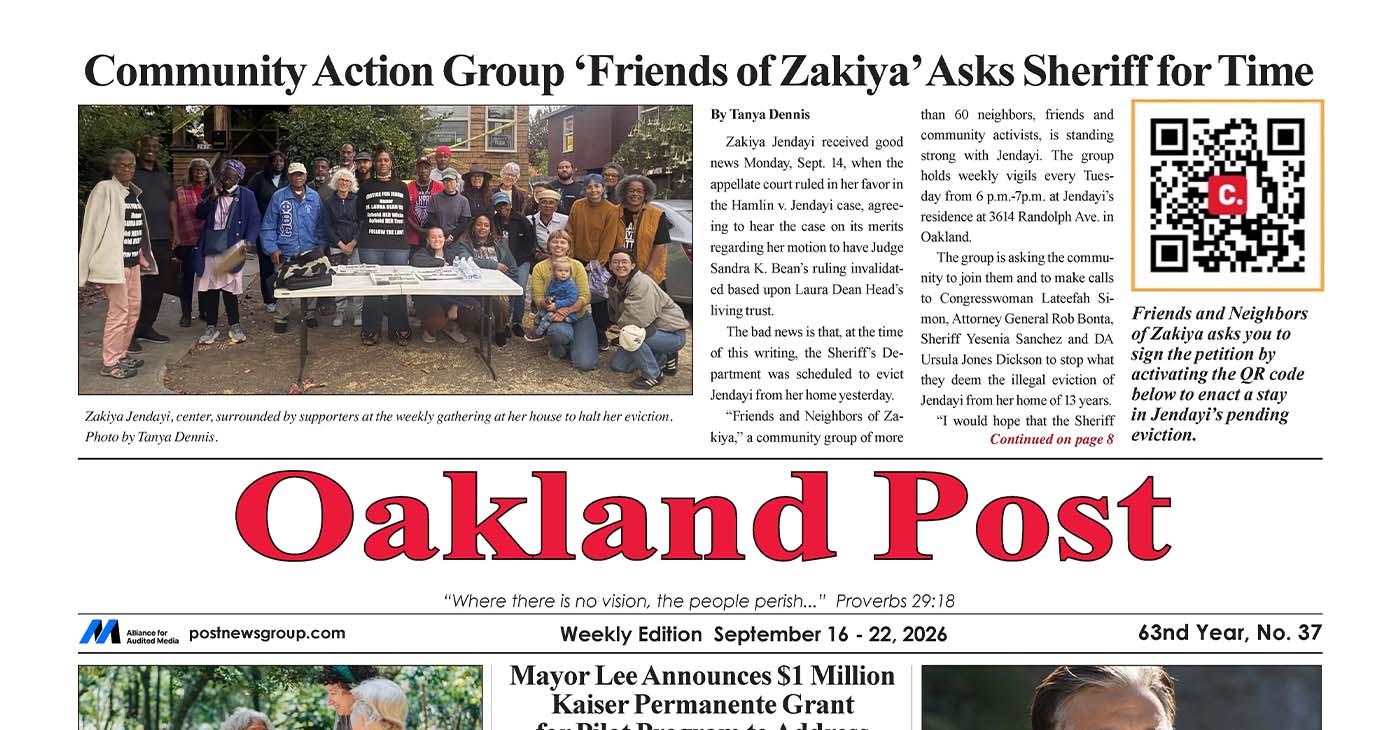
To enlarge your view of this issue, use the slider, magnifying glass icon or full page icon in the lower right corner of the browser window.
Activism
Oakland Post: Week of September 9 – 15, 2026
The printed Weekly Edition of the Oakland Post: Week of September 9 – 15, 2026

To enlarge your view of this issue, use the slider, magnifying glass icon or full page icon in the lower right corner of the browser window.



Asm. Corey Jackson Announces Launch of 24-Hour Childcare in His District

IN MEMORIAM: The Rev. Leon “Sonny” Clark, Longtime Orange County Pastor and Community Leader, Dies at 72

Poll: Becerra Widens His Lead Over Hilton; Californians Split on Wealth Tax

From Historic Memories to New Possibilities: Oakland Celebrates Coliseum 60

County Office of Education Says OUSD Finances Are Getting Healthier, Materially Stronger

LIVE FREE Sunday Dinner Brings Faith, Fellowship and Civic Conversation to Oakland

Remembering Chauncey Bailey as Student Journalists Face Threats to Truth-Telling

BLACspace Cooperative Invites Bay Area to Experience Oakland’s Black Cultural Ecosystem Through a BLAC Map Tour + Party

In Wake of Death on Doorstep, Williams Chapel Baptist Church Calls for Better Care, Funding for Unhoused

Oakland Centenarian Nuna McKee Honored!

Caribbean Nations Produce Action Plan Calling for UK Reparations Over Slavery

Oakland Post: Week of September 23 – 29, 2026

Doulas Are Helping Black California Moms Navigate Pregnancy–Even as High Mortality Rates Persist

Newsom Signs Addictive Social Media Law to Protect Kids

On Your November Ballot: Prop 38 Would Allocate $8.4 Billion to Immunology and Immunotherapy Funding

Standoff for Justice: Our Homes Are Worth Fighting For

Oakland Post: Week of August 26 – September 1, 2026

Frontier Airlines’ Return to Oakland Airport Brings Flights, Jobs and Opportunity

Gubernatorial Candidate Steve Hilton Blasts California New Tire Rules; Newsom Hits Back

Chef Sharon Lee Blends Culinary Excellence, Education and Empowerment

Jackie Wright Champions Bay Area Stories, Filmmakers and Cultural Institutions

Big City Mayors Ask for “Yes” Vote on Housing Bond Measure; Conservatives Say “No”

Oakland Coliseum Project Opens Door for Small Businesses to Build Bigger

Gov. Newsom’s Latest Appointees Include Sacramento Advocate for Formerly Incarcerated Students; State’s New Tech Chief

Misnamed ‘Parent’ PAC Seeks to Influence Oakland School Board Elections

Longtime BWOPA Member Brendalyn Goodall Appointed to California Workforce Development Board

Gov. Newsom Signs Law Shielding Immigration Aid Workers From Doxing Threats

Secretary of State Shirley N. Weber Urges Californians to Vote Early as Voter ID Battle Intensifies

From Palestine to Oakland: Seeds for Liberation Examines Shared Struggles for Freedom

IN MEMORIAM: Dolly Parton Dead at 80 — How She Built a Legacy of Love and Earned Her Place in Black Culture

The Conversation With Al McFarlane 6/23/26

Media Monday 6/22/26

LIVE! ASK ALMA! — TUES. 6.23.26 7PM EST

Car Buying Secrets: 4 Hidden Checks Before You Sign!

Is This 550 HP Charger Worth YOUR Money? AutoNetwork Review

Celebrating Juneteenth – Frederick Douglass on education and resistance

LIVE! — ASK ALMA! — TUES. 6.19.26 7PM EST

Hyundai Ioniq 5 Parking, Safety, and 360 View #shorts

2025 Ioniq 5 New Wiper & Powerful Performance! #shorts

Electric SUV Range: Is 259 Miles Enough? #shorts

EV Charging: How Fast Can You Charge an Electric Vehicle? #shorts

Biometric Cooling… Messaging Seats…Come on! 2025 Infiniti QX80 Autograph 4WD

Charged Up: Witness the Magic of a Fully Electric Car! #shorts

Range Rover Sport PHEV Included…: See What’s Inside This Luxury SUV! #shorts

Invisible Hood View: Perfect Parking with X-Ray Vision! #shorts
-
 Community2 weeks ago
Misnamed ‘Parent’ PAC Seeks to Influence Oakland School Board Elections
-

 Activism3 weeks ago
Oakland Post: Week of September 2 – 8, 2026
-

 Community2 weeks ago
Richmond Tiny House Village Farm & Garden Set to Open Gates on Sept. 26
-

 Black History2 weeks ago
Latest Massacre in Haiti Reveals Cruelty U.S. Deportations
-

 Black History2 weeks ago
OPINION: Nolan Wells’ Death One of Several Signifying Racial Terror Lives on in U.S. South
-

 Activism2 weeks ago
Oakland Post: Week of September 9 – 15, 2026
-

 Community2 weeks ago
Democratic Clubs Interview Candidates for Oakland School Board
-
 Featured2 weeks ago
‘Ready to See These Bills Become Law’: Sen. Weber’s Package of 15 Bills Advance to Gov. Newsom’s Desk
