
Community
Cecil Brown: Present for Pryor’s rise, and his demise.

In the book, “Pryor Lives!: Kiss My Rich, Happy Black…Ass!”, Cecil Brown tells the story of a mega-popular counterculture icon, from the perspective of someone he personally knew.
Cecil Brown met Richard Pryor in the parking lot of a club in Berkeley; Pryor was taking pulls from a cigarette, relaxing. He had just knocked the audience back with a comedy routine.
Brown last saw Pryor as he sat wheelchair bound, terminally ill, in his mansion in Southern California. Pryor had just enough energy to crack a joke or two about life.
In between, Cecil Brown, a writer from North Carolina, would become the best of friends with this comedian from Illinois, named “Rich”.
Before he met Pryor, Brown had already tasted stardom. After earning a Masters Degree from the University of Chicago, Brown published the book “The Life and Loves of Mr. Jiveass Nigger”. The book was immensely successful, and lead Brown to a career of writing everything from TV shows to movie scripts, and even opened the door for him to become a teacher.
While working as an educator in the Bay Area during the late 60’s, Brown got word of a hip comedian who was in town and decided to see his show. Brown ventured from his residence in the Berkeley Hills to Mandrake’s, an old nightclub that once stood on the corner of 10th St. and University Ave.

Pryor, a young but experienced comedian, was looking for a new act. The counterculture lifestyle inside of Mandrake’s (and in Berkeley as a whole) assisted him in developing that new act, according to Brown.
Within the first couple chapters of his book, Brown writes:
“Frank McConnell said the court jesters had a magical function. They could say things that nobody else would dare utter to the King. They had license. But sometimes they went too far. Not only would they expose the disease of the society, but also often they embodied the disease and acted out the ritual.”
That was Pryor, according to Brown.
Pryor has been the subject of many documentaries, news reports and even an autobiography called “Pryor Convictions”, which was co-written by Tom Gold.
But Brown felt as though something was missing from history’s library.
“I wanted to show all of the aspects of Richards life,” said Brown, during an interview in a coffee shop near Oakland’s Lake Merritt. “And through that, I’d be able to show how comedy works. The comic is a rep or spokesman for a group of people who’ve been marginalized,” Brown concluded.
Brown’s expertise in storytelling is shown in this book, threefold.
He is a history buff, with knowledge of the ancient methods of storytelling. He references everything from the Dogon Nation’s way of laughing during funerals to Juvenal, the Roman Satirist.
Secondly, Brown looks at Pryor’s method of storytelling; much of which is done through analyzing the four stages of social drama: breach, crisis, redress, and reintegration (citing sociologist Victor Turner). Brown says that Pryor, although unintentionally, would go through the stages of social drama– and that’s where he’d get his best material.
The third lens is what makes this book special; Brown shares the perspective of two friends. The journey from their first meeting in the late 1960’s, to the last time Brown saw Pryor, before the comedian passed at age 65.



Business
Surveillance Pricing Fight: State Senate Debates Bill Banning Retailers from Using AI to Set Prices Based on a Buyer’s Profile
OAKLAND POST — Currently, there is no precise public data quantifying how many Black residents in California are actively affected by surveillance pricing. However, because the practice leans heavily on ZIP codes and localized demographic tracking, algorithmic pricing models frequently result in higher costs for Black and non-white communities compared to others, according to the Electronic Frontier Foundation (EFF), a leading nonprofit organization defending civil liberties in the digital space


Surveillance pricing—the algorithmic practice of using personal data to determine individualized costs for goods and services—is widespread in California, according to Assemblymember Chris Ward (D-San Diego). He warns that this system is actively impacting consumers across the state, and Black Californians could be specifically targeted.
Ward’s Assembly Bill (AB) 2564, the Surveillance Pricing Act, aims to prohibit businesses from using this practice.
“Surveillance pricing is a growing phenomenon that a lot of people don’t realize is already happening,” Ward told California Black Media (CBM) at the State Capitol on June 29.
On June 22, the bill passed out of the Senate Privacy, Digital Technologies, and Consumer Protection Committee with a 5-2 vote and was re-referred to the Committee on Judiciary for consideration. On May 27, the Assembly voted to advance AB 2564 with a 42-21 vote.
Currently, there is no precise public data quantifying how many Black residents in California are actively affected by surveillance pricing. However, because the practice leans heavily on ZIP codes and localized demographic tracking, algorithmic pricing models frequently result in higher costs for Black and non-white communities compared to others, according to the Electronic Frontier Foundation (EFF), a leading nonprofit organization defending civil liberties in the digital space.
Justin Brookman, a public-interest lawyer, supports AB 2564. His organization is an official sponsor of the bill. He advocates on behalf of Consumer Reports.
“We found that people shopping for the exact same item at the exact same time, and the exact same store, were getting different prices. In some cases, up to 23% higher,” Brookman said. “So, one person looking at a jar of Skippy peanut butter, it was $2.99. Another person, same exact time, it was $3.69.”
AB 2564 is primarily opposed by a coalition of corporations and technology industry associations. They argue that the bill’s language is overly broad, outlaws common consumer-friendly discounts, and creates costly litigation risks for small businesses.
Chamber of Progress – a tech industry association that lobbies for public policies that expand digital commerce and technological advances – says that banning data-driven personalization would wipe away targeted digital coupons that families count on to prolong their budgets.
In a March 18 written letter to the Assembly Committee on Privacy and Consumer Protection, Robert Singleton, senior director of Policy and Public Affairs for California and the U.S. West at the Chamber of Progress, urged the body to oppose AB 2564.
“We share the legislature’s concern about affordability,” Singleton wrote. “The cost of living is the top issue facing American families, and we understand the impulse to ensure consumers are getting a fair deal. But this bill risks backfiring on the families it aims to help.
Assemblymember Lori Wilson (D-Suisun City) supported and voted for the bill in the Assembly on May 27, but she still has questions about a “litigation risk” that could be costly.
“Every business or retailer that is spending their time battling courts is spending resources, which drives the cost up for everyone,” said Wilson, a member of the California Legislative Black Caucus (CLBC).

Business
Oakland Children’s Hospital Workers and Patients Rally for Pediatric Medical Care
OAKLAND POST — “Children who go through a bone marrow transplant are immunocompromised, meaning that their immune system has been wiped out,” and having to take public transport to San Francisco exposes patients to the risk of getting a dangerous infection, said Paola Portillo, a social worker.
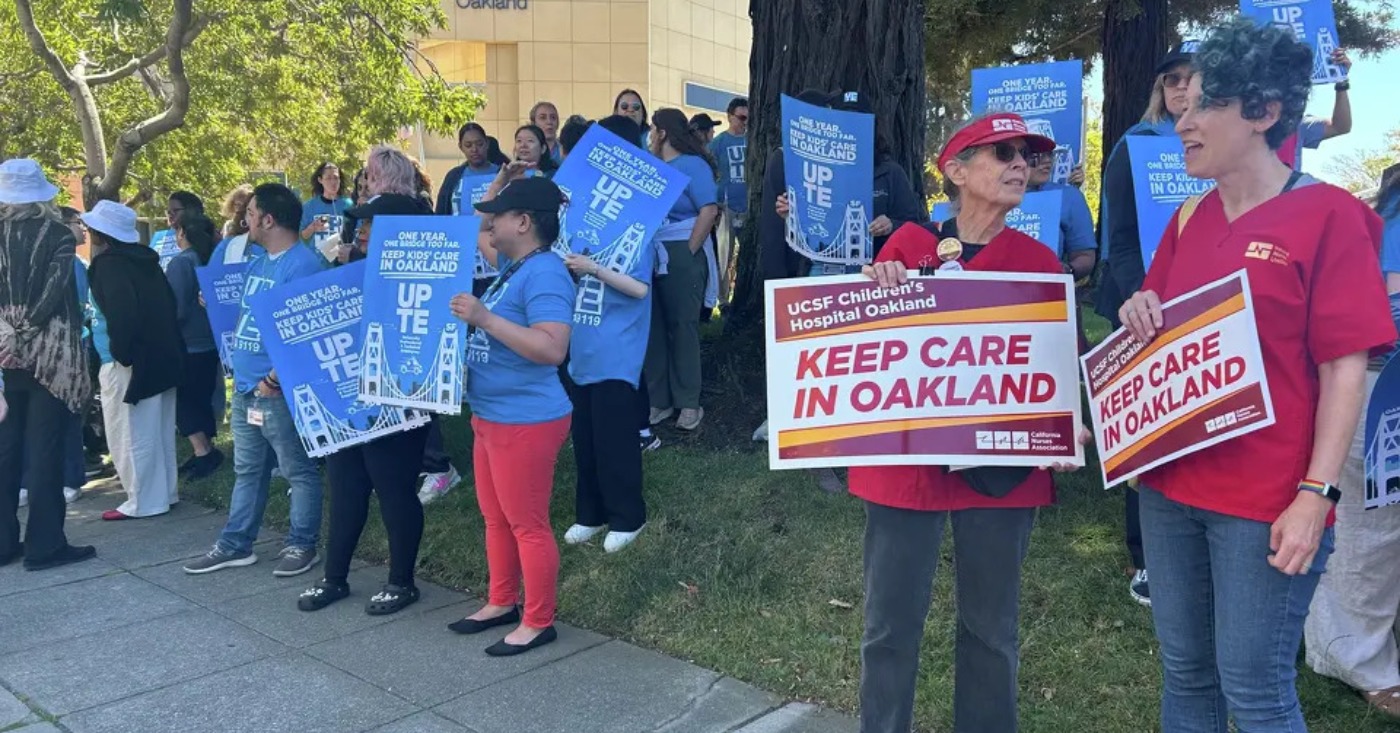
Staff, patients’ families, and supporters held a rally recently at UCSF Benioff Children’s Hospital in Oakland to protest the hospital’s decision to relocate specialized treatment clinics to San Francisco.
Protesters said the move is creating barriers for patients to access care and raised concerns over whether the hospital was appropriately using funds partially designated for pediatric services.
In response, hospital officials say they are concentrating resources for highly specialized procedures so patients can receive the highest quality of care.
One of the speakers at the rally, Paola Portillo, a social worker, said the hospital started transferring the clinics a year ago when UCSF Health integrated with the Children’s Hospital Oakland, located at 747 52nd St. in North Oakland.
According to Portillo, patients who need bone marrow treatments and interventional radiology are forced to travel to UCSF Benioff Children’s Hospital in San Francisco, which can be dangerous, she said.
“Children who go through a bone marrow transplant are immunocompromised, meaning that their immune system has been wiped out,” and having to take public transport to San Francisco exposes patients to the risk of getting a dangerous infection, she said.
UCSF spokesperson Kristen Bole says the move improves the hospital’s quality of care, giving bone marrow treatment (BMT) as an example.
“Inpatient BMT is a highly complex service where patient volume, specialized infrastructure, faculty coverage and 24/7 support are essential,” she said in a statement. “Concentrating non-gene therapy inpatient BMT care at Mission Bay allows us to provide the safest and most sustainable model for patients and families.”
Hospital officials also emphasized that moving care was not a one-way street. Beginning this month, patients admitted for rehabilitative treatment have been directed to the children’s hospital in Oakland, Bole said.
Speakers at the rally also claimed UCSF has not been transparent about how it has allocated funding from 2020’s Measure C, a measure that created a half-percent sales tax that partially funded pediatric health care at the children’s hospital.
“The community fought so hard for Measure C because every child deserves access to lifesaving, pediatric, high-quality care right here in Oakland,” said Agnes Cho, a policy advisor speaking on behalf of Alameda County Supervisor Nikki Fortunato Bas. “The funding should go towards strengthening care for children right here in Oakland.”
Protesters also said UCSF’s $3.3 billion endowment has been misused. Last October, the University Professional & Technical Employees union published a report on the University of California’s spending, which highlighted projects such as the $4.3 billion UCSF Helen Diller Medical Center at Parnassus Heights.
“What I have a problem with is saying the kids from the East Bay have to go to San Francisco to get care, so that UC can build a fancy hospital for its richest patients in San Francisco,” said union President Dan Russell.
The UCSF spokesperson said UCSF has been investing in its Oakland campus, explaining that upgrades that are expected to be completed in 2030 at a cost of $1.6 billion.
“Oakland is central to our pediatric health system, and we are making the largest investment in the campus’ history,” the spokeswoman said. “We do not make investments of this scale in a campus, workforce or community we plan to leave behind.”
This article includes coverage from Bay City News Service and media releases.
Black History
Opinion: When Politicians Start Sanitizing One Chapter of History, They’re Coming After The Whole Book
OAKLAND POST — The White House recently released a report criticizing the Smithsonian for supposedly promoting “anti-White activism” and other ideological sins. Buried inside is something even more troubling. The report argues Americans shouldn’t think of the Chinese Exclusion Act of 1882 primarily as a racist law. Instead, we’re told it was about national security.

I came to Winnipeg to perform my one-man show, 69, Emil Amok: Anchorman—The News Made Me Do It.
I didn’t expect to leave with another lesson about America.
It came over dim sum.
After the show, Shirley—a Chinese Canadian—and her friend Chris, a Sri Lankan-Mauritian Canadian—insisted on taking me to a restaurant in Winnipeg’s Chinatown.
A Filipino American. A Chinese Canadian. A Sri Lankan-Mauritian Canadian.
The United Nations, if it served dumplings.
Then Shirley told me about her father.
He arrived from China at 14 years old, speaking no English. The school put him in second grade just to learn the language. Once he caught up, they skipped him to ninth grade.
Two years later, he was working.
He opened a restaurant.
It burned down.
He opened another.
Eventually he bought a café in rural Manitoba serving chop suey, burgers, steaks and fries.
The Good Way Café became the place everybody gathered. Rock and roll played from the jukebox until midnight.
Her father, Arthur Mar, built a business, employed people and became part of his community.
Sound familiar?
It should.
It’s the same immigrant story Americans love to celebrate.
Until politics gets involved.
Because before Arthur Mar could build anything, Canada made him pay a $500 Chinese head tax—a fortune in the 1920s.
When that didn’t keep enough Chinese out, Canada passed its own Chinese Exclusion Act.
Different country.
Same racism.
Canada has spent decades admitting what it did.
The Trump administration wants America to do the opposite.
The White House recently released a report criticizing the Smithsonian for supposedly promoting “anti-White activism” and other ideological sins.
Buried inside is something even more troubling.
The report argues Americans shouldn’t think of the Chinese Exclusion Act of 1882 primarily as a racist law.
Instead, we’re told it was about national security.
Funny how those two words have always been available whenever politicians want to discriminate against somebody.
Black Americans have heard that song before.
Slave patrols became public safety.
Jim Crow became states’ rights.
Mass incarceration became law and order.
Same melody.
Different verse.
History has a way of putting racism in a respectable suit.
When politicians begin sanitizing one chapter of history, they’re coming after the whole book.
Communities of color don’t have identical histories.
But we recognize familiar tactics.
About the Author
Emil Guillermo is an award-winning journalist, commentator and comic monologist. He performs “69, Emil Amok: Anchorman—The News Made Me Do It” at the Winnipeg Fringe Festival, July 16–26.
Get Tix: https://www.winnipegfringe.com/performer-detail.aspx?kw=Emil+Amok+Productions
Follow him at YouTube.com/@emilamok1.

WORK FROM HOME
Home-based business with potential monthly income of $10K+ per month. A proven training system and website provided to maximize business effectiveness. Perfect job to earn side and primary income. Contact Lynne for more details: Lynne4npusa@gmail.com 800-334-0540


Starting This Summer, California Car Buyers Can Get an Instant $3500 Off the Cost of Electric Vehicles

Surveillance Pricing Fight: State Senate Debates Bill Banning Retailers from Using AI to Set Prices Based on a Buyer’s Profile

Oakland Children’s Hospital Workers and Patients Rally for Pediatric Medical Care

Opinion: When Politicians Start Sanitizing One Chapter of History, They’re Coming After The Whole Book

Beyond Politics: California Legislators Across Party Lines Celebrate Lori Wilson at 50

NPRC to Meet with California Attorney General’s Office on to Urge Guardianship Reform

Mount Zion MBC, Church of Jesus Christ of Latter-day Saints Partner to Bring 29,000 Meals to Alameda County

Councilmember Houston Helps Deter Trend to Award Contracts to Suburban Companies

Rep. Garamendi, House Democrats Demand Trump Administration Abandon Illegal Plans to Dismantle Civil Rights, Special Ed Offices

Council Gives Approval for $125 Million Oakland Coliseum Sale to AASEG

Job Readiness, Housing Resources Among Services Provided at Coliseum Job Fair

Free Back-to-School Summer Family and Community Event Is Coming to Richmond

New State Law Limits Student’s Cell Phone Use During School Hours

Why Trade Show Success Depends On Standing Out (Not Just Showing Up)

Gov. Gavin Newsom Signs Law Streamlining Affordable Housing Rules
Mount Zion MBC, Church of Jesus Christ of Latter-day Saints Partner to Bring 29,000 Meals to Alameda County
Oakland Children’s Hospital Workers and Patients Rally for Pediatric Medical Care

Saving Black Mothers Starts Outside the Hospital

IN MEMORIAM: Oakland Dance Legend Reginald Ray-Savage, 67
Gov. Gavin Newsom Signs Law Streamlining Affordable Housing Rules

Oakland Celebrates $125 Million Coliseum Sale


NPRC Heads to Washington to Elevate Adult Guardianship Reform at National Whistleblower Summit

Oakland Post: Week of June 17 – 23, 2026

The Part of Buying a Home That No Real Estate Show Ever Prepares You For

Agricultural Engineer Effie Gant Plans Bay Area Farmers Market Initiative

Ferry Fares to Increase July 1 as Ridership Hits Record Highs

NCBW-OBAC Champions Black Women Entrepreneurs at Business en Blaque Expo

UC Berkeley Named Top Public University in the U.S. and No. 7 in the World by ‘U.S. News’

Oakland Post: Week of July 1 – 7, 2026

The Conversation With Al McFarlane 6/23/26

Media Monday 6/22/26

LIVE! ASK ALMA! — TUES. 6.23.26 7PM EST

Car Buying Secrets: 4 Hidden Checks Before You Sign!

Is This 550 HP Charger Worth YOUR Money? AutoNetwork Review

Celebrating Juneteenth – Frederick Douglass on education and resistance

LIVE! — ASK ALMA! — TUES. 6.19.26 7PM EST

Hyundai Ioniq 5 Parking, Safety, and 360 View #shorts

2025 Ioniq 5 New Wiper & Powerful Performance! #shorts

Electric SUV Range: Is 259 Miles Enough? #shorts

EV Charging: How Fast Can You Charge an Electric Vehicle? #shorts

Biometric Cooling… Messaging Seats…Come on! 2025 Infiniti QX80 Autograph 4WD

Charged Up: Witness the Magic of a Fully Electric Car! #shorts

Range Rover Sport PHEV Included…: See What’s Inside This Luxury SUV! #shorts

Invisible Hood View: Perfect Parking with X-Ray Vision! #shorts
-
 Business12 hours ago
Mount Zion MBC, Church of Jesus Christ of Latter-day Saints Partner to Bring 29,000 Meals to Alameda County
-
 Business12 hours ago
Oakland Children’s Hospital Workers and Patients Rally for Pediatric Medical Care
-
 Black History4 days ago
Saving Black Mothers Starts Outside the Hospital
-
 Business2 days ago
Gov. Gavin Newsom Signs Law Streamlining Affordable Housing Rules
-
 Black History1 week ago
Oakland Celebrates $125 Million Coliseum Sale
-
 Community1 week ago
NPRC Heads to Washington to Elevate Adult Guardianship Reform at National Whistleblower Summit
-
 Business4 days ago
The Part of Buying a Home That No Real Estate Show Ever Prepares You For
-
 Activism1 week ago
Agricultural Engineer Effie Gant Plans Bay Area Farmers Market Initiative
