
Activism
California College of the Arts Staff Union Strikes, Citing Unfair Labor Practices
Members of the California College of the Arts staff union point to salaries at the administrative level, which they see as excessively high, and question why the school isn’t paying their lower wage workers more. The school’s 2020 990 filing shows four administrators made well over $270,000 in 2019. President Stephen Beal made a base salary of more than $580,000 while working 37.5 hours per week. Such a salary is over $150,000 more than both the current Mayor of San Francisco and the President of the United States. The 990 also estimates Beal made over $100,000 in addition to his base salary in “other compensation from the organization and related organizations.”

By Zack Haber
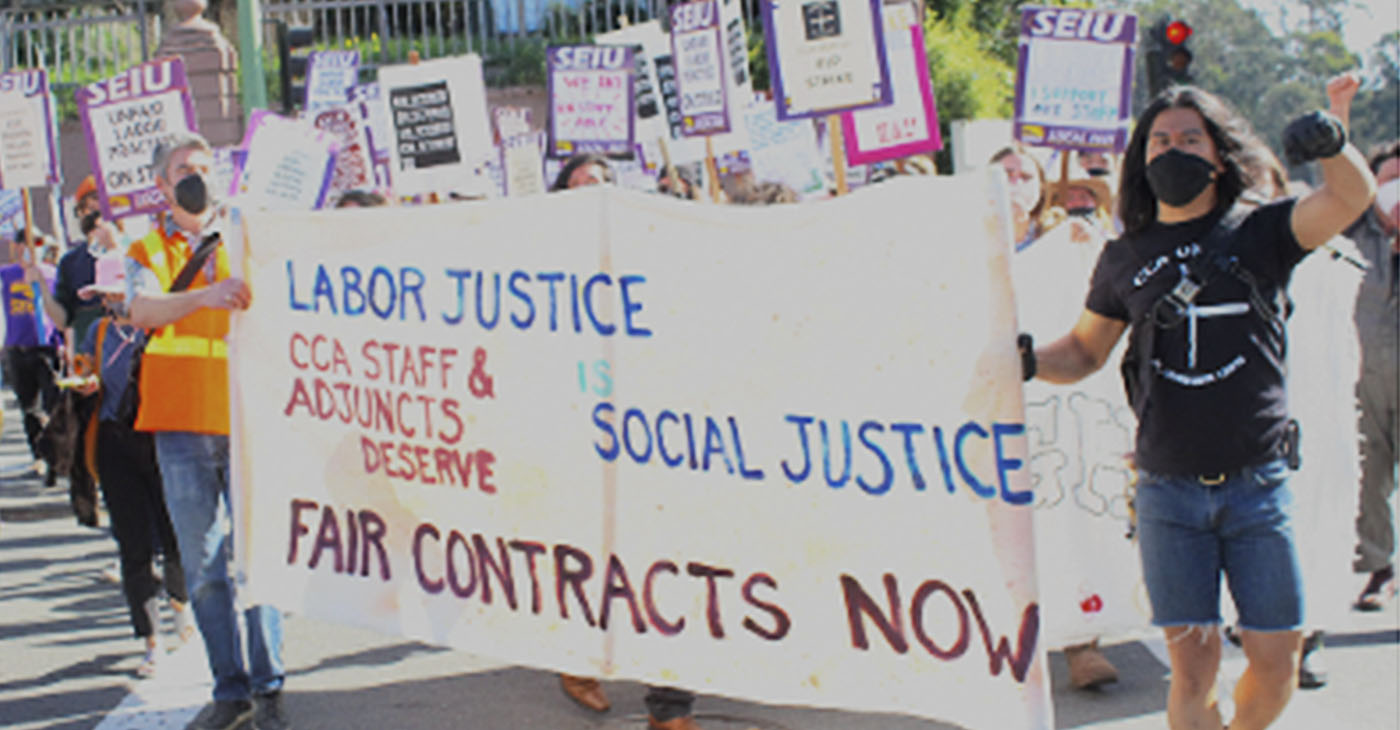
The staff union at California College of the Arts (CCA), a small, private college founded in 1907, engaged in a four-day strike and protest. They’re accusing the school of unfair labor practices that include stalling contract negotiations in an effort to withhold pay increases and benefits.
“We have a unionized workplace now,” said SEIU 1021 chapter President Matt Kennedy, who’s worked in the tech department of the college for 10 years. “CCA needs to acknowledge that. It’s taking forever to come to an agreement because they aren’t.”
The protests featured rallies, teach-ins, group art-making projects and daily pickets that started February 8 and end on February 12. The actions are taking place on the school’s San Francisco campus every day except Wednesday, when the protest moved to the school’s Oakland campus. Around 200 people, including union members and their supporters, showed up each day to the pickets.
In interviews with this reporter, Kennedy, along with three other current or former workers at CCA, all accused the school of bargaining in bad faith.
“CCA has been stonewalling and dragging their feet,” said Kēhau Lyons, an academic advisor who’s worked at CCA for about two and a half years and has been observing the bargaining sessions. “The management side just doesn’t want to get this completed.”
CCA’s staff successfully voted to unionize with SEIU 1021 in April of 2019. Since then, staff members say they have not received any raises outside of those required by law. While contract negotiations started in October of 2019, CCA’s staff is still working without a union contract. A study by Bloomberg Law based on National Labor Relations Board data shows that, between 2004 and the first half of 2021, the average amount of time it took employers and unions to agree on a first contract was a little over one year and one month. The union and CCA’s negotiations have, thus far, taken over two years and four months.
In an email, CCA Director of Communications Daniel Owens-Hill, disagreed with staff who accused the college of stalling negotiations.
“CCA remains ready and willing to negotiate as frequently as needed to achieve a fair and mutually beneficial collective bargaining agreement,” Owens-Hill wrote. “The college has a comprehensive proposal on the table that provides wage increases for our valued staff while also maintaining our ongoing commitment to student financial aid and a financially sustainable future.”
On September 27 of last year, National Labor Relations Board Regional Director Valerie Hardy-Mahoney sided with the union by issuing a Complaint and Notice of Hearing stating that CCA had “been failing and refusing to bargain collectively and in good faith with the union.” In that same document, she also proposed new bargaining guidelines for the college to follow going forward.
CCA is currently offering a 2% wage increase to all staff in the union. Workers interviewed for this article see that raise as inadequate and stressed that their most important request while bargaining has been “raising the floor” for staff salaries. To pay the expenses needed to live in the Bay Area, staff said, they want a minimum wage of $55,000. Kennedy said salary records show 40% of CCA staff makes less than $55,000 per year, and 10% make between $36,000 and $45,000. For many workers, the 2% increase would fall short of providing the minimum salary.
CCA workers point to salaries at the administrative level, which they see as excessively high, and question why the school isn’t paying their lower wage workers more. The school’s 2020 990 filing shows four administrators made well over $270,000 in 2019. President Stephen Beal made a base salary of more than $580,000 while working 37.5 hours per week. Such a salary is over $150,000 more than both the current Mayor of San Francisco and the President of the United States. The 990 also estimates Beal made over $100,000 in addition to his base salary in “other compensation from the organization and related organizations.”
In April of 2020, Beal’s base salary was cut by 25%, while the senior vice president’s was cut by 10%, and the vice president’s was cut by 5%.
CCA staff union members say they have noticed a high employment turnover rate which they attribute to their co-workers not receiving high enough pay. Emails from CCA’s Human Resources Department show that, since August, 19 staff union members have stopped working at the school, which is about 15% of the total union staff.
Randy Nakamura has taught as an adjunct at CCA’s graduate design program for the last six years, and is also part of CCA’s adjunct union’s bargaining unit. CCA’s adjunct union is separate from the staff union, but Nakamura and other adjuncts are also trying to reach a contract with CCA.
Nakamura says that since the CCA adjunct union contract expired in June of 2020, he and his fellow union members’ experiences bargaining to renew their contract have been similar to the staff union’s efforts to get CCA to agree to a first contract.
“CCA has taken every opportunity to not bargain with us,” said Nakamura. “Sometimes they’ll make us wait an hour and a half in a three-hour bargaining session just to talk.”
After a year and a half of bargaining, the adjunct union has not yet been able to renew its contract with CCA. Seeing themselves in a similar struggle as the staff union, over 100 CCA’s adjunct union member supported CCA’s staff union by sympathy striking, and not teaching classes during the strike.
Some adjuncts also joined staff on the picket line. Additionally, members of the CCA Student Union and some other CCA students who sympathize with the staff strike criticized CCA’s 2% wage increase offer as too low and picketed and did not attending classes to show their support.
“The staff and adjunct’s working conditions are student learning conditions,” the CCA Student Union wrote on a recent instagram post. “We as students completely benefit from union bargaining and a fair contract for our beloved staff.”
CCA faculty who are tenured or on tenure track are not part of the staff union and have separate independent contracts. But they also showed support.
“We are not willing to cross the picket line,” reads a support letter released on February 7 that 99 such faculty members signed. “[We] will instead find ways to express peaceful solidarity during the strike, including engaging in strike-related teach-ins and pedagogical activities.”
Through their spokesperson, David Owens-Hill, CCA criticized the strike.
“At a time when we are making rapid progress in negotiations and have reached agreement on so many items, a strike benefits no one,” wrote Owens-Hill in an email, “not our staff, not our faculty, and certainly not our students, who have just returned to fully in-person classes for the first time in nearly two years.”
CCA staff union members disagree with Owens-Hill.
“It’s important to show in our strike that CCA can’t get away with this,” said SEIU’s Kennedy. “Better working conditions and compensation make better learning conditions, and the college needs to make that a priority. But they’re not.”





Activism
Oakland Post: Week of April 1 – 7, 2026
The printed Weekly Edition of the Oakland Post: Week of April 1 – 7, 2026
To enlarge your view of this issue, use the slider, magnifying glass icon or full page icon in the lower right corner of the browser window.
Activism
Oakland Post: Week of March 18 – 24, 2026
The printed Weekly Edition of the Oakland Post: Week of March 18 – 24, 2026

To enlarge your view of this issue, use the slider, magnifying glass icon or full page icon in the lower right corner of the browser window.
Activism
Oakland Post: Week of March 11 -17, 2026
The printed Weekly Edition of the Oakland Post: Week of March 11 – 17, 2026
To enlarge your view of this issue, use the slider, magnifying glass icon or full page icon in the lower right corner of the browser window.

WORK FROM HOME
Home-based business with potential monthly income of $10K+ per month. A proven training system and website provided to maximize business effectiveness. Perfect job to earn side and primary income. Contact Lynne for more details: Lynne4npusa@gmail.com 800-334-0540


Oakland Post: Week of April 1 – 7, 2026

Black Artists in America, Installation Three Wraps at the Dixon Gallery and Gardens

Grief, Advocacy, and Education: A Counselor Reflects on Black Maternal Health

Future of Florida’s Black History Museum in Limbo

New Research Shows the Many Benefits of Early Learning

South Hampton K-8 Students Among Top 10 Finalists for Samsung’s ‘Solve for Tomorrow’ Competition

Cuba: No Negotiation with US on the President or Political System

Brooklyn Academy of Music Names Jamaican-Born Tamara McCaw as President

Trinidad & Tobego – U.S. Launches WhatsApp Channel for American Citizens in the Country

Oakland Post: Week of March 18 – 24, 2026

AI Innovation vs. Ethics and Environmental Impact

AI, Web3, and Digital Reparations

What If You Owned Your AI Agent?

Season 7, Episode 3 – January Reporter’s Roundtable 📱

Season 7, Episode 3 – January Reporter’s Roundtable

Reflecting on Black History Milestones in Birmingham AL

Oakland Post: Week of February 25 – March 3, 2026

PRESS ROOM: NBA Hall of Fame Nominee Terry Cummings Joins 100 Black Men of DeKalb County to Launch Victory & Values Initiative

Oakland Post: Week of March 4 – 10, 2026

Trump’s MAGA Allies are Creating Executive Order Plan to Steal the 2026 Midterms

U.S. manufacturing rebounds – how foundry services are adapting to rising demand

Poll Shows Support for Policies That Help Families Afford Child Care

Oakland Post: Week of March 11 -17, 2026

OP-ED: One Hundred Years of Black Workers Telling the Truth
Oakland Post: Week of March 18 – 24, 2026

Advancements in solar technology that are changing the way we power the world

Woman’s Search for Family’s Roots Leads to Ancestor John T. Ward – A Successful Entrepreneur and Conductor on the Underground Railroad

Financial Wellness and Mental Health: Managing Money Stress in College

COMMENTARY: Women of Color Shape Our Past and Future

PRESS ROOM: Civil Rights TV Launches in Selma as the World’s First 24/7 Civil Rights Television Network

Hyundai Ioniq 5 Parking, Safety, and 360 View #shorts

2025 Ioniq 5 New Wiper & Powerful Performance! #shorts

Electric SUV Range: Is 259 Miles Enough? #shorts

EV Charging: How Fast Can You Charge an Electric Vehicle? #shorts

Biometric Cooling… Messaging Seats…Come on! 2025 Infiniti QX80 Autograph 4WD

Charged Up: Witness the Magic of a Fully Electric Car! #shorts

Range Rover Sport PHEV Included…: See What’s Inside This Luxury SUV! #shorts

Invisible Hood View: Perfect Parking with X-Ray Vision! #shorts

AI Is Reshaping Black Healthcare: Promise, Peril, and the Push for Improved Results in California

ESSAY: Technology and Medicine, a Primary Care Point of View

Sanctuary Cities

The RESISTANCE – FREEDOM NOW

STATE OF THE PEOPLE: Freddie

ECONOMIC BOYCOTT DAY!!!!!

I told You So

-
 Activism3 weeks ago
Oakland Post: Week of March 11 -17, 2026
-
 Activism3 weeks ago
Oakland Post: Week of March 18 – 24, 2026
-
 Advice3 weeks ago
Financial Wellness and Mental Health: Managing Money Stress in College
-
 #NNPA BlackPress2 weeks ago
Brooklyn Academy of Music Names Jamaican-Born Tamara McCaw as President
-
 #NNPA BlackPress2 weeks ago
Grief, Advocacy, and Education: A Counselor Reflects on Black Maternal Health
-

 Advice4 weeks ago
Women & Wealth: Tips for Navigating Your Lifelong Financial Journey
-
 #NNPA BlackPress2 weeks ago
New Research Shows the Many Benefits of Early Learning
-
 #NNPA BlackPress2 weeks ago
Black Artists in America, Installation Three Wraps at the Dixon Gallery and Gardens
