
Opinion
65 Years After Brown v. Board of Education, We Risk Going Backward


This week marks the 65th anniversary of Brown v. Board of Education, the unanimous Supreme Court decision that outlawed apartheid in America, declaring segregated schools “inherently unequal” and unconstitutional.
Today, the common sense of the Brown decision is under attack. For nearly three decades, our schools have been re-segregating, reversing the progress made under Brown, reflecting the deep racial and economic segregation of our communities. Worse, several of Donald Trump’s nominees to the federal courts refuse even to endorse Brown as unassailable law.
As the United States grows more diverse, we run the risk of becoming more separate and more unequal.
The decision in Brown was and is compelling. Racially segregated schools were and are inherently separate and unequal. They also were and are unequal in resources. In affluent, largely white suburbs, public schools are new and modern, with advanced facilities and courses and good teachers. In low-income, minority neighborhoods, schools tend to be old and dilapidated, with less experienced teachers, fewer resources and fewer advanced courses.
Research shows that integration works. Segregation injures the chances for achievement, college success, long-term employment and income of students of color. Integration raises those chances with no detriment to white students. Indeed, the experience of going to a diverse school better prepares students of all races for the world they will enter.
With neighborhoods largely segregated — a legacy of racially restrictive laws and covenants, of bank and real estate red lining and more — integration of public schools inevitably required busing. Busing, of course, is routine across America, a service to parents. But opponents of integration used “forced busing” to rouse fears and hatred. The question was never about busing, it was about where the bus delivered the students.
When the federal courts, packed by judges appointed by Ronald Reagan and George H.W. Bush, retreated from desegregation orders, the schools began to re-segregate. Now, as Rep. Robert C. “Bobby” Scott (D-VA), chair of the House Committee on Education and Labor concludes: “After four decades without federal support for desegregation, we are right back where we started,” with schools that are increasingly separate and unequal.
A recent report, “Harming our Common Future, America’s Segregated Schools 65 Years After Brown,” by the UCLA Civil Rights Project and the Pennsylvania State University Center for Education and Civil Rights, detailed the bleak reality. As the Washington Post’s Valerie Strauss summarizes, “Over the past three decades, black students have been increasingly segregated in intensely segregated schools (defined as 90 to 100 percent nonwhite).” By 2016, 40 percent of all black students were in segregated schools.
The worst states? The “blue” states of New York, California, Illinois and Maryland, with New York the most segregated for blacks and California the most segregated for Latinos.
This isn’t just an urban problem: our suburbs are increasingly divided by race, with African-American suburban students attending schools that are three-fourths nonwhite, and white students in the same suburbs going to schools that are, on average, two-thirds white. Charter schools — increasingly a profit-making venture rather than an educational one — are even more segregated than traditional public schools.
Schools are segregated because our neighborhoods are segregated. Without residential integration and without metropolitan-wide integration policies, segregation will intensify, even as the country grows more diverse. Yet requirements that communities pursue residential integration remain unenforced and programs to subsidize scattered affordable housing are weak at best.
Now 65 years later, we face a stark choice: the promise of Brown or a country torn apart by racial tensions. Sadly, as Sherrilyn Ifill, president of the NAACP Legal Defense and Education Fund, reports, Donald Trump’s nominees to the federal bench increasingly refuse to endorse Brown v. Board as unassailable law. The Republican Senate is about to confirm three of these judges to lifetime appointments. Like the Voting Rights Act, gutted by five right-wing justices in the Shelby case, Brown v. Board of Education itself may be at risk.
Sixty-five years later, with our country more diverse than ever, we must once again decide if we will be one nation, with liberty and justice for all. That cannot be left to right-wing judges or timorous politicians. It is time once more for citizens of conscience to call this nation back to its better angels.

Activism
Oakland Post: Week of July 22 – 28, 2026
The printed Weekly Edition of the Oakland Post: Week of July 22 – 28, 2026


To enlarge your view of this issue, use the slider, magnifying glass icon or full page icon in the lower right corner of the browser window.

Activism
Oakland Post: Week of July 15 – 21, 2026
The printed Weekly Edition of the Oakland Post: Week of July 15 – 21, 2026
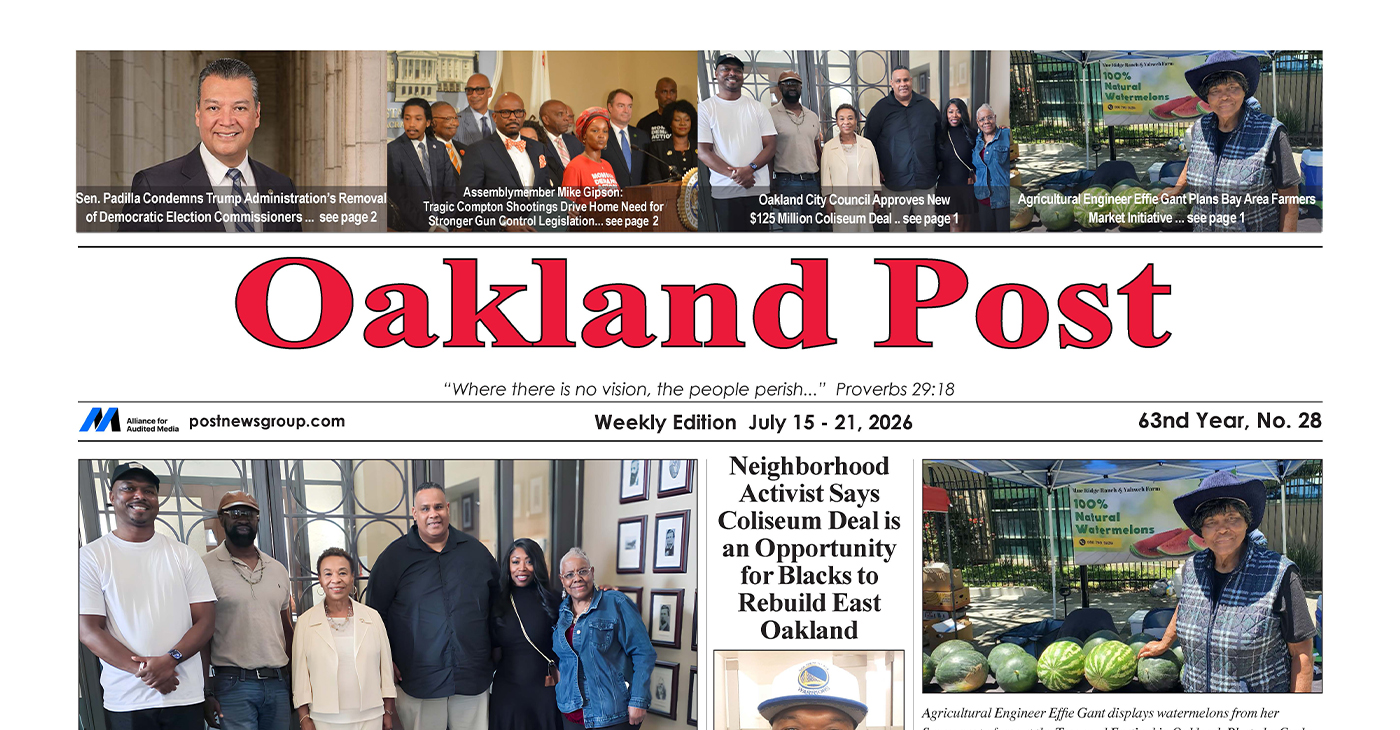
To enlarge your view of this issue, use the slider, magnifying glass icon or full page icon in the lower right corner of the browser window.
Activism
Oakland Post: Week of July 8 – 14, 2026
The printed Weekly Edition of the Oakland Post: Week of July 8 – 14, 2026
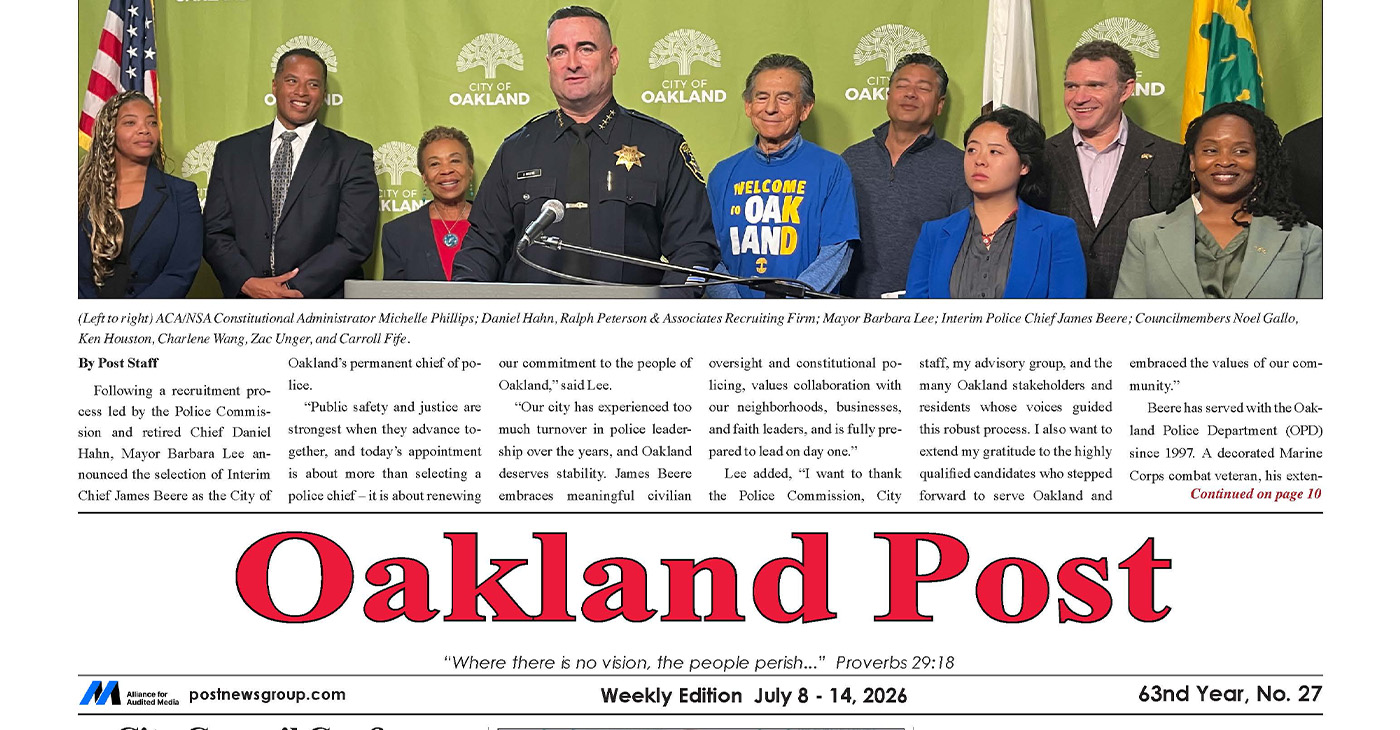
To enlarge your view of this issue, use the slider, magnifying glass icon or full page icon in the lower right corner of the browser window.

WORK FROM HOME
Home-based business with potential monthly income of $10K+ per month. A proven training system and website provided to maximize business effectiveness. Perfect job to earn side and primary income. Contact Lynne for more details: Lynne4npusa@gmail.com 800-334-0540


Oakland Post: Week of July 22 – 28, 2026

Fed Court to Decide Landmark First Amendment Case

Jordan Walker Leads Call for More Black Youth in Baseball

How Black WNBA Players Became Collateral Damage in the Caitlin Clark Culture War

NAACP Announces $20m Voter Registration Drive at National Convention in Chicago

Starting This Summer, California Car Buyers Can Get an Instant $3500 Off the Cost of Electric Vehicles

Surveillance Pricing Fight: State Senate Debates Bill Banning Retailers from Using AI to Set Prices Based on a Buyer’s Profile

Oakland Children’s Hospital Workers and Patients Rally for Pediatric Medical Care

Opinion: When Politicians Start Sanitizing One Chapter of History, They’re Coming After The Whole Book

Beyond Politics: California Legislators Across Party Lines Celebrate Lori Wilson at 50

NPRC to Meet with California Attorney General’s Office on to Urge Guardianship Reform

Mount Zion MBC, Church of Jesus Christ of Latter-day Saints Partner to Bring 29,000 Meals to Alameda County

Councilmember Houston Helps Deter Trend to Award Contracts to Suburban Companies

Rep. Garamendi, House Democrats Demand Trump Administration Abandon Illegal Plans to Dismantle Civil Rights, Special Ed Offices

Council Gives Approval for $125 Million Oakland Coliseum Sale to AASEG
Oakland Children’s Hospital Workers and Patients Rally for Pediatric Medical Care
Mount Zion MBC, Church of Jesus Christ of Latter-day Saints Partner to Bring 29,000 Meals to Alameda County
Surveillance Pricing Fight: State Senate Debates Bill Banning Retailers from Using AI to Set Prices Based on a Buyer’s Profile

Saving Black Mothers Starts Outside the Hospital

IN MEMORIAM: Oakland Dance Legend Reginald Ray-Savage, 67

Gov. Gavin Newsom Signs Law Streamlining Affordable Housing Rules

Oakland Celebrates $125 Million Coliseum Sale
Starting This Summer, California Car Buyers Can Get an Instant $3500 Off the Cost of Electric Vehicles

NPRC Heads to Washington to Elevate Adult Guardianship Reform at National Whistleblower Summit


Agricultural Engineer Effie Gant Plans Bay Area Farmers Market Initiative

The Part of Buying a Home That No Real Estate Show Ever Prepares You For

Oakland Post: Week of June 17 – 23, 2026

Oakland Post: Week of July 1 – 7, 2026

NCBW-OBAC Champions Black Women Entrepreneurs at Business en Blaque Expo

The Conversation With Al McFarlane 6/23/26

Media Monday 6/22/26

LIVE! ASK ALMA! — TUES. 6.23.26 7PM EST

Car Buying Secrets: 4 Hidden Checks Before You Sign!

Is This 550 HP Charger Worth YOUR Money? AutoNetwork Review

Celebrating Juneteenth – Frederick Douglass on education and resistance

LIVE! — ASK ALMA! — TUES. 6.19.26 7PM EST

Hyundai Ioniq 5 Parking, Safety, and 360 View #shorts

2025 Ioniq 5 New Wiper & Powerful Performance! #shorts

Electric SUV Range: Is 259 Miles Enough? #shorts

EV Charging: How Fast Can You Charge an Electric Vehicle? #shorts

Biometric Cooling… Messaging Seats…Come on! 2025 Infiniti QX80 Autograph 4WD

Charged Up: Witness the Magic of a Fully Electric Car! #shorts

Range Rover Sport PHEV Included…: See What’s Inside This Luxury SUV! #shorts

Invisible Hood View: Perfect Parking with X-Ray Vision! #shorts
-
 Business2 days ago
Oakland Children’s Hospital Workers and Patients Rally for Pediatric Medical Care
-
 Business2 days ago
Mount Zion MBC, Church of Jesus Christ of Latter-day Saints Partner to Bring 29,000 Meals to Alameda County
-
 Business2 days ago
Surveillance Pricing Fight: State Senate Debates Bill Banning Retailers from Using AI to Set Prices Based on a Buyer’s Profile
-
 Black History6 days ago
Saving Black Mothers Starts Outside the Hospital
-
 Business4 days ago
Gov. Gavin Newsom Signs Law Streamlining Affordable Housing Rules
-
 Black History1 week ago
Oakland Celebrates $125 Million Coliseum Sale
-
 Business2 days ago
Starting This Summer, California Car Buyers Can Get an Instant $3500 Off the Cost of Electric Vehicles
-
 Community1 week ago
NPRC Heads to Washington to Elevate Adult Guardianship Reform at National Whistleblower Summit
