
City Government
Public Ethics Complaint Filed Against Abel Guillén

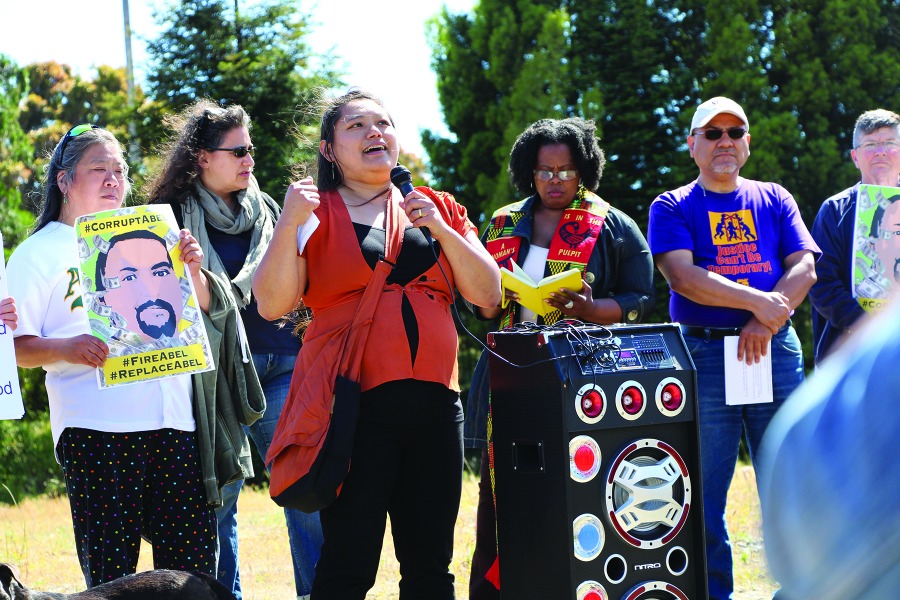
Co-founder of activist group Eastlake United for Justice Mari Rose Taruc speaks at a press conference on the corner of E. 12th St. on May 9 to discuss a complaint filed against District 2 Councilmember Abel Guillèn for allegedly violating the Oakland Campaign Reform Act. Photo by Sarah Carpenter
Former supporters of Councilmember Abel Guillén spoke at a press conference Wednesday in support of a complaint against the District 2 councilmember to the Public Ethics Commission for allegedly violating the Oakland Campaign Reform Act.
The complaint alleges that Guillén accepted campaign donations from donors associated with UrbanCore and EBALDC (East Bay Asian Local Development Corporation) while continuously voting to sell city-owned land to those companies — land that many of his constituents had hoped would be used for affordable housing rather than the mostly market-rate high rise the City Council ultimately approved.
“I walked door to door for [Guillén’s] campaign when he was down in the polls, because we thought he would stand up for working folks,” said Gary Jimenez, a vice president for SEIU Local 1021. “Needless to say, I won’t be walking for him this time.”
Guillén, who is up for re-election this November, is confident that his campaign has complied with all local donation regulations. “This is nothing but a political red herring—they should have checked the facts,” he said.
A local activist with Eastlake United for Justice, Dunya Alwan, filed the complaint against Guillén. She and other community organizers have been fighting for the fate of a parcel of land at the corner of E. 12th St. and Lakeside Dr. for years now.
“This complaint is because as residents of D2, many of us are deeply disappointed in [Guillén’s] conduct and I look forward to the Ethics Commission holding him accountable,” Alwan said.
Alwan and other activists held a press conference Wednesday to discuss the complaint. A small band of community activists held up signs with an artistic depiction of Guillén’s face, a money backdrop, and the pun-injected words “CorruptAbel,” “FireAbel,” and “ReplaceAbel.”
The E. 12th St. land was slated to become a luxury condo tower made by UrbanCore, but the original deal was scrapped after a secret memo was leaked revealing City Attorney Barbara Parker’s opinion that the deal was in violation of the state Surplus Lands Act.
After the initial deal was scrapped, UrbanCore teamed up with EBALDC, an affordable housing developer group, and submitted a new proposal, which contained some affordable housing.
Local activists teamed up with SAHA (Satellite Affordable Housing Associates) to present the “E. 12th People’s Proposal” in October 2015, for a development that would be 100 percent affordable housing.
Guillén said the SAHA proposal “called for fewer total units in a much shorter building” and that “it would have netted us fewer affordable units citywide than the [UrbanCore + EBALDC] proposal, by requiring significantly more in city subsidies.”
The complaint cites three parties who donated a total of six times in a total amount of $1800 to Guillén’s campaign during the time in which the council was negotiating the land sale—Zachary Wasserman (a private attorney working for UrbanCore), Ener Chiu (a director with EBALDC), and Jason Overman (previously an UrbanCore lobbyist).
The timing of the donations tend to align with months in which Guillén voted in favor of the UrbanCore and EBALDC proposal, but both UrbanCore and EBALDC have correctly stated that none of these donations have come from either of their companies.
“EBALDC has a policy against making political donations,” said Executive Director Joshua Simon. “We respect the privacy of our staff and will not comment on donations that may have been made by individuals.”
The Public Ethics Commission will review the complaint in the coming weeks, to determine its validity.
“I don’t expect this complaint to invalidate the council’s decision [about the land deal],” said Dan Siegel, attorney for East 12th Coalition. “However,…nothing has happened regarding the final sale of the land, so the council has the authority to reconsider this agreement.”












Activism
Oakland Post: Week of April 8 – 14, 2026
The printed Weekly Edition of the Oakland Post: Week of April 8 – 14, 2026

To enlarge your view of this issue, use the slider, magnifying glass icon or full page icon in the lower right corner of the browser window.
Activism
Oakland Post: Week of April 1 – 7, 2026
The printed Weekly Edition of the Oakland Post: Week of April 1 – 7, 2026
To enlarge your view of this issue, use the slider, magnifying glass icon or full page icon in the lower right corner of the browser window.
Activism
Oakland Post: Week of March 18 – 24, 2026
The printed Weekly Edition of the Oakland Post: Week of March 18 – 24, 2026

To enlarge your view of this issue, use the slider, magnifying glass icon or full page icon in the lower right corner of the browser window.


WORK FROM HOME
Home-based business with potential monthly income of $10K+ per month. A proven training system and website provided to maximize business effectiveness. Perfect job to earn side and primary income. Contact Lynne for more details: Lynne4npusa@gmail.com 800-334-0540


Oakland Post: Week of April 8 – 14, 2026

Oakland Post: Week of April 1 – 7, 2026

Black Artists in America, Installation Three Wraps at the Dixon Gallery and Gardens

Grief, Advocacy, and Education: A Counselor Reflects on Black Maternal Health

Future of Florida’s Black History Museum in Limbo

New Research Shows the Many Benefits of Early Learning

South Hampton K-8 Students Among Top 10 Finalists for Samsung’s ‘Solve for Tomorrow’ Competition

Cuba: No Negotiation with US on the President or Political System

Brooklyn Academy of Music Names Jamaican-Born Tamara McCaw as President

Trinidad & Tobego – U.S. Launches WhatsApp Channel for American Citizens in the Country

Oakland Post: Week of March 18 – 24, 2026

AI Innovation vs. Ethics and Environmental Impact

AI, Web3, and Digital Reparations

What If You Owned Your AI Agent?

Season 7, Episode 3 – January Reporter’s Roundtable 📱

Reflecting on Black History Milestones in Birmingham AL

Oakland Post: Week of February 25 – March 3, 2026

Oakland Post: Week of March 4 – 10, 2026

PRESS ROOM: NBA Hall of Fame Nominee Terry Cummings Joins 100 Black Men of DeKalb County to Launch Victory & Values Initiative

Trump’s MAGA Allies are Creating Executive Order Plan to Steal the 2026 Midterms

U.S. manufacturing rebounds – how foundry services are adapting to rising demand

Poll Shows Support for Policies That Help Families Afford Child Care

Oakland Post: Week of March 11 -17, 2026
Oakland Post: Week of March 18 – 24, 2026

OP-ED: One Hundred Years of Black Workers Telling the Truth

Advancements in solar technology that are changing the way we power the world

Financial Wellness and Mental Health: Managing Money Stress in College

Woman’s Search for Family’s Roots Leads to Ancestor John T. Ward – A Successful Entrepreneur and Conductor on the Underground Railroad

COMMENTARY: Women of Color Shape Our Past and Future

PRESS ROOM: Civil Rights TV Launches in Selma as the World’s First 24/7 Civil Rights Television Network

Hyundai Ioniq 5 Parking, Safety, and 360 View #shorts

2025 Ioniq 5 New Wiper & Powerful Performance! #shorts

Electric SUV Range: Is 259 Miles Enough? #shorts

EV Charging: How Fast Can You Charge an Electric Vehicle? #shorts

Biometric Cooling… Messaging Seats…Come on! 2025 Infiniti QX80 Autograph 4WD

Charged Up: Witness the Magic of a Fully Electric Car! #shorts

Range Rover Sport PHEV Included…: See What’s Inside This Luxury SUV! #shorts

Invisible Hood View: Perfect Parking with X-Ray Vision! #shorts

AI Is Reshaping Black Healthcare: Promise, Peril, and the Push for Improved Results in California

ESSAY: Technology and Medicine, a Primary Care Point of View

Sanctuary Cities

The RESISTANCE – FREEDOM NOW

STATE OF THE PEOPLE: Freddie

ECONOMIC BOYCOTT DAY!!!!!

I told You So
-
 Activism3 weeks ago
Oakland Post: Week of March 11 -17, 2026
-
 Activism3 weeks ago
Oakland Post: Week of March 18 – 24, 2026
-
 Advice3 weeks ago
Financial Wellness and Mental Health: Managing Money Stress in College
-
 #NNPA BlackPress2 weeks ago
Brooklyn Academy of Music Names Jamaican-Born Tamara McCaw as President
-
 #NNPA BlackPress2 weeks ago
Grief, Advocacy, and Education: A Counselor Reflects on Black Maternal Health
-
 #NNPA BlackPress2 weeks ago
New Research Shows the Many Benefits of Early Learning
-

 Advice4 weeks ago
Women & Wealth: Tips for Navigating Your Lifelong Financial Journey
-
 #NNPA BlackPress2 weeks ago
Black Artists in America, Installation Three Wraps at the Dixon Gallery and Gardens
