
Bay Area
Unhoused Residents Claim OPD Harassment During Covid-19 Pandemic

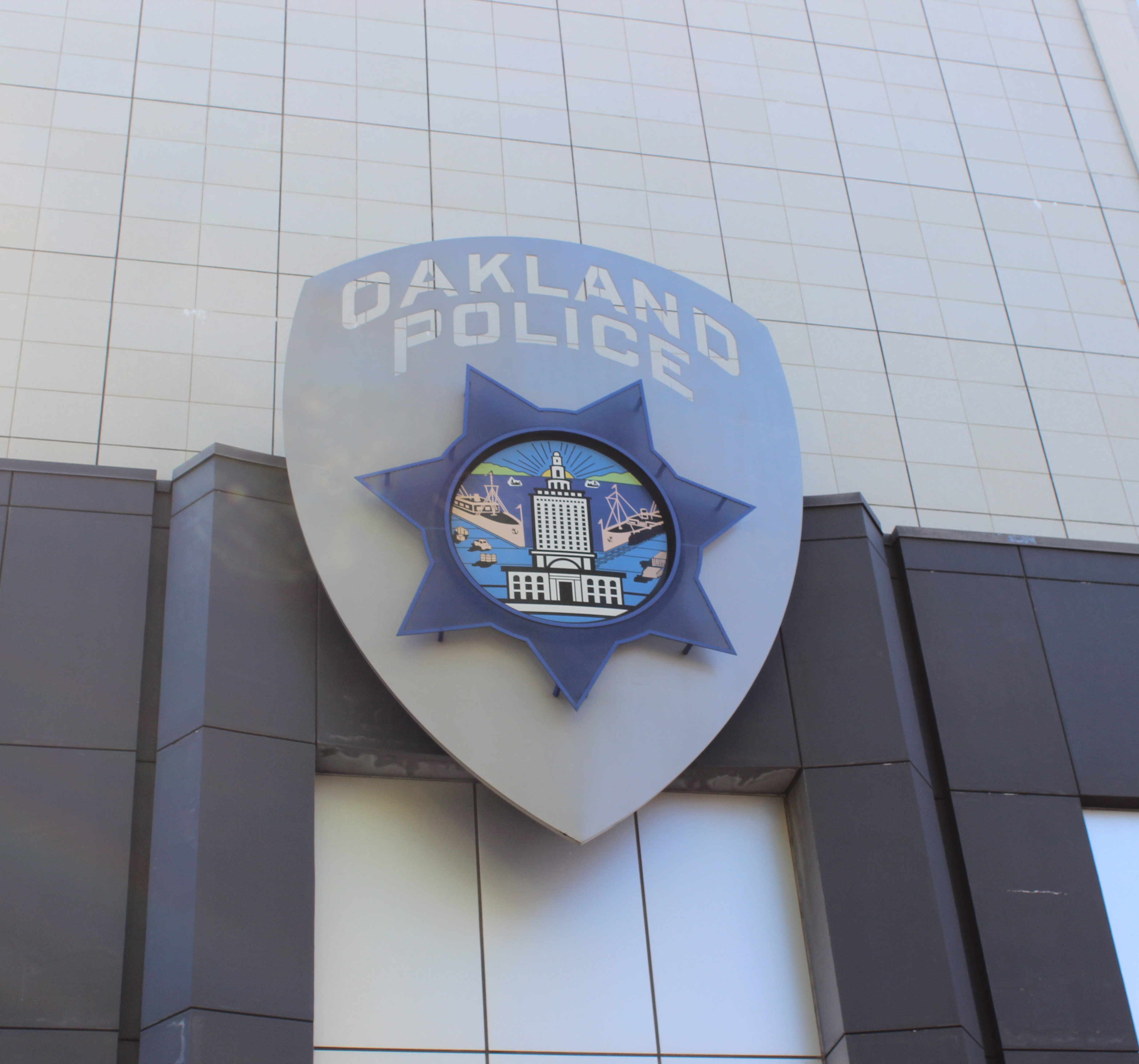
Unhoused Oakland residents say that officers from the Oakland Police Department (OPD) have been harassing and arresting them unjustly during the COVID-19 pandemic.
“We’re essential workers. We provide outreach to the community. There is no way, shape, form, or fashion we should even have been in that situation,” said unhoused resident Yanna Johnson, speaking of an incident on the evening of Friday, April 24 when police briefly detained her and arrested Leon Young, who is also unhoused, outside of The East Oakland Collective’s (EOC) headquarters near MacArthur Boulevard and 78th Avenue in East Oakland.
Before the incident, Johnson and Young had just finished doing work to provide essential needs to other unhoused people at risk for contracting COVID-19 who are temporarily sheltered in hotel rooms. EOC and Housing and Dignity Village (HDV), organizations that advocate for unhoused people, have fundraised to temporarily shelter those who are unsheltered and at risk for contracting COVID-19 at three different hotels.
Johnson and Young are lifelong Black Oakland residents. Needa Bee of HDV, who was helping at the hotels and was at the scene while the incident occurred says the police action was racially motivated.
“They targeted the Black folks who happened to be driving a luxury car that we got donated due to the work we’re doing,” said Bee.

Young says he was arrested due to a case of mistaken identity.
“[The officers] kept calling me this name: Emory, Emory, over and over again,” Young said.
One officer pointed a gun at Young’s face during the arrest.
“I got to fearing for my life,” said Young.
“Officers detained an individual at gunpoint who they believed at the time matched the description of a person wanted in connection with a prior shooting,” OPD media wrote in an email to Bay Area reporter Darwin BondGraham.
The same email also states that while “the officers determined he was not the shooting suspect,” Young was still transported to Santa Rita Jail because he had a no-bail warrant out in connection with an unrelated charge. He was released at eight the next morning.
Video of the incident that EOC’s Candice Elder posted to Facebook shows that some police did not wear masks during the incident and none wore gloves even while touching people. The Oakland Post emailed OPD media and asked if officers are required to wear gloves and masks in contact situations to protect themselves and the public from COVID-19 but have not yet heard a response.
In West Oakland, unhoused people living on and near Wood Street say there has been an increased police presence. Dayton Andrews of The United Front Against Displacement, a group that does clean up work around Wood Street and has recently installed handwashing stations and freshwater tanks at the site, says he’s seen police on site every weekend since shelter-in-place has started.
One unhoused Oakland resident told The Oakland Post his RV got stolen from Wood Street one night in mid-April so he sought shelter by putting pillows and a blanket in a van he said was “stripped and appeared abandoned.”
The resident said he saw a police officer and tried to tell him about his stolen RV, but while he was telling his story, the officer ran the VIN number on the van, which he found to be stolen, and arrested him for possession of a stolen vehicle, jailing him for a night. But the resident says he didn’t know the van was stolen.
Also in West Oakland, in the morning of April 24th and on 3rd and Peralta Streets, unhoused Oakland resident Paul Taj Schrager said that OPD and city workers pressured him to quickly move his three vehicles which blocked access to CalTrans land without, at first, offering to give him any aid with moving. The vehicles housed five people and his possessions, but one didn’t run.
“[They said] that we had an hour to move everything, and if not they’d come back with tow trucks. They were not very nice about it at all,” said Schrager.
Markaya Spikes, who lives nearby in a self-made home and says she had had previous interactions with the officers present, approached and helped mediate the situation. After discussion, Schrager says they agreed to let him into a city-sanctioned safe parking site.
When The Oakland Post contacted Schrager on April 27, he said he and the people he lives with never made it into the safe parking site. Instead, they moved to the other side of the street from where they had stayed previously.
“I was starting to pack and getting set to go, but I spoke with a person [at the safe parking site] that said I couldn’t just drive in,” said Schrager.



Activism
Oakland Post: Week of September 30 – October 6, 2026
The printed Weekly Edition of the Oakland Post: Week of September 30 – October 6, 2026

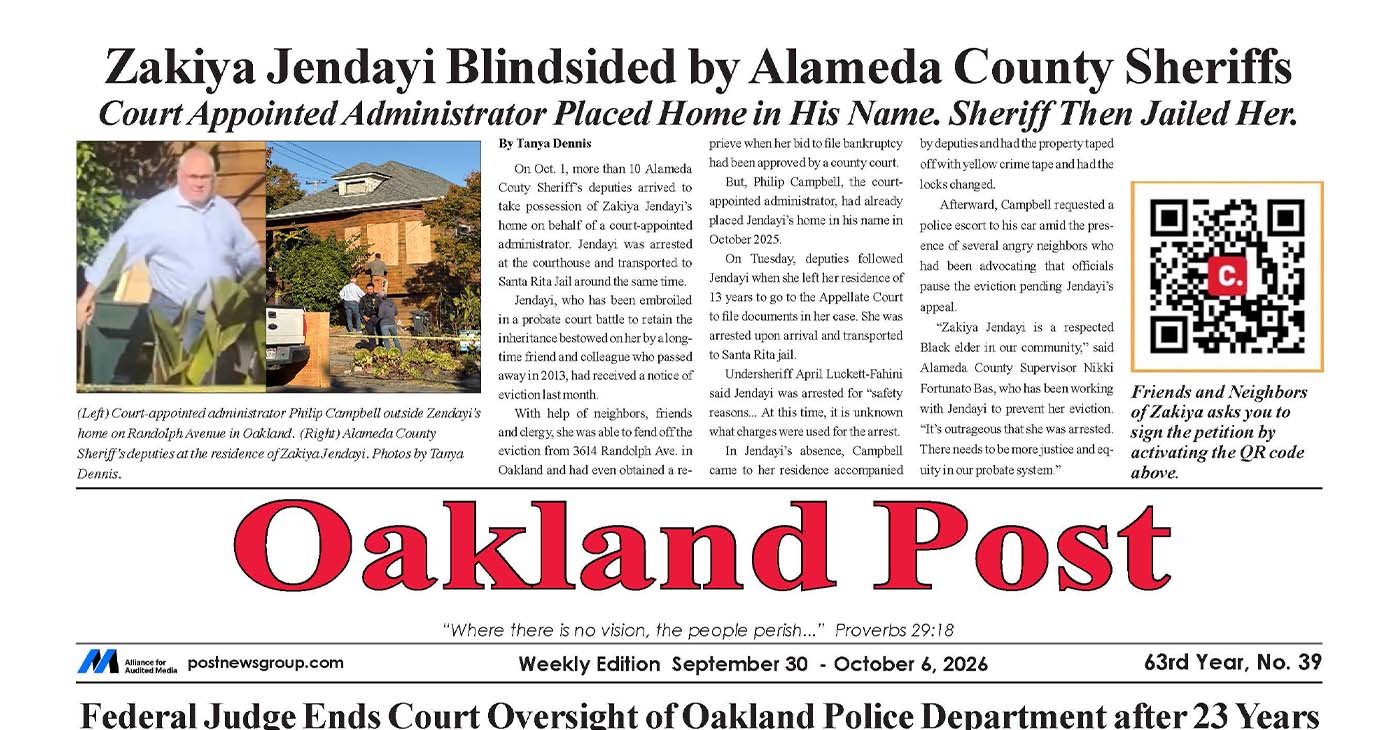
To enlarge your view of this issue, use the slider, magnifying glass icon or full page icon in the lower right corner of the browser window.

Activism
Oakland Post: Week of September 23 – 29, 2026
The printed Weekly Edition of the Oakland Post: Week of September 23 – 29, 2026

To enlarge your view of this issue, use the slider, magnifying glass icon or full page icon in the lower right corner of the browser window.

Activism
Oakland Post: Week of September 16 – 22, 2026
The printed Weekly Edition of the Oakland Post: Week of September 16 – 22, 2026

To enlarge your view of this issue, use the slider, magnifying glass icon or full page icon in the lower right corner of the browser window.



Listening as a Lifeline: A Doula’s Witness to Black Maternal Health

New Protections for Ticket Buyers: Gov. Newsom Signs Assemblymember Isaac Bryan’s Bill

‘We Don’t Talk Trash — We Pick Up Trash!’

Zakiya Jendayi Arrested, Locked Out of Home by Sheriff’s Deputies

Oakland Post: Week of September 30 – October 6, 2026

Asm. Corey Jackson Announces Launch of 24-Hour Childcare in His District

IN MEMORIAM: The Rev. Leon “Sonny” Clark, Longtime Orange County Pastor and Community Leader, Dies at 72

Poll: Becerra Widens His Lead Over Hilton; Californians Split on Wealth Tax

From Historic Memories to New Possibilities: Oakland Celebrates Coliseum 60

County Office of Education Says OUSD Finances Are Getting Healthier, Materially Stronger

LIVE FREE Sunday Dinner Brings Faith, Fellowship and Civic Conversation to Oakland

Remembering Chauncey Bailey as Student Journalists Face Threats to Truth-Telling

BLACspace Cooperative Invites Bay Area to Experience Oakland’s Black Cultural Ecosystem Through a BLAC Map Tour + Party

In Wake of Death on Doorstep, Williams Chapel Baptist Church Calls for Better Care, Funding for Unhoused

Oakland Centenarian Nuna McKee Honored!

Standoff for Justice: Our Homes Are Worth Fighting For

Oakland Post: Week of August 26 – September 1, 2026

Frontier Airlines’ Return to Oakland Airport Brings Flights, Jobs and Opportunity

Gubernatorial Candidate Steve Hilton Blasts California New Tire Rules; Newsom Hits Back

Chef Sharon Lee Blends Culinary Excellence, Education and Empowerment

Jackie Wright Champions Bay Area Stories, Filmmakers and Cultural Institutions

Misnamed ‘Parent’ PAC Seeks to Influence Oakland School Board Elections

Oakland Coliseum Project Opens Door for Small Businesses to Build Bigger

Big City Mayors Ask for “Yes” Vote on Housing Bond Measure; Conservatives Say “No”

Gov. Newsom’s Latest Appointees Include Sacramento Advocate for Formerly Incarcerated Students; State’s New Tech Chief

Longtime BWOPA Member Brendalyn Goodall Appointed to California Workforce Development Board

Gov. Newsom Signs Law Shielding Immigration Aid Workers From Doxing Threats

Secretary of State Shirley N. Weber Urges Californians to Vote Early as Voter ID Battle Intensifies

Oakland Post: Week of September 2 – 8, 2026

IN MEMORIAM: Dolly Parton Dead at 80 — How She Built a Legacy of Love and Earned Her Place in Black Culture

The Conversation With Al McFarlane 6/23/26

Media Monday 6/22/26

LIVE! ASK ALMA! — TUES. 6.23.26 7PM EST

Car Buying Secrets: 4 Hidden Checks Before You Sign!

Is This 550 HP Charger Worth YOUR Money? AutoNetwork Review

Celebrating Juneteenth – Frederick Douglass on education and resistance

LIVE! — ASK ALMA! — TUES. 6.19.26 7PM EST

Hyundai Ioniq 5 Parking, Safety, and 360 View #shorts

2025 Ioniq 5 New Wiper & Powerful Performance! #shorts

Electric SUV Range: Is 259 Miles Enough? #shorts

EV Charging: How Fast Can You Charge an Electric Vehicle? #shorts

Biometric Cooling… Messaging Seats…Come on! 2025 Infiniti QX80 Autograph 4WD

Charged Up: Witness the Magic of a Fully Electric Car! #shorts

Range Rover Sport PHEV Included…: See What’s Inside This Luxury SUV! #shorts

Invisible Hood View: Perfect Parking with X-Ray Vision! #shorts
-
 Community3 weeks ago
Misnamed ‘Parent’ PAC Seeks to Influence Oakland School Board Elections
-
 Activism4 weeks ago
Oakland Post: Week of September 2 – 8, 2026
-

 Activism3 weeks ago
Oakland Post: Week of September 9 – 15, 2026
-

 Community3 weeks ago
Richmond Tiny House Village Farm & Garden Set to Open Gates on Sept. 26
-

 Black History3 weeks ago
Latest Massacre in Haiti Reveals Cruelty U.S. Deportations
-

 Black History3 weeks ago
OPINION: Nolan Wells’ Death One of Several Signifying Racial Terror Lives on in U.S. South
-

 Business2 weeks ago
Mayor Lee Announces $1 Million Kaiser Permanente Grant for Pilot Program to Address Homelessness, Clean Up Public Spaces throughout Oakland
-

 Community3 weeks ago
Democratic Clubs Interview Candidates for Oakland School Board
