Activism
Young Adults Speak Out at Climate Adaptation Seminar
The Alliance of Regional Collaboratives for Climate Adaptation (ARCCA), is conducting a series of seminars entitled “Building an Inclusive and Equitable Adaptation Movement.” Their recent seminar, held on July 20, focused on the youth and how they could be more recognized and represented in the climate adaptation space.

The Alliance of Regional Collaboratives for Climate Adaptation (ARCCA), is conducting a series of seminars entitled “Building an Inclusive and Equitable Adaptation Movement.” Their recent seminar, held on July 20, focused on the youth and how they could be more recognized and represented in the climate adaptation space.
ARCCA is a coalition of the Local Government Commission and represents leading collaborative networks from across California that strive to build regional resilience to climate impacts. ARCCA members work to enhance public health, protect natural systems, build economies, and create resilient, livable communities throughout California.
ARCCA members effectively bolster their individual and collective efforts by sharing best practices and resources, identifying strategies to overcome key barriers and challenges, and conducting joint campaigns and projects.
ARCCA believes that the youth have been under-represented in the climate initiative. “It has become more apparent over the years that the youth, with their activism and experience, can have a pivotal role to play in our adaption to climate change. It is the goal of ARRCA, in their work in climate change, to expand the youth’s participation in their projects and actively include them in our leadership phases and decision-making processes,” said Catherine Foster, the moderator of the seminar, and ARCCA’s Climate & Energy Project manager, LGC.

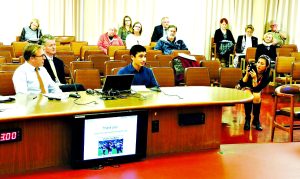
Three college graduates who were involved in the environmental movement on their campuses spoke during the seminar.
Tianna Shaw-Wakeman holds a Bachelor’s degree in psychology and a Master’s degree in Social Entrepreneurship from the University of Southern California, and graduated as the first Black Valedictorian for the Class of 2021. She served and led many of the prominent campus environmental activism groups. “We all work with people who are different places, so recognize the gaps in your knowledge, and also what the other person does and does not know,” Wakeman said.
Skyler Kriese graduated from Santa Clara University in 2020 with a B.S. in Environmental Studies. She is a 2020-2021 CivicSpark AmeriCorps Fellow supporting Butte County Department of Development Services on three grant-funded, long-range planning projects. Following her service year, she will continue her studies at the University of Michigan, pursuing an M.S. in Environmental Justice and Environmental Policy and Planning.
Kriese says that local governments need to identify environment justice communities and address environmental justice in their general plans. This is important so that processes and policies can begin to work and ultimately create healthier communities.
Moiz Mir was the president of the Environmental Student Organization at California State University Sacramento from 2017–2019. As an intern at the Sacramento Mayor’s Office, he organized youth summits to include students’ voices in the Mayors’ Commission on Climate Change and served on the commission’s Community Health, Resiliency and Equity Technical Advisory Committees.
Mir advocates building toward inclusivity, to reach out to a more diverse people in the work toward climate adaptation.
For more information on ARCCA and their upcoming seminars, go to https://arccacalifornia.org/embedding-equity-in-adaptation/

