
Politics
With court defeat, GOP health law effort now aimed at ’16


Students cheer as they hold up signs indicating the numbers of people in different states who would lose healthcare coverage, now over written with “still covered” stickers, after the Supreme Court decided that the Affordable Care Act (ACA) may provide nationwide tax subsidies, Thursday June 25, 2015, outside of the Supreme Court in Washington. (AP Photo/Jacquelyn Martin)
By Alan Fram
Associated Press
WASHINGTON (AP) — The Supreme Court’s resounding rejection of a conservative attempt to gut President Barack Obama’s health care overhaul won’t stop Republicans from attacking the law they detest. But now, their efforts will be chiefly about teeing up the issue for the 2016 presidential and congressional elections.
The court’s decision left GOP lawmakers stunned and uncertain about their next steps. Most agreed they would continue trying to annul the entire law and erase individual pieces of it, like its taxes on medical devices. Yet many also conceded they have little leverage to force Obama to scale back — let alone kill — one of his most treasured legislative achievements.
“Obamacare is fundamentally broken,” said House Speaker John Boehner, R-Ohio, who said repeal efforts would continue. But he declined to guarantee a vote on a replacement plan this year and said, “It’s very difficult to deal with it when you have a president that fundamentally disagrees with us. And so the struggle will continue.”
“We’ll continue to pick away at the law,” said Sen. John Barrasso, R-Wyo., a leader of Senate GOP efforts to craft a bill responding to a court victory that never came. “But ultimately our goal is to repeal and replace, and that’s not going to be possible until after the 2016 elections,” when Republicans hope for a GOP president.
That leaves Republicans mostly using efforts to void or dramatically weaken the health care overhaul to contrast their views with Obama’s for voters.
“I believe 2016 will be a national referendum on repealing Obamacare,” said Sen. Ted Cruz, R-Texas, who’s seeking his party’s presidential nomination.
Yet though few would admit it, the court’s ruling caused many Republicans to exhale.
By leaving intact federal subsidies that help millions afford health care, the ruling lets Republicans bash Obama’s law in their 2016 campaigns without having to quickly help those who would have lost assistance. GOP lawmakers are divided over how — and even whether — to help those losing subsidies, and failure to do so could have created many angry voters.
“There isn’t some sort of, that sword of Damocles hanging over our heads that people are going to lose their care in 30 days or something,” said Rep. Greg Walden, R-Ore., who heads House GOP campaign efforts.
Republicans have promised to repeal and replace Obama’s law since its 2010 enactment, but have yet to rally behind a plan doing that.
Had the GOP-backed lawsuit by conservatives succeeded, the 34 states likeliest to lose subsidies included many that will be pivotal in next year’s elections. That included Florida, a key presidential state where a national high of 1.3 million people could have lost assistance, plus Pennsylvania, Illinois, Ohio, Wisconsin and New Hampshire, where GOP senators could face tight re-election battles and worried about constituents losing aid.
“The court has saved Republicans from themselves,” said former Rep. Tom Davis of Virginia, who once led the House Republican political organization.
It took just minutes for both sides to use the ruling for political fundraising. GOP presidential hopeful Jeb Bush, the former Florida governor, emailed for money to stop “the overreaches of the last six years,” while Senate Democrats warned that Republicans have “pledged to destroy Obamacare.”
The decision was a relief to the health care industry, which feared chaos in the insurance market, and business groups hoping Congress would now turn to making specific changes in the law to ease employers’ costs.
In Thursday’s ruling, the justices by 6-3 left intact subsidies that help 8.7 million people buy health insurance — most of whom analysts say couldn’t otherwise afford coverage.
Conservative plaintiffs said the law’s wording limited that aid to states running their own insurance marketplaces — not the three-dozen states using the federal website HealthCare.org. The law’s defenders said killing those subsidies would destabilize health insurance by increasingly leaving only sicker, costlier people with coverage — raising everyone’s rates.
“Congress passed the Affordable Care Act to improve health insurance markets, not to destroy them,” Chief Justice John Roberts wrote in the majority opinion, using the law’s formal name. Roberts’ deciding vote found the law constitutional in 2012.
“We should start calling this law SCOTUScare,” said dissenting Justice Antonin Scalia, using the court’s acronym.
Savoring his triumph at the White House, Obama noted that his law has had five years to take hold and said: “This is not about the Affordable Care Act as legislation, or Obamacare as a political football. This is health care in America.”
Even so, Republicans had little reason to back off, especially those concerned about primaries from conservative challengers. An April Associated Press-GfK Poll showed that 71 percent of Republicans oppose the law, compared to 33 percent of independents and 14 percent of Democrats.
“We’ve got to put something on the president’s desk, not just a repeal but what are we going to do, what’s our alternative,” said Rep. Tim Huelskamp, R-Kan.
In the latest potential wedge between conservatives and Boehner, the speaker said he had not decided whether to use streamlined procedures that could avoid a Senate filibuster. Conservatives want to use those rules, but that device can be used only rarely and some Republicans want to save it for something Obama might sign, like deficit reduction.
___
Associated Press writer Erica Werner contributed to this report.
Copyright 2015 The Associated Press. All rights reserved. This material may not be published, broadcast, rewritten or redistributed.


Activism
Oakland Post: Week of July 1 – 7, 2026
The printed Weekly Edition of the Oakland Post: Week of July 1 – 7, 2026
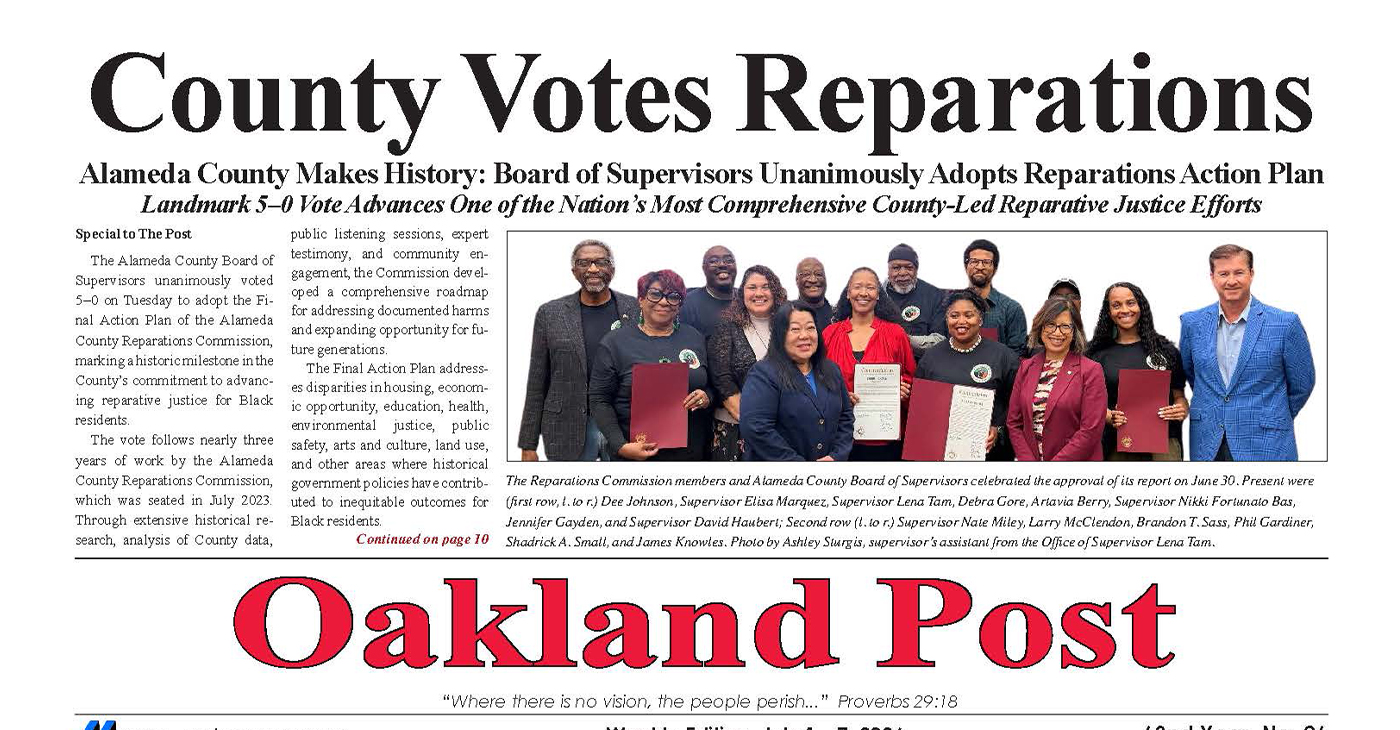
To enlarge your view of this issue, use the slider, magnifying glass icon or full page icon in the lower right corner of the browser window.
Activism
NPRC Joins National Grand Jury Proceedings Seeking Accountability, Constitutional Restoration
Organizers state that testimony will explore historical and political developments that they believe have contributed to the expansion of corporate influence over public institutions and governmental decision-making. Participants are expected to discuss concerns regarding constitutional governance, individual liberties, property rights, and the protection of vulnerable populations, including seniors and persons with disabilities.

Special to The Post
The National Probate Reform Coalition (NPRC) has joined Toll and Roll and a growing coalition of advocacy organizations, victims, whistleblowers, and citizen groups in support of a nationally broadcast People’s Grand Jury proceeding scheduled for July 1 and July 7.
Organizers describe the event as a public forum designed to examine allegations of government abuse, judicial misconduct, legislative failures, and the erosion of constitutional protections affecting millions of Americans.
The proceedings will feature testimony from victims, families, advocates, and organizations from across the country who contend they have experienced harm through government actions, institutional neglect, and failures of oversight.
According to organizers, the People’s Grand Jury will focus on concerns involving probate courts, guardianships, conservatorships, child welfare systems, property rights, civil liberties, and what participants view as a growing disconnect between government institutions and the constitutional rights of the people they are sworn to serve.
NPRC is participating because many of the issues being examined mirror the concerns raised by advocates, victims, and families who have participated in its monthly town halls. For years, families have reported cases involving exploitation of elders, questionable guardianships, estate depletion, denial of due process, and a lack of meaningful oversight within probate court systems.
“This proceeding gives victims and advocates an opportunity to place their experiences on the public record,” said Tanya Dennis, lead facilitator of NPRC. “For too long, families have struggled to have their voices heard regarding elder abuse, probate exploitation, and government inaction. This forum allows those stories to be shared before a national audience.”
Organizers state that testimony will explore historical and political developments that they believe have contributed to the expansion of corporate influence over public institutions and governmental decision-making. Participants are expected to discuss concerns regarding constitutional governance, individual liberties, property rights, and the protection of vulnerable populations, including seniors and persons with disabilities.
In keeping with principles of transparency and fairness, invitations have been extended to legislators, members of the judiciary, law enforcement representatives, and other public officials who may wish to respond to concerns raised during the proceedings or defend actions taken by their respective institutions.
One of the primary outcomes sought by organizers is public consideration and support for the People’s Remedy and Restoration Act, a proposed legislative framework that advocates believe would strengthen oversight, increase accountability, provide remedies for victims of governmental abuse, and restore constitutional protections.
The proceedings are expected to be broadcast nationally, providing citizens throughout the United States an opportunity to observe testimony, review evidence presented, and participate in an ongoing conversation regarding government accountability and the protection of individual rights.
Advocates hope the hearings will encourage meaningful dialogue, legislative reform, and renewed public engagement in the democratic process.
Individuals, organizations, public officials, and members of the media interested in attending or obtaining access information may contact the organizers at tollandroll2025@gmail.com.
As Americans continue to debate the future of constitutional governance, judicial accountability, and the protection of vulnerable citizens, the July proceedings are expected to serve as a significant forum for public testimony and civic engagement. For more information, go to https://tollandroll.com
Activism
Local Civil Rights Attorney, Activist Walter Riley Reveals Life Lessons from 70 Years in the Movement
Widely known in Oakland for his unifying leadership on issues of social justice and human rights, Riley is also recognized for his famous son, Raymond “Boots” Riley, a rap artist, political activist, and successful filmmaker, whose latest film, “I Love Boosters,” is now in theaters and capturing national attention.

By Ken Epstein
Prominent civil rights attorney and activist Walter Riley recently went on radio station KPFA 94.1 to discuss his new book co-authored with local veteran organizer Jesse Strauss: “Civil Rights and Structural Attacks: Conversations with Walter Riley.”
Widely known in Oakland for his unifying leadership on issues of social justice and human rights, Riley is also recognized for his famous son, Raymond “Boots” Riley, a rap artist, political activist, and successful filmmaker, whose latest film, “I Love Boosters,” is now in theaters and capturing national attention.
Born in North Carolina, Riley has lived in San Francisco, Chicago, and Detroit, but his longtime home is Oakland, California.
Over the years, he was a leader in the South against Jim Crow, participated as a student in the historic 1968 San Francisco State University strike that created Black Studies and Ethnic Studies in the U.S. and scored victories in the fight for open college admissions.
He was also a labor organizer and was involved in early Black Panther Party formations, anti-war protests, and was a leader of the Progressive Labor Party, a pro-Mao, Marxist Leninist party.
In an interview on KPFA’s “Upfront” with host Brian Edwards-Tiekert on June 18, he discussed some of his formative experiences, born in 1944 to a family of sharecroppers who worked on a tobacco farm near Durham, North Carolina.
“I came from a farming family, the ninth child of 11 children,” Riley said. “My mom and dad got married as teenagers, and they were together for their entire lives. Growing up in this large family, we had to deal with various aspects of what it meant to live in an economically depressed area with parents who had come through what they called “Hoover times” (the Great Depression) in the South.
“They were proud of every one of their children when they took some stand, to develop and show some sense of dignity,” he said.
In his neighborhood, slavery was not a distant memory. There are many people “who knew firsthand what it was to have family members that had lived as enslaved people and lived in communities where enslaved people had lived.
“(Under tenant farming), the landowner negotiated for the entire family: the farmer, the wife, the children – everybody was involved on the farm. Kids were often engaged. We had to shovel, hoe tobacco to keep the weeds from taking over, to make sure that tobacco worms didn’t eat up the tobacco. If a child was old enough to plow, they would walk behind a horse or mule and plow a field, working from sunup to sundown,” he said.
The houses did not have indoor bathrooms, running water or electricity. “A lot of the names in the Black community were the same names as these slave owners. We could see the names of folks on the streets, street names of people who had enslaved people, and they were symbols to me of a world that did not see me as a human being, that has not treated my ancestors as humans, has treated us as chattel to be sold, to be owned, to be property,” Riley said
“When we were counted by our government, we were counted only for the purposes of allowing white people, white men, to have a vote.”
By 1950, when he was 6 years old, his family moved to another house, leaving tenant farming. His father took a job in construction.
“My parents wanted the younger kids to have education,” he continued. “The older kids had to work on the farms. By the time I came along, I was the second child born in a hospital. “My parents looked forward to younger kids to have more sense of independence from the economic and social depravities that they saw around them.”
Watching television, he became aware of the suffering under Jim Crow, including the lynching in Mississippi of Emmett Till in 1955 and Mack Parker in 1959.
When he was 13, he joined a picket line in town in front of a variety store chain that did not hire Black people and became active in the Civil Rights Movement. By time he was in high school, he had become a leader in the local chapter of the NAACP and met Malcolm X and later Medgar Evers, leaders who were both assassinated.
Married and with a child, he moved with his family in the early 1960s to San Francisco, attending San Francisco State University while working full time.
He participated in the San Francisco State University strike, the longest student strike in U.S. history, where students and their supporters prevailed in the face of mass arrests and daily violent police attacks.
While many people remember the strike for its historic victory – the creation of the first Black Studies and Ethnic Studies programs in the country. “But open admissions was the thing,” he said. “Open admissions had to do with people being able to go to school for free. People should be able to go to school just because they come here and say, ‘I want to go to school. I want an education’ (because) we live in a rich country.”
Studying Marxism, including dialectical materialism, he gradually began to understand structure of the system that needs to be changed, he said. “It requires a lot of study, and it still does.”
WORK FROM HOME
Home-based business with potential monthly income of $10K+ per month. A proven training system and website provided to maximize business effectiveness. Perfect job to earn side and primary income. Contact Lynne for more details: Lynne4npusa@gmail.com 800-334-0540


Diabetes in Black California: Turning the Tide from Crisis to Control

Oakland Post: Week of July 1 – 7, 2026

Prescott Circus Theatre Presents Free Summer Performance Series

NPRC Joins National Grand Jury Proceedings Seeking Accountability, Constitutional Restoration

Local Civil Rights Attorney, Activist Walter Riley Reveals Life Lessons from 70 Years in the Movement

50 Years Later, ‘Wake Up Everybody!’ Still Resonates During Black Music

Inaugural Juneteenth Awards Ceremony Celebrates the Fillmore’s Black History, Leadership and Resilience

Thousands Come Out to Celebrate Juneteenth in Richmond

East Oakland COGIC Celebrates Re-Dedication

Black Repertory Group Needs Volunteers to Help Shape the Next Generation of Artists and Leaders

Oakland Post: Week of June 24 – 30, 2026


Oakland Museum Presents Landmark Retrospective Celebrating Beloved Bay Area Artist Mildred Howard

Ferry Fares to Increase July 1 as Ridership Hits Record Highs

Stop the Hate Symposium Brings Oakland Together Through Dialogue, Partnership, and Community Healing

After 10-Year Wait, Fillmore Heritage Center Reopens in San Francisco

Oakland Post: Week of June 3 – 9, 2026

Oakland Post: Week of May 27 – June 2, 2026

COMMENTARY: Black Music is the Sound of Black Freedom: Let Us Reclaim Both This Juneteenth

2026 World Cup is Here and Atlanta is Ready For It

Oakland Director Boots Dazzles Once Again in ‘I Love Boosters’

Oakland Post: Week of June 10 – 16, 2026

5 Cleveland Police Officers Injured, Gunfire Erupts During East Side Pursuit

Sale of Coliseum to African American Developers Moves Toward Completion

Oakland Post: Week of June 17 – 23, 2026

Venus Williams Calls a Sabalenka Exit a Tragedy

COMMENTARY: Using Art, Healing, And Community to Transform Mental Health Dialogue
Ferry Fares to Increase July 1 as Ridership Hits Record Highs

UC Berkeley Named Top Public University in the U.S. and No. 7 in the World by ‘U.S. News’

The Conversation With Al McFarlane 6/23/26

Media Monday 6/22/26

LIVE! ASK ALMA! — TUES. 6.23.26 7PM EST

Car Buying Secrets: 4 Hidden Checks Before You Sign!

Is This 550 HP Charger Worth YOUR Money? AutoNetwork Review

Celebrating Juneteenth – Frederick Douglass on education and resistance

LIVE! — ASK ALMA! — TUES. 6.19.26 7PM EST

Hyundai Ioniq 5 Parking, Safety, and 360 View #shorts

2025 Ioniq 5 New Wiper & Powerful Performance! #shorts

Electric SUV Range: Is 259 Miles Enough? #shorts

EV Charging: How Fast Can You Charge an Electric Vehicle? #shorts

Biometric Cooling… Messaging Seats…Come on! 2025 Infiniti QX80 Autograph 4WD

Charged Up: Witness the Magic of a Fully Electric Car! #shorts

Range Rover Sport PHEV Included…: See What’s Inside This Luxury SUV! #shorts

Invisible Hood View: Perfect Parking with X-Ray Vision! #shorts
-
 Art4 weeks ago
After 10-Year Wait, Fillmore Heritage Center Reopens in San Francisco
-
 Activism2 weeks ago
 -
 Art4 weeks ago
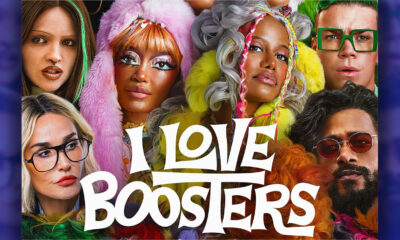
Oakland Director Boots Dazzles Once Again in ‘I Love Boosters’
-
 Activism4 weeks ago
Oakland Post: Week of June 10 – 16, 2026
-
 Business3 weeks ago
Sale of Coliseum to African American Developers Moves Toward Completion
-
 Activism3 weeks ago
Oakland Post: Week of June 17 – 23, 2026
-
 Alameda County2 weeks ago
Ferry Fares to Increase July 1 as Ridership Hits Record Highs
-
 Bay Area2 weeks ago
UC Berkeley Named Top Public University in the U.S. and No. 7 in the World by ‘U.S. News’
