
City Government
Will City-funded Jobs Go to Oakland’s Black Residents?

The City Council will vote Tuesday on a resolution to guarantee jobs for unemployed and underemployed African American and women workers who have long been left out of opportunities to work on city-funded construction projects.
The Oakland Post Salon last month voted unanimously to call on the City Council to strengthen its local job policies, raising concerns about whether the mayor’s $600 million infrastructure bond on the November ballot would create jobs for Oakland’s most impoverished residents.
Among the council members who are working with the community to advance the enhanced jobs proposals are Larry Reid, Rebecca Kaplan and Desley Brooks.
The resolution contains a set of proposals that would strengthen the city’s jobs policies and repair loopholes in existing policies – which have led to many jobs for Oakland residents – but not for African Americans or women.
Although African Americans make up 28 percent of the city’s population, they receive only 9 percent of the work hours on city-funded construction projects, according to city data.
The resolution would enact specific proposals to enhance local job opportunities.
First, the resolution would set hiring goals first by zip code, then citywide, within the city’s 50 percent Local Employment Program and 15 percent for the Oakland Apprentice Program.
In other words, half the jobs would go to people who live in the poorest, most impacted neighborhoods, mostly in East Oakland and West Oakland – people who have long been long left out of the economy.
“In specific districts of Oakland, the demographics are that of a Third World Country with high unemployment rates, dumping, blight, high crime rates, high school dropout rates, low birth rates and serious health conditions due to poor air quality, poor housing and stress tantamount to post traumatic stress syndrome,” the Sept. 27 city staff report said.
Second, the resolution would eliminate the “core employee” loophole, which has allowed building contractors to bring their own employees to a construction project, thus undermining the 50 percent local hiring commitment.
Third, the resolution would “mandate the immediate placement” of the city’s local hiring procedures and policies in all Project Labor Agreements, which promise that all jobs on city projects go to labor unions.
“The long-term concern is that ever present nature of exclusivity of Project Labor Agreements … tends to leave behind a significant portion of underemployed Oakland residents,” the report said.
“This request is to include the expectation of monitoring, enforcing and reporting in the name of Oakland residents first,” according to the report.
The report underscored the difficulty of changing the hiring patterns in construction.
“The construction industry… stops short in a level playing field for all ethnic groups,” the report said.
Finally, the resolution would apply the 50 percent local job program and 15 percent Oakland apprenticeship program to include professional service occupations and industries, including data entry, customer service, auto mechanics, warehouse workers and manufacturing.









Activism
Oakland Post: Week of April 1 – 7, 2026
The printed Weekly Edition of the Oakland Post: Week of April 1 – 7, 2026
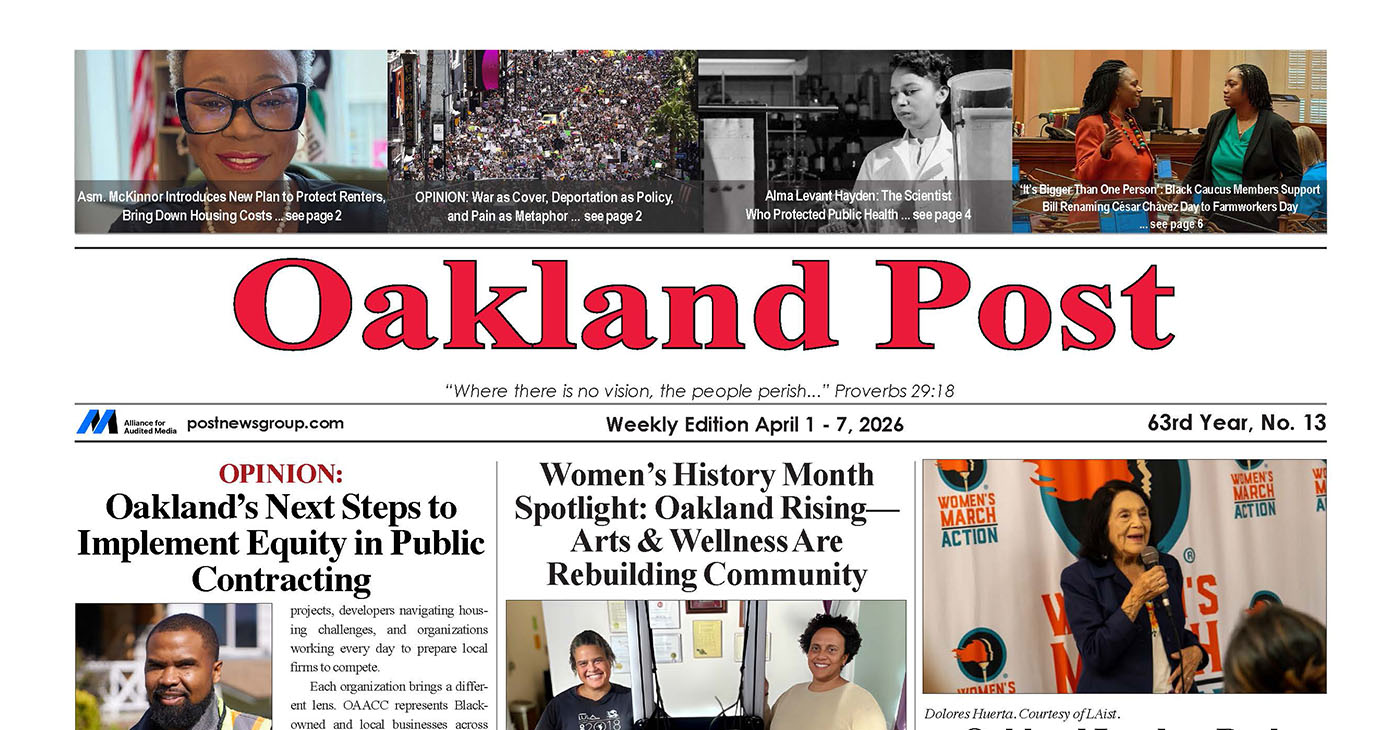
To enlarge your view of this issue, use the slider, magnifying glass icon or full page icon in the lower right corner of the browser window.
Activism
Oakland Post: Week of March 18 – 24, 2026
The printed Weekly Edition of the Oakland Post: Week of March 18 – 24, 2026

To enlarge your view of this issue, use the slider, magnifying glass icon or full page icon in the lower right corner of the browser window.
Activism
Oakland Post: Week of March 11 -17, 2026
The printed Weekly Edition of the Oakland Post: Week of March 11 – 17, 2026
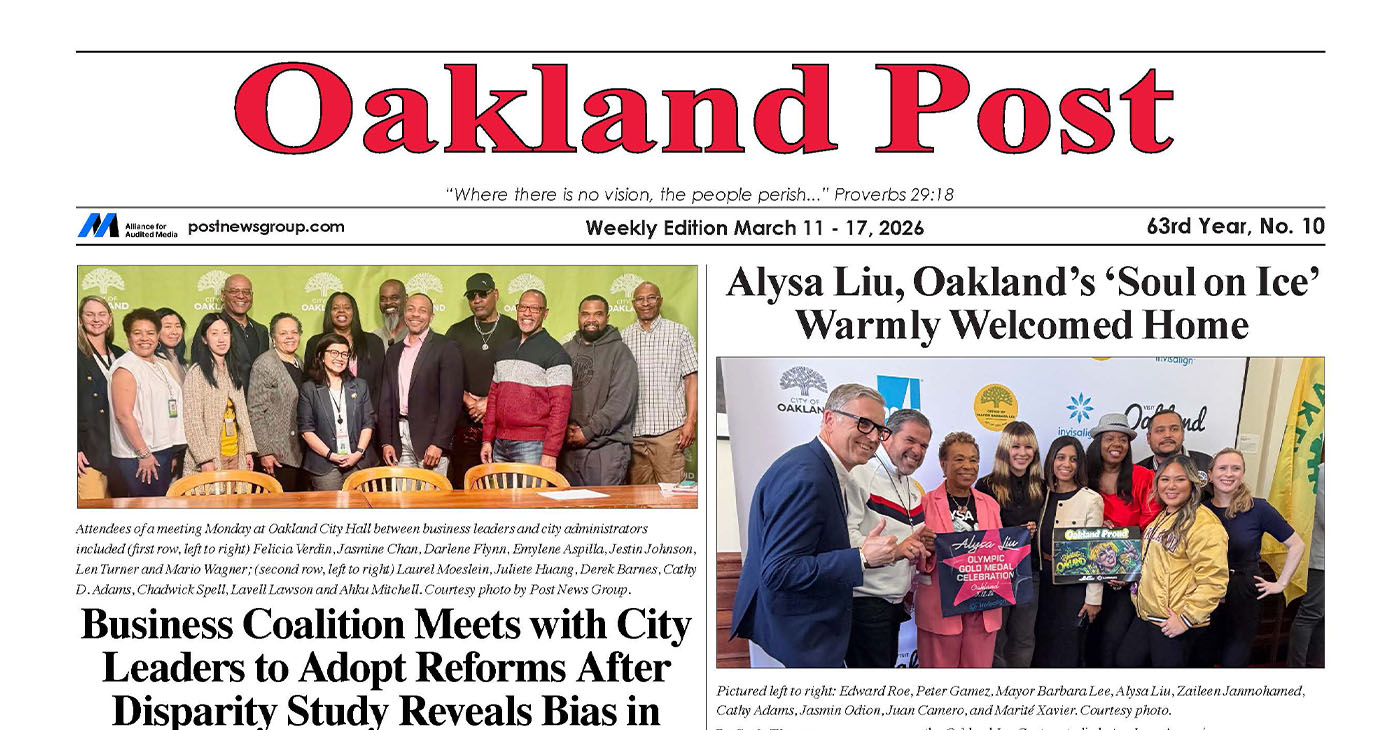
To enlarge your view of this issue, use the slider, magnifying glass icon or full page icon in the lower right corner of the browser window.


WORK FROM HOME
Home-based business with potential monthly income of $10K+ per month. A proven training system and website provided to maximize business effectiveness. Perfect job to earn side and primary income. Contact Lynne for more details: Lynne4npusa@gmail.com 800-334-0540


Oakland Post: Week of April 1 – 7, 2026

Black Artists in America, Installation Three Wraps at the Dixon Gallery and Gardens

Grief, Advocacy, and Education: A Counselor Reflects on Black Maternal Health

Future of Florida’s Black History Museum in Limbo

New Research Shows the Many Benefits of Early Learning

South Hampton K-8 Students Among Top 10 Finalists for Samsung’s ‘Solve for Tomorrow’ Competition

Cuba: No Negotiation with US on the President or Political System

Brooklyn Academy of Music Names Jamaican-Born Tamara McCaw as President

Trinidad & Tobego – U.S. Launches WhatsApp Channel for American Citizens in the Country

Oakland Post: Week of March 18 – 24, 2026

AI Innovation vs. Ethics and Environmental Impact

AI, Web3, and Digital Reparations

What If You Owned Your AI Agent?

Season 7, Episode 3 – January Reporter’s Roundtable 📱

Season 7, Episode 3 – January Reporter’s Roundtable

Reflecting on Black History Milestones in Birmingham AL

Oakland Post: Week of February 25 – March 3, 2026

Oakland Post: Week of March 4 – 10, 2026

PRESS ROOM: NBA Hall of Fame Nominee Terry Cummings Joins 100 Black Men of DeKalb County to Launch Victory & Values Initiative

Trump’s MAGA Allies are Creating Executive Order Plan to Steal the 2026 Midterms

U.S. manufacturing rebounds – how foundry services are adapting to rising demand

Poll Shows Support for Policies That Help Families Afford Child Care

Oakland Post: Week of March 11 -17, 2026
Oakland Post: Week of March 18 – 24, 2026

OP-ED: One Hundred Years of Black Workers Telling the Truth

Advancements in solar technology that are changing the way we power the world

Financial Wellness and Mental Health: Managing Money Stress in College

Woman’s Search for Family’s Roots Leads to Ancestor John T. Ward – A Successful Entrepreneur and Conductor on the Underground Railroad

COMMENTARY: Women of Color Shape Our Past and Future

PRESS ROOM: Civil Rights TV Launches in Selma as the World’s First 24/7 Civil Rights Television Network

Hyundai Ioniq 5 Parking, Safety, and 360 View #shorts

2025 Ioniq 5 New Wiper & Powerful Performance! #shorts

Electric SUV Range: Is 259 Miles Enough? #shorts

EV Charging: How Fast Can You Charge an Electric Vehicle? #shorts

Biometric Cooling… Messaging Seats…Come on! 2025 Infiniti QX80 Autograph 4WD

Charged Up: Witness the Magic of a Fully Electric Car! #shorts

Range Rover Sport PHEV Included…: See What’s Inside This Luxury SUV! #shorts

Invisible Hood View: Perfect Parking with X-Ray Vision! #shorts

AI Is Reshaping Black Healthcare: Promise, Peril, and the Push for Improved Results in California

ESSAY: Technology and Medicine, a Primary Care Point of View

Sanctuary Cities

The RESISTANCE – FREEDOM NOW

STATE OF THE PEOPLE: Freddie

ECONOMIC BOYCOTT DAY!!!!!

I told You So
-
 Activism3 weeks ago
Oakland Post: Week of March 11 -17, 2026
-
 Activism3 weeks ago
Oakland Post: Week of March 18 – 24, 2026
-
 Advice3 weeks ago
Financial Wellness and Mental Health: Managing Money Stress in College
-
 #NNPA BlackPress2 weeks ago
Brooklyn Academy of Music Names Jamaican-Born Tamara McCaw as President
-
 #NNPA BlackPress2 weeks ago
Grief, Advocacy, and Education: A Counselor Reflects on Black Maternal Health
-

 Advice4 weeks ago
Women & Wealth: Tips for Navigating Your Lifelong Financial Journey
-
 #NNPA BlackPress2 weeks ago
New Research Shows the Many Benefits of Early Learning
-
 #NNPA BlackPress2 weeks ago
Black Artists in America, Installation Three Wraps at the Dixon Gallery and Gardens
