
Black History
While Some Minority Students and Teachers Thrive in Distant Learning, Others Struggle Daily
NNPA NEWSWIRE — “There’s a bunch of research about the value add of Black teachers in school. It turns out that Black teachers help all students to perform better,” says Sekou Biddle, the Vice President of Advocacy and Student Professional Development Programs at the United Negro College Fund. “White students perform better too. When Black people do well, everyone does well. The problem is that when others do well without us doing well, they leave us behind,” concluded Biddle, who leads advocacy efforts to ensure that more African American students will be college-ready and better prepared to enroll in and complete college.


By Stacy M. Brown, NNPA Newswire Senior National Correspondent
@StacyBrownMedia
Sponsored by the Bill and Melinda Gates Foundation, the NNPA continues its campaign to raise awareness about education barriers for students of color and help bridge the learning gap for minorities, especially during the coronavirus pandemic.
In a series of interviews with Dr. Edwards-Jones and other educators and community stakeholders, the NNPA hopes to push the importance of bridging the education gap and digital divide that has long proven challenging for minority students.
Dr. Peggy Edwards-Jones has spent much of the past two decades as a principal at the Friendship Collegiate Academy Early College Campus in the Northeast section of Washington, D.C.
Incoming freshman at Friendship Collegiate Academy are referred to as scholars.
And with good reason.
In an interview with National Newspaper Publishers Association (NNPA) President and CEO, Dr. Benjamin F. Chavis Jr., Dr. Edwards-Jones relayed what she called her proudest moments in education thus far.
Those moments include graduating over 3,500 scholars, with a 100 percent acceptance rate to a college or university. Some of her scholars graduate with one to two years of college courses completed before leaving high school.
At least 80 percent of those scholars who graduated completed their first year of college. Ninety-nine percent of the students are African American or individuals of color.
“The biggest issue for minority students is an opportunity,” Dr. Edward-Jones offered.
“At our campus, students can select majors like science, engineering, and computer science and take courses toward graduation,” Dr. Edwards-Jones added.
Dr. Edwards-Jones sits on several boards and committees, including the National Save Our Schools Coalition, the American Federation of Teachers Program and Policy Council, D.C. Community School Task Force, and the Advisory Panel to the National Commission on Writing in America’s Schools.
“The overall goal is to make sure that the students are college-ready, so we give them college courses. The biggest thing we have found across the country is access,” Dr. Edwards-Jones posited.
Other professionals noted that access for the underserved is vital.
“We can see our students prevail with access, just like any other groups across the country.”
“Black children need to hear about and learn about Black excellence, not as a set of exceptional stories, but that these are happening every single day,” said Sekou Biddle, the Vice President of Advocacy and Student Professional Development Programs at the United Negro College Fund (UNCF).
“The thing that people miss is the importance of Black educators,” Biddle offered further.
“There’s a bunch of research about the value add of Black teachers in school. It turns out that Black teachers help all students to perform better,” he pronounced.
“White students perform better too. When Black people do well, everyone does well. The problem is that when others do well without us doing well, they leave us behind,” concluded Biddle, who leads advocacy efforts to ensure that more African American students will be college-ready and better prepared to enroll in and complete college.
Biddle manages UNCF’s advocacy platform, including three major components: grass-tops partnerships, grassroots engagement, and messaging and research.
Elizabeth A. Davis, the new president of the Washington Teachers’ Union (WTU), told the NNPA that the pandemic had magnified the digital divide.
“The digital divide is not new, and I am familiar with a lot of the inequities that have existed in D.C. public schools,” Davis noted.
She has helped transform the WTU into a social justice, solution-driven organization dedicated to advancing and promoting quality education for all children regardless of their zip codes or results of a school lottery.
“The pandemic has pulled back the covers on a lot of these inequities, and they’ve been glaring,” Davis added.
“I refer to the achievement gap as the ‘opportunity gap’ because the achievement gap goes to capacity to learn.”
“In our students, I have not met a student in my 40 years of teaching that did not have the capacity to reach whatever bar I set for them. What I have noticed is that the opportunity to learn for African American students, not only in the District but throughout the country, has not been there.”
Davis said the inequities in education must be addressed in meaningful ways.
“We can’t exclude poverty and homelessness,” Davis proclaimed.
“We have 6,000 students in our public school system in D.C. that report to school from homeless shelters. It is going to take a heavy lift and a deep amount of understanding. We cannot overlook the fact that our students, Black and Brown students, have been trying to catch up, and collaboration is key to that. It’s quite critical.”
Finally, Davis offered that teachers also require support.
“In mid-March when teachers had to transition very quickly from brick-and-mortar teaching to distant teaching, they did so in five days with no professional training,” Davis recalled.
“We know we will be in a hybrid model of teaching for some time, so we need to get distance learning right. The first step is closing the digital divide,” she said.
“We want each student to have one-to-one devices, and we need to talk about preparing our teachers with sustained and ongoing professional development that not only help them develop the know-how to use the digital platforms but the know-how to transition to vigorous and well-rounded content.”





Activism
Oakland Post: Week of March 11 -17, 2026
The printed Weekly Edition of the Oakland Post: Week of March 11 – 17, 2026
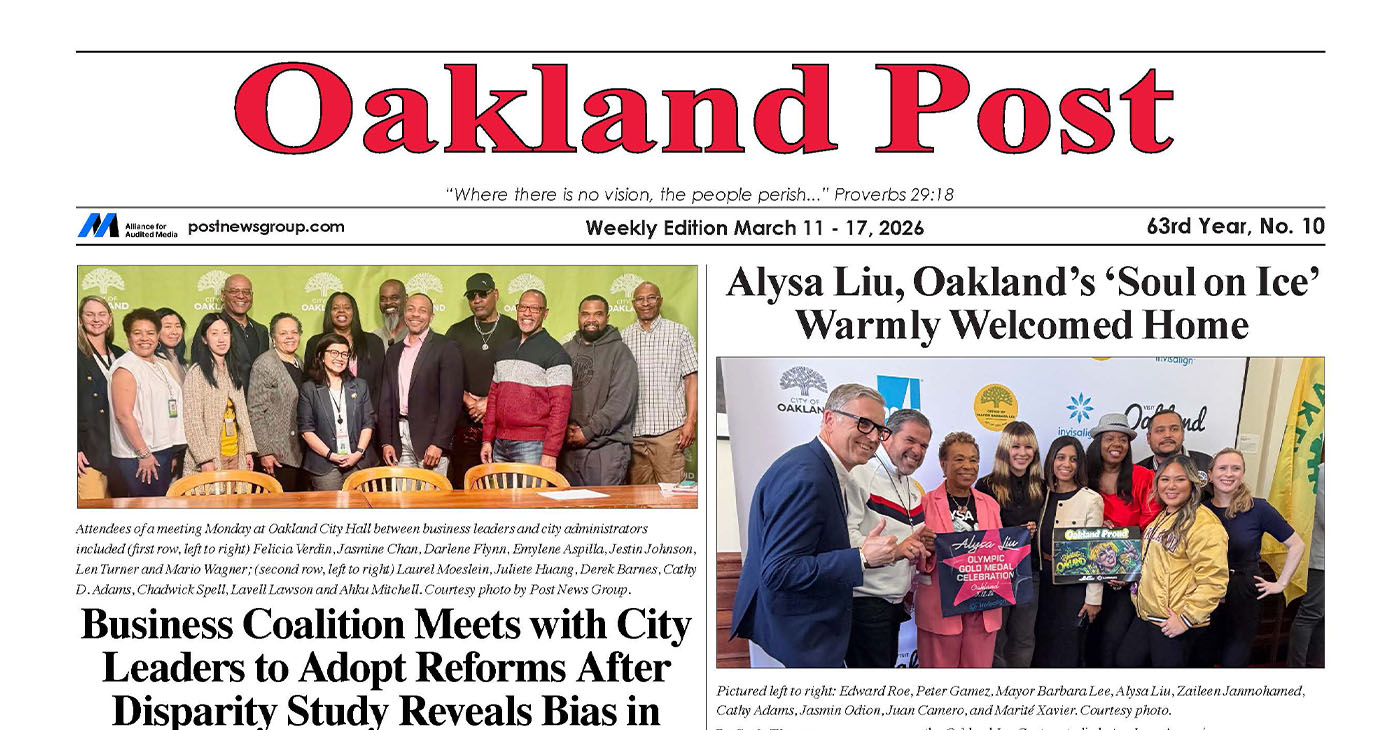
To enlarge your view of this issue, use the slider, magnifying glass icon or full page icon in the lower right corner of the browser window.
Activism
Oakland Post: Week of March 4 – 10, 2026
The printed Weekly Edition of the Oakland Post: Week of March 4 – 10, 2026

To enlarge your view of this issue, use the slider, magnifying glass icon or full page icon in the lower right corner of the browser window.
Activism
Oakland Post: Week of February 25 – March 3, 2026
The printed Weekly Edition of the Oakland Post: Week of – February 25 – March 3, 2026
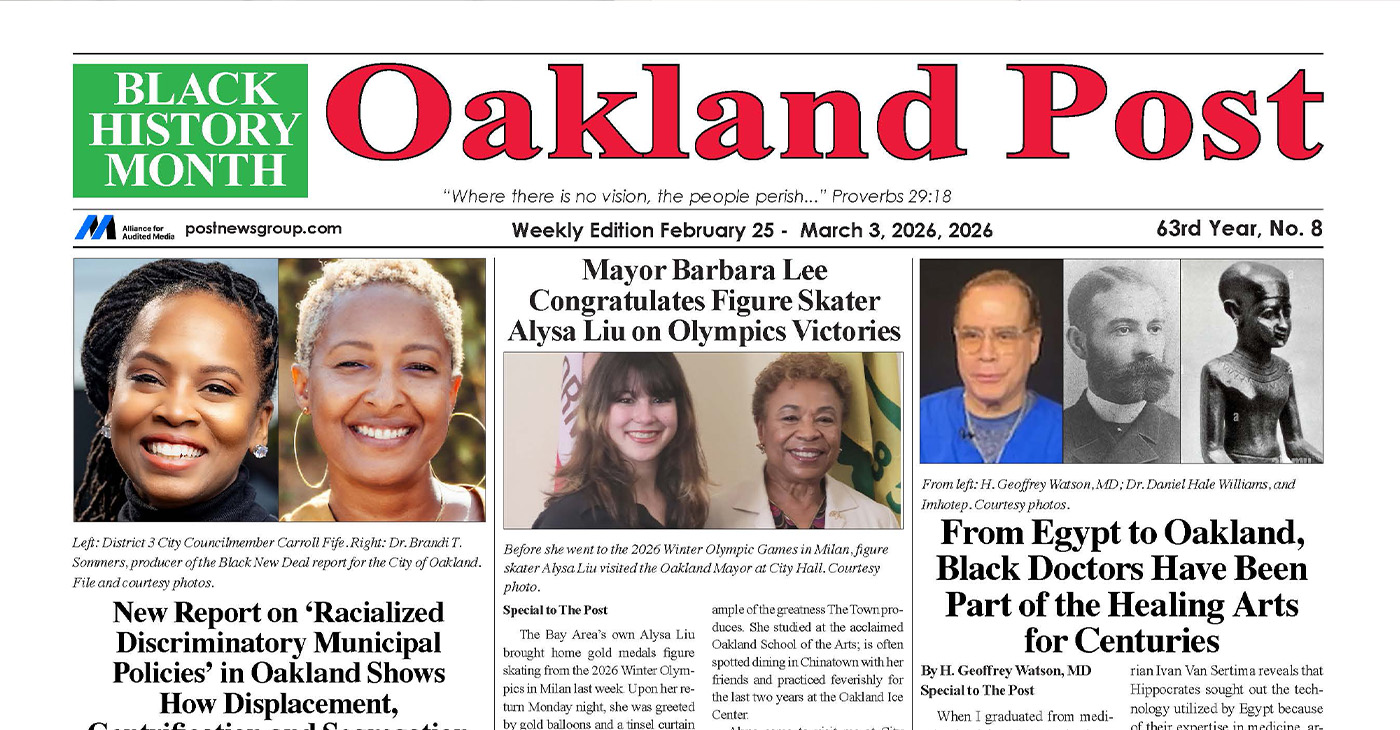
To enlarge your view of this issue, use the slider, magnifying glass icon or full page icon in the lower right corner of the browser window.
WORK FROM HOME
Home-based business with potential monthly income of $10K+ per month. A proven training system and website provided to maximize business effectiveness. Perfect job to earn side and primary income. Contact Lynne for more details: Lynne4npusa@gmail.com 800-334-0540


Financial Wellness and Mental Health: Managing Money Stress in College

Oakland Post: Week of March 11 -17, 2026

Women & Wealth: Tips for Navigating Your Lifelong Financial Journey

COMMENTARY: Women of Color Shape Our Past and Future

Woman’s Search for Family’s Roots Leads to Ancestor John T. Ward – A Successful Entrepreneur and Conductor on the Underground Railroad

Advocates Raise Alarm Over ICE Operation, MOU and Detention Risks in Baltimore County

Pete Buttigieg to Join Mayor Randall Woodfin for Community Town Hall in Birmingham

WATCH: Week One – NNPA’s “Leadership Matters” Video Series

Oakland Post: Week of March 4 – 10, 2026

OP-ED: NNPA Launches 2026 “Leadership Matters” Video Series

PRESS ROOM: PMG and Cranbrook Horizons-Upward Bound Launch Journey Fellowship Cohort 2

Los Angeles Summit Brings Together Leaders to Tackle Poverty and Affordability

Civil Rights TV Launches 24/7 Network Focused on Black History, Education and Equity

REVIEW: The Ultimate Hot Girl Summer Getaway: Sunseeker Resort Florida

COMMENTARY: How You Stop a Prescription Medicine is as Important as How You Start

Book Review: Books on Black History and Black Life for Kids

Community Celebrates Turner Group Construction Company as Collins Drive Becomes Turner Group Drive

Discrimination in City Contracts

California Launches Study on Mileage Tax to Potentially Replace Gas Tax as Republicans Push Back

COMMENTARY: The Biases We Don’t See — Preventing AI-Driven Inequality in Health Care

Black History Events in the East Bay

Post Newspaper Invites NNPA to Join Nationwide Probate Reform Initiative

Art of the African Diaspora Celebrates Legacy and Community at Richmond Art Center

New Bill, the RIDER Safety Act, Would Support Transit Ambassadors and Safety on Public Transit

COMMENTARY: The National Protest Must Be Accompanied with Our Votes

Oakland Post: Week of February 4 – 10, 2026

Oakland Post: Week of February 11 – 17, 2026

Dorothy Lee Bolden: Uniting Domestic Workers

After Don Lemon’s Arrest, Black Officials Raise Concerns About Independent Black Media

Reflecting on Black History Milestones in Birmingham AL

Hyundai Ioniq 5 Parking, Safety, and 360 View #shorts

2025 Ioniq 5 New Wiper & Powerful Performance! #shorts

Electric SUV Range: Is 259 Miles Enough? #shorts

EV Charging: How Fast Can You Charge an Electric Vehicle? #shorts

Biometric Cooling… Messaging Seats…Come on! 2025 Infiniti QX80 Autograph 4WD

Charged Up: Witness the Magic of a Fully Electric Car! #shorts

Range Rover Sport PHEV Included…: See What’s Inside This Luxury SUV! #shorts

Invisible Hood View: Perfect Parking with X-Ray Vision! #shorts

AI Is Reshaping Black Healthcare: Promise, Peril, and the Push for Improved Results in California

ESSAY: Technology and Medicine, a Primary Care Point of View

Sanctuary Cities

The RESISTANCE – FREEDOM NOW

STATE OF THE PEOPLE: Freddie

ECONOMIC BOYCOTT DAY!!!!!

I told You So
-
 #NNPA BlackPress3 weeks ago
Reflecting on Black History Milestones in Birmingham AL
-
 #NNPA BlackPress3 weeks ago
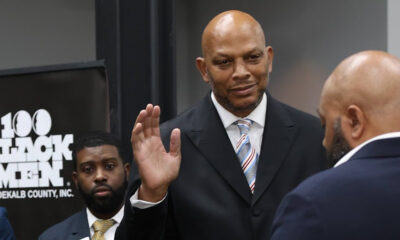
PRESS ROOM: NBA Hall of Fame Nominee Terry Cummings Joins 100 Black Men of DeKalb County to Launch Victory & Values Initiative
-

 #NNPA BlackPress4 weeks ago
U.S. manufacturing rebounds – how foundry services are adapting to rising demand
-

 #NNPA BlackPress4 weeks ago
OP-ED: One Hundred Years of Black Workers Telling the Truth
-
 Activism3 weeks ago
Oakland Post: Week of February 25 – March 3, 2026
-

 #NNPA BlackPress4 weeks ago
Advancements in solar technology that are changing the way we power the world
-

 #NNPA BlackPress3 weeks ago
Trump’s MAGA Allies are Creating Executive Order Plan to Steal the 2026 Midterms
-

 #NNPA BlackPress4 weeks ago
PRESS ROOM: Civil Rights TV Launches in Selma as the World’s First 24/7 Civil Rights Television Network
