Connect with us

News

Warriors Ready to Defend Their Championship & Represent “The Town”

Published

on

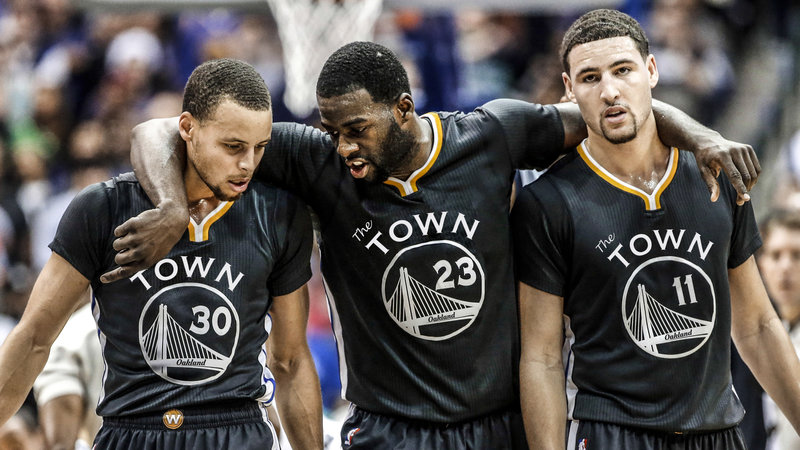
The 2016-2017 NBA Champions, the Golden State Warriors held their first media day ahead of the upcoming season last Saturday at their downtown Oakland facility.  The team introduced some of the new players as well as their new “The Town” jerseys.
The new jerseys pay  tribute to the team’s over four decade history in Oakland and will be worn on special occasions.  With yellow trimming and a gray base, the jersey has dislpays the city’s Oak tree symbol prominently across each player’s chest. NBA all star Klay Thompson modeled the jerseys in several photo shoots for the media. And as the defending champions, and winner of two championships in the past three years, there is a lot of pressure on the team look good on and off the court.
             
“This year reminds me of two years ago, with the continuity, almost the exact roster coming back,” said Warrior head coach Steve Kerr. “I expect that we’ll be able to get right into camp and make progress right away without having to build too much of the foundation. The foundation is already there.”
One of the new players added to the foundation is Nick Young, a 6-foot-6 wing from USC, who last played for the Los Angeles Lakers.  Also called ‘Swaggy P’,  Young is a colorful player with charisma and a unique style.. He was a key scorer and a solid defender for the Los Angeles Lakers and he will be looked upon to play that role on the Warriors’ second unit. 
 
“For me, the goal is winning,” said Young. He said the teams feels like a family atmosphere and that was important in his decision to move.
“They all get along and they all talk from top to bottom,” continued Young. “I think that plays a major role on how they play on the court, too.It’s a family feel. They let you be you. You don’t have to worry about nothing else, just basketball.”
Young’s addition was good news to Kevin Durant.
“His (Young’s) personality fits perfectly,” added Durant. “Nick just always has that energy and excitement with him. It just feels that way every time I see him. So to be able to work with him every day is going to be a joy. And I know his game is going to translate, a guy that can shoot the ball, can score, create for everybody. I’m looking forward to going out there and getting better with him.”
 Stephen Curry is longest tenured Warrior on the team, as he heads into  his eighth year with the Warriors. He said that winning is the focus of the team. Not shots or touches, but winning.
“The way we play, everybody touches the ball,” said Curry.  “Everybody is involved, and everybody should be a threat when they’re on the floor. With the high IQ guys we have on this team, we just find a way for it to blend and work.”
Training camp runs through September with preseason games taking place in October. The regular season has been pushed up and the Warriors will host their first home game of the 2017-2018 season against the Houston Rockets on Tuesday, October 17th.

Continue Reading
Click to comment

Leave a Reply

Your email address will not be published. Required fields are marked *

Arts and Culture

COMMENTARY: Black Music is the Sound of Black Freedom: Let Us Reclaim Both This Juneteenth

Black Music Month started when Black Music Association members Ed Wright, Kenny Gamble and his wife, journalist and radio host Dyanna Williams were able to persuade President Jimmy Carter to establish the observation on June 7, 1979.

Published

on

Robert Johnson (1911-1938) is thought of as the godfather of blues music, especially Delta blues. The 29 songs recorded by him during his short life have been of massive inspiration to guitarists and musicians over the last 80 years. Public domain photo.

By Wanda Ravernell

Black Music Month and Juneteenth are inextricably linked – Black music is the sound of our freedom.

From the plaintive moans of the enslaved Africans’ ‘sorrow songs,’ to the fields of Civil War battle where Black soldiers picked up abandoned bugles, to the upright piano played in juke joints on Saturday night and churches come Sunday morning, our ancestors’ innovation in the face of want, fear, degradation, and hopelessness has yielded genres of music imitated ’round the world.

Black Music Month started when Black Music Association members Ed Wright, Kenny Gamble and his wife, journalist and radio host Dyanna Williams were able to persuade President Jimmy Carter to establish the observation on June 7, 1979.

In 2000, Congress made it official. In 2009, Pres. Barack Obama changed the name to African American Music Heritage Month and in 2023, Pres. Joe Biden changed it back to Black Music Month, two years after he declared Juneteenth a national holiday, the result of a movement led by Opal Lee.

Our ancestors battle for freedom over these last 400 years and the music that allowed them expression of their humanity deserved to be honored.

But we may be losing sight of the value of their sacrifices.

‘Sing a Song Full of the Faith That the Dark past Has Taught Us…’

Along with the long-known exploitation of Black musicians whose recordings were stolen by record companies, the commercialization of Juneteenth feels like another kind of theft.

I had never heard of Juneteenth until I moved to the Bay Area from my hometown of Philadelphia. I didn’t know it was one of many freedom festivals celebrated by descendants of enslaved people in the United States.

Emancipation Day was Jan. 1 in Pennsylvania, April 16 in Wash., D.C., May 20 in Florida, and Aug. 8 in Kentucky. But Juneteenth, June 19, has the most renown, known in Texas as the ‘colored peoples’ Fourth of July.’

It was marked by parades, beauty pageants, rodeos, backyard barbecues and church picnics.

Yes, church.

The formerly enslaved began the day praying in thanks for their freedom just as they had prayed for Jubilee – the day of freedom – when they had chains on their feet and hands. They ‘testified’ about their past suffering and how they had managed to overcome.

And they sang.

Although, we will not hold it this year, Omnira Institute’s Juneteenth Ritual of Remembrance recalled this part of Juneteenth with prayers in the languages of the African captives. In the middle of the ceremony, a soloist would lead us in singing “Many Thousand Gone” while we took turns reciting portions of the Emancipation Proclamation, the news of freedom that took more than two years to reach Texas – two months after the Civil War ended.

“Many Thousand Gone” was famously recorded by Black luminary Paul Robeson in 1947:

“No more auction block for me,

No more, no more

No more auction black for me

Many thousand gone.”

Other verses refer to the ‘pint of salt’ and the ‘driver’s lash,’ the realities of enslavement that they had survived.

‘Sing a Song Full of the Hope That the Present has Brought Us’

All of the genres of African American music have at their root songs like that, the essence being, as Stevie Wonder, wrote, “the joy inside our pain.” So Black music is not just music. It is our story, our history, our very strength.

During the Civil Rights Movement, which peaked 100 years after slavery ended, the people testified that it was the freedom songs – based on spirituals – that gave them the heart to march, face attack dogs, fire hoses, beatings, and shootouts with vigilantes.

The music reminded them that power was in the people. That music, our music, can do so again. We don’t have to accept the commodification of the products of our culture.

The power of those songs is showing a resurgence across the South as we battle again for the right to self-determination through the ballot box.

Those songs are the voices of our ancestors, voices forged in their blood, their sweat, their tears, joy and, above all, faith.  Those songs, those prayers live in our blood and our very breath.

This Juneteenth, let us reclaim those holy voices expressed in Black music for ourselves. It is our birthright. It can neither be bought nor sold.  No more. Never again.

Wanda Ravernell is the executive director of Omnira Institute, sponsor for 18 years of the Juneteenth Ritual of Remembrance and Oakland’s 11th Annual Black-Eyed Pea Festival, which will take place on Sept. 12.

Continue Reading

Activism

Oakland Post: Week of June 3 – 9, 2026

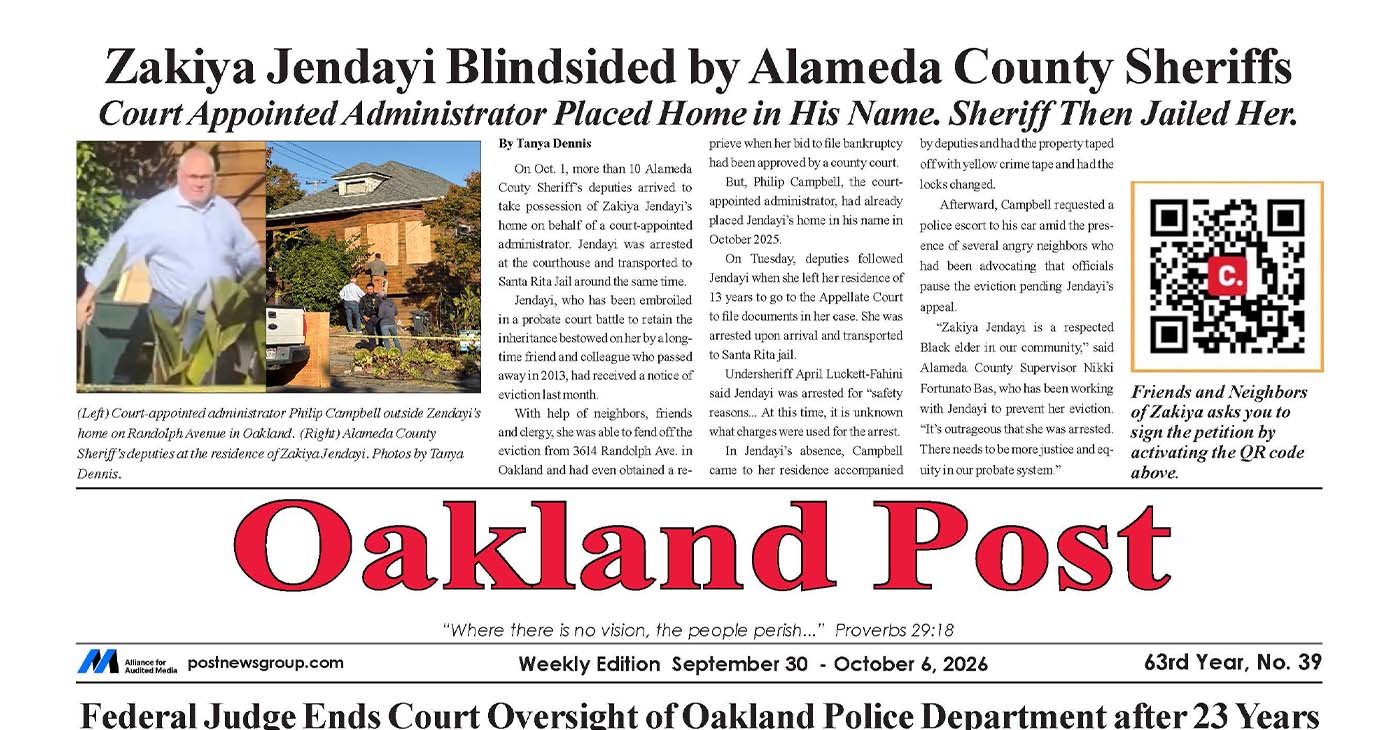
The printed Weekly Edition of the Oakland Post: Week of June 3 – 9, 2026

Published

on

To enlarge your view of this issue, use the slider, magnifying glass icon or full page icon in the lower right corner of the browser window.

Continue Reading

#NNPA BlackPress

Study: Waiting Lists for Child Care Assistance Nearly Doubled

BLACKPRESS USA NEWSWIRE — “Since the expiration of tens of billions of dollars in federal child care funding in 2023 and 2024, an already fragile child care system has been pushed even closer to the brink.”
The post Study: Waiting Lists for Child Care Assistance Nearly Doubled appeared first on BlackPressUSA.

Published

on

By National Women’s Law Center

The National Women’s Law Center released its annual State Child Care Assistance Policies report, finding that the number of children placed on waiting lists for federally funded child care assistance nearly doubled between 2024 and 2025 — and that number has only continued to grow.

The report serves as a key resource for state lawmakers, advocates, and policymakers by tracking state child care assistance policies and identifying where states are strengthening support for families and early educators — or falling behind.

“This deeply troubling increase in the number of children on child care waiting lists is the result of a failure to invest in this crucial sector,” said Karen Schulman, senior director of state child care policy and author of the report. “Since the expiration of tens of billions of dollars in federal child care funding in 2023 and 2024, an already fragile child care system has been pushed even closer to the brink.”

Key findings in the report related to waiting lists for child care assistance include:

• 17 states had waiting lists or a freeze on intake for child care assistance in February 2025, up from 13 states in February 2024.

• Approximately 106,700 children nationwide were added to waiting lists between February 2024 and February 2025, bringing the total to 225,500 children in February 2025 — a 90 percent increase compared to February 2024.

• The numbers climbed even further between February 2025 and summer/fall 2025, with more than 175,000 additional children added to state waiting lists in just a few months — a 78 percent increase.

• At least seven states newly began placing families on waiting lists or freezing intake, while at least 10 additional states saw their waiting lists grow, after February 2025.

The report also includes state-by-state data on key child care assistance policies, including income eligibility limits, parent copayments, provider payment rates, and eligibility policies for parents searching for work.

Click the link to learn more: Warning Signs: State Child Care Assistance Policies 2025.

The post Study: Waiting Lists for Child Care Assistance Nearly Doubled appeared first on BlackPressUSA.

Continue Reading

Subscribe to receive news and updates from the Oakland Post

* indicates required

CHECK OUT THE LATEST ISSUE OF THE OAKLAND POST

ADVERTISEMENT

WORK FROM HOME

Home-based business with potential monthly income of $10K+ per month. A proven training system and website provided to maximize business effectiveness. Perfect job to earn side and primary income. Contact Lynne for more details: Lynne4npusa@gmail.com 800-334-0540

Facebook

Trending

Copyright ©2021 Post News Group, Inc. All Rights Reserved.