
Activism
The War of Modern Life in America
As we come out of Memorial Day, let’s not forget the victims of all our “other wars.”


I don’t want to diminish the memory of those who fought in our military wars. They deserve Memorial Day.
But perhaps post-Memorial Day, we should take a moment to remember those who died in our other “American wars.”
Like the American Covid war, which as of Tuesday, stands at more than 594,201 deaths—more than any U.S. war since the Civil War.
Clearly the fight against Covid was a failure from the start, only coming into a better sense of control with a new administration’s no-nonsense, more scientific approach.
I thought about all that during a memorial tribute on Sunday to Corky Lee, the Asian American photographer who made it his life mission to document AAPI lives.

It was an event I was honored to have emceed.
While some people tried to get back to normal over the weekend, I was on Zoom with about 300 others celebrating my friend Corky, who died of Covid on Jan. 27. On that day, he was one of 4,101 to die of Covid in our country, making the total number back then around 429,000 deaths. In four months, the number of deaths has increased by nearly 30 percent.
That’s now considered “acceptable.”
It shouldn’t be.
The other war we must consider is the one we saw last week.
SAN JOSE-VTA RAMPAGE
Paul Megia, 42, would have been driving back home from Disneyland right now after celebrating the middle school graduation of one of his three children.
Instead, the family is in mourning. Megia, a Filipino immigrant, died in another mass shooting in America, this one in San Jose at the Valley Transit Authority..
The deaths from gun violence in our country have become so routine we hardly pay attention to them– unless they are “mass shootings.” Even then, there are so many that some only get cursory news coverage. (More than 239 as of May 31, according to the Gun Violence Archive).
But the ones covered are usually carried out by a gunman, a man on a mission, armed with a military assault weapon, and since March, a surprising number of Asian Americans were killed.
In Atlanta on March 16, six of the eight were Korean Americans.
In Indianapolis on April 16, four of the eight victims were Sikh Americans.
In San Jose, on May 26, nine innocent lives were lost in the deadliest mass shooting in the history of the Bay Area.
Two of the nine were Asian American. Taptejdeep Singh, 36, a Sikh American, was seen as a hero–, in the final moments of his life, he alerted others about the gunman. And then there was Megia, who immigrated to America from the Philippines as a toddler and found his American Dream working his way up the ranks from bus operator to assistant superintendent.
By my count, that’s 12 Asian American deaths in the three most publicized mass shootings since March.
The San Jose gunman, Samuel Cassidy, had three semi-automatic handguns, 32 high-capacity magazines, and fired 39 shots, as he went from building to building militaristically, killing some people, passing over others. Cassidy was known as a disgruntled employee since 2016 when he was stopped upon re-entering the country after a visit from the Philippines. DHS found books and notes about terror and violence, and how he hated the VTA.
This is modern life in America, where people like Megia and Singh can go to work with no guarantee of returning home.
As we come out of Memorial Day, let’s not forget the victims of all our “other wars.”
And mind you, I’m not even counting police-related shootings and incidents which make up its own category of shame.
Political folks must have the courage to acknowledge and deal with these “other wars” within our modern America that cost real lives and cause real pain. They will when we do.
Emil Guillermo is a journalist and commentator. He vlogs at www.amok.com FaceBook@ emilguillermo.media Twitter@emilamok











Activism
Oakland Post: Week of September 30 – October 6, 2026
The printed Weekly Edition of the Oakland Post: Week of September 30 – October 6, 2026

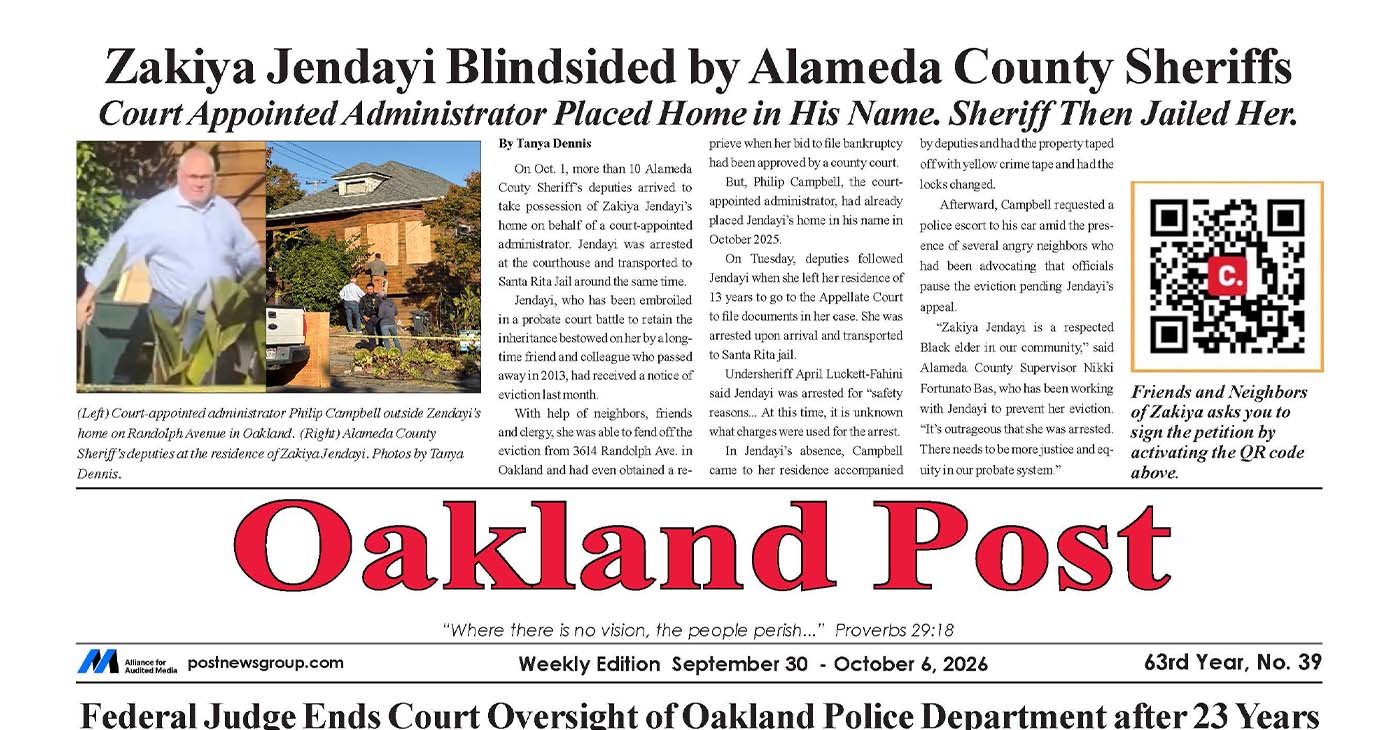
To enlarge your view of this issue, use the slider, magnifying glass icon or full page icon in the lower right corner of the browser window.

Activism
Oakland Post: Week of September 23 – 29, 2026
The printed Weekly Edition of the Oakland Post: Week of September 23 – 29, 2026

To enlarge your view of this issue, use the slider, magnifying glass icon or full page icon in the lower right corner of the browser window.
Activism
Oakland Post: Week of September 16 – 22, 2026
The printed Weekly Edition of the Oakland Post: Week of September 16 – 22, 2026

To enlarge your view of this issue, use the slider, magnifying glass icon or full page icon in the lower right corner of the browser window.



OP-ED: Proposition 44 Would Put a Price on Trust

OP-ED: Proposition 40: It’s Time to Play Chess, Not Checkers

Listening as a Lifeline: A Doula’s Witness to Black Maternal Health

New Protections for Ticket Buyers: Gov. Newsom Signs Assemblymember Isaac Bryan’s Bill

‘We Don’t Talk Trash — We Pick Up Trash!’

Zakiya Jendayi Arrested, Locked Out of Home by Sheriff’s Deputies

Oakland Post: Week of September 30 – October 6, 2026

Asm. Corey Jackson Announces Launch of 24-Hour Childcare in His District

IN MEMORIAM: The Rev. Leon “Sonny” Clark, Longtime Orange County Pastor and Community Leader, Dies at 72

Poll: Becerra Widens His Lead Over Hilton; Californians Split on Wealth Tax

From Historic Memories to New Possibilities: Oakland Celebrates Coliseum 60

County Office of Education Says OUSD Finances Are Getting Healthier, Materially Stronger

LIVE FREE Sunday Dinner Brings Faith, Fellowship and Civic Conversation to Oakland

Remembering Chauncey Bailey as Student Journalists Face Threats to Truth-Telling

BLACspace Cooperative Invites Bay Area to Experience Oakland’s Black Cultural Ecosystem Through a BLAC Map Tour + Party

Standoff for Justice: Our Homes Are Worth Fighting For

Oakland Post: Week of August 26 – September 1, 2026

Frontier Airlines’ Return to Oakland Airport Brings Flights, Jobs and Opportunity

Gubernatorial Candidate Steve Hilton Blasts California New Tire Rules; Newsom Hits Back

Chef Sharon Lee Blends Culinary Excellence, Education and Empowerment

Jackie Wright Champions Bay Area Stories, Filmmakers and Cultural Institutions

Misnamed ‘Parent’ PAC Seeks to Influence Oakland School Board Elections

Oakland Coliseum Project Opens Door for Small Businesses to Build Bigger

Gov. Newsom’s Latest Appointees Include Sacramento Advocate for Formerly Incarcerated Students; State’s New Tech Chief

Big City Mayors Ask for “Yes” Vote on Housing Bond Measure; Conservatives Say “No”

Longtime BWOPA Member Brendalyn Goodall Appointed to California Workforce Development Board

Oakland Post: Week of September 2 – 8, 2026

Gov. Newsom Signs Law Shielding Immigration Aid Workers From Doxing Threats

Secretary of State Shirley N. Weber Urges Californians to Vote Early as Voter ID Battle Intensifies

IN MEMORIAM: Dolly Parton Dead at 80 — How She Built a Legacy of Love and Earned Her Place in Black Culture

The Conversation With Al McFarlane 6/23/26

Media Monday 6/22/26

LIVE! ASK ALMA! — TUES. 6.23.26 7PM EST

Car Buying Secrets: 4 Hidden Checks Before You Sign!

Is This 550 HP Charger Worth YOUR Money? AutoNetwork Review

Celebrating Juneteenth – Frederick Douglass on education and resistance

LIVE! — ASK ALMA! — TUES. 6.19.26 7PM EST

Hyundai Ioniq 5 Parking, Safety, and 360 View #shorts

2025 Ioniq 5 New Wiper & Powerful Performance! #shorts

Electric SUV Range: Is 259 Miles Enough? #shorts

EV Charging: How Fast Can You Charge an Electric Vehicle? #shorts

Biometric Cooling… Messaging Seats…Come on! 2025 Infiniti QX80 Autograph 4WD

Charged Up: Witness the Magic of a Fully Electric Car! #shorts

Range Rover Sport PHEV Included…: See What’s Inside This Luxury SUV! #shorts

Invisible Hood View: Perfect Parking with X-Ray Vision! #shorts
-
 Community4 weeks ago
Misnamed ‘Parent’ PAC Seeks to Influence Oakland School Board Elections
-

 Activism4 weeks ago
Oakland Post: Week of September 9 – 15, 2026
-

 Community4 weeks ago
Richmond Tiny House Village Farm & Garden Set to Open Gates on Sept. 26
-

 Black History4 weeks ago
Latest Massacre in Haiti Reveals Cruelty U.S. Deportations
-

 Black History4 weeks ago
OPINION: Nolan Wells’ Death One of Several Signifying Racial Terror Lives on in U.S. South
-

 Business2 weeks ago
Mayor Lee Announces $1 Million Kaiser Permanente Grant for Pilot Program to Address Homelessness, Clean Up Public Spaces throughout Oakland
-

 Community4 weeks ago
Democratic Clubs Interview Candidates for Oakland School Board
-
 Uncategorized2 weeks ago
Oakland People’s Arms Embargo Coalition Demands End to Military Shipments Thru Oakland
