
Activism
The Bay Area Celebrates Dr. Martin Luther King Jr Day with Service, Marches, Music
“Make a career of humanity,” said King, who was assassinated in Memphis, Tenn., on April 4, 1968, when he had come to support a strike by underpaid sanitation workers. “Commit yourself to the noble struggle for civil rights. You will make a greater person of yourself, a greater nation of your country, and a finer world to live in.”


By Daisha Williams

Rev. Dr. Martin Luther King’s legacy of radical change and community empowerment will be celebrated on Monday, Jan. 20.
Though his birthday is Jan. 15, since 1986, the national holiday has been held on the third Monday of January, often as a day of volunteer service.
“Make a career of humanity,” said King, who was assassinated in Memphis, Tenn., on April 4, 1968, when he had come to support a strike by underpaid sanitation workers. “Commit yourself to the noble struggle for civil rights. You will make a greater person of yourself, a greater nation of your country, and a finer world to live in.”
There is a myriad of ways that people can spend this day, with many different options in the Bay Area.
In Oakland, the MLK Jr. Multicultural Rally Committee will hold its 34th annual Dr. Martin Luther King Rally on Jan. 20 at 10 a.m. at 99 Hegenberger Road featuring speakers from the MLK Freedom Center. For more information, call 510-827-2414.
The same day, the 11th Annual Reclaim MLK’s Radical Legacy Day of Action will be taking place. The Anti Police-Terror Project intends this march to hold true to Dr King’s values which have been watered down since his death. The march will begin at the Oscar Grant Plaza (Oakland City Hall) at 11 a.m.
Honoring the Day of Service, people of all ages can help clean up the Martin Luther King Jr. Regional Shoreline at Doolittle Drive and Swan Way in Oakland from 9 a.m.-12 noon. Cleanups are at the Tidewater Boating Center and Oakport Staging Area, and gardening and maintenance at MLK Grove. No registration required.
The African American Museum and Library at 659 14th St. will hold its annual film festival honoring Rev. King on Monday from 10 a.m. to 5 p.m. Films shown appropriate for children are “The Youngest Marcher” and “The North Star,” shown at 12:10 p.m. and 12:40 p.m. respectively.
In San Francisco, the week-long MLK festival has already started.
On Monday, one of the most enduring observations will occur. According to Johnny Funcheap, “the 2025 MLK March is a poignant and symbolic journey that pays homage to the historic Selma to Montgomery marches and the monumental Voting Rights Act of 1965. Spanning 1.5 miles, this commemorative march and parade begins at San Francisco’s Caltrain Station and winds its way through the heart of the city, ultimately culminating at the serene Yerba Buena Gardens.
“A parade will begin at 11 am starting at 4th and King streets, ending at the Yerba Buena Gardens where there will be a music festival and a health and wellness festival later in the day.”

Selma, AL, USA September 14, 2011 The Brown AME Church in Selma Alabama was the starting point of Martin Luther King’s March to Montgomery to support voting and civil rights
San Francisco is not the only place with events that day though.
In Hayward, there will be a free event on Monday celebrating MLK’s life, with a program of music, community awards and a keynote address by Rev. Amos Brown of San Francisco’s Third Baptist Church. It will be held at the Hayward Unified School District Performing Arts Center beginning at 2390 Panama St. at 4:30 p.m.
The City of Marin’s celebration in honor of Dr. King’s life will take place at 630 Drake Ave. in Sausalito from 11 a.m. to 3 p.m. and will include music, spoken word, youth presentation and speakers. Free and open to the public, this year’s theme will be “Voices of Change, Empowering a New Generation.”
There will be a similar celebration from 1 p.m. to 3 p.m. on Jan. 20 at the Solano County Fairgrounds McCormick Hall at 900 Fairgrounds Dr. in Vallejo. This event has been organized by the Solano County Black Chamber of Commerce and is free to attend. RSVP is required. Please call 707-673-2148 or www.solanoblackchamber.com.
A popular way to spend MLK Day is by giving back to your community. In Richmond, there will be a day of community service on the Richmond Greenway. The Watershed Project organized this event to beautify the greenway and provide opportunity for community reflection and empowerment. They will be meeting at Unity Park Community Plaza at 9 a.m. on Monday to kick off this event. Not only is this free to participate in, but lunch will be provided.
In Stockton, there will be a two-day celebration in honor of Dr. King with keynote speaker Bishop Jerry W. Macklin. The first part of this event will be on Jan. 19 at 5 p.m. at Progressive Community Church in Stockton at 2820 South B St. The next day, a Unity March will begin at 10 a.m. at the Stockton Memorial Civic Auditorium. Registration for the march begins at 9 a.m. This event is being put on by Ministers and Community United, INC.








Activism
Oakland Post: Week of September 30 – October 6, 2026
The printed Weekly Edition of the Oakland Post: Week of September 30 – October 6, 2026
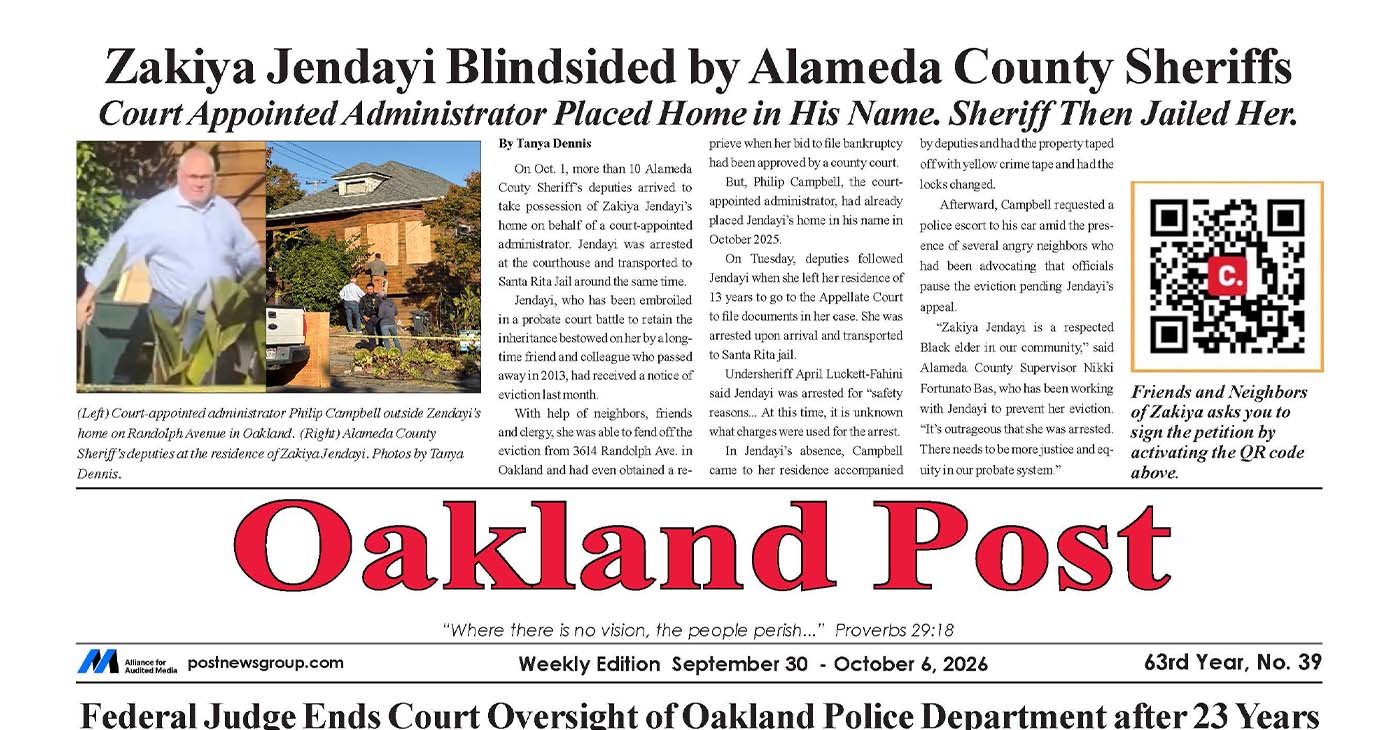
To enlarge your view of this issue, use the slider, magnifying glass icon or full page icon in the lower right corner of the browser window.
Activism
Oakland Post: Week of September 23 – 29, 2026
The printed Weekly Edition of the Oakland Post: Week of September 23 – 29, 2026

To enlarge your view of this issue, use the slider, magnifying glass icon or full page icon in the lower right corner of the browser window.
Activism
Oakland Post: Week of September 16 – 22, 2026
The printed Weekly Edition of the Oakland Post: Week of September 16 – 22, 2026

To enlarge your view of this issue, use the slider, magnifying glass icon or full page icon in the lower right corner of the browser window.


Listening as a Lifeline: A Doula’s Witness to Black Maternal Health

New Protections for Ticket Buyers: Gov. Newsom Signs Assemblymember Isaac Bryan’s Bill

‘We Don’t Talk Trash — We Pick Up Trash!’

Zakiya Jendayi Arrested, Locked Out of Home by Sheriff’s Deputies

Oakland Post: Week of September 30 – October 6, 2026

Asm. Corey Jackson Announces Launch of 24-Hour Childcare in His District

IN MEMORIAM: The Rev. Leon “Sonny” Clark, Longtime Orange County Pastor and Community Leader, Dies at 72

Poll: Becerra Widens His Lead Over Hilton; Californians Split on Wealth Tax

From Historic Memories to New Possibilities: Oakland Celebrates Coliseum 60

County Office of Education Says OUSD Finances Are Getting Healthier, Materially Stronger

LIVE FREE Sunday Dinner Brings Faith, Fellowship and Civic Conversation to Oakland

Remembering Chauncey Bailey as Student Journalists Face Threats to Truth-Telling

BLACspace Cooperative Invites Bay Area to Experience Oakland’s Black Cultural Ecosystem Through a BLAC Map Tour + Party

In Wake of Death on Doorstep, Williams Chapel Baptist Church Calls for Better Care, Funding for Unhoused

Oakland Centenarian Nuna McKee Honored!

Standoff for Justice: Our Homes Are Worth Fighting For

Oakland Post: Week of August 26 – September 1, 2026

Frontier Airlines’ Return to Oakland Airport Brings Flights, Jobs and Opportunity

Gubernatorial Candidate Steve Hilton Blasts California New Tire Rules; Newsom Hits Back

Chef Sharon Lee Blends Culinary Excellence, Education and Empowerment

Jackie Wright Champions Bay Area Stories, Filmmakers and Cultural Institutions

Big City Mayors Ask for “Yes” Vote on Housing Bond Measure; Conservatives Say “No”

Oakland Coliseum Project Opens Door for Small Businesses to Build Bigger

Misnamed ‘Parent’ PAC Seeks to Influence Oakland School Board Elections

Gov. Newsom’s Latest Appointees Include Sacramento Advocate for Formerly Incarcerated Students; State’s New Tech Chief

Longtime BWOPA Member Brendalyn Goodall Appointed to California Workforce Development Board

Gov. Newsom Signs Law Shielding Immigration Aid Workers From Doxing Threats

Secretary of State Shirley N. Weber Urges Californians to Vote Early as Voter ID Battle Intensifies

Oakland Post: Week of September 2 – 8, 2026

IN MEMORIAM: Dolly Parton Dead at 80 — How She Built a Legacy of Love and Earned Her Place in Black Culture

The Conversation With Al McFarlane 6/23/26

Media Monday 6/22/26

LIVE! ASK ALMA! — TUES. 6.23.26 7PM EST

Car Buying Secrets: 4 Hidden Checks Before You Sign!

Is This 550 HP Charger Worth YOUR Money? AutoNetwork Review

Celebrating Juneteenth – Frederick Douglass on education and resistance

LIVE! — ASK ALMA! — TUES. 6.19.26 7PM EST

Hyundai Ioniq 5 Parking, Safety, and 360 View #shorts

2025 Ioniq 5 New Wiper & Powerful Performance! #shorts

Electric SUV Range: Is 259 Miles Enough? #shorts

EV Charging: How Fast Can You Charge an Electric Vehicle? #shorts

Biometric Cooling… Messaging Seats…Come on! 2025 Infiniti QX80 Autograph 4WD

Charged Up: Witness the Magic of a Fully Electric Car! #shorts

Range Rover Sport PHEV Included…: See What’s Inside This Luxury SUV! #shorts

Invisible Hood View: Perfect Parking with X-Ray Vision! #shorts
-
 Community3 weeks ago
Misnamed ‘Parent’ PAC Seeks to Influence Oakland School Board Elections
-
 Activism4 weeks ago
Oakland Post: Week of September 2 – 8, 2026
-

 Community3 weeks ago
Richmond Tiny House Village Farm & Garden Set to Open Gates on Sept. 26
-

 Activism3 weeks ago
Oakland Post: Week of September 9 – 15, 2026
-

 Black History3 weeks ago
Latest Massacre in Haiti Reveals Cruelty U.S. Deportations
-

 Black History3 weeks ago
OPINION: Nolan Wells’ Death One of Several Signifying Racial Terror Lives on in U.S. South
-

 Community3 weeks ago
Democratic Clubs Interview Candidates for Oakland School Board
-

 Business2 weeks ago
Mayor Lee Announces $1 Million Kaiser Permanente Grant for Pilot Program to Address Homelessness, Clean Up Public Spaces throughout Oakland
