Politics
Supreme Court Upholds Nationwide Health Care Law Subsidies
Published
11 years agoon
By
Oakland Post

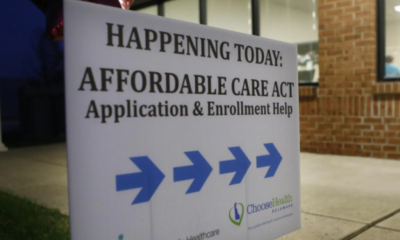
Supporters of the Affordable Care Act hold up signs as the opinion for health care is reported outside of the Supreme Court in Washington, Thursday June 25, 2015. (AP Photo/Jacquelyn Martin)
MARK SHERMAN, Associated Press
WASHINGTON (AP) — The Supreme Court on Thursday upheld the nationwide tax subsidies underpinning President Barack Obama’s health care overhaul, rejecting a major challenge to the landmark law in a ruling that preserves health insurance for millions of Americans.
The justices said in a 6-3 ruling that the subsidies that 8.7 million people currently receive to make insurance affordable do not depend on where they live, as opponents contended.
The outcome was the second major victory for Obama in politically charged Supreme Court tests of his most significant domestic achievement. And it came the same day the court gave him an unexpected victory by preserving a key tool the administration uses to fight housing bias.
Chief Justice John Roberts again voted with his liberal colleagues in support of the health care law. Roberts also was the key vote to uphold it in 2012. Justice Anthony Kennedy, a dissenter in 2012, was part of the majority on Thursday.
“Congress passed the Affordable Care Act to improve health insurance markets, not to destroy them,” Roberts declared in the majority opinion.
Limiting the subsidies only to individuals in states with their own exchanges could well push insurance markets in the other states “into a death spiral,” Roberts wrote.
Justice Antonin Scalia, in a dissent he summarized from the bench, strongly disagreed. “We should start calling this law SCOTUScare,” he said, using an acronym for the Supreme Court and suggesting his colleagues’ ownership by virtue of their twice stepping in to save the law from what he considered worthy challenges.
His comment drew a smile from Roberts, his seatmate and the object of Scala’s ire.
Scalia said that Roberts’ 2012 decision that upheld the law and his opinion on Thursday “will publish forever the discouraging truth that the Supreme Court of the United States favors some laws over others, and is prepared to do whatever it takes to uphold and assist its favorites.”
Justices Samuel Alito and Clarence Thomas joined the dissent, as they did in 2012.
Nationally, 10.2 million people have signed up for health insurance under the Obama health overhaul. That includes the 8.7 million people who are receiving an average subsidy of $272 a month to help pay their insurance premiums.
Of those receiving subsidies, 6.4 million were at risk of losing that aid because they live in states that did not set up their own health insurance exchanges.
The health insurance industry breathed a big sigh of relief, and a national organization representing state regulators from both political parties said the court’s decision will mean stable markets for consumers.
“This decision allows (state officials) to move forward with a level of confidence that their markets will not see significant disruption due to a paradigm shift,” said Ben Nelson, CEO of the National Association of Insurance Commissioners and a former Democratic senator from Nebraska.
Shares of publicly traded hospital operators including HCA Holdings Inc. and Tenet Healthcare Corp. soared after the ruling relieved those companies of the prospect of having to deal with an influx of uninsured people. Investors had worried that many patients would drop their coverage if they no longer had tax credits to help pay.
Republicans said the ruling would not mean the end of the political fight over the law, widely dubbed “Obamacare.”
Sen. Lindsey Graham of South Carolina, a Republican presidential contender, said that for 2016 candidates for Congress or the White House health care will be the “most dominant issue in the country.”
And Senate Majority Leader Mitch McConnell said Democrats who support the law “now have a choice: crow about Obamacare’s latest wobble toward the edge, or work with us to address the ongoing negative impact of a 2,000-page law that continues to make life miserable for too many of the same people it purported to help.”
The challenge devised by die-hard opponents of the law relied on four words — “established by the state” — in the more than 900-page law.
The law’s opponents argued that the vast majority of people who now get help paying for their insurance premiums are ineligible for their federal tax credits. That is because roughly three dozen states opted against creating their own health insurance marketplaces, or exchanges, and instead rely on the federal healthcare.gov to help people find coverage if they don’t get insurance through their jobs or the government.
In the challengers’ view, the phrase “established by the state” demonstrated that subsidies were to be available only to people in states that set up their own exchanges.
The administration, congressional Democrats and 22 states responded that it would make no sense to construct the law the way its opponents suggested. The idea behind the law’s structure was to decrease the number of uninsured. The law prevents insurers from denying coverage because of “pre-existing” health conditions. It requires almost everyone to be insured and provides financial help to consumers who otherwise would spend too much of their paycheck on their premiums.
The point of the last piece, the subsidies, is to keep enough people in the pool of insured to avoid triggering a disastrous decline in enrollment, a growing proportion of less healthy people and premium increases by insurers.
Several portions of the law indicate that consumers can claim tax credits no matter where they live. No member of Congress said that subsidies would be limited, and several states said in a separate brief to the court that they had no inkling they had to set up their own exchange for their residents to get tax credits.
The 2012 case took place in the midst of Obama’s re-election campaign, when Obama touted the largest expansion of the social safety net since the advent of Medicare nearly a half-century earlier. But at the time, the benefits of the Affordable Care Act were mostly in the future. Many of its provisions had yet to take effect.
In 2015, the landscape has changed, although the partisan and ideological divisions remain for a law that passed Congress in 2010 with no Republican votes.
The case is King v. Burwell, 14-114.
___
Associated Press writers Ricardo Alonso-Zaldivar, Connie Cass and Jessica Gresko in Washington and Business Writer Tom Murphy in Indianapolis contributed to this report.
Copyright 2015 The Associated Press. All rights reserved. This material may not be published, broadcast, rewritten or redistributed.
Oakland Post
You may like
-
Coalition Featuring Rev. Al Sharpton, Martin Luther King III Announces March on Washington 2026
-
COMMENTARY: Cruelty Is the Point: Haiti, TPS, and the Politics of Punishment
-
Nearly 5 Million Americans Lose ACA Health Coverage as Subsidies Expire
-
Supreme Court Voting Rights Ruling Reverberates From the South to California
-
ACA Deadline Nears as 20 million Brace for Higher Health Costs
-
Closing the Divide on Health Care Costs; It Won’t Be All Democrats Want
Black History
Fed Court to Decide Landmark First Amendment Case
CHICAGO DEFENDER — Three federal judges in Atlanta heard oral arguments in July regarding the appeal of the 2024 conspiracy conviction of the Uhuru 3. This appeal challenges the conviction of Chairman Omali Yeshitela, Penny Hess, and Jesse Nevel, who were found guilty of conspiracy to be secret agents of Russia. This verdict followed their acquittal on charges of serving as secret Russian agents.
Published
2 hours agoon
July 27, 2026
On July 22, 2026 three federal judges in the 11th Circuit Court of Appeals in Atlanta – Chief Judge William Pryor, Judge Jill Pryor and Judge Andrew Brasher – heard oral arguments in the appeal of the 2024 unconstitutional conspiracy conviction of the Uhuru 3.
A Tampa jury had acquitted 84-year-old veteran African liberation fighter Chairman Omali Yeshitela and two white reparations organizers Penny Hess and Jesse Nevel of serving as secret agents of Russia, but contradictorily convicted them on the secondary false charge of conspiracy to be secret agents of Russia – all because they had expressed opinions opposing the U.S. support for Ukraine along with advocating for reparations to African people and charging the U.S. with genocide in its treatment of Black people.
This precedent-setting anti-colonial free speech fightback has won international and national support from First Amendment defenders and social justice activists from across the political spectrum, including the National Lawyers Guild, the Civil Liberties Defense Center, the National Conference of Black Lawyers, the Center for Political Innovation, the U.S. Peace Council, U.S. Hands Off Cuba Committee, former NYC Councilman Charles Barron, Dr. Cornel West, Jimmy Dore, Max Blumenthal, Dr. Gerald Horne and Tucker Carlson.
During the 2024 trial, the Uhuru 3’s legal team convinced the jury that the opinions expressed by Yeshitela were his own and not directed by the Russian government by showing print and video evidence of Yeshitela’s activism spanning decades.
Chairman Omali’s published writings, showing a consistent worldview of African Internationalism and anti-colonialism, can be read in 58 years of The Burning Spear newspaper, freely available in the University of Florida’s digital newspaper collection.
In the past five decades he has traveled to seventeen countries to speak to audiences, including in 2019 as the winning presenter at the Oxford Union’s “Africa Debate”. He has been interviewed and featured on platforms such as CNN, Democracy Now, Al Mayadeen, Press TV and countless national and international radio stations, podcasts and newspapers.
The DOJ had argued that the Uhuru 3 are engaged in spreading disinformation “even if the information is true but it makes the government look bad.”
In their earlier Motion to Dismiss, attorneys for the Uhuru 3 argued, “The government here is using a federal criminal statute to prosecute members of an activist group for political speech and activism in opposition to U.S. foreign policy. In so doing, this prosecution strikes at the heart of the First Amendment.”
“This is the first case in which the government has used the statute that criminalizes unregistered foreign agents (18 USC §951) to target political or dissenting speech. In short, if this case is allowed to go forward, it will reverse more than eight decades of Supreme Court precedent that prohibits the government from targeting dissenting political speech and dissent.”
The appeal of the Uhuru 3’s false conviction on the lesser charge of conspiracy was filed a year ago on June 16, 2025. It argues three points, that:
- The lower court’s finding that lawful political speech loses its First Amendment protections when the speaker is alleged to be a Russian agent, should be reversed.
- The government presented insufficient evidence of a conspiracy as it presented no evidence, as conceded by the government’s own case agents, that the APSP defendants 1) acted or agreed to act under the direction or control of Ioniv or the AGMR, or 2) knew of the registration requirement, essential elements of a conspiracy.
- The jury was misled to believe that it could convict the defendants on the conspiracy charge despite the absence of evidence as to the underlying crime.
More than 80 Uhuru 3 supporters packed the Atlanta courtroom again on July 22, spilling into an overflow room where attendees watched the proceedings on closed circuit TV.
Notable figures attending the hearing included Attorney Mawuli Davis, National Co-Chair of the National Coalition of Black Lawyers; Belinda Parker Brown of Louisiana United International; Efia Nwangaza, veteran of the Student Nonviolent Coordinating Committee (SNCC) and Malcolm X Center for Self-Determination; John McCarthy of the Center for Political Innovation; Mark Friedman of the U.S. Hands off Cuba Committee and Paulette Dauteuil of the Jericho Movement and Leonard Peltier Ad Hoc Defense Committee.
Not a “content neutral” prosecution
The oral argument hearing took less than thirty minutes. Uhuru 3 Attorney Leonard Goodman began: “This is a novel case. It’s the first time that Section 951 has been used to directly target speech. The indictment does not allege that any of these defendants conspired to commit espionage or destroy property. Rather the indictment charges a conspiracy to disseminate pro-Russian political speech, which is described in the indictment as Russian “propaganda and disinformation”.
Chief Judge Pryor interjected, “This indictment seems to be necessarily to implicate speech, but the real question is whether the offense, that is, the failure to register for acting as an agent of a foreign government, is content neutral? It seems to me that it is. It may be that the speech activities on behalf of that foreign state would be evidence that you are an agent that hasn’t registered.
He went on to ask, “imagine for me a hypothetical where the individual was acting as an agent on behalf of the state of Israel and was advocating the attack on Iran, which the United States government was involved in as well and was supportive of the United States activities as well. It seems to me that would be an offense under this statute in that situation just as much as in this situation.”
Attorney Goodman tried to expose the fallacy of “content neutrality” by citing the think tanks in Washington D.C. that receive millions of dollars from U.S. allies who are not indicted as unregistered foreign agents, but he was cut off by the judges.
Some court observers were concerned that the judges’ comments appeared to favor the prosecution. But speaking to reporters as the Uhuru 3 and supporters emerged from the Atlanta Federal Courthouse, Chairman Omali said, “The court recognized there are some issues that need resolution. Attorney Leonard Goodman did an extraordinary job. The prosecution did not have a reasonable explanation about why we were facing conspiracy charges when the jury had found us not guilty on the foundational charge.”
He went on to say, “Nobody in this country has a connection to the struggle for free speech more than Black people. When the Bill of Rights was adopted in 1791, African people were property. We had no rights. There was no assumption it was for us. This is what I’m hoping that, particularly white people, would come to understand. When they came for us around free speech issues that we never had, it’s not us they’re coming for, they’re coming for you. They’re coming for everyone.”
Chairman Yeshitela’s lawyer, Attorney Ade Griffin declared, “We’re here today to change the law for generations to come. And that’s an extremely hard thing to do.”
At the Debrief
Uhuru 3 supporters then walked to the nearby Georgia State University College of Law for a debrief discussion forum and lunch co-sponsored by the Black Law Students Association and the Davis Bozeman Johnson Law group.
Attorney Leonard Goodman shared his reflections on the hearing. “When federal prosecutors want to prosecute some poor old lady for a drug conspiracy because her son was selling drugs in the house and she was ignoring the signs, they ask for what’s called an ‘ostrich instruction’ which is you can’t put your head in the sand and not see what’s going on around you.
“Well, it should have been applied to the judges as well because it was a little shocking to hear them suggest that we are going to find that this was a content-neutral prosecution. ‘We weren’t going after these people because they are pro-Russia and it just so happens that we raided their home three months after Russia invaded Ukraine and Omali started giving speeches saying we shouldn’t be fueling this war by sending bombs to Ukraine. It’s just a coincidence.’”
“President Trump took how many millions from Miriam Adelson, a dual citizen, who was born in Israel and a direct quid pro quo. And I say this as an American Jew, bar mitzvah’d in Chicago. If the decision goes against us, we’ll be filing a petition for rehearing and if that’s denied we will go to the Supreme Court.”
Angela Reaney agreed, “If we lose today, it just means that we have an opportunity to make a bigger impact in the Supreme Court.”
Attorney Mutaqee Akbar, legal counsel for Uhuru 3 member Jesse Nevel, is the son of legendary African psychologist Na’im Akbar. He agreed that, “It’s clear that you all were targeted because of what you were saying. But the same doesn’t apply when people advocate on behalf of Israel. Think about AIPAC. They don’t say the same thing when people advocate for other European nations that go along with what the United States says, that go along with colonialism. It’s only when you speak against what this government says you shouldn’t speak against. The fact that it’s not right just means we need to keep fighting. The struggle continues.”
Chairman Omali discussed the vanguard role of the African anti-colonial struggle in keeping democratic space open for everyone. “It was not the struggle against facism that destroyed McCarthyism or kept society open. It was the struggle of Black people against colonialism that kept the society open.”
Some supporters who attended the court hearing expressed frustration and asked why the judges were allowed to interrupt and take up the time that was supposed to be allotted to the defense lawyers.
Attorney Goodman replied, “They have the power. We don’t.”
Chairman Yeshitela added, “Yet.”
More info at www.handsoffuhuru.org
The post Fed court to decide landmark First Amendment case appeared first on Chicago Defender.
Based on reporting by Chicago Defender.
bpusa-syndication
Black History
How Black WNBA Players Became Collateral Damage in the Caitlin Clark Culture War
AFRO-AMERICAN – WASHINGTON — Caitlin Clark, a WNBA player, has been weaponized against Black women, leading to federal government involvement. A letter signed by 11 Republican lawmakers, led by Texas Rep. August Pfluger, was sent to WNBA Commissioner Cathy Engelbert, threatening a Department of Justice investigation into the league due to concerns that fouls against Clark “may be racially motivated.
Published
6 hours agoon
July 27, 2026
(Black Press USA Newswire) – Caitlin Clark is more than a WNBA player; she has become a tool of weaponization against Black women. And now the federal government is involved.
Led by Texas Rep. August Pfluger, 11 Republican lawmakers signed a letter to WNBA Commissioner Cathy Engelbert, threatening to have the Department of Justice investigate the league because fouls against Clark “may be racially motivated.”
“As Commissioner, you have an obligation to ensure that every player competes in a safe and professional environment, both on and off the court, free from violence, discrimination, or retaliation. If discrimination or retaliation is occurring and creating a hostile work environment, we support any appropriate investigation by the Department of Justice, the Department of Labor, or the Equal Employment Opportunity Commission. If true, such conduct could constitute violations of federal civil rights laws,” the letter stated.
The letter creates a false narrative and is irresponsible and dangerous.
Stephanie Christmas, a former women’s basketball player at Georgia Southern University, has remained a WNBA fan since its inaugural season in 1997. Christmas has never seen politicians use their platforms to sway the league’s direction.
“If you want only one player to play the game, that’s not basketball anymore,” Christmas shared. “I don’t think that they should be putting any legislation in place. They are making it worse for the players and the WNBA game.”
The people who are using Clark as a tool couldn’t care less about what occurs in between the lines of a basketball court. Statistically, Clark is a decent shooter and above-average passer, but she lacks offensive efficiency and is a liability on defense. Her most staunch defenders are not basketball enthusiasts; instead, they view Clark as a symbol to further their hatred for Black women.
Every moment of discomfort Clark appears to face on the court becomes an opportunity for her supporters to unleash vile and racist language against the alleged perpetrator. If Clark is fouled hard, engages in trash talk with an opponent, or receives what she views as an unfair call by a referee, her defenders are incited to unleash their wrath.
During a tightly contested match between Clark’s Indiana Fever and Phoenix Mercury in June, the Mercury’s Alyssa Thomas and Clark were on the court battling for a loose ball. Thomas’ arm briefly pressed against Clark’s neck during the scramble, but no foul was called. Following the game, Thomas was issued a flagrant one and suspended for one game by WNBA officials. The play triggered Clark’s supporters, and they aimed racial slurs and death threats at Thomas. Thomas responded by calling out WNBA commissioner Engelbert for not protecting athletes in the league.
“We still have yet to hear anything from Cathy. It’s no surprise,” Thomas shared in a press conference after her suspension. “You can see what’s being said on social media. It’s unfortunate, but as usual, she remains silent. That’s unfortunate when our lives are being threatened.”
It was only after Thomas’ statement that Engelbert responded to the threats sparked by Clark’s supporters.
“The WNBA vehemently condemns any and all forms of hate,” Engelbert said in a statement. “The safety and well-being of everyone in our community is always the league’s top priority. We are aware of Alyssa Thomas’ comments, and what she and her teammates have experienced is completely unacceptable and not representative of the WNBA community.”
Weeks later, Chelsea Gray of the Las Vegas Aces faced racial animus following a simple foul call that went against Clark. While driving to the basket, Gray was fouled on the arm by Clark, who collapsed to the ground and held her stomach as if she was in pain. Clark yelled at the referee, claiming that Gray had hit her, but video replay proved that Gray never initiated contact with Clark.
But an otherwise normal basketball play led to Gray enduring racial slurs and harassment. Following the game, Gray reposted a screenshot on Instagram of a man using a racial slur against her, and she wrote, “People act like we make this s— up.”
The post went viral, and the man, who worked for Hilton Grand Vacations, was fired within days.
Gray responded to the ordeal in a press conference, revealing that she and other WNBA players have faced ongoing harassment.
“Enough is kind of enough,” Gray said. “These messages are not the first time. It’s not. There was other stuff, too. I just decided to share that one. This time I got fed up with it, and I just decided to share it. And maybe I don’t share the other ones, but I know people will think twice.”
Clark never asked to become a symbol for those who aim hatred at Black women, but is she doing enough to distance herself from the position?
She issued a statement after hearing of the harassment Thomas experienced. “The harassment, the hate. None of that is OK,” Clark said. “There should never be a question of character, as I’ve always stood up here and said that, and that’s truly what I believe; that’s how I was raised. So, none of that is okay, and I don’t want anyone to experience that.”
It’s similar to another statement Clark made in 2025 after Angel Reese faced racial slurs while playing against the Fever in Indianapolis. “There’s no place for that in our game, there’s no place for that in society,” Clark said. “Certainly, we want every person who comes into our arena, whether player or fan, to have a great experience. I appreciate the league doing that. I appreciate that the Fever organization has been at the forefront of that.”
A competitive moment between Clark and Reese during the 2023 NCAA Championship game sparked a cultural division that followed both players to the WNBA. Their star power has coincided with the league’s recent emergence, but the overall success continues to be marred by the divisiveness initiated by Clark’s supporters.
“I would like for to have addressed her fans,” Christmas said. “Her fans are making threats, and they’re making racist comments. And it’s only racial coming from her fans. They don’t even really love the game. They just love her and then try to make it about race. At some point. I would like to see her stand against her fans when she sees them attacking some people that are on the court.”
Beyond her polarizing fanbase, Clark has also been accused of presenting herself as a victim and throwing tantrums on the court when things don’t go her way. During a recent game against the Golden State Valkyries, Clark used her hand to create distance while driving for a layup against the Valkyries’ Kiah Stokes. Clark fell to the ground after the layup and began berating referee Gerda Gatling while yelling, “Give me a f—-g call! I got fouled five times!” Replay video revealed that Stokes initiated no contact, and Gatling showed restraint by not giving Clark a technical foul.
The clip of Clark’s tantrum went viral, and she faced backlash online for her negative attitude.
“Caitlin Clark is a liar and the most dangerous type of white woman,” @mama4obama wrote on X. “One whose lies get Black women death threats. She wasn’t even touched and should have been thrown out of the game for the way she behaved toward the ref.”
“The Caitlin Clark experience serves as a microcosm of America’s divided socio-political atmosphere.”
The Caitlin Clark experience serves as a microcosm of America’s divided socio-political atmosphere. She has been chosen as a figurehead for hatred and division while her Black colleagues on the court remain prime targets.
It’s become an inescapable stain for a league that fought for years to garner interest and respect.
The opinions expressed in this commentary are those of the writer and not necessarily those of the AFRO.
The post How Black WNBA players became collateral damage in the Caitlin Clark culture war appeared first on AFRO American Newspapers.
Based on reporting by Afro-American – Washington.
bpusa-syndication
Black History
NAACP Announces $20m Voter Registration Drive at National Convention in Chicago
GARY CRUSADER — The NAACP announced a $20 million voter registration campaign at its 117th annual convention in Chicago. The campaign aims to register between six and 10 million voters who did not participate in the last two elections.
Published
6 hours agoon
July 27, 2026
With just over three months before the midterm elections, the NAACP at its 117th annual convention in Chicago announced an unprecedented $20 million voter registration campaign ahead of the midterm elections.
The announcement kicked off the NAACP’s national convention at McCormick Place where thousands of visitors and delegates participated in workshops and seminars that stressed the organization’s theme of “We the People” and purpose of educating Blacks about their constitutional rights.
Throughout the week-long convention, vendors sold merchandise, media organizations held onsite interviews in “The HUB,” and visitors signed a massive “We the People” mural.
Governor J.B. Pritzker and Mayor Brandon Johnson were among the dignitaries who reinforced the NAACP’s message during the convention’s opening plenary.
Black voting rights have been under attack in the last several months when Louisiana, Tennessee, Alabama and Florida gutted historic Black congressional districts after the U.S. Supreme Court ruled such districts were unconstitutional and were no longer needed in modern times despite protections under the Voting Rights Act of 1965.
The NAACP, the nation’s oldest civil rights organization, is concerned those decisions will roll back political and economic gains Blacks have made in the last six decades.
NAACP Board Chairman Leon Russell told the opening session that the NAACP would undertake a $20 million voter registration and mobilization drive “to motivate six million to 10 million voters” who did not cast ballots in the last two elections to do so.
As part of the campaign, the NAACP plans to recruit “tens of thousands of volunteers to join the crusade to turn out millions of us this November.”
The plan will target voters in 14 states and 33 congressional districts, with the full list expected to be disclosed later.
“We must move 60 percent or more of all eligible voters to the polls,” Russell said.
The NAACP has a history of leading voter registration drives in Black neighborhoods across America.
In his speech, Pritzker said, “In Washington and across the country, extremists holding high office are working to erase Black history rather than learn from it, to take away voting rights instead of strengthening them, to divide us rather than unite us,” he said.
He added, “These are not simply disagreements over policy. These are challenges to the very idea that democracy belongs to all of us. Challenges to the very idea that we are all created equal.”
Pritzker said the phrase “We the People” reflects America’s ongoing effort to expand equality, noting that the nation’s founding ideals initially excluded enslaved people, women and other groups.
Mayor Brandon Johnson said, “For 117 years this incredible organization has helped bend the arc of history towards justice. And not because progress was inevitable, but because ordinary people made the extraordinary decision to organize, advocate and refuse to accept injustice as the reigning form of governance. That work has never been easy, and today it remains as urgent as it has ever been.
“Across this country we are witnessing wicked efforts to undermine fundamental rights, weaken Democratic institutions, and to turn neighbors against one another.
“We see attempts to silence the truth and erase our history and convince people that somehow division is stronger than solidarity. But history has taught us something very different. Every time people have been told to accept injustice, they have risen together to reject it. “
During Trump’s second term in office, the NAACP has filed more than 70 lawsuits to stop his grasping and often unconstitutional moves to grab total power.
Pritzker said “Illinois has been at the forefront of the struggle for freedom and equality” ever since Jean Baptiste Point du Sable, a non-white, was the first permanent resident of what is now Chicago, Pritzker noted.
Pritzker also said Illinois also gave the nation the crusading African American journalist Ida B. Wells, and it elected more African American members of Congress than any other state. He said Illinois gave the nation the late civil rights leader Jesse Jackson and “a young community organizer” who eventually went from Chicago to the White House, Barack Obama.
“But such progress is not inevitable,” the governor warned. “It requires people willing to sacrifice. None of this is by accident. It is because Black America shows up, reminding us of the painful part of our history while giving us hope for the future.”
Based on reporting by Gary Crusader.
bpusa-syndication
SEARCH POST NEWS GROUP
CHECK OUT THE LATEST ISSUE OF THE OAKLAND POST

ADVERTISEMENT
WORK FROM HOME
Home-based business with potential monthly income of $10K+ per month. A proven training system and website provided to maximize business effectiveness. Perfect job to earn side and primary income. Contact Lynne for more details: Lynne4npusa@gmail.com 800-334-0540

Fed Court to Decide Landmark First Amendment Case
Jordan Walker Leads Call for More Black Youth in Baseball
How Black WNBA Players Became Collateral Damage in the Caitlin Clark Culture War
NAACP Announces $20m Voter Registration Drive at National Convention in Chicago
Starting This Summer, California Car Buyers Can Get an Instant $3500 Off the Cost of Electric Vehicles
Surveillance Pricing Fight: State Senate Debates Bill Banning Retailers from Using AI to Set Prices Based on a Buyer’s Profile
Oakland Children’s Hospital Workers and Patients Rally for Pediatric Medical Care
Opinion: When Politicians Start Sanitizing One Chapter of History, They’re Coming After The Whole Book
Beyond Politics: California Legislators Across Party Lines Celebrate Lori Wilson at 50
NPRC to Meet with California Attorney General’s Office on to Urge Guardianship Reform
Mount Zion MBC, Church of Jesus Christ of Latter-day Saints Partner to Bring 29,000 Meals to Alameda County
Councilmember Houston Helps Deter Trend to Award Contracts to Suburban Companies
Rep. Garamendi, House Democrats Demand Trump Administration Abandon Illegal Plans to Dismantle Civil Rights, Special Ed Offices
Council Gives Approval for $125 Million Oakland Coliseum Sale to AASEG
Job Readiness, Housing Resources Among Services Provided at Coliseum Job Fair
Mount Zion MBC, Church of Jesus Christ of Latter-day Saints Partner to Bring 29,000 Meals to Alameda County
Oakland Children’s Hospital Workers and Patients Rally for Pediatric Medical Care
Surveillance Pricing Fight: State Senate Debates Bill Banning Retailers from Using AI to Set Prices Based on a Buyer’s Profile
Saving Black Mothers Starts Outside the Hospital
IN MEMORIAM: Oakland Dance Legend Reginald Ray-Savage, 67
Gov. Gavin Newsom Signs Law Streamlining Affordable Housing Rules
Oakland Celebrates $125 Million Coliseum Sale
NPRC Heads to Washington to Elevate Adult Guardianship Reform at National Whistleblower Summit
The Part of Buying a Home That No Real Estate Show Ever Prepares You For
Oakland Post: Week of June 17 – 23, 2026
Agricultural Engineer Effie Gant Plans Bay Area Farmers Market Initiative
Oakland Post: Week of July 1 – 7, 2026
NCBW-OBAC Champions Black Women Entrepreneurs at Business en Blaque Expo
Ferry Fares to Increase July 1 as Ridership Hits Record Highs
The Conversation With Al McFarlane 6/23/26
Media Monday 6/22/26
LIVE! ASK ALMA! — TUES. 6.23.26 7PM EST
Car Buying Secrets: 4 Hidden Checks Before You Sign!
Is This 550 HP Charger Worth YOUR Money? AutoNetwork Review
Celebrating Juneteenth – Frederick Douglass on education and resistance
LIVE! — ASK ALMA! — TUES. 6.19.26 7PM EST
Hyundai Ioniq 5 Parking, Safety, and 360 View #shorts
2025 Ioniq 5 New Wiper & Powerful Performance! #shorts
Electric SUV Range: Is 259 Miles Enough? #shorts
EV Charging: How Fast Can You Charge an Electric Vehicle? #shorts
Biometric Cooling… Messaging Seats…Come on! 2025 Infiniti QX80 Autograph 4WD
Charged Up: Witness the Magic of a Fully Electric Car! #shorts
Range Rover Sport PHEV Included…: See What’s Inside This Luxury SUV! #shorts
Invisible Hood View: Perfect Parking with X-Ray Vision! #shorts
Trending
-
Business20 hours agoMount Zion MBC, Church of Jesus Christ of Latter-day Saints Partner to Bring 29,000 Meals to Alameda County
-
Business19 hours agoOakland Children’s Hospital Workers and Patients Rally for Pediatric Medical Care
-
Business16 hours agoSurveillance Pricing Fight: State Senate Debates Bill Banning Retailers from Using AI to Set Prices Based on a Buyer’s Profile
-
Black History5 days agoSaving Black Mothers Starts Outside the Hospital
-
Business3 days agoGov. Gavin Newsom Signs Law Streamlining Affordable Housing Rules
-
Black History1 week agoOakland Celebrates $125 Million Coliseum Sale
-
Community1 week agoNPRC Heads to Washington to Elevate Adult Guardianship Reform at National Whistleblower Summit
-
Business4 days agoThe Part of Buying a Home That No Real Estate Show Ever Prepares You For