
Technology
Samsung’s Smart TVs Are Inserting Unwanted Ads Into Users’ Own Movies


In this Jan. 5, 2015 photo, models pose with a Samsung Electronics Co.’ SUHD 4K smart TV during a press conference in Seoul, South Korea. (AP Photo/Ahn Young-joon)
(The Verge) – Samsung’s smart TVs have already come under fire this week for a poorly worded privacy policy that apparently let the devices listen in on owners’ conversations. Now, there are reports that the sets are inserting ads “every 20-30 minutes” into users’ own, locally stored content. There’s been a string of complaints online by customers using third-party video apps such as Plex and Australian service Foxtel, with most referring to rogue Pepsi ads interrupting their viewing. “After about 15 minutes of watching live TV, the screen goes blank, and then a 16:9 sized Pepsi ad (taking up about half the screen) pops up,” wrote a professed Samsung smart TV owner on Foxtel’s support forums. “It’s as if there is a popup ad on the TV.”

Samsung addressed similar complaints in January after tech writer David Chartier posted a picture of a pop-up ad for a “Yahoo Broadcast Interactivity” app appearing on his smart TV. Samsung explained that these sorts of ads were supposed to be opt-in only and was working with Yahoo to improve the system.
“We are working with Yahoo to create an opt-in screen prompt specific to their service as soon as possible,” Samsung told Business Insider, adding that to disable them users should “press Menu on your Samsung Remote and scroll to Smart Hub > Terms & Policy > Yahoo Privacy Policy. Scroll to ‘I disagree with the Yahoo Privacy Notice’ and you can toggle the option on to opt-out.”




Business
Newsom Signs Addictive Social Media Law to Protect Kids
Newsom said California’s approach focuses on the features that can encourage excessive social media use rather than taking the broader step of banning teenagers from the platforms altogether. He contrasted the measure with restrictions adopted in Australia and Malaysia that prevent teenagers from accessing social media or creating accounts.


Word Count: 391
Gov. Gavin Newsom has signed a new California law targeting addictive social media features that can keep children scrolling, giving the state new authority to restrict how platforms engage young users.
AB 1709, authored by Assemblymember Josh Lowenthal (D-Long Beach) prohibits social media companies from giving children under 16 access to personalized feeds, including “For You” pages, as well as other features designed to maximize screen time, such as infinite scrolling and video autoplay.
The law does not prevent children under 16 from using social media. Instead, platforms must deactivate the covered features for those users.
“This is about actually addressing the problem, the scrolling, the algorithms,” Newsom said Sept. 10 during a bill-signing event in the San Francisco Bay Area.
Newsom said California’s approach focuses on the features that can encourage excessive social media use rather than taking the broader step of banning teenagers from the platforms altogether. He contrasted the measure with restrictions adopted in Australia and Malaysia that prevent teenagers from accessing social media or creating accounts.
The law comes amid growing concerns about the impact of social media on children’s mental health and well-being. California lawmakers have increasingly focused on the design and business practices of technology platforms as part of efforts to protect young users.
AB 1709 is one of 13 youth online safety and privacy laws Newsom signed Sept.10. The package also includes measures regulating AI chatbots, increasing potential penalties for technology companies and establishing additional protections for children using digital services.
Lowenthal said the new rules represent a shift toward greater accountability for technology companies.
“We want oversight. We want accountability. We’re done asking nicely, and we’re demanding that there is a duty of care across these platforms — a duty that puts the wellness of our children ahead of profits,” Lowenthal said.
The law builds on California’s broader effort to regulate children’s online experiences. A separate law, AB 1043, will require users to provide their birth dates when setting up new phones or laptops beginning in January, with device manufacturers required to share users’ ages with apps.
Some youth online safety advocates have supported AB 1709 as a more targeted alternative to outright social media bans. Others have warned that the restrictions could make it harder for some LGBTQ+ young people to find support online and questioned how effectively age requirements can be enforced.

Commentary
OPINION: The New American Fear – From 9-11 to AI
The terrorists didn’t invent American racism, xenophobia or political paranoia. We shouldn’t give 19 hijackers that much credit. But after 9/11, America built an enormous security structure around fear. Surveillance expanded. Wars followed. Congress created the Department of Homeland Security. TSA transformed airports. Immigration enforcement was reorganized and ICE was created.

I was quiet about 9/11 until this week, when terrorism got an upgrade.
Artificial intelligence.
I have taken 9/11 seriously every year. Twenty-five years later, I was all “feeled out.”
I’ve gone to Ground Zero. I’ve written about the dead, the survivors, the first responders and those who survived that day only to become sick years later.
But this isn’t another column about where we were.
It’s about what America became.
For me, September 11, 2001, marks the beginning of a New America. Not the diverse, multicultural America I hoped was emerging.
This is the America that fear built.
I was 3,000 miles away in the Bay Area watching CNBC.
Then the planes hit.
The markets shut down.
And something else opened.
Fear.
At first, fear brought us together. We had a common enemy and, briefly, rediscovered a common good.
But fear is a terrible foundation for democracy.
The person we feared was initially the terrorist.
Then the Muslim.
Then the Arab.
Then the Sikh mistaken for an Arab.
Then the immigrant. The undocumented. The person at the border.
The category continues to expand.
Maybe that’s the real 25-year story of 9/11.
We went from finding common ground to looking for flaws that prove somebody doesn’t belong.
The terrorists didn’t invent American racism, xenophobia or political paranoia. We shouldn’t give 19 hijackers that much credit.
But after 9/11, America built an enormous security structure around fear.
Surveillance expanded. Wars followed. Congress created the Department of Homeland Security. TSA transformed airports. Immigration enforcement was reorganized and ICE was created.
Temporary emergency became permanent infrastructure.
Recently, Anthropic researcher Jacob Coxon quit his job and warned that people building advanced AI genuinely believe it could kill humanity by the end of this decade.
He walked away two months before his Anthropic equity vested.
That’s credibility.
President Trump has taken a different view. On Sept. 14 he called fears of AI destroying humanity a “HOAX” and declared, “WHOEVER WINS AI, WINS!” He said the only guardrail AI needs is a “STRONG AND SMART (High IQ!) PRESIDENT.”
We have built the threat.
We finance it. We feed it our words, photographs, voices, art and knowledge. We invite it into our homes and carry it in our pockets.
Americans are confronting something genuinely frightening.
AI could eliminate or transform jobs. And its increasingly powerful systems raise questions even some of their creators say they cannot fully answer.
So, the question what do we do with fear without surrendering our common humanity.
That requires real leadership and oversight from Congress, if not the president.
Trump insists Iran can’t have a nuclear weapon. But on AI, his emphasis is winning the race, especially against China.
That’s the trap.
Fear of China becomes the argument for going full speed ahead.
Twenty-five years after 9/11, we have another chance to get fear right.
Be smart enough to know what to be afraid of.
And make sure we stay in control of the tech.
We’ve got to be smarter than the machines.
About the Author
Emil Amok Guillermo is an award-winning journalist, commentator and comic monologist. He hosts a micro-talk show on YouTube. See him at Comedy Day at Robin Williams Meadow in San Francisco’s Golden Gate Park, on Sept. 20, around 2:45 p.m. Free.
Business
Oakland Launches Aerbits Program to Identify, Report Abandoned Trash
“Aerbits, which was approved by the Privacy Advisory Commission, uses modern technology and best practices to help our crews clear trash faster and more efficiently, while our targeted outreach and enforcement strategies address the root causes of dumping. Together, we are going to get the job done.”
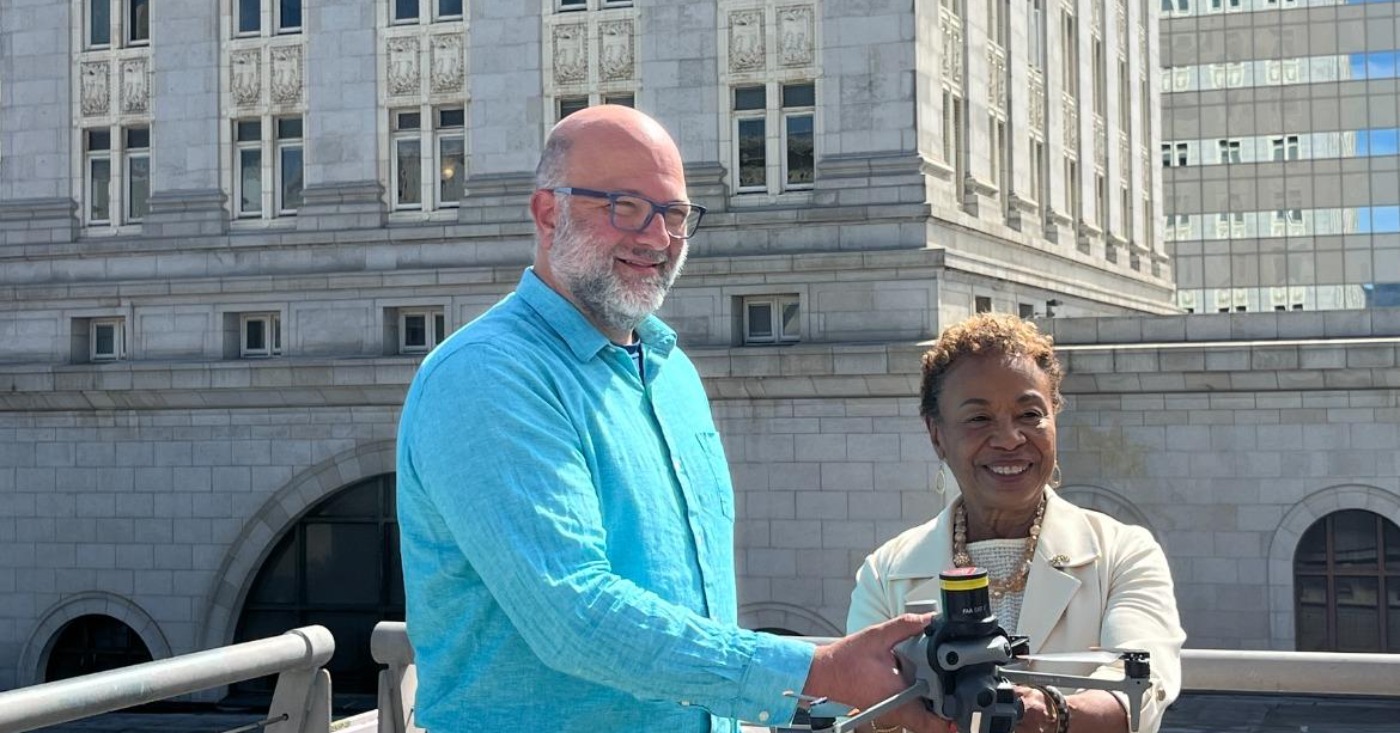
On Tuesday, the City of Oakland launched Aerbits, an innovative new program that deploys AI-assisted aerial imaging technology to proactively detect and report abandoned trash on streets and sidewalks – to support timely and effective removal of illegal dumping.
By shifting from a reactive, complaint-based system to data-driven proactive detection, the City can deploy cleanup resources faster, more efficiently, and more equitably to the areas in greatest need.
Approved by both the Privacy Advisory Commission and the Oakland City Council, Aerbits is the latest addition to Oakland’s comprehensive strategy to eliminate illegal dumping from the Town.
“Oakland residents and businesses deserve clean streets and today we are one step closer to a safer, cleaner, and greener Oakland,” said Mayor Barbara Lee. “Our strategy strengthens eradication, education, and enforcement efforts across every neighborhood.
“Aerbits, which was approved by the Privacy Advisory Commission, uses modern technology and best practices to help our crews clear trash faster and more efficiently, while our targeted outreach and enforcement strategies address the root causes of dumping. Together, we are going to get the job done.”
The impacts of illegal dumping on Oakland are profound, disproportionately burdening historically disinvested communities while threatening public health, safety, and economic vitality.
The City is united in taking action to remedy it – with the mayor, Council, administration, Public Works Department, community groups and more coming together to make change.
In May, the City Council approved the Illegal Dumping Expenditures Action Plan, which approves and funds multiple actions – including Aerbits – to help remedy illegal dumping.
This past June, Oakland secured $9.2 million from the Crankstart Foundation to scale up operations like Aerbits and break the cycle of illegal dumping across Oakland.
The Aerbits aerial imaging system photographs public rights-of-way to pinpoint exact locations, estimate waste volumes, and classify types of debris. This enables City dispatchers to understand the problem and efficiently deploy the appropriate crew and equipment to each site.
Built with privacy at its core, the technology contains no facial recognition, no license plate readers, and uses no personally identifying information. Aerbits takes pictures of trash – not of people.
“I founded Aerbits because I saw a major gap in the data that was available to City crews on the streets, and I wanted our children to have a cleaner environment” said Aerbits Founder Brian Johnson.
“Aerbits enables cleanups to be timelier, more effective, and more equitable. By providing real-time comprehensive data, automating the creation of work orders, and improving closure of cleared tickets, we are removing the problems that occur when relying primarily on a complaint-based system,” he said.
Aerbits is the latest milestone in the series of actions the City is taking to implement the City Council-approved Illegal Dumping Expenditures Action Plan. Recent actions taken by the City include:
- Stricter Enforcement: Enacted a new Illegal Dumping Enforcement Ordinance increasing penalties and holding vehicle owners responsible; hired additional Environmental Enforcement Officers equipped with updated citation technology; and worked alongside State Senator Jesse Arreguin on legislation that allows the City to boot vehicles tied to repeat dumping offences.
- Community Resources: Reinstated the popular “Bulky Block Parties” offering residents free, convenient ways to get rid of bulky waste, alongside expanded public education campaigns.
- Expanded Fleet Equipment: Obtained new heavy-duty Lightning Loader trucks that allow us to clean up more volumes of debris faster than ever before.
Rebecca Kaplan is a former City Councilmember-at-large for the City of Oakland.


Newsom Signs Addictive Social Media Law to Protect Kids

On Your November Ballot: Prop 38 Would Allocate $8.4 Billion to Immunology and Immunotherapy Funding

Ask California: Golden State Releases New AI Chatbot

Asm. Isaac Bryan’s Bill Banning California Police From ICE Side Jobs Reaches Newsom’s Desk

Assemblymember LaShae Sharp-Collins’s Bill Would Pause Law Enforcement’s Use of Shock Gloves Pending Study

BOOK REVIEW: ‘Laws of Solomon’ Reveals Tender Heart of Former Child Soldier

OPINION: The New American Fear – From 9-11 to AI

Passing for White, Fighting for Black America: The Courage of Walter White

Oakland People’s Arms Embargo Coalition Demands End to Military Shipments Thru Oakland

Barbara Lee Mourns Gloria Steinem, Remembers a Friendship Rooted in Equality

Event Preview: ‘Fashion v. Fascism’ – A Runway Revolution Is Coming to the Bay Area

Two Looming Threats Every Alameda County Elder Should Know About

Oakland Mayor Reads to Children at Bookout Block Party at Marcus Books Store

Tradition Comes to the Streets in 11th Annual Black-Eyed Pea Festival at the Freedom Farmers Market

Attorney General Rob Bonta Continues Opposition to President Trump’s Tariff Regime

Department of Homeland Security Demands California Secretary of State Shirley N. Weber Scrub Voter Rolls

“The Power to See Threats Sooner”: Gov. Newsom, Safety Officials Showcase California’s Investments in Hi-Tech Wildfire Prevention

California Sen. Padilla Joins Colleagues to Introduce Bill Imposing Term Limits on Supreme Court Justices

Less Affluent School Districts, Including Sacramento City, Face Threat of State Takeover

Car Wash Workers Cope with Lingering Impacts of ICE Raids

ESSAY: California Can Close Its Colorectal Cancer Gap

As Part of Your Back-to- School Checklist, Vaccinate

Oakland ‘Port Serves as a Powerful Engine for Good Jobs and Economic Development

Gov. Newsom Announces $109.6 Million in Funding for 278 Supportive Homes in Bakersfield, Contra Costa, Sacramento and Fresno

California Hispanic Chambers of Commerce Unveils: ‘Powering the Future’ Theme for 47th Annual Statewide Convention

Congresswoman Simon Demands Investigation into Trump’s Abuse of Emergency Powers for Coal Export Terminal in West Oakland

Four Candidates, Including Incumbent Barbara Lee, Qualify for Oakland Mayor’s Race

Oakland Post: Week of August 12 – 18, 2026

From Blueprint to Breakthrough: Tackling Affordable Housing in Oakland

Oakland Observes Black August with Block Parties, Film Showings, Workshops

The Conversation With Al McFarlane 6/23/26

Media Monday 6/22/26

LIVE! ASK ALMA! — TUES. 6.23.26 7PM EST

Car Buying Secrets: 4 Hidden Checks Before You Sign!

Is This 550 HP Charger Worth YOUR Money? AutoNetwork Review

Celebrating Juneteenth – Frederick Douglass on education and resistance

LIVE! — ASK ALMA! — TUES. 6.19.26 7PM EST

Hyundai Ioniq 5 Parking, Safety, and 360 View #shorts

2025 Ioniq 5 New Wiper & Powerful Performance! #shorts

Electric SUV Range: Is 259 Miles Enough? #shorts

EV Charging: How Fast Can You Charge an Electric Vehicle? #shorts

Biometric Cooling… Messaging Seats…Come on! 2025 Infiniti QX80 Autograph 4WD

Charged Up: Witness the Magic of a Fully Electric Car! #shorts

Range Rover Sport PHEV Included…: See What’s Inside This Luxury SUV! #shorts

Invisible Hood View: Perfect Parking with X-Ray Vision! #shorts
-

 Commentary3 weeks ago
Standoff for Justice: Our Homes Are Worth Fighting For
-

 Activism3 weeks ago
Oakland Post: Week of August 26 – September 1, 2026
-

 Business3 weeks ago
Gubernatorial Candidate Steve Hilton Blasts California New Tire Rules; Newsom Hits Back
-

 Business3 weeks ago
Frontier Airlines’ Return to Oakland Airport Brings Flights, Jobs and Opportunity
-

 Business3 weeks ago
Chef Sharon Lee Blends Culinary Excellence, Education and Empowerment
-

 Education3 weeks ago
Gov. Newsom’s Latest Appointees Include Sacramento Advocate for Formerly Incarcerated Students; State’s New Tech Chief
-

 Business3 weeks ago
Oakland Coliseum Project Opens Door for Small Businesses to Build Bigger
-

 Community3 weeks ago
Big City Mayors Ask for “Yes” Vote on Housing Bond Measure; Conservatives Say “No”
Technology
Samsung’s Smart TVs Are Inserting Unwanted Ads Into Users’ Own Movies
In this Jan. 5, 2015 photo, models pose with a Samsung Electronics Co.’ SUHD 4K smart TV during a press conference in Seoul, South Korea. (AP Photo/Ahn Young-joon)
(The Verge) – Samsung’s smart TVs have already come under fire this week for a poorly worded privacy policy that apparently let the devices listen in on owners’ conversations. Now, there are reports that the sets are inserting ads “every 20-30 minutes” into users’ own, locally stored content. There’s been a string of complaints online by customers using third-party video apps such as Plex and Australian service Foxtel, with most referring to rogue Pepsi ads interrupting their viewing. “After about 15 minutes of watching live TV, the screen goes blank, and then a 16:9 sized Pepsi ad (taking up about half the screen) pops up,” wrote a professed Samsung smart TV owner on Foxtel’s support forums. “It’s as if there is a popup ad on the TV.”

Samsung addressed similar complaints in January after tech writer David Chartier posted a picture of a pop-up ad for a “Yahoo Broadcast Interactivity” app appearing on his smart TV. Samsung explained that these sorts of ads were supposed to be opt-in only and was working with Yahoo to improve the system.
“We are working with Yahoo to create an opt-in screen prompt specific to their service as soon as possible,” Samsung told Business Insider, adding that to disable them users should “press Menu on your Samsung Remote and scroll to Smart Hub > Terms & Policy > Yahoo Privacy Policy. Scroll to ‘I disagree with the Yahoo Privacy Notice’ and you can toggle the option on to opt-out.”
Business
Newsom Signs Addictive Social Media Law to Protect Kids
Newsom said California’s approach focuses on the features that can encourage excessive social media use rather than taking the broader step of banning teenagers from the platforms altogether. He contrasted the measure with restrictions adopted in Australia and Malaysia that prevent teenagers from accessing social media or creating accounts.
Word Count: 391
Gov. Gavin Newsom has signed a new California law targeting addictive social media features that can keep children scrolling, giving the state new authority to restrict how platforms engage young users.
AB 1709, authored by Assemblymember Josh Lowenthal (D-Long Beach) prohibits social media companies from giving children under 16 access to personalized feeds, including “For You” pages, as well as other features designed to maximize screen time, such as infinite scrolling and video autoplay.
The law does not prevent children under 16 from using social media. Instead, platforms must deactivate the covered features for those users.
“This is about actually addressing the problem, the scrolling, the algorithms,” Newsom said Sept. 10 during a bill-signing event in the San Francisco Bay Area.
Newsom said California’s approach focuses on the features that can encourage excessive social media use rather than taking the broader step of banning teenagers from the platforms altogether. He contrasted the measure with restrictions adopted in Australia and Malaysia that prevent teenagers from accessing social media or creating accounts.

The law comes amid growing concerns about the impact of social media on children’s mental health and well-being. California lawmakers have increasingly focused on the design and business practices of technology platforms as part of efforts to protect young users.
AB 1709 is one of 13 youth online safety and privacy laws Newsom signed Sept.10. The package also includes measures regulating AI chatbots, increasing potential penalties for technology companies and establishing additional protections for children using digital services.
Lowenthal said the new rules represent a shift toward greater accountability for technology companies.
“We want oversight. We want accountability. We’re done asking nicely, and we’re demanding that there is a duty of care across these platforms — a duty that puts the wellness of our children ahead of profits,” Lowenthal said.
The law builds on California’s broader effort to regulate children’s online experiences. A separate law, AB 1043, will require users to provide their birth dates when setting up new phones or laptops beginning in January, with device manufacturers required to share users’ ages with apps.
Some youth online safety advocates have supported AB 1709 as a more targeted alternative to outright social media bans. Others have warned that the restrictions could make it harder for some LGBTQ+ young people to find support online and questioned how effectively age requirements can be enforced.
Commentary
OPINION: The New American Fear – From 9-11 to AI
The terrorists didn’t invent American racism, xenophobia or political paranoia. We shouldn’t give 19 hijackers that much credit. But after 9/11, America built an enormous security structure around fear. Surveillance expanded. Wars followed. Congress created the Department of Homeland Security. TSA transformed airports. Immigration enforcement was reorganized and ICE was created.
I was quiet about 9/11 until this week, when terrorism got an upgrade.
Artificial intelligence.
I have taken 9/11 seriously every year. Twenty-five years later, I was all “feeled out.”
I’ve gone to Ground Zero. I’ve written about the dead, the survivors, the first responders and those who survived that day only to become sick years later.
But this isn’t another column about where we were.
It’s about what America became.
For me, September 11, 2001, marks the beginning of a New America. Not the diverse, multicultural America I hoped was emerging.
This is the America that fear built.
I was 3,000 miles away in the Bay Area watching CNBC.
Then the planes hit.
The markets shut down.
And something else opened.
Fear.
At first, fear brought us together. We had a common enemy and, briefly, rediscovered a common good.
But fear is a terrible foundation for democracy.
The person we feared was initially the terrorist.
Then the Muslim.
Then the Arab.
Then the Sikh mistaken for an Arab.
Then the immigrant. The undocumented. The person at the border.
The category continues to expand.
Maybe that’s the real 25-year story of 9/11.
We went from finding common ground to looking for flaws that prove somebody doesn’t belong.
The terrorists didn’t invent American racism, xenophobia or political paranoia. We shouldn’t give 19 hijackers that much credit.
But after 9/11, America built an enormous security structure around fear.
Surveillance expanded. Wars followed. Congress created the Department of Homeland Security. TSA transformed airports. Immigration enforcement was reorganized and ICE was created.
Temporary emergency became permanent infrastructure.
Recently, Anthropic researcher Jacob Coxon quit his job and warned that people building advanced AI genuinely believe it could kill humanity by the end of this decade.
He walked away two months before his Anthropic equity vested.
That’s credibility.
President Trump has taken a different view. On Sept. 14 he called fears of AI destroying humanity a “HOAX” and declared, “WHOEVER WINS AI, WINS!” He said the only guardrail AI needs is a “STRONG AND SMART (High IQ!) PRESIDENT.”
We have built the threat.
We finance it. We feed it our words, photographs, voices, art and knowledge. We invite it into our homes and carry it in our pockets.
Americans are confronting something genuinely frightening.
AI could eliminate or transform jobs. And its increasingly powerful systems raise questions even some of their creators say they cannot fully answer.
So, the question what do we do with fear without surrendering our common humanity.
That requires real leadership and oversight from Congress, if not the president.
Trump insists Iran can’t have a nuclear weapon. But on AI, his emphasis is winning the race, especially against China.
That’s the trap.
Fear of China becomes the argument for going full speed ahead.
Twenty-five years after 9/11, we have another chance to get fear right.
Be smart enough to know what to be afraid of.
And make sure we stay in control of the tech.
We’ve got to be smarter than the machines.
About the Author
Emil Amok Guillermo is an award-winning journalist, commentator and comic monologist. He hosts a micro-talk show on YouTube. See him at Comedy Day at Robin Williams Meadow in San Francisco’s Golden Gate Park, on Sept. 20, around 2:45 p.m. Free.
Business
Oakland Launches Aerbits Program to Identify, Report Abandoned Trash
“Aerbits, which was approved by the Privacy Advisory Commission, uses modern technology and best practices to help our crews clear trash faster and more efficiently, while our targeted outreach and enforcement strategies address the root causes of dumping. Together, we are going to get the job done.”
On Tuesday, the City of Oakland launched Aerbits, an innovative new program that deploys AI-assisted aerial imaging technology to proactively detect and report abandoned trash on streets and sidewalks – to support timely and effective removal of illegal dumping.
By shifting from a reactive, complaint-based system to data-driven proactive detection, the City can deploy cleanup resources faster, more efficiently, and more equitably to the areas in greatest need.
Approved by both the Privacy Advisory Commission and the Oakland City Council, Aerbits is the latest addition to Oakland’s comprehensive strategy to eliminate illegal dumping from the Town.
“Oakland residents and businesses deserve clean streets and today we are one step closer to a safer, cleaner, and greener Oakland,” said Mayor Barbara Lee. “Our strategy strengthens eradication, education, and enforcement efforts across every neighborhood.
“Aerbits, which was approved by the Privacy Advisory Commission, uses modern technology and best practices to help our crews clear trash faster and more efficiently, while our targeted outreach and enforcement strategies address the root causes of dumping. Together, we are going to get the job done.”
The impacts of illegal dumping on Oakland are profound, disproportionately burdening historically disinvested communities while threatening public health, safety, and economic vitality.
The City is united in taking action to remedy it – with the mayor, Council, administration, Public Works Department, community groups and more coming together to make change.
In May, the City Council approved the Illegal Dumping Expenditures Action Plan, which approves and funds multiple actions – including Aerbits – to help remedy illegal dumping.
This past June, Oakland secured $9.2 million from the Crankstart Foundation to scale up operations like Aerbits and break the cycle of illegal dumping across Oakland.
The Aerbits aerial imaging system photographs public rights-of-way to pinpoint exact locations, estimate waste volumes, and classify types of debris. This enables City dispatchers to understand the problem and efficiently deploy the appropriate crew and equipment to each site.
Built with privacy at its core, the technology contains no facial recognition, no license plate readers, and uses no personally identifying information. Aerbits takes pictures of trash – not of people.
“I founded Aerbits because I saw a major gap in the data that was available to City crews on the streets, and I wanted our children to have a cleaner environment” said Aerbits Founder Brian Johnson.
“Aerbits enables cleanups to be timelier, more effective, and more equitable. By providing real-time comprehensive data, automating the creation of work orders, and improving closure of cleared tickets, we are removing the problems that occur when relying primarily on a complaint-based system,” he said.
Aerbits is the latest milestone in the series of actions the City is taking to implement the City Council-approved Illegal Dumping Expenditures Action Plan. Recent actions taken by the City include:
- Stricter Enforcement: Enacted a new Illegal Dumping Enforcement Ordinance increasing penalties and holding vehicle owners responsible; hired additional Environmental Enforcement Officers equipped with updated citation technology; and worked alongside State Senator Jesse Arreguin on legislation that allows the City to boot vehicles tied to repeat dumping offences.
- Community Resources: Reinstated the popular “Bulky Block Parties” offering residents free, convenient ways to get rid of bulky waste, alongside expanded public education campaigns.
- Expanded Fleet Equipment: Obtained new heavy-duty Lightning Loader trucks that allow us to clean up more volumes of debris faster than ever before.
Rebecca Kaplan is a former City Councilmember-at-large for the City of Oakland.
-
Commentary3 weeks ago
Standoff for Justice: Our Homes Are Worth Fighting For
-
Activism3 weeks ago
Oakland Post: Week of August 26 – September 1, 2026
-
Business3 weeks ago
Gubernatorial Candidate Steve Hilton Blasts California New Tire Rules; Newsom Hits Back
-
Business3 weeks ago
Frontier Airlines’ Return to Oakland Airport Brings Flights, Jobs and Opportunity
-
Business3 weeks ago
Chef Sharon Lee Blends Culinary Excellence, Education and Empowerment
-
Education3 weeks ago
Gov. Newsom’s Latest Appointees Include Sacramento Advocate for Formerly Incarcerated Students; State’s New Tech Chief
-
Business3 weeks ago
Oakland Coliseum Project Opens Door for Small Businesses to Build Bigger
-
Community3 weeks ago
Big City Mayors Ask for “Yes” Vote on Housing Bond Measure; Conservatives Say “No”

Leave a Reply