
California Black Media
Reports Cast Shadows on the Economic Picture for Black Californians
Recent studies suggest that the economic picture for Black Californians is not looking rosy. The state is becoming less affordable for African Americans, leading many families to relocate to less expensive places both within and past the borders.


By Lila Brown
California Black Media
Recent studies suggest that the economic picture for Black Californians is not looking rosy.
The state is becoming less affordable for African Americans, leading many families to relocate to less expensive places both within and past the borders.
“After pandemic-era declines, California’s poverty rate is on the rise. Expansions to safety net programs during the pandemic reduced poverty substantially, but these expansions had mostly expired by the end of 2022,” reads a report published by the Public Policy Institute of California (PPIC) on Oct. 24.
For Black Californians, the poverty rate at 13.6% is more than double the percentage of African Americans living in California, which currently stands at about 5.8% of nearly 40 million Californians.
“The state’s overall poverty rate increased from 11.7% in fall 2021 to 13.2% in early 2023,” the PPIC report continued.
The unemployment numbers for Black Californians also remain high — and continue to climb.
According to the Economic Policy Institute, the unemployment rate for Black Californians stands at 7.4%, which is higher than the state’s 4.5% total unemployment rate for the second quarter of 2023. This is also higher than the national rate of 5.8%.
In California, the Black-white unemployment ratio is at 1.9 to 1. The national Black-white unemployment ratio remained at 2 to 1 in the second quarter of 2023, maintaining the historic trend of Black workers being twice as likely to be unemployed as white workers. There’s nowhere in the country where the unemployment numbers for Black and white workers are equal.
For September, the California Employment Development Department (EDD) reported that unemployment was on the rise. The state’s unemployment rate crept up to 4.7%, an increase of 144,000 people. It is the second-highest unemployment rate of any state. The labor force — Californians working or looking for work — also shrank.
Between 2021 and 2022, the overall poverty rate in California rose from 11.0% to 16.4%. This increase can be linked to the high costs of living, inflation, and the end of pandemic-era supports. Financial assistance cut the poverty rate for Black Californians by one quarter to 9.5% in 2021, but it nearly doubled to 18.6% the year after.
U.S. Census data showed that 54% of Black Californians reported facing difficulty paying for essential needs like food and housing.
Los Angeles County (15.5%) and San Diego County (15.0%) had the highest poverty rates. The Central Valley and Sierra region had the lowest (10.7%), largely due to lower housing costs.
In China last week, Gov. Gavin Newsom highlighted the strength of California’s economy, the fifth-largest in the world, and President Joe Biden released his Bidenomics report in June highlighting the achievements of his Invest in America plan.
The White House reports that under the Biden-Harris Administration, Black Americans have experienced their lowest recorded unemployment rate and the highest employment rate since November 2000.
The participation of Black workers in the labor force has also reached its highest level since August 2008. The poverty rate for Black children has been reduced by more than 12%, impacting over 200,000 children, through the Thrifty Food Plan.
Most reports point to signs that the nation is at pre-pandemic levels and California has recovered its pandemic-induced job losses in June 2022, according to the latest California Labor Market Review released in August.
However, numbers indicating the state economy is strong contrast with the harsh realities confronting many Black Californians struggling to make ends meet.
A study by the Urban Institute shines light on the complex challenges Black Californians face as more decide to relocate to less expensive areas, driven by a combination of economic factors like housing unaffordability, rolling layoffs, rising inflation, increasing renter evictions, and stagnant salaries.
“This has been the reality of many Black Californians: As the Black populations of San Francisco and Alameda counties drop, those of Contra Costa and Sacramento rise. As Los Angeles sees its share of Black residents decline, neighboring Riverside and San Bernardino shares increase,” that report says.
Lisa D. Cook, governor of the Federal Reserve Board, says unemployment is the root of all of America’s social problems and pushing for maximum employment is the solution to minimizing poverty. Cook spoke while accepting the Louis E. Martin Award on Oct. 18 in Washington, D.C.
“Maximum employment boosts long-run economic potential. It means that a vital resource is being used productively. A strong labor market increases labor force participation and the willingness of firms to recruit and upgrade the skills of workers,” Cook stated.
“The full participation of all segments of society should be expected to result in more ideas, including more diverse ideas, more invention, and more innovation.”













Activism
Oakland Post: Week of April 1 – 7, 2026
The printed Weekly Edition of the Oakland Post: Week of April 1 – 7, 2026
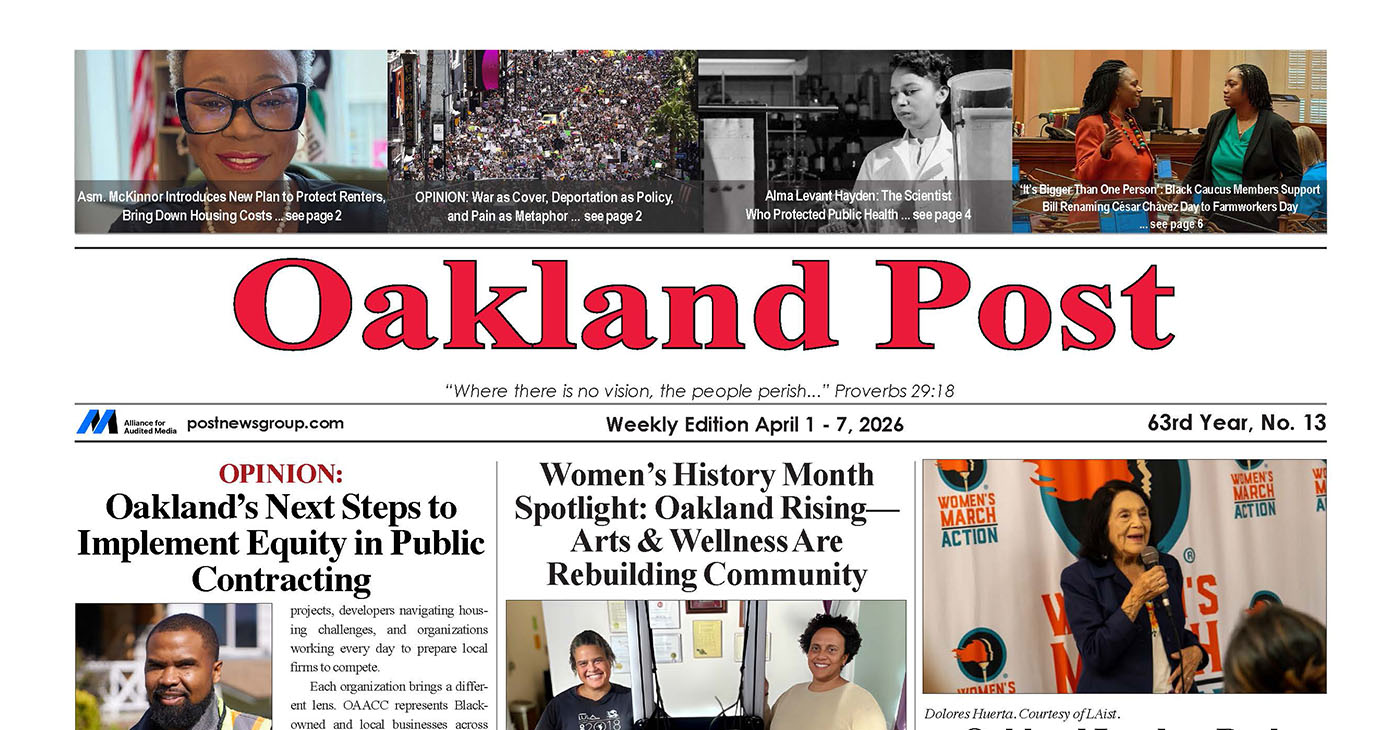
To enlarge your view of this issue, use the slider, magnifying glass icon or full page icon in the lower right corner of the browser window.
Activism
Oakland Post: Week of March 18 – 24, 2026
The printed Weekly Edition of the Oakland Post: Week of March 18 – 24, 2026

To enlarge your view of this issue, use the slider, magnifying glass icon or full page icon in the lower right corner of the browser window.
Activism
Oakland Post: Week of March 11 -17, 2026
The printed Weekly Edition of the Oakland Post: Week of March 11 – 17, 2026
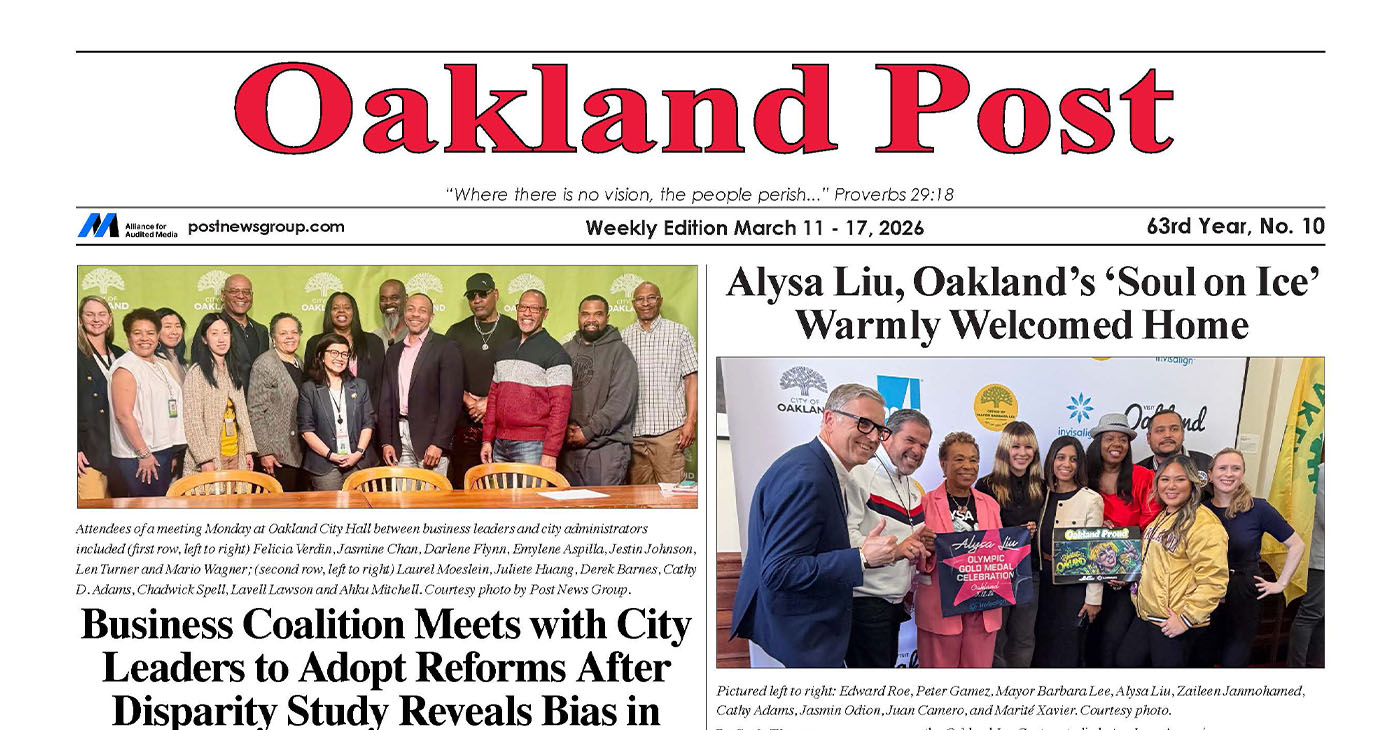
To enlarge your view of this issue, use the slider, magnifying glass icon or full page icon in the lower right corner of the browser window.


WORK FROM HOME
Home-based business with potential monthly income of $10K+ per month. A proven training system and website provided to maximize business effectiveness. Perfect job to earn side and primary income. Contact Lynne for more details: Lynne4npusa@gmail.com 800-334-0540


Oakland Post: Week of April 1 – 7, 2026

Black Artists in America, Installation Three Wraps at the Dixon Gallery and Gardens

Grief, Advocacy, and Education: A Counselor Reflects on Black Maternal Health

Future of Florida’s Black History Museum in Limbo

New Research Shows the Many Benefits of Early Learning

South Hampton K-8 Students Among Top 10 Finalists for Samsung’s ‘Solve for Tomorrow’ Competition

Cuba: No Negotiation with US on the President or Political System

Brooklyn Academy of Music Names Jamaican-Born Tamara McCaw as President

Trinidad & Tobego – U.S. Launches WhatsApp Channel for American Citizens in the Country

Oakland Post: Week of March 18 – 24, 2026

AI Innovation vs. Ethics and Environmental Impact

AI, Web3, and Digital Reparations

What If You Owned Your AI Agent?

Season 7, Episode 3 – January Reporter’s Roundtable 📱

Season 7, Episode 3 – January Reporter’s Roundtable

Reflecting on Black History Milestones in Birmingham AL

Oakland Post: Week of February 25 – March 3, 2026

PRESS ROOM: NBA Hall of Fame Nominee Terry Cummings Joins 100 Black Men of DeKalb County to Launch Victory & Values Initiative

Oakland Post: Week of March 4 – 10, 2026

Trump’s MAGA Allies are Creating Executive Order Plan to Steal the 2026 Midterms

U.S. manufacturing rebounds – how foundry services are adapting to rising demand

Poll Shows Support for Policies That Help Families Afford Child Care

OP-ED: One Hundred Years of Black Workers Telling the Truth

Oakland Post: Week of March 11 -17, 2026

Advancements in solar technology that are changing the way we power the world
Oakland Post: Week of March 18 – 24, 2026

Woman’s Search for Family’s Roots Leads to Ancestor John T. Ward – A Successful Entrepreneur and Conductor on the Underground Railroad

COMMENTARY: Women of Color Shape Our Past and Future

PRESS ROOM: Civil Rights TV Launches in Selma as the World’s First 24/7 Civil Rights Television Network

OP-ED: NNPA Launches 2026 “Leadership Matters” Video Series

Hyundai Ioniq 5 Parking, Safety, and 360 View #shorts

2025 Ioniq 5 New Wiper & Powerful Performance! #shorts

Electric SUV Range: Is 259 Miles Enough? #shorts

EV Charging: How Fast Can You Charge an Electric Vehicle? #shorts

Biometric Cooling… Messaging Seats…Come on! 2025 Infiniti QX80 Autograph 4WD

Charged Up: Witness the Magic of a Fully Electric Car! #shorts

Range Rover Sport PHEV Included…: See What’s Inside This Luxury SUV! #shorts

Invisible Hood View: Perfect Parking with X-Ray Vision! #shorts

AI Is Reshaping Black Healthcare: Promise, Peril, and the Push for Improved Results in California

ESSAY: Technology and Medicine, a Primary Care Point of View

Sanctuary Cities

The RESISTANCE – FREEDOM NOW

STATE OF THE PEOPLE: Freddie

ECONOMIC BOYCOTT DAY!!!!!

I told You So
-
 Activism3 weeks ago
Oakland Post: Week of March 11 -17, 2026
-
 #NNPA BlackPress4 weeks ago
Woman’s Search for Family’s Roots Leads to Ancestor John T. Ward – A Successful Entrepreneur and Conductor on the Underground Railroad
-
 Activism2 weeks ago
Oakland Post: Week of March 18 – 24, 2026
-
 #NNPA BlackPress4 weeks ago
COMMENTARY: Women of Color Shape Our Past and Future
-

 Advice3 weeks ago
Financial Wellness and Mental Health: Managing Money Stress in College
-

 #NNPA BlackPress4 weeks ago
Advocates Raise Alarm Over ICE Operation, MOU and Detention Risks in Baltimore County
-

 #NNPA BlackPress4 weeks ago
Pete Buttigieg to Join Mayor Randall Woodfin for Community Town Hall in Birmingham
-
 #NNPA BlackPress2 weeks ago
Brooklyn Academy of Music Names Jamaican-Born Tamara McCaw as President
