History
Pullman Porters’ Role in Creating West Oakland’s Black Middle Class

At the California Historical Society in San Francisco, authors Thomas and Wilma Tramble presented the rich history of “The Pullman Porters of West Oakland to a crowd of 50 people on Aug. 14.

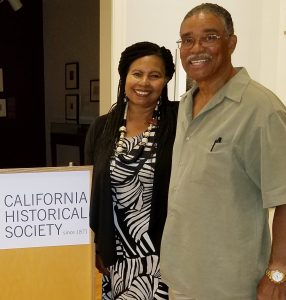
Wilma and Thomas Tramble, authors of “The Pullman Porters and West Oakland,” present the history of the West Oakland Pullman Porters at the California Historical Society in San Francisco. Photo by Carla Thomas.
Thomas Tramble gave the audience insight into how newly freed slaves gave African American’s an opportunity to work and create a blossoming middle class in Oakland. The Trambles also gave an historical account of C.L. Dellums, uncle of the late Congressman Ron Dellums, who advocated for the fair treatment of Pullman porters and was active with the Brotherhood of Pullman Porters.
Just one year prior to the Emancipation Proclamation in 1863, George Pullman created the Pullman Company. By 1867, the company became the Pullman Palace Car company, a luxury train company with a wealthy clientele.
The company provided jobs for many African American men but at a cost. After unpaid training for three days, employees worked day and night averaging 100 hours per week.


Every porter was called “George,” available 24 hours a day making beds in the sleeper cars, cleaning bathrooms, shining shoes and ironing clothes while dressed in their distinctive uniforms. The porters garnered more respect than the waiters in the dining cars.
“The conditions were inhumane until the unions negotiated successfully with the leadership of C.L. Dellums, said Thomas Tramble.
Famously, the porters organized as the Brotherhood of Sleeping Car Porters in 1925 for better hours, wages, benefits and collective bargaining. By 1937, the porters succeeded and the Pullman Company met their demands.
In Oakland, Pullman porters were required to live west of Adeline Street. As a hub of transportation and industry since the mid-19th century, West Oakland became a vital commercial conduit transforming the neighborhood from a transcontinental rail terminal into a true settlement of residents employed by the Pullman Palace Car Company as early as 1867.
After years of struggling in labor negotiations, the Brotherhood of Sleeping Car Porters Union became the first African American-led union to sign a contract with a large American company, establishing headquarters at Fifth and Wood Streets in West Oakland. “Soon families, benevolent societies, and churches followed, and a true community came into being,” said Tramble.
“The Pullman Porters and West Oakland,” written by Thomas and Wilma Tramble, contains many photographs from the African- American Museum and Library at Oakland. The Trambles make a case that employment with the Pullman Company allowed families in West Oakland to create community and achieve middle-class status.
“This is the story of a people, having found themselves freed of a horrid slavery system in 1865 and building a thriving community in West Oakland and the beginnings of a Black middle class in the area. Stable and consistent employment as a Pullman porter made this possible.”
“The story of the Pullman Porters and C.L. Dellums contribution is a rich part of our California history and particularly in West Oakland that gave the community a foundation to build on,” said Susan D. Anderson, the California Historical Society Director of Collections, Library, Exhibitions and Public Programs. “The Trambles provide a great presentation and insight into this important part of our history.”

