
Activism
Past, Present, Possible! Oakland Residents Invited to Reimagine the 980 Freeway
Organizers ask attendees coming to 1233 Preservation Park Way to think of the event as a “time portal”—a walkable journey through the Past (harm and flourishing), Present (community conditions and resilience), and Future (collective visioning).


By Randolph Belle
Special to The Post

Join EVOAK!, a nonprofit addressing the historical harm to West Oakland since construction of the 980 freeway began in 1968, will hold a block party on Oct. 25 at Preservation Park for a day of imagination and community-building from 10 a.m. to 4 p.m.
Organizers ask attendees coming to 1233 Preservation Park Way to think of the event as a “time portal”—a walkable journey through the Past (harm and flourishing), Present (community conditions and resilience), and Future (collective visioning).
Activities include:
- Interactive Visioning: Site mapping, 3-D/digital modeling, and design activities to reimagine housing, parks, culture, enterprise, and mobility.
- Story & Memory: Oral history circles capturing life before the freeway, the rupture it caused, and visions for repair.
- Data & Policy: Exhibits on health, environment, wealth impacts, and policy discussions.
- Culture & Reflection: Films, installations, and performances honoring Oakland’s creativity and civic power.
The site of the party – Preservation Park – itself tells part of the story of the impact on the community. Its stately Victorians were uprooted and relocated to the site decades ago to make way for the I-980 freeway, which displaced hundreds of Black families and severed the heart of West Oakland. Now, in that same space, attendees will gather to reckon with past harms, honor the resilience that carried the community forward, and co-create an equitable and inclusive future.
A Legacy of Resistance
In 1979, Paul Cobb, publisher of the Post News Group and then a 36-year-old civil-rights organizer, defiantly planted himself in front of a bulldozer on Brush Street to prevent another historic Victorian home from being flattened for the long-delayed I-980 Freeway. Refusing to move, Cobb was arrested and hauled off in handcuffs—a moment that landed him on the front page of the Oakland Tribune.
Cobb and his family had a long history of fighting for their community, particularly around infrastructure projects in West Oakland. In 1954, his family was part of an NAACP lawsuit challenging the U.S. Post Office’s decision to place its main facility in the neighborhood, which wiped out an entire community of Black residents.
In 1964, they opposed the BART line down Seventh Street—the “Harlem of the West.” Later, Cobb was deeply involved in successfully rerouting the Cypress Freeway out of the neighborhood after the Loma Prieta earthquake.
The 980 Freeway, a 1.6-mile stretch, created an ominous barrier severing West Oakland from Downtown. Opposition stemmed from its very existence and the national practice of plowing freeways through Black communities with little input from residents and no regard for health, economic, or social impacts. By the time Cobb stood before the bulldozer, construction was inevitable, and his fight shifted toward jobs and economic opportunity.
Fast-forward 45 years: Cobb recalled the story at a convening of “Super OGs” organized to gather input from legacy residents on reimagining the corridor. He quickly retrieved his framed Tribune front page, adding a new dimension to the conversation about the dedication required to make change. Themes of harm repair and restoration surfaced again and again, grounded in memories of a thriving, cohesive Black neighborhood before the freeway.
The Lasting Scar
The 980 Freeway was touted as a road to prosperity—funneling economic opportunity into the City Center, igniting downtown commerce, and creating jobs. Instead, it cut a gash through the city, erasing 503 homes, four churches, 22 businesses, and hundreds of dreams. A promised second approach to the Bay Bridge never materialized.
Planning began in the late 1940s, bulldozers arrived in 1968, and after years of delays and opposition, the freeway opened in 1985. By then, Oakland’s economic engines had shifted, leaving behind a 600-foot-wide wound that resulted in fewer jobs, poorer health outcomes, and a divided neighborhood. The harm of displacement and loss of generational wealth was compounded through redlining, disinvestment, drugs, and the police state. Many residents fled to outlying cities, while those who stayed carried forward the spirit of perseverance.
The Big Picture
At stake now is up to 67 acres of new, buildable land in Downtown West Oakland. This time, we must not repeat the institutional wrongs of the past. Instead, we must be as deliberate in building a collective, equitable vision as planners once were in destroying communities.
EVOAK!’s strategy is rooted in four pillars: health, housing, economic development, and cultural preservation. These were the very foundations stripped away, and they are what they aim to reclaim. West Oakland continues to suffer among the worst social determinants of health in the region, much of it linked to the three freeways cutting through the neighborhood.
The harms of urban planning also decimated cultural life, reinforced oppressive public safety policies, underfunded education, and fueled poverty and blight.
Healing the Wound
West Oakland was once the center of Black culture during the Great Migration—the birthplace of the Black Panther Party and home to the “School of Champions,” the mighty Warriors of McClymonds High. Drawing on that legacy, we must channel the community’s proud past into a bold, community-led future that restores connection, sparks innovation, and uplifts every resident.
Two years ago, Caltrans won a federal Reconnecting Communities grant to fund Vision 980, a community-driven study co-led by local partners. Phase 1 launched in Spring 2024 with surveys and outreach; Phase 2, a feasibility study, begins in 2026. Over 4,000 surveys have already been completed. This once-in-a-lifetime opportunity could transform the corridor into a blank slate—making way for accessible housing, open space, cultural facilities, and economic opportunity for West Oakland and the entire region.
Leading with Community
In parallel, EVOAK! is advancing a community-led process to complement Caltrans’ work. EVOAK! is developing a framework for community power-building, quantifying harm, exploring policy and legislative repair strategies, structuring community governance, and hosting arts activations to spark collective imagination. The goal: a spirit of co-creation and true collaboration.
What EVOAK! Learned So Far
Through surveys, interviews, and gatherings, residents have voiced their priorities: a healthy environment, stable housing, and opportunities to thrive. Elders with decades in the neighborhood shared stories of resilience, community bonds, and visions of what repair should look like.
They heard from folks like Ezra Payton, whose family home was destroyed at Eighth and Brush streets; Ernestine Nettles, still a pillar of civic life and activism; Tom Bowden, a blues man who performed on Seventh Street as a child 70 years ago; Queen Thurston, whose family moved to West Oakland in 1942; Leo Bazille who served on the Oakland City Council from 1983 to 1993; Herman Brown, still organizing in the community today; Greg Bridges, whose family’s home was picked up and moved in the construction process; Martha Carpenter Peterson, who has a vivid memory of better times in West Oakland; Sharon Graves, who experienced both the challenges and the triumphs of the neighborhood; Lionel Wilson, Jr., whose family were anchors of pre-freeway North Oakland; Dorothy Lazard, a resident of 13th Street in the ’60s and font of historical knowledge; Bishop Henry Williams, whose simple request is to “tell the truth,” James Moree, affectionately known as “Jimmy”; the Flippin twins, still anchored in the community; and Maxine Ussery, whose father was a business and land owner before redlining.
EVOAK! will continue to capture these stories and invites the public to share theirs as well.
Beyond the Block Party
The 980 Block Party is just the beginning. Beyond this one-day event, EVOAK! Is building a long-term process to ensure West Oakland’s future is shaped by those who lived its past. To succeed, EVOAK! Is seeking partners across the community—residents, neighborhood associations, faith groups, and organizations—to help connect with legacy residents and host conversations.
980 Block Party Event Details
Saturday, Oct. 25
10 a.m. – 4 p.m.
Preservation Park, 1233 Preservation Park Way, Oakland, CA 94612
980BlockParty.org
info@evoak.org


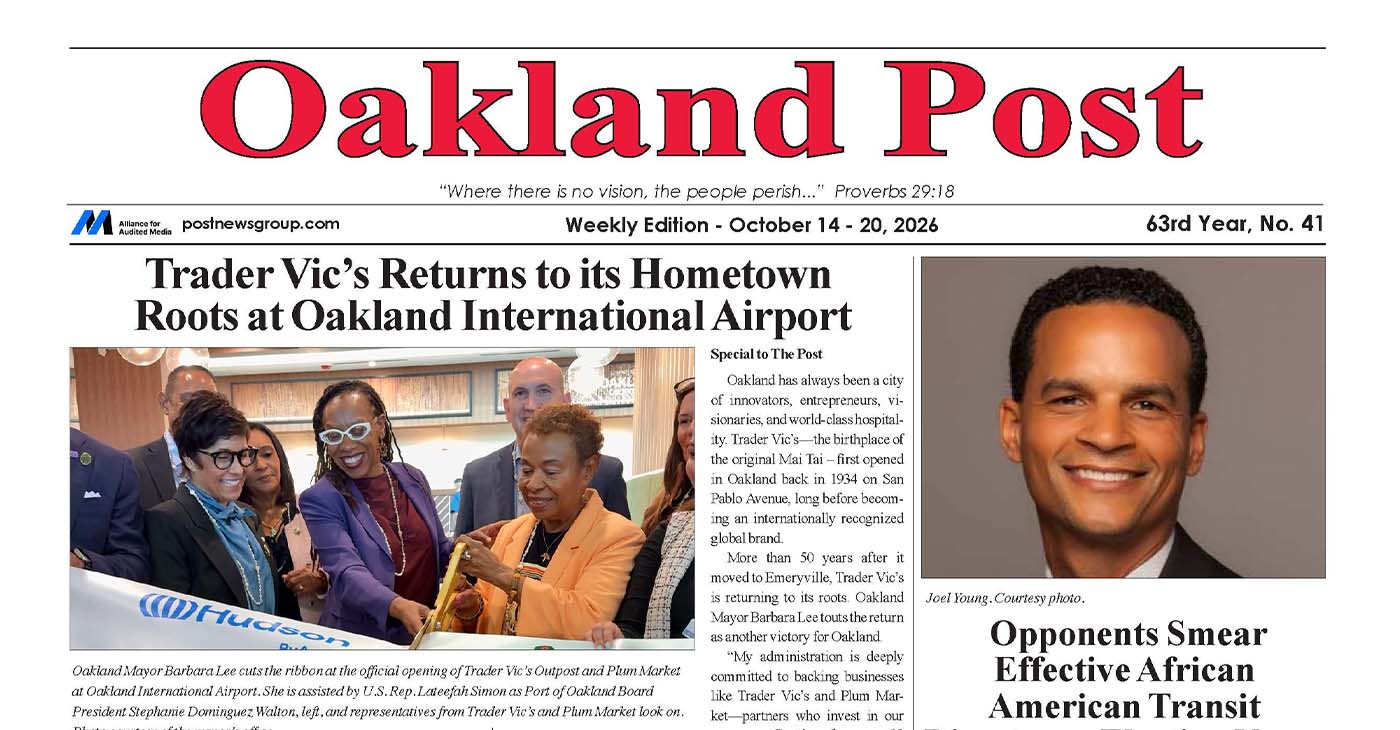
To enlarge your view of this issue, use the slider, magnifying glass icon or full page icon in the lower right corner of the browser window.
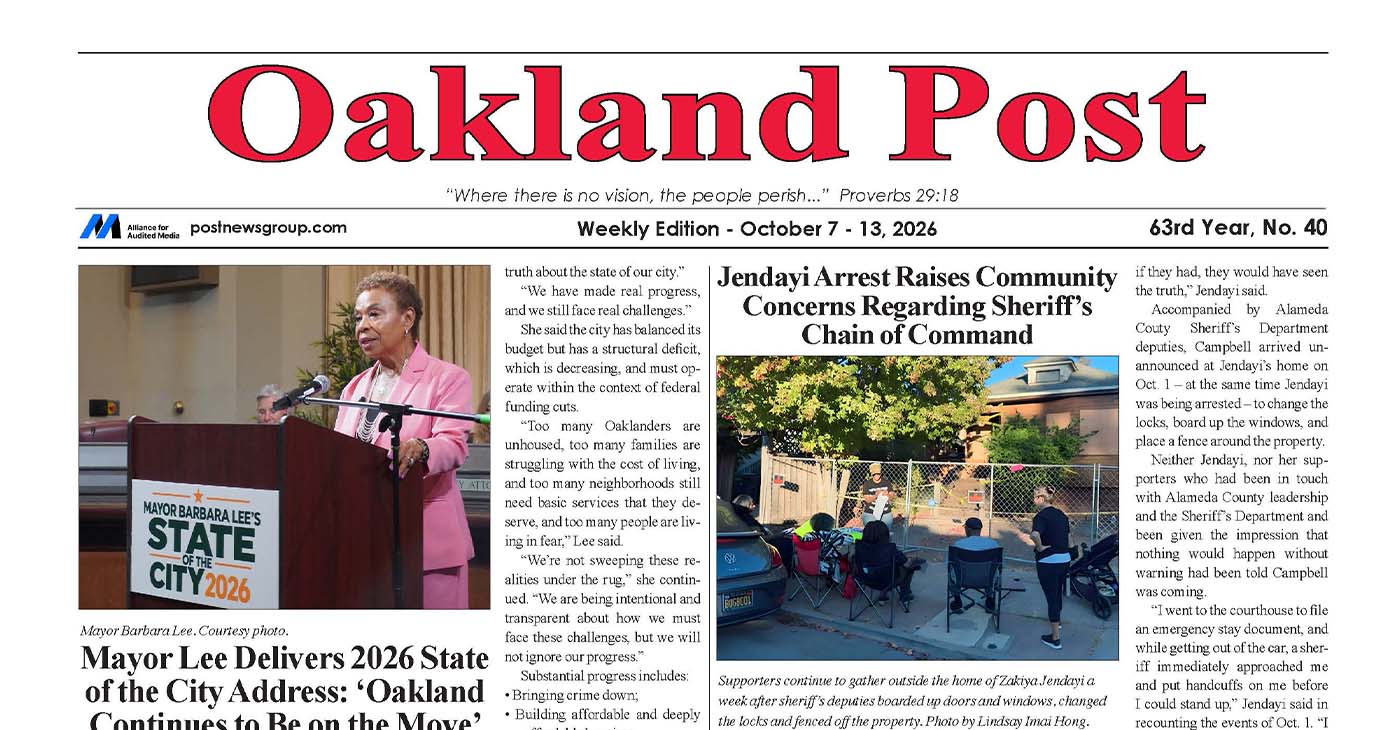
To enlarge your view of this issue, use the slider, magnifying glass icon or full page icon in the lower right corner of the browser window.
Activism
Oakland Post: Week of September 30 – October 6, 2026
The printed Weekly Edition of the Oakland Post: Week of September 30 – October 6, 2026
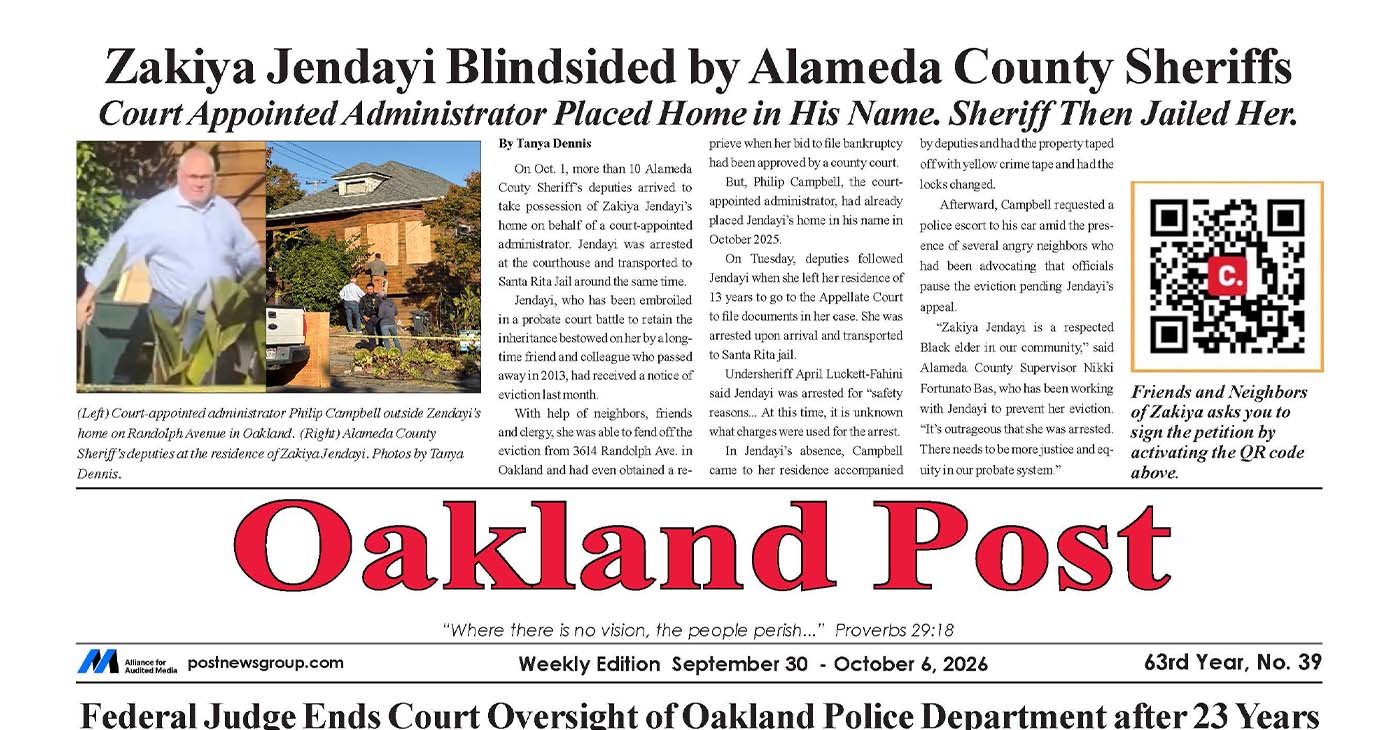
To enlarge your view of this issue, use the slider, magnifying glass icon or full page icon in the lower right corner of the browser window.


Mayor Barbara Lee Holds Special State of the City Address in Deep East Oakland

Practitioners of African Traditional Spirituality Offer Ancestral Reverence Ritual Oct. 31

It’s Time to Lose Weight Before the Holidays

Trader Vic’s Returns to Its Oakland Roots

Oakland Coal Terminal Backed by Trump Would Be Bigger, Dirtier Than Promised, Says Report

Opponents Smear Effective African American Transit Director as Election Nears

Oakland Post: Week of October 14 – 20, 2026

OP-ED: The Black Church Writes AI’s Next Chapter

OP-ED: The Black Church Writes AI’s Next Chapter

WCCUSD Joins Statewide Organic School Food Purchasing Cooperative

Democrats, Community Groups Back Measure EE to Change How Oakland Is Governed

Four Tips to Help You Plan a Holiday “Staycation”

Veterans Housing Project Proposed for South Richmond
PRESS ROOM: Transformative Justice Coalition 2026 Voting Rights Champion Awards Reception ‘Yesterday Is Today: The Battle For Voting Rights

Mayor Lee Delivers 2026 State of the City Address: ‘Oakland Continues to Be on the Move’

Misnamed ‘Parent’ PAC Seeks to Influence Oakland School Board Elections

Oakland Post: Week of September 2 – 8, 2026

Oakland Post: Week of September 9 – 15, 2026

Poll: Becerra Widens His Lead Over Hilton; Californians Split on Wealth Tax

County Office of Education Says OUSD Finances Are Getting Healthier, Materially Stronger

Richmond Tiny House Village Farm & Garden Set to Open Gates on Sept. 26

Latest Massacre in Haiti Reveals Cruelty U.S. Deportations

Mayor Lee Announces $1 Million Kaiser Permanente Grant for Pilot Program to Address Homelessness, Clean Up Public Spaces throughout Oakland

OPINION: Nolan Wells’ Death One of Several Signifying Racial Terror Lives on in U.S. South

Listening as a Lifeline: A Doula’s Witness to Black Maternal Health

BLACspace Cooperative Invites Bay Area to Experience Oakland’s Black Cultural Ecosystem Through a BLAC Map Tour + Party

Zakiya Jendayi Arrested, Locked Out of Home by Sheriff’s Deputies

Democratic Clubs Interview Candidates for Oakland School Board

Oakland Post: Week of September 16 – 22, 2026

Oakland People’s Arms Embargo Coalition Demands End to Military Shipments Thru Oakland

The Conversation With Al McFarlane 6/23/26

Media Monday 6/22/26

LIVE! ASK ALMA! — TUES. 6.23.26 7PM EST

Car Buying Secrets: 4 Hidden Checks Before You Sign!

Is This 550 HP Charger Worth YOUR Money? AutoNetwork Review

Celebrating Juneteenth – Frederick Douglass on education and resistance

LIVE! — ASK ALMA! — TUES. 6.19.26 7PM EST

Hyundai Ioniq 5 Parking, Safety, and 360 View #shorts

2025 Ioniq 5 New Wiper & Powerful Performance! #shorts

Electric SUV Range: Is 259 Miles Enough? #shorts

EV Charging: How Fast Can You Charge an Electric Vehicle? #shorts

Biometric Cooling… Messaging Seats…Come on! 2025 Infiniti QX80 Autograph 4WD

Charged Up: Witness the Magic of a Fully Electric Car! #shorts

Range Rover Sport PHEV Included…: See What’s Inside This Luxury SUV! #shorts

Invisible Hood View: Perfect Parking with X-Ray Vision! #shorts
-
 Economy3 weeks ago
Poll: Becerra Widens His Lead Over Hilton; Californians Split on Wealth Tax
-
 Business3 weeks ago
County Office of Education Says OUSD Finances Are Getting Healthier, Materially Stronger
-
 Business4 weeks ago
Mayor Lee Announces $1 Million Kaiser Permanente Grant for Pilot Program to Address Homelessness, Clean Up Public Spaces throughout Oakland
-
 Black History2 weeks ago
Listening as a Lifeline: A Doula’s Witness to Black Maternal Health
-
 Art3 weeks ago
BLACspace Cooperative Invites Bay Area to Experience Oakland’s Black Cultural Ecosystem Through a BLAC Map Tour + Party
-
 Lead Story2 weeks ago
Zakiya Jendayi Arrested, Locked Out of Home by Sheriff’s Deputies
-
 Activism4 weeks ago
Oakland Post: Week of September 16 – 22, 2026
-
 Uncategorized4 weeks ago
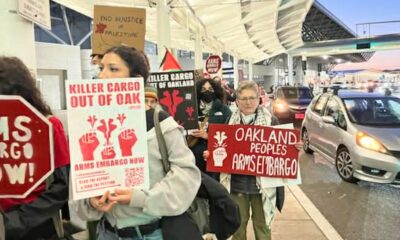
Oakland People’s Arms Embargo Coalition Demands End to Military Shipments Thru Oakland
