
Black History
OPINION: Black Women Will Suffer Harshest Consequences After the Overturn of Roe
The impact of new abortion bans and restrictions will be felt most acutely by poor and working-class Black women — Black women are significantly more likely to live in poverty compared to white women. For these women, the overturning of Roe won’t mean that abortions will end; it will mean that access to critical, potentially life-saving healthcare will move hundreds of miles out of reach. It will mean time off of work (likely unpaid) and travel and childcare costs — expenses that may not be possible for women living paycheck to paycheck, struggling to simply put meals on the table.

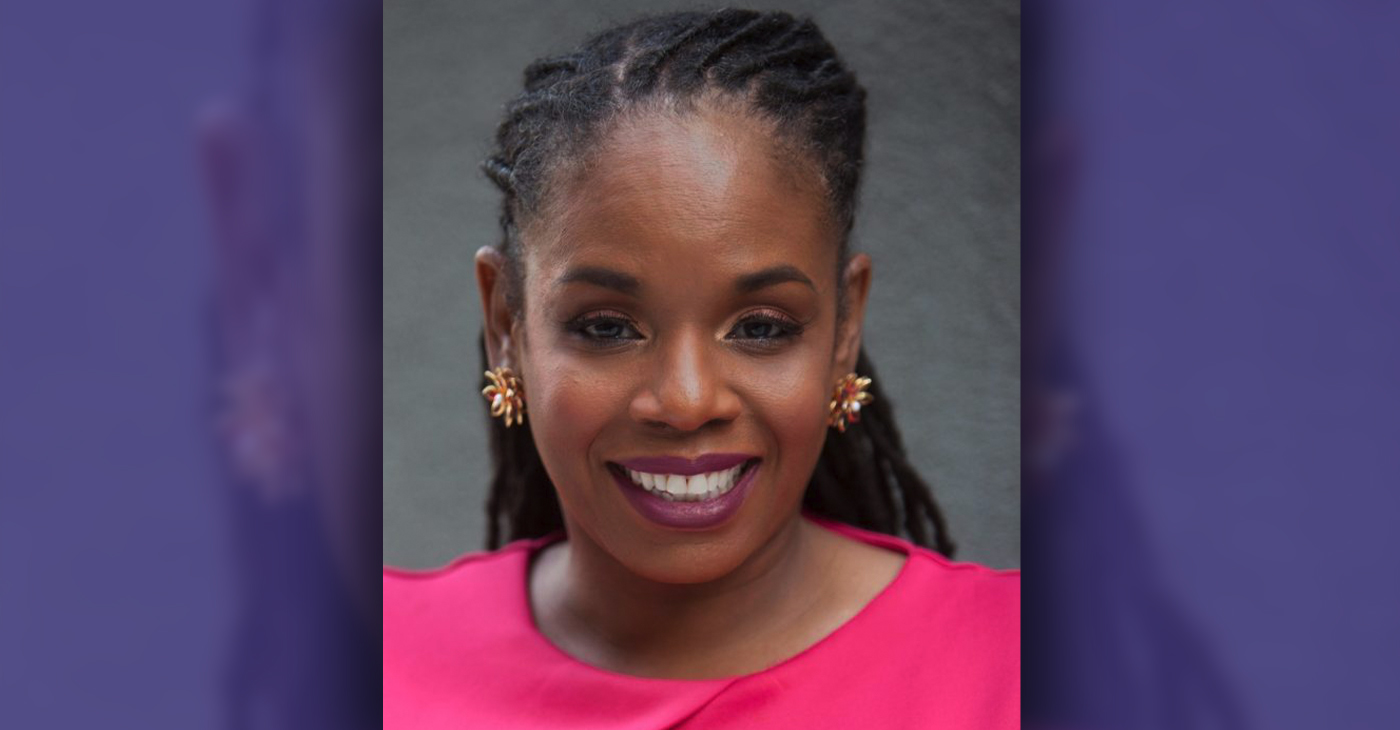
By Glynda Carr
The Supreme Court just dealt a devastating blow to reproductive rights. With its decision in Dobbs v. Jackson, five Republican-appointed Justices on the U.S. Supreme Court swept away half a century of progress and eviscerated women’s rights and equality. After last month’s leaked opinion, we knew this moment could come, but that doesn’t make the news any easier to digest.
For Black women in this country, the decision is especially devastating. Thirteen percent of American women are Black, but 38% of people receiving abortion care are Black. Abortion is necessary healthcare — and a lack of access can quite literally mean life or death for many Black women. This is especially true for Black women who have lower incomes, live in rural areas, and do not have access to health care because of systemic racism and discrimination.
According to Centers for Disease Control and Prevention data, Black women are nearly three times more likely to die during childbirth than white women and are more likely to face maternal health issues. With new abortion restrictions and bans, these health outcomes are expected to get even worse: a 2021 Duke University study estimated the potential death toll following a total abortion ban and found a 33% increase in Black women who died due to pregnancy-related complications.
The states that are already moving to ban abortion are among those with the largest Black populations in the country. Consider Mississippi, the state with the highest percentage of Black residents in the nation, and one of the 13 states with a “trigger law” that ensured the decision would result in a near-immediate ban on abortion access. Three other states with the highest proportion of Black residents — Tennessee, Louisiana, and Arkansas — have these trigger laws in place, and many other states, especially in the South, are moving to severely restrict or outright ban abortion.
The impact of new abortion bans and restrictions will be felt most acutely by poor and working-class Black women — Black women are significantly more likely to live in poverty compared to white women. For these women, the overturning of Roe won’t mean that abortions will end; it will mean that access to critical, potentially life-saving healthcare will move hundreds of miles out of reach. It will mean time off of work (likely unpaid) and travel and childcare costs — expenses that may not be possible for women living paycheck to paycheck, struggling to simply put meals on the table.
At a time like this, when daughters suddenly have fewer rights than their mothers and grandmothers, it is challenging to imagine a way forward. But the answer is to do everything we can to restore our rights and ensure every woman has access to the healthcare they need and deserve, a right afforded to them under our nation’s Constitution.
To do that, we need to elect and elevate more Black women. Black women have been at the forefront of the fight to protect and expand reproductive rights — from members of Congress like Reps. Cori Bush, Ayanna Pressley, and Lauren Underwood, to our first Black woman Vice President Kamala Harris, to soon-to-be-seated Supreme Court Justice Ketanji Brown Jackson.
We must elect Stacey Abrams to lead the state of Georgia — one of the states that is now positioned to severely restrict — or overturn the right to access abortion care under the leadership of their current governor, Brian Kemp.
And finally, we need to not only encourage, but throw our unwavering support behind more Black women from all across the country to run for office — women who personally understand the deep impact that a lack of healthcare and abortion restrictions have on communities that have lacked fair representation for far too long.
Today and every day, I stand with my partners and allies ready to continue the critical fight for access to affordable, safe, legal abortions for all women, no matter where they live, how they identify, or how much money they have. We will not back down.
Glynda Carr is president and CEO of Higher Heights for America, the only national organization providing Black women with a political home exclusively dedicated to harnessing their power to expand Black women’s elected representation and voting participation, and advance progressive policies.
The views expressed in this article are the writer’s own.













Activism
Oakland Post: Week of March 18 – 24, 2026
The printed Weekly Edition of the Oakland Post: Week of March 18 – 24, 2026
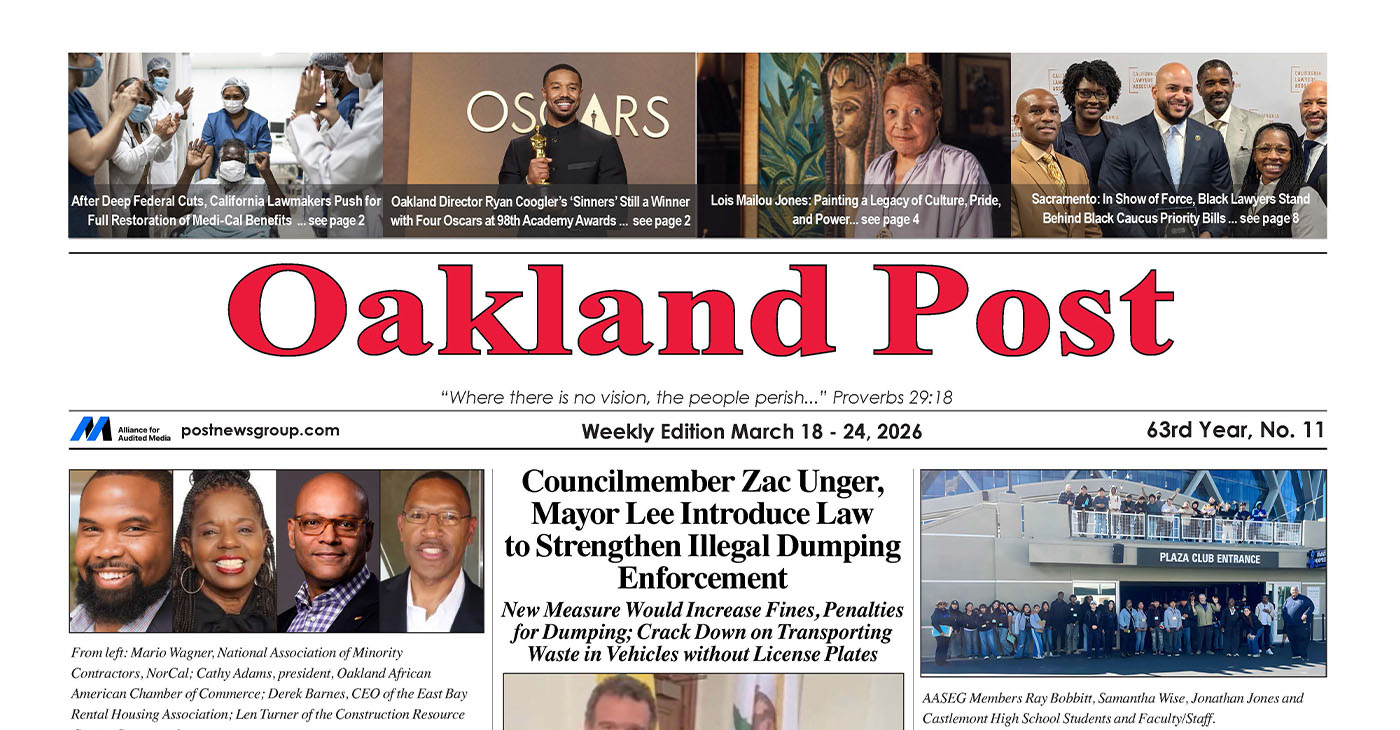
To enlarge your view of this issue, use the slider, magnifying glass icon or full page icon in the lower right corner of the browser window.
Activism
Oakland Post: Week of March 11 -17, 2026
The printed Weekly Edition of the Oakland Post: Week of March 11 – 17, 2026
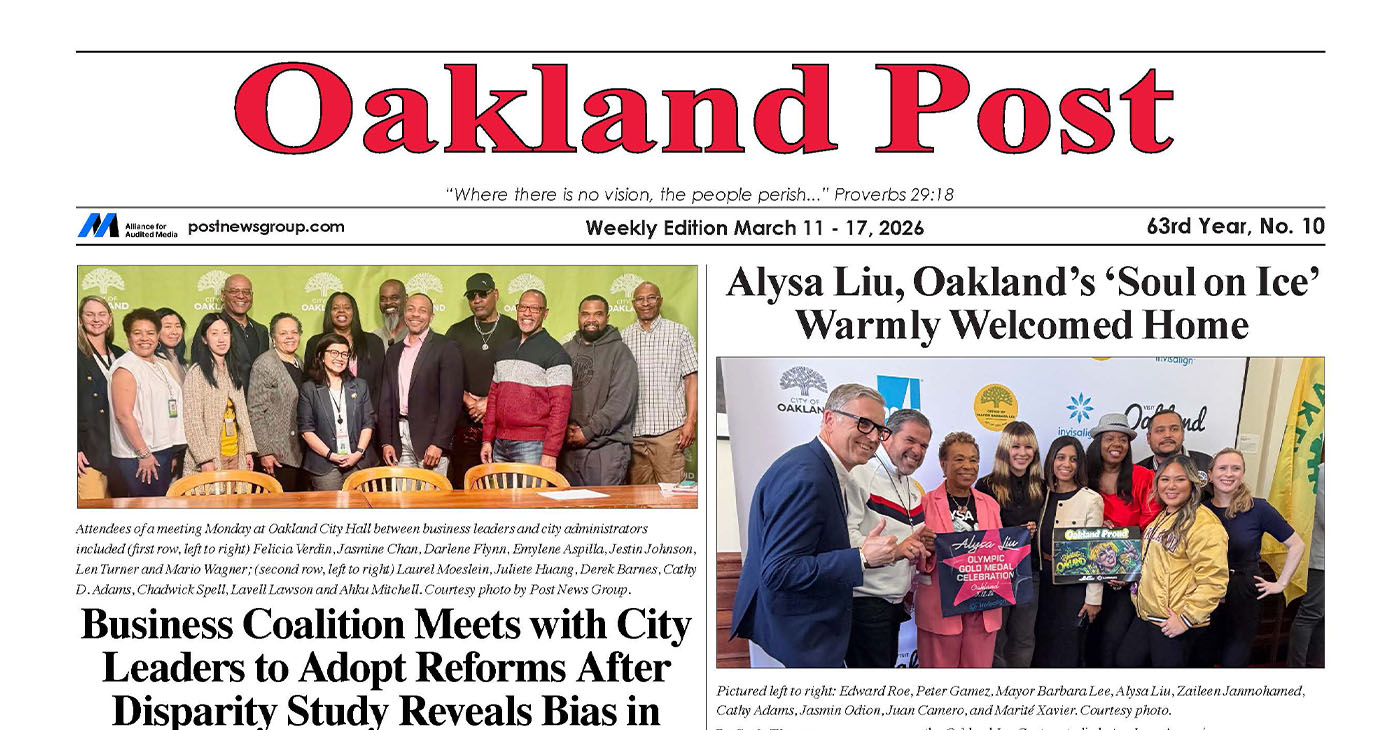
To enlarge your view of this issue, use the slider, magnifying glass icon or full page icon in the lower right corner of the browser window.
Activism
Oakland Post: Week of March 4 – 10, 2026
The printed Weekly Edition of the Oakland Post: Week of March 4 – 10, 2026
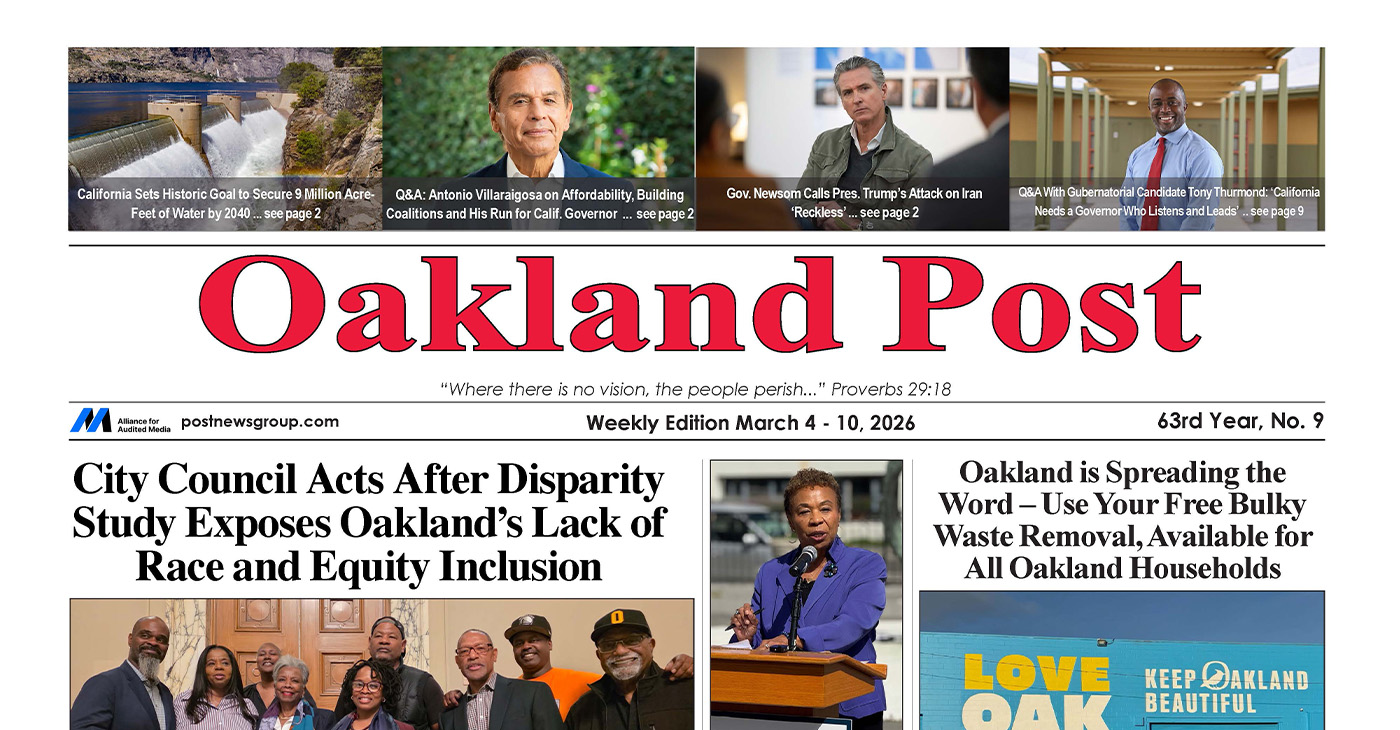
To enlarge your view of this issue, use the slider, magnifying glass icon or full page icon in the lower right corner of the browser window.

WORK FROM HOME
Home-based business with potential monthly income of $10K+ per month. A proven training system and website provided to maximize business effectiveness. Perfect job to earn side and primary income. Contact Lynne for more details: Lynne4npusa@gmail.com 800-334-0540


Black Artists in America, Installation Three Wraps at the Dixon Gallery and Gardens

Grief, Advocacy, and Education: A Counselor Reflects on Black Maternal Health

Future of Florida’s Black History Museum in Limbo

New Research Shows the Many Benefits of Early Learning

South Hampton K-8 Students Among Top 10 Finalists for Samsung’s ‘Solve for Tomorrow’ Competition

Cuba: No Negotiation with US on the President or Political System

Brooklyn Academy of Music Names Jamaican-Born Tamara McCaw as President

Trinidad & Tobego – U.S. Launches WhatsApp Channel for American Citizens in the Country

Oakland Post: Week of March 18 – 24, 2026

AI Innovation vs. Ethics and Environmental Impact

AI, Web3, and Digital Reparations

What If You Owned Your AI Agent?

Season 7, Episode 3 – January Reporter’s Roundtable 📱

Season 7, Episode 3 – January Reporter’s Roundtable

AI, Media, and Power | Part 2, Real-World Impacts and Tradeoffs

Reflecting on Black History Milestones in Birmingham AL

CITY OF SAN LEANDRO STATE OF CALIFORNIA PUBLIC WORKS DEPARTMENT ENGINEERING DIVISION NOTICE TO BIDDERS FOR ANNUAL STREET OVERLAY/REHABILITATION 2019-21 – PHASE III

Oakland Post: Week of February 18 – 24, 2026

Oakland Post: Week of February 25 – March 3, 2026

PRESS ROOM: NBA Hall of Fame Nominee Terry Cummings Joins 100 Black Men of DeKalb County to Launch Victory & Values Initiative

Trump’s MAGA Allies are Creating Executive Order Plan to Steal the 2026 Midterms

Oakland Post: Week of March 4 – 10, 2026

Chase Oakland Community Center Hosts Alley-Oop Accelerator Building Community and Opportunity for Bay Area Entrepreneurs

U.S. manufacturing rebounds – how foundry services are adapting to rising demand

Poll Shows Support for Policies That Help Families Afford Child Care

OP-ED: One Hundred Years of Black Workers Telling the Truth

Advancements in solar technology that are changing the way we power the world

Woman’s Search for Family’s Roots Leads to Ancestor John T. Ward – A Successful Entrepreneur and Conductor on the Underground Railroad

Oakland Post: Week of March 11 -17, 2026

COMMENTARY: Women of Color Shape Our Past and Future

Hyundai Ioniq 5 Parking, Safety, and 360 View #shorts

2025 Ioniq 5 New Wiper & Powerful Performance! #shorts

Electric SUV Range: Is 259 Miles Enough? #shorts

EV Charging: How Fast Can You Charge an Electric Vehicle? #shorts

Biometric Cooling… Messaging Seats…Come on! 2025 Infiniti QX80 Autograph 4WD

Charged Up: Witness the Magic of a Fully Electric Car! #shorts

Range Rover Sport PHEV Included…: See What’s Inside This Luxury SUV! #shorts

Invisible Hood View: Perfect Parking with X-Ray Vision! #shorts

AI Is Reshaping Black Healthcare: Promise, Peril, and the Push for Improved Results in California

ESSAY: Technology and Medicine, a Primary Care Point of View

Sanctuary Cities

The RESISTANCE – FREEDOM NOW

STATE OF THE PEOPLE: Freddie

ECONOMIC BOYCOTT DAY!!!!!

I told You So

-
 Activism4 weeks ago
Oakland Post: Week of March 4 – 10, 2026
-
 #NNPA BlackPress4 weeks ago
Woman’s Search for Family’s Roots Leads to Ancestor John T. Ward – A Successful Entrepreneur and Conductor on the Underground Railroad
-
 Activism3 weeks ago
Oakland Post: Week of March 11 -17, 2026
-
 #NNPA BlackPress4 weeks ago
COMMENTARY: Women of Color Shape Our Past and Future
-

 #NNPA BlackPress4 weeks ago
Advocates Raise Alarm Over ICE Operation, MOU and Detention Risks in Baltimore County
-

 Advice3 weeks ago
Financial Wellness and Mental Health: Managing Money Stress in College
-

 #NNPA BlackPress4 weeks ago
Pete Buttigieg to Join Mayor Randall Woodfin for Community Town Hall in Birmingham
-
 Activism2 weeks ago
Oakland Post: Week of March 18 – 24, 2026
