
Opinion
Op-Ed:Behind Flint Water Horror, a Corrosive Cynicism

The basic story of the poisoning of the children of Flint, Mich., through the water they drink is now pretty well known, but as more details come out, it keeps getting worse.
Republican Gov. Rick Snyder, after passing a big tax cut for the rich and corporations on coming into office, had to find cuts to make up for the lost revenue.
In Flint and other cities, he essentially nullified democratic elections, deposed elected mayors and city councils and installed his own agents with virtually dictatorial powers.
The “emergency manager” of Flint decided that the city could save money by discontinuing its water supply from Lake Huron and instead drawing it from the toxic Flint River.
He then failed to treat the new water with additives needed to keep the city’s old pipes from leaching lead. When people objected to the brown, smelly water filled with particles that was coming out of the taps, the governor’s men reassured them the water was safe.
All of Flint’s children were exposed to water with elevated levels of lead.
Now we learn that General Motors complained to state officials that the water was corroding their auto parts. So the governor’s team gave GM its own hook up back to the water from Lake Huron — while still insisting to the residents of Flint that the water was safe for their children to drink.

State officials also acted promptly to respond to the bad water for one other constituency: state employees in Flint’s state office building. Even as it was reassuring residents that the water was safe to drink, Flint officials arranged for coolers of purified water to be set up on all the floors of the office building.
Flint’s residents — disproportionately Black and low income — were seen as disposable. And they are not alone.
The national statistics on lead poisoning, as Kevin Drum of Mother Jones details, show that African-Americans were poisoned at three times the rate of whites until recent times.
And, of course, low-income people are poisoned at higher rates than the more affluent; poor, urban African-Americans and Latinos suffer the highest rates of all.
Drum notes that while white children were severely afflicted in the postwar lead epidemic, it produced “nothing less than a carnage among Black kids.”
He argues that before lead was brought under control in the late 1980s, virtually an entire generation of urban Black teenagers was at risk of lower IQs, more behavior problems in school, higher rates of violent behavior.
This, of course, reinforced already vicious racial stereotypes of African-Americans, and of the poor. The only hope in Flint is that the children’s exposure was limited in time and intensity, but even that is grasping at straws.
And as Flint resident and documentary filmmaker Michael Moore points out, this isn’t just a crisis of water.
Flint’s residents now see the value of their homes wiped out and their hopes for jobs dashed. Few would consider buying a home in Flint now.
Few employers will want to set up shop there or expand there. The governor’s men have wreaked untold economic damage on the residents of Flint on top of the threat to their health.
The lessons of Flint are plain. Those who scorn government are the wrong people to elect to head it. Government capacity to enforce health and safety, to police environmental poisons and water safety, is essential to the security of our children.
As America gets more and more unequal, the cynical, unstated assumption that there are some who are simply disposable, who don’t deserve decent services, is likely to spread.
But Flint may end up showing something else as well. That cynicism is more corrosive than the toxic water coming from the Flint River. People aren’t going to put up with it.
They aren’t going to adjust quietly to the decline of basic services. The Flint calamity was exposed because the poorest residents objected time and again, despite the reassurances issued by authorities.
The failure of the governor’s local dictator and of the state officials themselves is now apparent.
Yet the reaction to the calamity still seems in slow motion. It is time for the federal government to step in.
Investigations should lead to indictments. Federal resources should be mobilized to rectify the water in Flint immediately, and to provide the city with a real plan for renovation and revival.


Activism
Oakland Post: Week of April 8 – 14, 2026
The printed Weekly Edition of the Oakland Post: Week of April 8 – 14, 2026

To enlarge your view of this issue, use the slider, magnifying glass icon or full page icon in the lower right corner of the browser window.
Activism
Oakland Post: Week of April 1 – 7, 2026
The printed Weekly Edition of the Oakland Post: Week of April 1 – 7, 2026
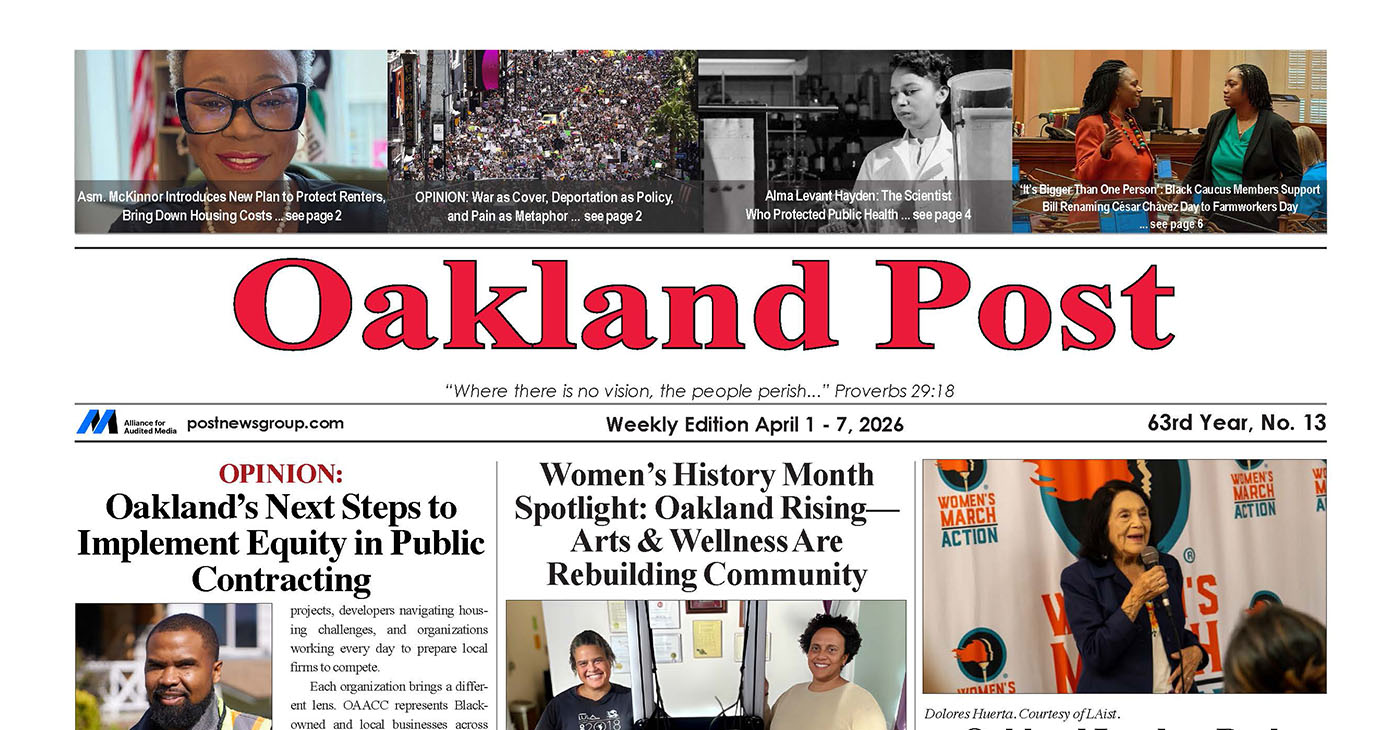
To enlarge your view of this issue, use the slider, magnifying glass icon or full page icon in the lower right corner of the browser window.
Activism
Oakland Post: Week of March 18 – 24, 2026
The printed Weekly Edition of the Oakland Post: Week of March 18 – 24, 2026

To enlarge your view of this issue, use the slider, magnifying glass icon or full page icon in the lower right corner of the browser window.

WORK FROM HOME
Home-based business with potential monthly income of $10K+ per month. A proven training system and website provided to maximize business effectiveness. Perfect job to earn side and primary income. Contact Lynne for more details: Lynne4npusa@gmail.com 800-334-0540


Oakland Post: Week of April 8 – 14, 2026

Oakland Post: Week of April 1 – 7, 2026

Black Artists in America, Installation Three Wraps at the Dixon Gallery and Gardens

Grief, Advocacy, and Education: A Counselor Reflects on Black Maternal Health

Future of Florida’s Black History Museum in Limbo

New Research Shows the Many Benefits of Early Learning

South Hampton K-8 Students Among Top 10 Finalists for Samsung’s ‘Solve for Tomorrow’ Competition

Cuba: No Negotiation with US on the President or Political System

Brooklyn Academy of Music Names Jamaican-Born Tamara McCaw as President

Trinidad & Tobego – U.S. Launches WhatsApp Channel for American Citizens in the Country

Oakland Post: Week of March 18 – 24, 2026

AI Innovation vs. Ethics and Environmental Impact

AI, Web3, and Digital Reparations

What If You Owned Your AI Agent?

Season 7, Episode 3 – January Reporter’s Roundtable 📱

Reflecting on Black History Milestones in Birmingham AL

Oakland Post: Week of February 25 – March 3, 2026

Oakland Post: Week of March 4 – 10, 2026

PRESS ROOM: NBA Hall of Fame Nominee Terry Cummings Joins 100 Black Men of DeKalb County to Launch Victory & Values Initiative

Trump’s MAGA Allies are Creating Executive Order Plan to Steal the 2026 Midterms

U.S. manufacturing rebounds – how foundry services are adapting to rising demand
Oakland Post: Week of March 18 – 24, 2026

Poll Shows Support for Policies That Help Families Afford Child Care

Oakland Post: Week of March 11 -17, 2026

OP-ED: One Hundred Years of Black Workers Telling the Truth

Advancements in solar technology that are changing the way we power the world

Financial Wellness and Mental Health: Managing Money Stress in College

Woman’s Search for Family’s Roots Leads to Ancestor John T. Ward – A Successful Entrepreneur and Conductor on the Underground Railroad

COMMENTARY: Women of Color Shape Our Past and Future

PRESS ROOM: Civil Rights TV Launches in Selma as the World’s First 24/7 Civil Rights Television Network

Hyundai Ioniq 5 Parking, Safety, and 360 View #shorts

2025 Ioniq 5 New Wiper & Powerful Performance! #shorts

Electric SUV Range: Is 259 Miles Enough? #shorts

EV Charging: How Fast Can You Charge an Electric Vehicle? #shorts

Biometric Cooling… Messaging Seats…Come on! 2025 Infiniti QX80 Autograph 4WD

Charged Up: Witness the Magic of a Fully Electric Car! #shorts

Range Rover Sport PHEV Included…: See What’s Inside This Luxury SUV! #shorts

Invisible Hood View: Perfect Parking with X-Ray Vision! #shorts

AI Is Reshaping Black Healthcare: Promise, Peril, and the Push for Improved Results in California

ESSAY: Technology and Medicine, a Primary Care Point of View

Sanctuary Cities

The RESISTANCE – FREEDOM NOW

STATE OF THE PEOPLE: Freddie

ECONOMIC BOYCOTT DAY!!!!!

I told You So
-
 Activism3 weeks ago
Oakland Post: Week of March 18 – 24, 2026
-
 Activism3 weeks ago
Oakland Post: Week of March 11 -17, 2026
-
 Advice3 weeks ago
Financial Wellness and Mental Health: Managing Money Stress in College
-
 #NNPA BlackPress3 weeks ago
Brooklyn Academy of Music Names Jamaican-Born Tamara McCaw as President
-
 #NNPA BlackPress2 weeks ago
Grief, Advocacy, and Education: A Counselor Reflects on Black Maternal Health
-
 #NNPA BlackPress2 weeks ago
New Research Shows the Many Benefits of Early Learning
-
 #NNPA BlackPress2 weeks ago
Black Artists in America, Installation Three Wraps at the Dixon Gallery and Gardens
-

 Advice4 weeks ago
Women & Wealth: Tips for Navigating Your Lifelong Financial Journey
