
City Government
OP-ED: Reining in and Raining on the Surveillance State

By JP Massar
Groundbreaking legislation that will put limits upon the local surveillance state is up for consideration in the Bay Area these next few months. With a new administration being handed the vast resource of existing Federal surveillance capabilities, it is more crucial than ever that localities understand what their police are doing in this regard and take measures to protect the civil liberties of the people.
On January 24th, the Oakland City Council Public Safety Committee had before it a ‘use and privacy policy’ (tinyurl.com/hw2t7ez) for Cell Site Simulators (aka Stingrays) – devices which can track your cellphone and, if configured to do so, snoop on your communications.
The Public Safety Committee voted unanimously to approve the policy, sending it on to the full Oakland City Council. This is an example of a policy that should be in place for all surveillance equipment, and civil liberties groups around the Bay are working towards that end. To wit:
The Bart Board of Directors is scheduling consideration of a Surveillance Equipment Regulation Ordinance (tinyurl.com/zgzh558). This ‘meta-ordinance’ mandates that all surveillance equipment – including Cell Site Simulators – be acquired through a public process. Use and privacy policies vetted in public must be in place before deployment for all such equipment, and a cost/benefit and civil liberties analysis done beforehand. The ordinance would also require yearly audits of equipment use, publicly available.
This would be similar to a proposed ordinance which the Oakland Privacy Advisory Commission passed several weeks ago (tinyurl.com/zfwc235) for consideration by the Oakland City Council next month.
Berkeley is also in the beginning stages of considering its own Surveillance Equipment Regulation Ordinance. Santa Clara County adopted the first such ordinance of its kind in the nation about a
year ago.
The Cell Site Simulator use and privacy policy Oakland’s Public Safety Committee considered was crafted by the Oakland Privacy Advisory Commission and is likely the strongest such policy in the nation. It’s significantly stronger than existing state laws such as one Illinois passed six months ago (tinyurl.com/hybkmzu), and it’s not clear if there are any other, local, publicly vetted policies in place putting real limitations on the use of these devices – devices which gained notoriety in the last couple of years for their indiscriminant deployment (tinyurl.com/mpu286h).
As proposed, the policy says a Cell Site Simulator:
- can never be used to intercept content, only to locate a cell phone;
- can only be used with a warrant, or in an emergency for 48 hours before obtaining a warrant;
- can only be used for certain, delineated purposes. The allowed purposes are to locate a missing person or at-risk individual, assist in investigations involving danger to the life or physical safety of an individual, or to apprehend known fugitives. They cannot be used in a “dragnet” operation; the cell phone to be located must be known in advance.
In addition a log of each use must be maintained, and an annual report detailing usage statistics, locations of deployment and costs must be compiled.
Would the world be better off without such powerful technologies? Would we be safer if the police could use surveillance without limits? Or is there a middle, accepting that surveillance technology will not just go away and will inevitably become more sophisticated? Is there a middle, knowing that the power to watch, unchecked, inevitably corrupts the watcher and demeans those surveilled?
Oakland Privacy, which has worked hard since the defeat of the Domain Awareness Center in 2014 promoting privacy and surveillance restrictions, suggests that such a middle needs to exist, because the consequence otherwise is not no surveillance state, but rather unfettered government – and big business – access to everything we say and do.
Oakland, Berkeley and BART should pass these ordinances. By opening up the process of acquiring surveillance equipment to public scrutiny, we hope that tradeoffs will be analyzed and consequences of surveillance discussed, so that the people – not the NSA, not Donald Trump, and not your local police – can draw the lines.
JP Massar is a member of the Oakland Privacy Working Group.








Activism
Oakland Post: Week of April 1 – 7, 2026
The printed Weekly Edition of the Oakland Post: Week of April 1 – 7, 2026

To enlarge your view of this issue, use the slider, magnifying glass icon or full page icon in the lower right corner of the browser window.
Activism
Oakland Post: Week of March 18 – 24, 2026
The printed Weekly Edition of the Oakland Post: Week of March 18 – 24, 2026

To enlarge your view of this issue, use the slider, magnifying glass icon or full page icon in the lower right corner of the browser window.
Activism
Oakland Post: Week of March 11 -17, 2026
The printed Weekly Edition of the Oakland Post: Week of March 11 – 17, 2026
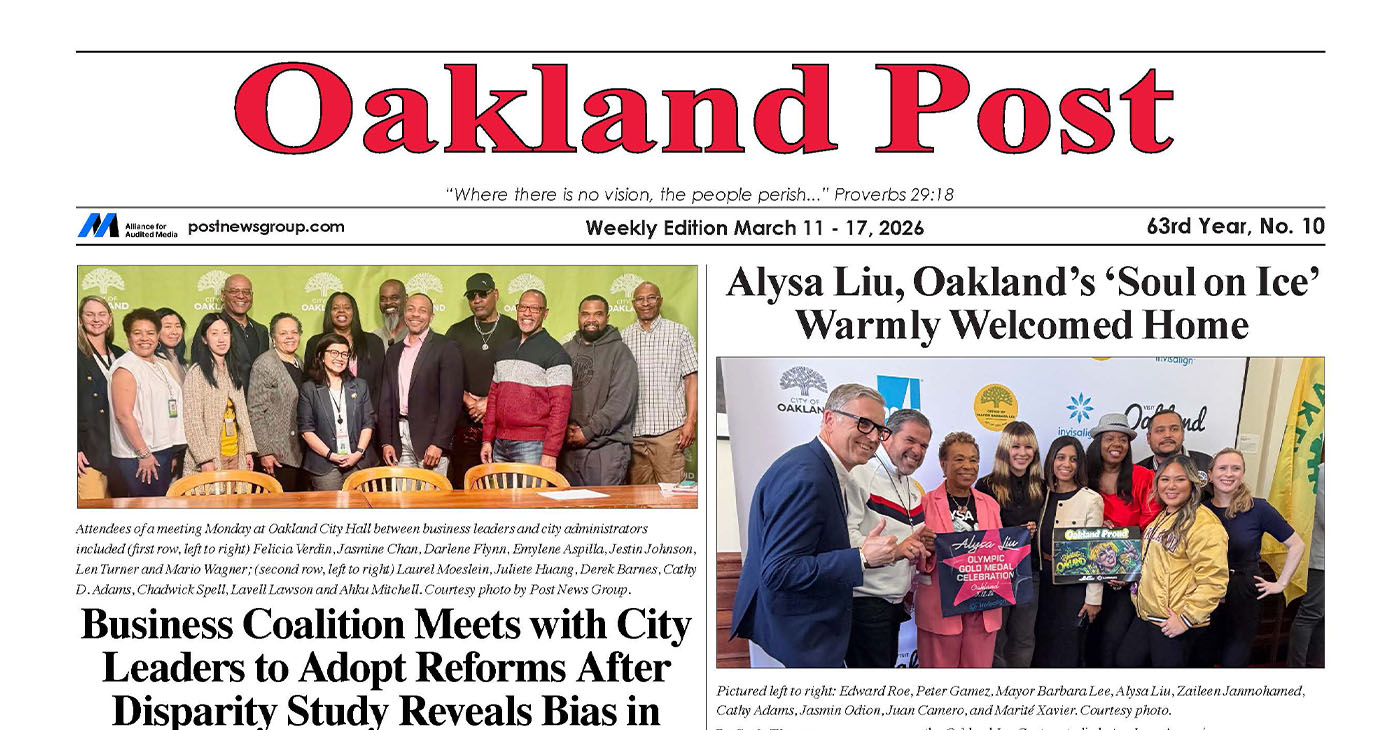
To enlarge your view of this issue, use the slider, magnifying glass icon or full page icon in the lower right corner of the browser window.

WORK FROM HOME
Home-based business with potential monthly income of $10K+ per month. A proven training system and website provided to maximize business effectiveness. Perfect job to earn side and primary income. Contact Lynne for more details: Lynne4npusa@gmail.com 800-334-0540


Oakland Post: Week of April 1 – 7, 2026

Black Artists in America, Installation Three Wraps at the Dixon Gallery and Gardens

Grief, Advocacy, and Education: A Counselor Reflects on Black Maternal Health

Future of Florida’s Black History Museum in Limbo

New Research Shows the Many Benefits of Early Learning

South Hampton K-8 Students Among Top 10 Finalists for Samsung’s ‘Solve for Tomorrow’ Competition

Cuba: No Negotiation with US on the President or Political System

Brooklyn Academy of Music Names Jamaican-Born Tamara McCaw as President

Trinidad & Tobego – U.S. Launches WhatsApp Channel for American Citizens in the Country

Oakland Post: Week of March 18 – 24, 2026

AI Innovation vs. Ethics and Environmental Impact

AI, Web3, and Digital Reparations

What If You Owned Your AI Agent?

Season 7, Episode 3 – January Reporter’s Roundtable 📱

Season 7, Episode 3 – January Reporter’s Roundtable

Reflecting on Black History Milestones in Birmingham AL

Oakland Post: Week of February 25 – March 3, 2026

PRESS ROOM: NBA Hall of Fame Nominee Terry Cummings Joins 100 Black Men of DeKalb County to Launch Victory & Values Initiative

Trump’s MAGA Allies are Creating Executive Order Plan to Steal the 2026 Midterms

Oakland Post: Week of March 4 – 10, 2026

U.S. manufacturing rebounds – how foundry services are adapting to rising demand

Poll Shows Support for Policies That Help Families Afford Child Care

OP-ED: One Hundred Years of Black Workers Telling the Truth

Oakland Post: Week of March 11 -17, 2026

Advancements in solar technology that are changing the way we power the world

Woman’s Search for Family’s Roots Leads to Ancestor John T. Ward – A Successful Entrepreneur and Conductor on the Underground Railroad
Oakland Post: Week of March 18 – 24, 2026

COMMENTARY: Women of Color Shape Our Past and Future

PRESS ROOM: Civil Rights TV Launches in Selma as the World’s First 24/7 Civil Rights Television Network

OP-ED: NNPA Launches 2026 “Leadership Matters” Video Series

Hyundai Ioniq 5 Parking, Safety, and 360 View #shorts

2025 Ioniq 5 New Wiper & Powerful Performance! #shorts

Electric SUV Range: Is 259 Miles Enough? #shorts

EV Charging: How Fast Can You Charge an Electric Vehicle? #shorts

Biometric Cooling… Messaging Seats…Come on! 2025 Infiniti QX80 Autograph 4WD

Charged Up: Witness the Magic of a Fully Electric Car! #shorts

Range Rover Sport PHEV Included…: See What’s Inside This Luxury SUV! #shorts

Invisible Hood View: Perfect Parking with X-Ray Vision! #shorts

AI Is Reshaping Black Healthcare: Promise, Peril, and the Push for Improved Results in California

ESSAY: Technology and Medicine, a Primary Care Point of View

Sanctuary Cities

The RESISTANCE – FREEDOM NOW

STATE OF THE PEOPLE: Freddie

ECONOMIC BOYCOTT DAY!!!!!

I told You So
-
 Activism3 weeks ago
Oakland Post: Week of March 11 -17, 2026
-
 #NNPA BlackPress4 weeks ago
Woman’s Search for Family’s Roots Leads to Ancestor John T. Ward – A Successful Entrepreneur and Conductor on the Underground Railroad
-
 Activism2 weeks ago
Oakland Post: Week of March 18 – 24, 2026
-
 #NNPA BlackPress4 weeks ago
COMMENTARY: Women of Color Shape Our Past and Future
-

 Advice3 weeks ago
Financial Wellness and Mental Health: Managing Money Stress in College
-

 #NNPA BlackPress4 weeks ago
Advocates Raise Alarm Over ICE Operation, MOU and Detention Risks in Baltimore County
-

 #NNPA BlackPress4 weeks ago
Pete Buttigieg to Join Mayor Randall Woodfin for Community Town Hall in Birmingham
-
 #NNPA BlackPress2 weeks ago
Brooklyn Academy of Music Names Jamaican-Born Tamara McCaw as President
