
#NNPA BlackPress
Olympians ‘Make a Splash’ to Curb Black, Latinx Drownings
By Aswad Walker | Houston Defender | Word In Black Cullen Jones (right) and student at a recent ‘Make a Splash’ swimming lesson in Houston, TX. Photograph courtesy of Mike Lewis/USA Swimming. This post was originally published on Defender Network (WIB) – With summer nearly upon us, pool season will soon kick off. Unfortunately, especially for Black and Latinx […]
The post Olympians ‘Make a Splash’ to Curb Black, Latinx Drownings first appeared on BlackPressUSA.

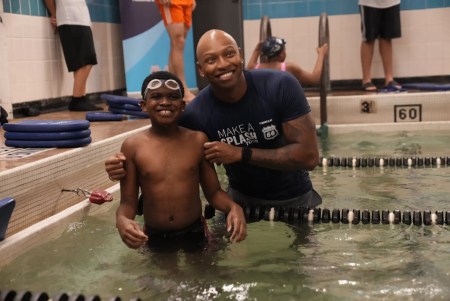
By Aswad Walker | Houston Defender | Word In Black
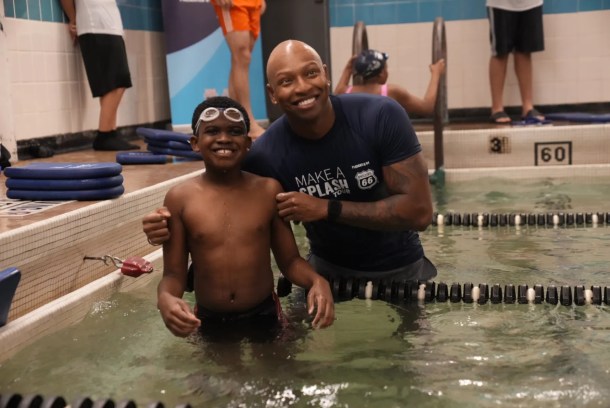
This post was originally published on Defender Network
(WIB) – With summer nearly upon us, pool season will soon kick off. Unfortunately, especially for Black and Latinx youth, that means increased danger due to stats that show them far more likely to drown than white children.
To help prevent such tragedies, the USA Swimming Foundation and Phillips 66 have been sponsoring an annual “Make a Splash Tour,” where former Olympic swimmers visit cities across the country providing swimming lessons for youth, especially Black and Latinx children.
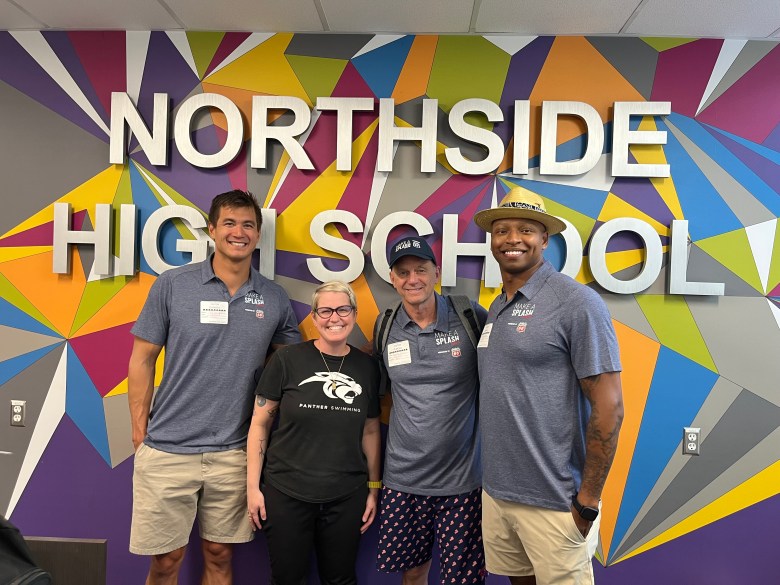
Recently, Olympians Cullen Jones (2008 and 2012 Olympic Games) and Nathan Adrian (2008, 2012 and 2016) were in Houston sharing this life-saving skill with H-Town children. The Defender spoke with the two about this initiative.
DEFENDER: So, what brings two Olympians to Houston?
CULLEN JONES: We’re here for the “Make a Splash Tour.” After 2008, USA Swimming Foundation and Phillips 66 started a water education program that really focused on trying to get more kids to learn to swim. It was very focused on trying to break generational barriers, especially in Black Americans, Latino Americans, and honestly, the numbers for Caucasian Americans aren’t great either. So, at the time it was 70% of Blacks, 60% of Latinos and 40% of Caucasians (who didn’t know how to swim). It was a US problem. So, we’ve been doing it for 15 years. And the best part about this is we started in Houston and 15 years later, we’re back in Houston, just trying to push the importance of learning to swim. (May) is International Water Safety Month, and the pools are opening. Kids are trying to get near the water. We wanna make sure they’re safer around the water.
DEFENDER: Why is water safety something that all parents and really all people should have way higher on our radar?
NATHAN ADRIAN: It’s the only sport that is a lifesaving skill. And as Cullen mentioned, the statistics are just kind of eye-opening when you see them. (Today), 60% of African-American children don’t know how to swim, 45% of Hispanic/Latino children don’t know how to swim and 40% of Caucasian children don’t know how to swim. And the coolest part is that lessons have been shown to be 88% effective in preventing drowning; formalized swim lessons. That’s it. And in terms of public health initiatives, that’s one of the most successful ones. And the other thing that we really try to emphasize is that if a parent or guardian doesn’t know how to swim, they’re only 19% likely to put their own children into swim lessons. So, once we break that cycle… and let me give Cullen a lot of props, because he is actually the one who was doing it for so long. He was at the first stop in Houston [15 years ago], and it inspired me as a young athlete, that, hey, he’s doing something great with his career, and I would love to be able to do the same thing, when the time came for me. Just in 2022, USA Swimming Foundation gave just under $1 million to help provide grants for swim opportunities for those who can’t afford it.
CULLEN JONES: And if you listen to the numbers that Nathan said, they were lower than mine because 10 years ago, the 70% was where it is (for Black youth). Now we’re seeing that the work is actually (paying off). Not only people are paying attention to swimming, but they’re understanding the message we are sending is so vital and important.
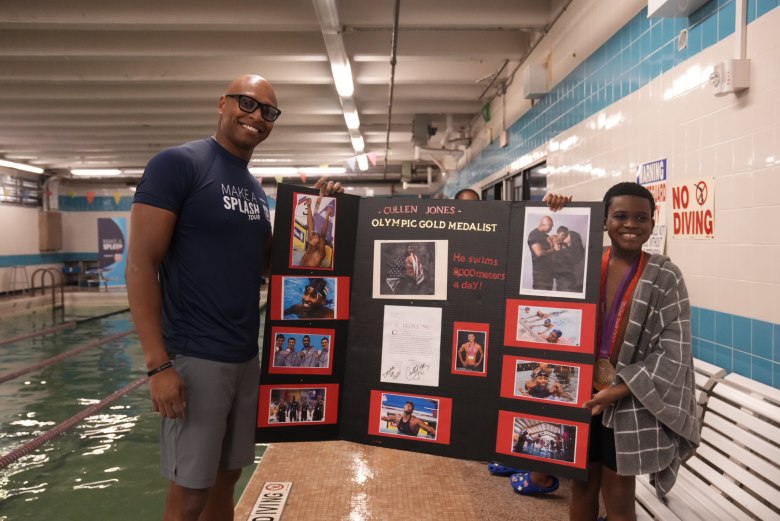
DEFENDER: With those crazy and scary numbers of the percentage of children that don’t know how to swim, what was the process for you two becoming comfortable with the water and learning how to swim?
NATHAN ADRIAN: My town’s claim to fame is it has the most coastline in any county in Washington state. So, my parents saw that a lot of the parks and things might have had docks, they were near the water. They felt really strongly that I needed to be in swim lessons as early as I could be. So, my time was spent doing swim lessons over and over and over.
CULLEN JONES: I had humble beginnings of being just like Nathan, a water baby, loving the water, wanting to be near the water. So, my parents took me to an amusement park, but I had not had swim lessons. I think what’s important about my story was that there were lifeguards there. My parents were there. Normally, you hear the story and it’s like someone was doing something they weren’t supposed to be doing. And, I was still able to go underwater; had to be resuscitated. And then, my parents were like, “Never again. We’re getting you into swim lessons.” And then, 20 years later, swimming’s still a primary piece of my life and becoming an Olympian; but humble beginnings of almost drowning. I was almost the statistics that we are trying to fight.
DEFENDER: So, growing up in the Black community and being a swimmer, what was that like?
CULLEN JONES: Everyone’s playing basketball, football, and, “Oh, you’re doing that swimming thing?” And then, we win gold medals and then the conversation changes. “Oh, how’s swimming going?” It changes then. But, growing up, it was a little different, wearing Speedos for a living. But it was my life. I enjoyed it. My best friends were swimmers. So, it was a great upbringing. But I did notice that I was alone many of the times when it came to looking left and right and seeing if there were gonna be other Black swimmers. There just wasn’t. But now as, as we’ve talked about what “Make a Splash” stands for, and as swimming becomes more and more popular, we are seeing more people of color… in water right now. So, we’re moving in the right direction.
DEFENDER: Final question, what are the 1-3 biggest tips you can give to parents and to children about to get in the water?
CULLEN JONES: Water watchers. Never, ever swim alone. The second one that I can think of right now is “Reach; Don’t Go.” When someone is in danger, they will pull their closest loved one underwater just to get (above water). It’s a fight-or-flight situation at that point. So, one of the things that lifeguards always talk about is do not try to put your hand out to pull someone back. Find something to help them, to bring them to safety.
NATHAN ADRIAN: The last one could be swim lessons. It is that important.
The post Olympians ‘Make a Splash’ to Curb Black, Latinx Drownings appeared first on The Sacramento Observer.
This article originally appeared in the Sacramento Observer.
The post Olympians ‘Make a Splash’ to Curb Black, Latinx Drownings first appeared on BlackPressUSA.









#NNPA BlackPress
Lock In Car Price: Avoid Dealer Payment Traps!
Watch the long-form video https://youtu.be/YANxGwD2CjI Don’t get swayed by monthly payments! Always settle the out-of-the-door price first, including all fees. Only then discuss monthly payments, terms, and potential add-ons. #AutoNetwork #CarBuyingTips #CarSales #DealershipSecrets #Negotiation
The post Lock In Car Price: Avoid Dealer Payment Traps! appeared first on BlackPressUSA.


Watch the long-form video
Don’t get swayed by monthly payments! Always settle the out-of-the-door price first, including all fees. Only then discuss monthly payments, terms, and potential add-ons. #AutoNetwork #CarBuyingTips #CarSales #DealershipSecrets #Negotiation
The post Lock In Car Price: Avoid Dealer Payment Traps! appeared first on BlackPressUSA.

#NNPA BlackPress
Sell Your Car: Get Offers BEFORE Visiting Dealerships!
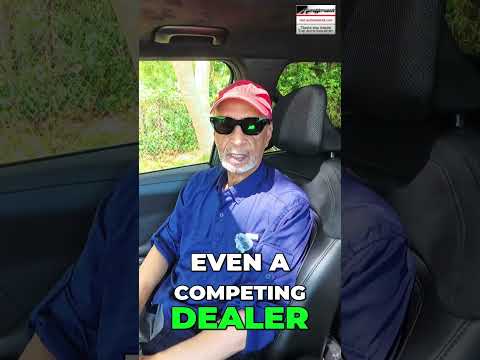
Watch the video https://youtu.be/zJF32l2Fz8I. Before you step onto a lot, get a written offer for your trade-in from CarMax, Carvana, or even a competing dealer. Make them beat it, or they lose your business. Get that number on paper, not just in your head. #AutoNetwork #TradeInTips #CarBuying #Negotiation #SmartShopping
The post Sell Your Car: Get Offers BEFORE Visiting Dealerships! appeared first on BlackPressUSA.
Watch the video
Before you step onto a lot, get a written offer for your trade-in from CarMax, Carvana, or even a competing dealer. Make them beat it, or they lose your business. Get that number on paper, not just in your head. #AutoNetwork #TradeInTips #CarBuying #Negotiation #SmartShopping
The post Sell Your Car: Get Offers BEFORE Visiting Dealerships! appeared first on BlackPressUSA.
#NNPA BlackPress
The Conversation With Al McFarlane 6/23/26
The conversation continues.
The post The Conversation With Al McFarlane 6/23/26 appeared first on BlackPressUSA.

The conversation continues.
The post The Conversation With Al McFarlane 6/23/26 appeared first on BlackPressUSA.

WORK FROM HOME
Home-based business with potential monthly income of $10K+ per month. A proven training system and website provided to maximize business effectiveness. Perfect job to earn side and primary income. Contact Lynne for more details: Lynne4npusa@gmail.com 800-334-0540



Oakland Museum Presents Landmark Retrospective Celebrating Beloved Bay Area Artist Mildred Howard

Ferry Fares to Increase July 1 as Ridership Hits Record Highs

Stop the Hate Symposium Brings Oakland Together Through Dialogue, Partnership, and Community Healing

Six Months in, Probate Reform Coalition Marks Progress in Protecting Elders From Financial Abuse

A Long Time Coming: School District Kicks Off Massive $97 Million Renovation of West Oakland’s McClymonds High School

IN MEMORIAM: Oakland Dance Legend Reginald Ray-Savage, 67

UC Berkeley Named Top Public University in the U.S. and No. 7 in the World by ‘U.S. News’

NCBW-OBAC Champions Black Women Entrepreneurs at Business en Blaque Expo

Lock In Car Price: Avoid Dealer Payment Traps!

Sell Your Car: Get Offers BEFORE Visiting Dealerships!

The Conversation With Al McFarlane 6/23/26

Media Monday 6/22/26

LIVE! ASK ALMA! — TUES. 6.23.26 7PM EST

Car Buying Secrets: 4 Hidden Checks Before You Sign!

Book Review: Books for College-Bound Students

Q&A with Steven Bradford: Why He Wants Your Vote for California Insurance Commissioner

Oakland Mayor Pushes Charter Overhaul to Clarify Roles in City Government, Increase Accountability and Improve Service Delivery

The Ladies of Delta Sigma Theta Hold Day of Advocacy at the Capitol in Sacramento

OPINION: The Fire of Oakland’s Justin Jones

How Is AI Affecting California? The State Wants You to Share Your Story

California Launches Free Diaper Program for Newborns Statewide

Rep. Kamlager-Dove Introduces Bill to Protect Women in Custody After Reports Detailing Miscarriages and Neglect

More and More, Black Californians Are Worried About Rising Costs of Housing, Energy, Food and Gas

After 10-Year Wait, Fillmore Heritage Center Reopens in San Francisco

Asm. Jackson Bill Requiring Anti-Hate Speech Training for Calif. Public Officials Sent to “Suspense File”

Oakland Post: Week of May 20 – 26, 2026

Oakland Post: Week of May 27 – June 2, 2026

Oakland Post: Week of June 3 – 9, 2026

Advocates Rally at State Capitol to Demand Heat Protections for Incarcerated People; More Funding for DV Survivors
The Conversation With Al McFarlane 6/23/26
Media Monday 6/22/26
LIVE! ASK ALMA! — TUES. 6.23.26 7PM EST
Car Buying Secrets: 4 Hidden Checks Before You Sign!

Is This 550 HP Charger Worth YOUR Money? AutoNetwork Review

Celebrating Juneteenth – Frederick Douglass on education and resistance

LIVE! — ASK ALMA! — TUES. 6.19.26 7PM EST

Hyundai Ioniq 5 Parking, Safety, and 360 View #shorts

2025 Ioniq 5 New Wiper & Powerful Performance! #shorts

Electric SUV Range: Is 259 Miles Enough? #shorts

EV Charging: How Fast Can You Charge an Electric Vehicle? #shorts

Biometric Cooling… Messaging Seats…Come on! 2025 Infiniti QX80 Autograph 4WD

Charged Up: Witness the Magic of a Fully Electric Car! #shorts

Range Rover Sport PHEV Included…: See What’s Inside This Luxury SUV! #shorts

Invisible Hood View: Perfect Parking with X-Ray Vision! #shorts
-
 Art3 weeks ago
After 10-Year Wait, Fillmore Heritage Center Reopens in San Francisco
-
 Activism3 weeks ago
Oakland Post: Week of June 3 – 9, 2026
-

 #NNPA BlackPress3 weeks ago
5 Cleveland Police Officers Injured, Gunfire Erupts During East Side Pursuit
-

 #NNPA BlackPress3 weeks ago
2026 World Cup is Here and Atlanta is Ready For It
-
 Arts and Culture3 weeks ago
COMMENTARY: Black Music is the Sound of Black Freedom: Let Us Reclaim Both This Juneteenth
-
 Art3 weeks ago
Oakland Director Boots Dazzles Once Again in ‘I Love Boosters’
-
 #NNPA BlackPress3 weeks ago
COMMENTARY: Using Art, Healing, And Community to Transform Mental Health Dialogue
-

 #NNPA BlackPress3 weeks ago
Venus Williams Calls a Sabalenka Exit a Tragedy
