Alameda County
Oakland Begins Month-Long Closure on Largest Homeless Encampment
At 8 a.m. sharp, city workers began piling up trash and dismantling makeshift homes along the nearly five-block encampment. City crews blocked off streets from 14th Ave to 17th Ave, between E. 12th and International Blvd, due to the Safe Work Zone Ordinance that was passed by the city council in 2022 to protect workers from harassment during cleanings, according to a city spokesperson.

By Magaly Muñoz


The City of Oakland began a three-week-long breakdown of the largest homeless encampment in the city on E. 12th Street on Monday morning. Residents and advocates said they are devastated about the displacement of dozens of people.
At 8 a.m. sharp, city workers began piling up trash and dismantling makeshift homes along the nearly five-block encampment. City crews blocked off streets from 14th Ave to 17th Ave, between E. 12th and International Blvd, due to the Safe Work Zone Ordinance that was passed by the city council in 2022 to protect workers from harassment during cleanings, according to a city spokesperson.
Jaz Colibri, one of the many advocates at the closure, said the encampment sweeps were “intense and terrifying” to witness. They claimed that several residents, many of them non-English speakers, had not been aware that the sweep was happening that day because of a lack of proper communication and outreach from Oakland.
Colibri added that the city had done a Census “many months ago” and “had not bothered to count people since then”, meaning dozens of individuals have missed out on housing and resources in the last few weeks because the city doesn’t offer outreach in multiple languages.

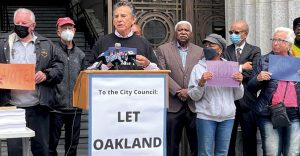
“Basically, [Oakland] dropped the ball on actually getting to know everybody who lives here and then creating a housing solution that meets everyone’s needs,” Colibri said.
City spokesperson Jean Walsh told the Post that notices of the closure operation were posted in Spanish and Chinese prior to Monday, but did not clarify if outreach was done in those languages as well.
Nearly a dozen Oakland police vehicles, California Highway Patrol officers, and Oakland Public Works staff were gathered along E 12th waiting for residents to pack up their belongings and move away from the area.
Advocates said residents “felt unsafe” due to the hefty law enforcement presence.
One city worker, who was picking up debris near 16th Ave, said, “They’ve known we were coming for a long time now” in reference to resident confusion about the sweeping.
The state doubled down on its requirement to get cities and counties to deal with their homelessness crisis at a press conference Monday afternoon. Gov. Gavin Newsom’s office released a “model ordinance” that is intended to provide a starting point that local municipalities can use to build from and adjust in creating their own policies on encampments, if they haven’t done so yet.
Newsom said “No more excuses, time to deliver” after the state has poured hundreds of millions of dollars into solving the issue.
Oakland was awarded a $7.2 million grant from the state in 2024 to close long-standing encampments in the city, including camps at Martin Luther King, Jr. and 23rd Street, and Mosswood Park.
Residents at these encampments were offered wraparound supportive services, temporary shelter, and eventually will be transitioned to permanent supportive housing, according to a city statement from last year.
Residents who accepted housing at these three encampments were moved into newly acquired property, formerly the Extended Stay America Hotel in West Oakland, which will first serve as interim housing for up to 150 individuals and couples in 105 units, and in the coming year, will be converted into 125 units of permanent housing.
Walsh said as of May 2, “32 residents of the recently closed Mosswood Park encampment moved into the Mandela House program” and as of May 12, “41 residents of the East 12th Street encampment have already accepted offers to move to the Mandela House.” The city will provide final numbers of how many accepted and moved into housing after the closure operation is over.
