
Economics
National Conference Seeks to Raise Black Home Ownership Rates

Rebuilding wealth among Black Americans through homeownership is the focus of the Mid-Winter Regional Conferences to be convened by National Association of Real Estate Brokers (NAREB).
Homeownership rates continue to stagnate from a high of approximately 49 percent prior to the recent, economically-disabling recession that started in 2006, to a now intractable low of 42 percent.
Strategy sessions encouraging Black Americans to become homeowners, coupled with a laser-focused advocacy campaign addressing public policies, private practices and regulations obstructing fair mortgage lending will be covered at NAREB’s first of four national hub conferences scheduled.
The theme of the conference is “Rebuilding Black Wealth Through Homeownership,” runs Feb. 18-20, at the Hilton Garden Inn, 1800 Powell St. in Emeryville.
“NAREB is taking the lead to re-build Black wealth through homeownership. NAREB’s goal is to increase homeownership for Black Americans by two million in five years,” said Ron Cooper, president of the National Association of Real Estate Brokers (NAREB) which has been fighting for Democracy in Housing for Black Americans and professionals in the real estate industry since its founding in 1947.
Latest available mortgage lending data for Oakland indicates that of the 2,112 loans made in 2014, only 67, or 3.2 percent (3.2 percent) of those loans were granted to Black American purchasers; who represented 27 percent (27 percent) of the city’s population.
The report also noted that the average loan amount in Oakland in 2014 was nearly $400,000.
“The situation in Oakland is not unlike other parts of the country. NAREB’s mission is to ensure that Black Americans and others adversely affected by the devastating economic meltdown have the opportunity to rebuild their economic legacy that was destroyed or drastically diminished during the nation’s near financial collapse, Cooper added.
On Saturday, Feb. 20, NAREB is convening Community Wealth Building Day at the Oakland City Hall, 1 Frank O’Gawa Plaza. The free event is open to the public to help Black Americans learn why owning a home can positively change their financial futures.
Also, there will be educational sessions designed to help residents better understand the home buying process and how to sustain a newly purchased home.
The Community Wealth Building Day culminates NAREB’S 2016 Mid-Winter Regional Conferences; this year being held in four hub cities. The three-day professional real estate conferences are being held in: Oakland (February 18-20); Memphis, TN ((March 10-12); Philadelphia, PA (April 7-9), and Chicago (April 21-23).
For more information and to register for the professional real estate conferences, visit www.nareb.com.


Activism
Oakland Post: Week of April 1 – 7, 2026
The printed Weekly Edition of the Oakland Post: Week of April 1 – 7, 2026
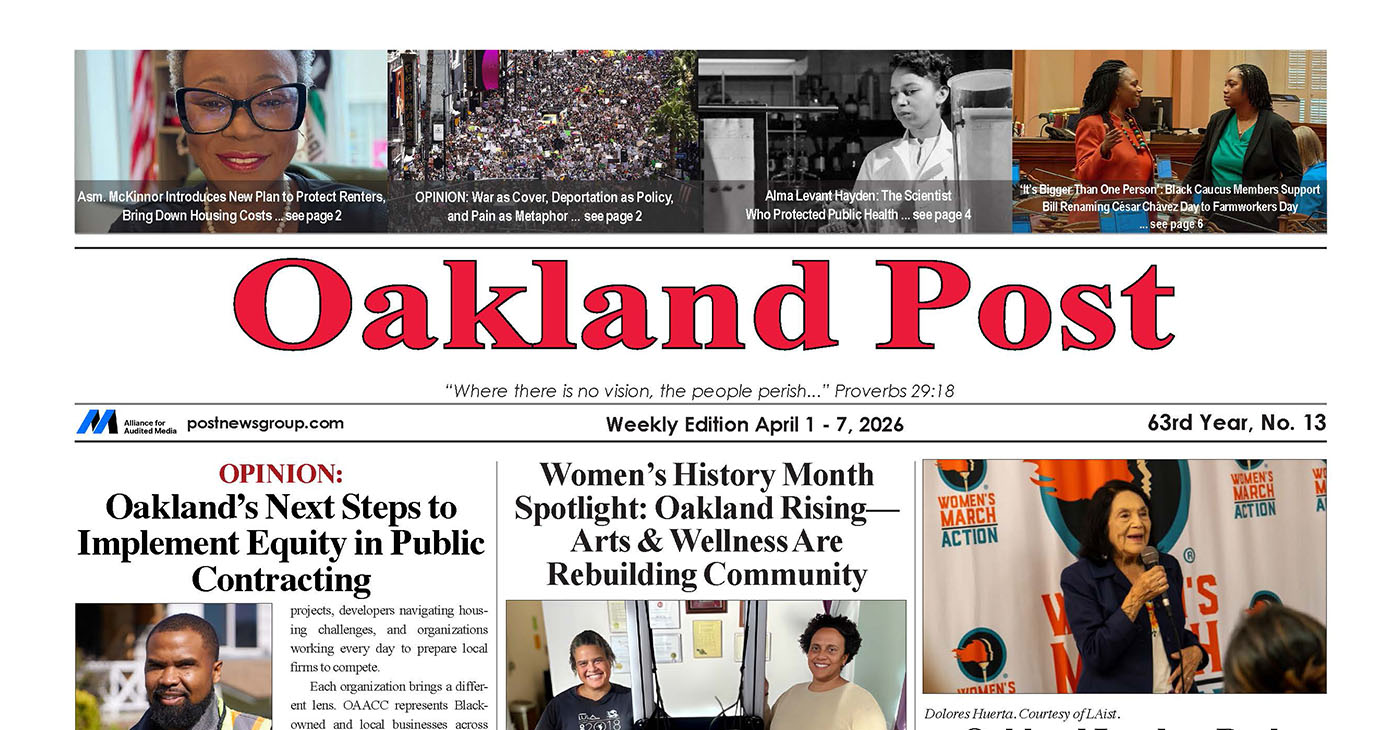
To enlarge your view of this issue, use the slider, magnifying glass icon or full page icon in the lower right corner of the browser window.
Activism
Oakland Post: Week of March 18 – 24, 2026
The printed Weekly Edition of the Oakland Post: Week of March 18 – 24, 2026

To enlarge your view of this issue, use the slider, magnifying glass icon or full page icon in the lower right corner of the browser window.
Activism
Oakland Post: Week of March 11 -17, 2026
The printed Weekly Edition of the Oakland Post: Week of March 11 – 17, 2026
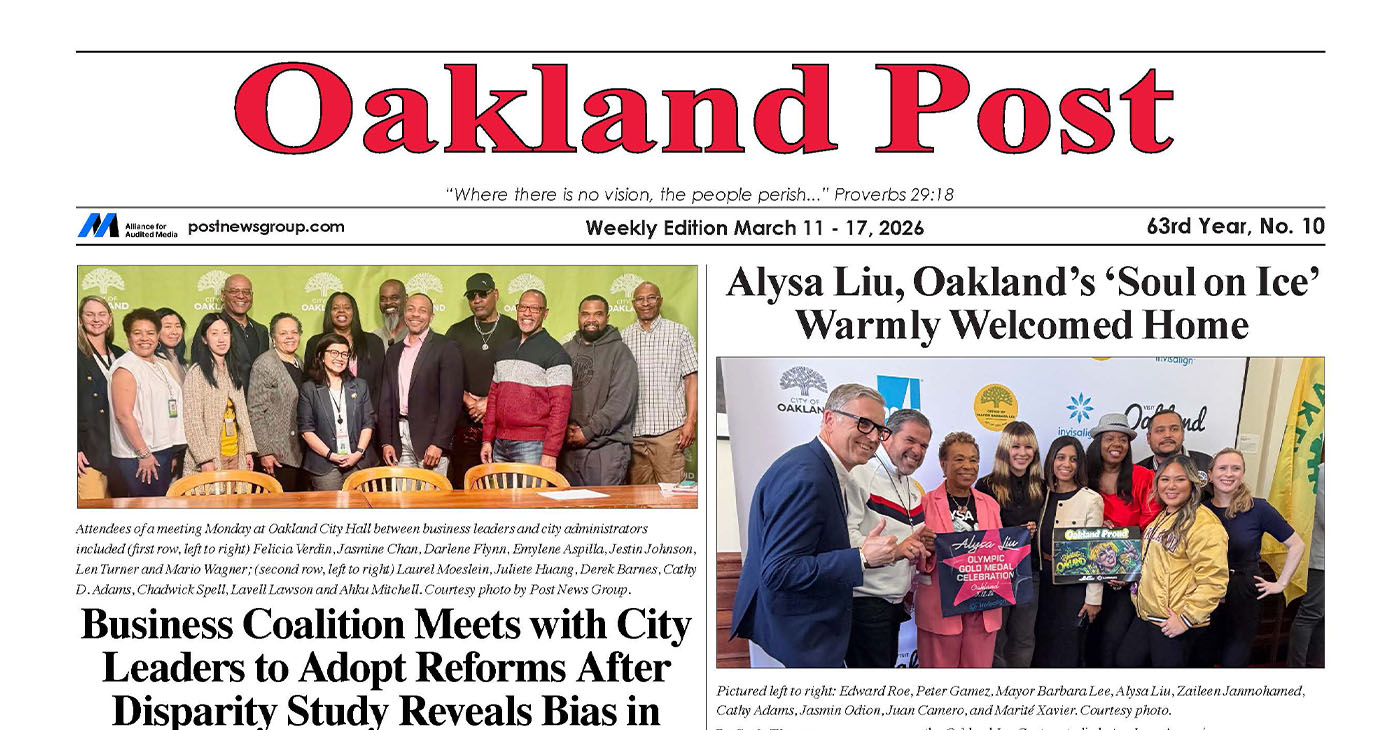
To enlarge your view of this issue, use the slider, magnifying glass icon or full page icon in the lower right corner of the browser window.


WORK FROM HOME
Home-based business with potential monthly income of $10K+ per month. A proven training system and website provided to maximize business effectiveness. Perfect job to earn side and primary income. Contact Lynne for more details: Lynne4npusa@gmail.com 800-334-0540


Oakland Post: Week of April 1 – 7, 2026

Black Artists in America, Installation Three Wraps at the Dixon Gallery and Gardens

Grief, Advocacy, and Education: A Counselor Reflects on Black Maternal Health

Future of Florida’s Black History Museum in Limbo

New Research Shows the Many Benefits of Early Learning

South Hampton K-8 Students Among Top 10 Finalists for Samsung’s ‘Solve for Tomorrow’ Competition

Cuba: No Negotiation with US on the President or Political System

Brooklyn Academy of Music Names Jamaican-Born Tamara McCaw as President

Trinidad & Tobego – U.S. Launches WhatsApp Channel for American Citizens in the Country

Oakland Post: Week of March 18 – 24, 2026

AI Innovation vs. Ethics and Environmental Impact

AI, Web3, and Digital Reparations

What If You Owned Your AI Agent?

Season 7, Episode 3 – January Reporter’s Roundtable 📱

Season 7, Episode 3 – January Reporter’s Roundtable

Reflecting on Black History Milestones in Birmingham AL

Oakland Post: Week of February 25 – March 3, 2026

PRESS ROOM: NBA Hall of Fame Nominee Terry Cummings Joins 100 Black Men of DeKalb County to Launch Victory & Values Initiative

Trump’s MAGA Allies are Creating Executive Order Plan to Steal the 2026 Midterms

Oakland Post: Week of March 4 – 10, 2026

Chase Oakland Community Center Hosts Alley-Oop Accelerator Building Community and Opportunity for Bay Area Entrepreneurs

U.S. manufacturing rebounds – how foundry services are adapting to rising demand

Poll Shows Support for Policies That Help Families Afford Child Care

OP-ED: One Hundred Years of Black Workers Telling the Truth

Advancements in solar technology that are changing the way we power the world

Oakland Post: Week of March 11 -17, 2026

Woman’s Search for Family’s Roots Leads to Ancestor John T. Ward – A Successful Entrepreneur and Conductor on the Underground Railroad
Oakland Post: Week of March 18 – 24, 2026

COMMENTARY: Women of Color Shape Our Past and Future

PRESS ROOM: Civil Rights TV Launches in Selma as the World’s First 24/7 Civil Rights Television Network

Hyundai Ioniq 5 Parking, Safety, and 360 View #shorts

2025 Ioniq 5 New Wiper & Powerful Performance! #shorts

Electric SUV Range: Is 259 Miles Enough? #shorts

EV Charging: How Fast Can You Charge an Electric Vehicle? #shorts

Biometric Cooling… Messaging Seats…Come on! 2025 Infiniti QX80 Autograph 4WD

Charged Up: Witness the Magic of a Fully Electric Car! #shorts

Range Rover Sport PHEV Included…: See What’s Inside This Luxury SUV! #shorts

Invisible Hood View: Perfect Parking with X-Ray Vision! #shorts

AI Is Reshaping Black Healthcare: Promise, Peril, and the Push for Improved Results in California

ESSAY: Technology and Medicine, a Primary Care Point of View

Sanctuary Cities

The RESISTANCE – FREEDOM NOW

STATE OF THE PEOPLE: Freddie

ECONOMIC BOYCOTT DAY!!!!!

I told You So
-
 Activism3 weeks ago
Oakland Post: Week of March 11 -17, 2026
-
 #NNPA BlackPress4 weeks ago
Woman’s Search for Family’s Roots Leads to Ancestor John T. Ward – A Successful Entrepreneur and Conductor on the Underground Railroad
-
 Activism2 weeks ago
Oakland Post: Week of March 18 – 24, 2026
-
 #NNPA BlackPress4 weeks ago
COMMENTARY: Women of Color Shape Our Past and Future
-

 Advice3 weeks ago
Financial Wellness and Mental Health: Managing Money Stress in College
-

 #NNPA BlackPress4 weeks ago
Advocates Raise Alarm Over ICE Operation, MOU and Detention Risks in Baltimore County
-

 #NNPA BlackPress4 weeks ago
Pete Buttigieg to Join Mayor Randall Woodfin for Community Town Hall in Birmingham
-
 #NNPA BlackPress2 weeks ago
Brooklyn Academy of Music Names Jamaican-Born Tamara McCaw as President
