
Uncategorized
A mother tongue spoken by millions of Americans still gets no respect.

Ain’t No Reason
By Lex Friedman
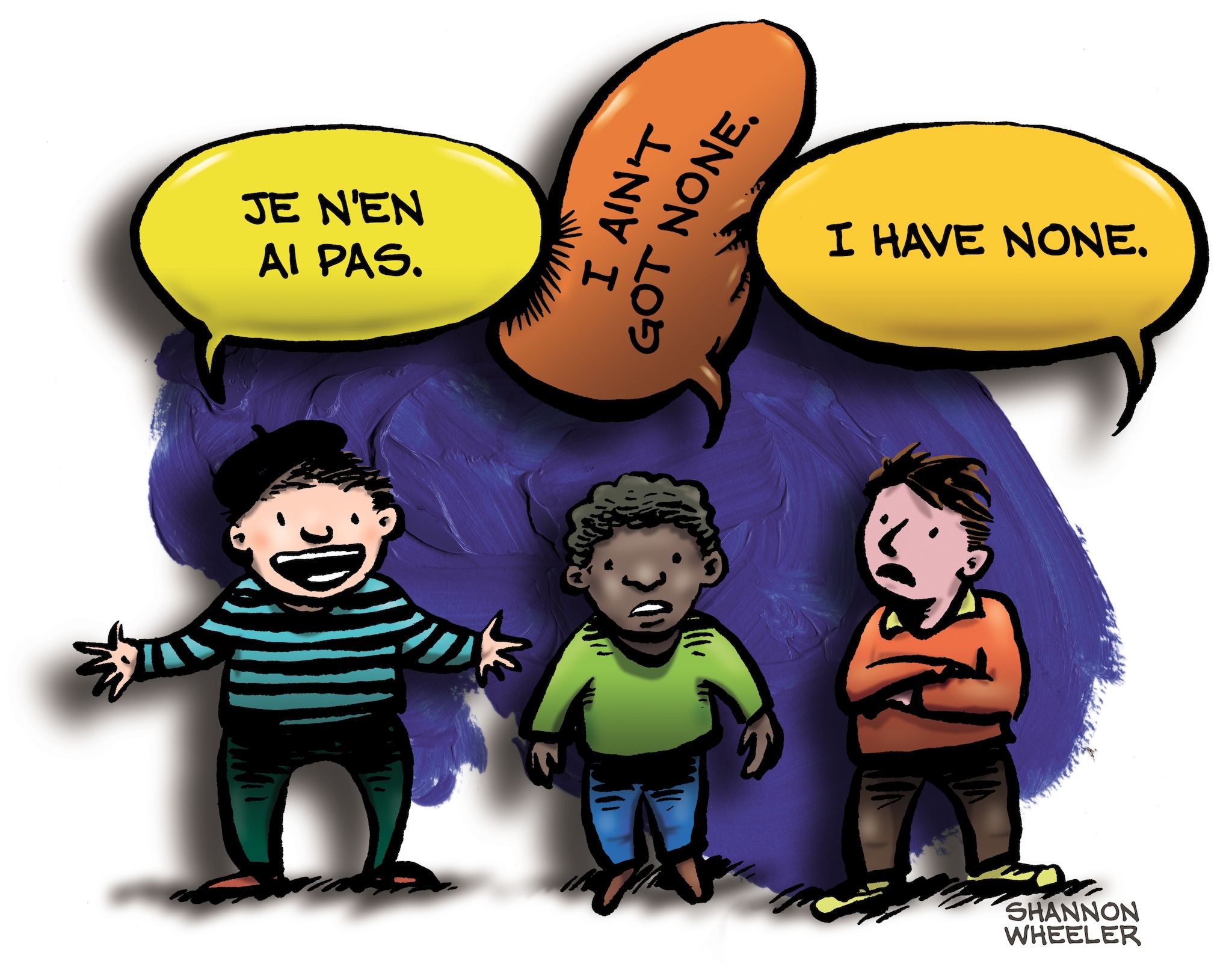 The Oakland, California, school board officially recognized the legitimacy of Ebonics in 1996. Controversy erupted when it issued its decree, but its action was almost entirely misunderstood. No modern linguist embraces the term Ebonics. The more accurate — and less politically charged — label is African American Vernacular English (AAVE).Linguistics professor Rebecca Wheeler notes, “When the public uses the term Ebonics, it pulls with it all the societal negative connotations — the ridicule, the jokes, the sneering, all of that — so linguists don’t use the term. It’s not a technical term, and we seek to avoid negative associations.”The educators in California had no plans to teach kids to speak and write AAVE; this wasn’t an attempt to get “ain’t” in their grammar books. Rather, the Oakland school board’s ruling was meant to stop unfairly punishing kids whose first instinct was to speak at school the way they spoke at home.
Oakland wanted to recognize the language’s existence. Others were opposed. The battle still simmers.
Ingredients in language soup
Folks who paid strict attention in Linguistics 101 — I majored in the subject — might remember pidgins and creoles. A pidgin is a simplified, ad-hoc language shared by speakers who lack a common tongue. It borrows rules and words from all languages involved, and has its own rules as well. But a pidgin isn’t a full language; it lacks the rich vocabulary and structure.
A creole, on the other hand, develops when children start learning and speaking the pidgin as their primary form of communication. Those who speak a pidgin have a native tongue and may speak several languages, and they are well aware that the pidgin is an amalgam. But a creole is the mother tongue of the speaker, who has likely heard and spoken it from infancy while being raised in a world in which pidgin may be the lingua franca.1
There’s debate over whether AAVE is a pidgin or a creole or something else entirely. Some suggest that AAVE is a creole that developed in West Africa, from the descendants of pidgins that developed between African slaves and the Europeans who traded them between the 16th and 19th centuries. The other theory (Rubba 1997) is that AAVE is simply a dialect of English that came about “through a history of social and geographic separation of its speakers from speakers of other varieties of English.”
Critics of AAVE attack strawmen — Jim ScareCrows, if you will. “You can’t teach this stuff!” they fret, though no one wants to teach it. And, just as wrongly, they claim that AAVE is a sloppy, messy, unstructured language. Let’s disprove that falsehood first.
Don’t not be negative, nohow
AAVE doesn’t follow traditional American English’s rules of grammar; it instead enforces its own. Some of AAVE’s grammatical structures closely mirror those of French. Here are a couple of examples.
A common AAVE construction follows this pattern:
I ain’t got none.
I ain’t singin’ nothing.
I ain’t never eat no sushi.
Teachers of English grammar might cringe at the offensive double negatives on display. They’re ungrammatical in traditional English, but they’re not without precedent. As you can see, AAVE wraps negators on either side of the verbs. Here are those same sentences in French:
Je n’en ai pas.
Je ne chanterai pas.
Je n’ai jamais mangé de sushis.
As you can see, French has precisely the same structure. What in traditional English would qualify as an ungrammatical double negative is in French — and AAVE — the correct and necessary phrasing. Though it obviously differs from English’s rules, the two-part negation in French isn’t wrong, any more than it’s wrong that the word for “annoying” in French is “pénible.” AAVE’s negations follow its own strict grammar.
An interesting element of AAVE’s rules for negatives is that, in negative statements, every possible negation should be used:
I ain’t tell nobody nothing about no sushi.
Imperfectly stated
Another way that AAVE’s grammar rules mirror those of French: Both employ an imperfect tense. The imperfect (l’imparfait in French) is a kind of past tense that’s used in French for a variety of purposes, most of which are beyond our scope.2 The French imperfect commonly describes habitual, repeated actions or states of existence. In English, the imperfect tense requires some circumlocation; in French, it’s a verb conjugation.
In high school, I used to read a lot.
Au lycée, je lisais beaucoup.
The “ais” suffix attached to the verb lire (to read) here indicates the imperfect tense, referring to a regular habit of reading during my high school years. AAVE offers a very similar tense, but instead of suffixes, it leverages the presence of the verb to be.
He crazy, but he don’t be crazy.
That statement indicates that the individual being described is currently in the act of exhibiting craziness, but isn’t habitually crazy: He [is] crazy, but he don’t be [in the habit of being] crazy, as it were. The rules in operation: Drop any “to be” verb when describing the present tense (“He crazy”), and use “be” regardless of the subject to identify an imperfect tense verb (“He be crazy”).
AAVE isn’t a perfect parallel to French. Many AAVE grammar rules emulate rules from other languages: Its use of unmarked past tense (for example, omitting the -ed suffix, as in He pass his driver’s test yesterday) is akin to similar structures in Asian and Native American languages; its unmarked plurality in noun phrases (I want three scoop [of] ice cream) hews closely to how Japanese works.
Speakers of it use the same unspoken rules whenever they use the language, and different speakers apply the same rules consistently. If such speakers were just poor at using standard English, you wouldn’t see most AAVE speakers making the same so-called mistakes identically again and again.
It’s easy to label critics of AAVE-as-a-language as racists, and that certainly covers some. But those who criticize without intentional bigotry are likely mis- or uninformed about what constitutes a language. Critics may claim that AAVE is just “made up,” forgetting that American English isn’t exactly codified in our DNA, either.3
So AAVE is a language — so what? What the heck was Oakland’s point in the mid-1990s?
AAVE, education, and code-switching
Ray Jackendoff, currently the co-director of the Center for Cognitive Studies at Tufts University (and formerly chair of the linguistics program at Brandeis University while I attended the school), studied linguistics under Chomsky at MIT. Jackendoff points me to a passage in his 2002 book, Foundations of Language, wherein he makes this point:
An important part of learning to read is appreciating how orthography reflects pronunciation. If one is teaching reading of Standard English to a child who does not speak it, it is difficult to establish this crucial link.
Speakers who arrive at school without constant experience with Standard English thus start at a disadvantage that is compounded by the rejection of their native mode of speech. And that’s where Oakland’s school board tried to help. Its ruling aimed to encourage teachers to recognize that students growing up with AAVE spoke it as its own distinct language; judging their first language as lousy English, instead of accepting it on its own merits, did those students a serious disservice.
AAVE isn’t the first language to spur such a debate. Some educators in Hawaii have long bemoaned Hawaiian Creole English (HCE), which is spoken by many — probably most — Hawaiians. (It’s often referred to as a pidgin, even though it’s been spoken for generations.) HCE combines English and Hawaiian words and grammar; since its rules are distinct from each, some teachers are inclined to tell students that they’re speaking or writing incorrectly whenever those kids use HCE.
With AAVE, however, it’s 17 years after the school board decision, and the state of the discussion has hardly advanced at all.
What the doctor prescribed
The debate over HCE and AAVE is really the same ages-old linguistic debate between prescriptivists and descriptivists played out another way. Prescriptivists want to freeze the language as they believe it either is or should be spoken — for instance, they object to the increasing use of “they” as a singular pronoun — while descriptivists aim to document how people actually speak.
Rebecca Wheeler, the professor at Christopher Newport University mentioned at the outset, is a descriptivist, like all linguists. She says that these kids are speaking AAVE because that’s what they know; it’s not wrong — it’s their language. She thus advocates teaching students who speak AAVE at home the concept of code-switching. The general idea is simply the notion of switching between two different languages as needed.
Rather than labeling their language use as incorrect when students speak or write in AAVE, Wheeler says, teachers should instead coach those students: “In formal writing, we say, ‘I’m not doing anything,’ not ‘I ain’t doing nothing.’”
Schools should recognize the legitimacy of AAVE as a language for their students, and teach those students to recognize when and how to switch between AAVE and American English as appropriate. But most schools don’t do that. They simply teach students that the way they speak is wrong. Don’t talk this way; talk our way.
Wheeler says we’re still not doing right by children who grow up with AAVE. “The consequences are that students are being terribly misassessed in our schools. Teachers think that black kids are making mistakes, when really they’re re-creating what they hear and learn at home,” Wheeler says. “They’re counting as mistakes things that are patterns and rule-based, so [the students are] being placed in lower reading groups.”
Many of us unfairly judge others based on how they speak. Kenneth the page, on the late, great 30 Rock, spoke with a southern accent meant to exemplify his yokel-ness. Maybe you think that British accents sound dignified, or that the Minnesota accent on display in Fargo betrays its speakers’ intellectual inferiority.
“People don’t always realize that dialect prejudice still exists,” Wheeler says. “Reminding them, and explaining notions like the grammatical rules that govern AAVE — that’s a true ‘aha!’ experience. That alone is important, and people can grasp it — and grasping it, that’s actually a big thing.” Supreme Court Justice Clarence Thomas, who famously rarely speaks in public proceedings, grew up speaking Gullah, a creole spoken around the southern Atlantic coast. Justice Thomas told high school students in 2000 about Gullah, “People praise it now, but they used to make fun of us back then.”
Wheeler says that most teachers and school systems are ill-equipped to sort this out. She says, “The testing system remains entrenched in proper grammar, bad grammar, right and wrong. There’s no room for anything else. It’s appalling.”
The future soon
You might assume — I did — that AAVE is a blip in the move toward the homogenization of language over time due to television, movies, the Internet, and our increasing connectedness. But we’d both be wrong. Wheeler notes that recent work by William Labov at the University of Pennsylvania shows that dialects are diverging in the United States.
“We change and become similar in language only when we’re in true contact, in authentic linguistic contact, with our interlocutor,” Wheeler says. This requires proximity and true two-way conversations by speakers of different dialects. But media isn’t “linguistic engagement,” she notes, and thus doesn’t influence people’s modes of speaking as much as one would intuit.
Couple the failure of the Internet and mass media to assimilate AAVE with the reality that African American populations are increasingly separated from white populations by socioeconomics, and the only reasonable expectation is, Wheeler says, “the divergence of the language.”
This sounds a bit grim and emphasizes the continued disparity between how schools view language and how language actually works for these AAVE speakers and other populations. And if our language is going to diverge despite the Internet, perhaps our educational philosophies can improve because of it.
Illustration by Shannon Wheeler4.
Correction: This article originally stated that “I ain’t got none” was equivalent to the French phrase “Je n’ais pas tout.” Several Francophones alerted us that “n’ais” was not a proper conjugation of the verb and that, even as “je n’ai pas tout” the phrase would have meant, more or less, “I don’t have everything.”
It turns out that there are many ways to say “I have none” in French, which are based on context. The consensus among native speakers is that “Je n’en ai pas” reflects a more idiomatic way to say “I have none” in the context of things like money. We’ve updated the article to reflect that.
Lex says he’s sorry that his years of French failed him, and your editor will consult native speakers before approving phrases in languages he does not speak. Our illustrator has graciously updated his graphic that contained the phrase.—gf
- Many regions of the world have had lingua francas, or languages used for communication among peoples. (The term lingua franca comes from the name of a former lingua franca.) These are sometimes pidgins or creoles, such as the Chinook Jargon of the Pacific Northwest, and sometimes fully realized natively spoken languages, like Swahili or French, that become the de facto tool for commerce or diplomacy in larger areas. ↩
- You can merci me later for not getting into them. ↩
- That said, if you feel like really blowing your own mind, dive into Noam Chomsky’s theory of Universal Grammar to learn how many linguists do believe that the roots of language — and specifically grammar — are hard-wired into the human brain, and that certain grammar rules are endemic to all human language. ↩
- Shannon Wheeler is the Eisner Award-winning creator of the comic and opera Too Much Coffee Man. Wheeler contributes to a variety of publications including The New Yorker and The Onion. Wheeler currently lives in Portland, Oregon, with his cats, chickens, bees, girlfriend, and children. He has produced multiple books that are pretty easy to find. His weekly comic strip is published in various alternative weeklies and online. ↩


Uncategorized
PRESS ROOM: Transformative Justice Coalition 2026 Voting Rights Champion Awards Reception ‘Yesterday Is Today: The Battle For Voting Rights
BLACKPRESSUSA NEWSWIRE –

Featuring a Special Fireside Chat with 16th Street Baptist Church Bombing Survivor Sarah Collins Rudolph
WASHINGTON, D.C. — Sixty-three years after the bombing of Birmingham’s Sixteenth Street Baptist

Church shocked the conscience of the nation, Sarah Collins Rudolph—known as the “Fifth Little Girl”—will join the Transformative Justice Coalition (TJC) for a special Fireside Chat examining the enduring connection between the civil rights struggle of 1963 and the battle for voting and civil rights in 2026.
The Fireside Chat, hosted in partnership with Attorney A. Scott Bolden of Reed Smith, LLP, will be a featured part of TJC’s 2026 Voting Rights Champion Awards Reception, held in commemoration of the September 15, 1963 bombing of the Sixteenth Street Baptist Church in Birmingham, Alabama.
Collins Rudolph survived the bombing that killed four young girls, including her sister, Addie Mae Collins, and left her seriously injured. During this extraordinary conversation, she will share her firsthand experience of the bombing, its lifelong impact, and her continuing struggle for justice.
Her appearance comes at a consequential moment for voting and civil rights in America and offers a living reminder that the struggle against racial hatred, disenfranchisement, and injustice is not simply a chapter of history. Under the theme “Yesterday Is Today: The Battle for Voting and Civil Rights in 2026,” the evening will connect the sacrifices of the Civil Rights Movement with the continuing responsibility to protect voting rights and advance justice today.
WHAT: Transformative Justice Coalition 2026 Voting Rights Champion Awards Reception
“Yesterday Is Today: The Battle For Voting And Civil Rights In 2026”
Featuring a Special Fireside Chat with 16th Street Baptist Church Bombing Survivor Sarah Collins Rudolph
WHO: Barbara Arnwine, Esquire, Founder/President/Co-Leader, Transformative Justice Coalition
Daryl D. Jones, Esquire, Board Chair/Co-Leader, Transformative Justice Coalition
Sarah Collins Rudolph, Sixteenth Street Baptist Church Bombing Survivor
A. Scott Bolden, Esquire, Reed Smith, LLP; Sponsor of the Fireside Chat and Reception
WHEN: Wednesday, September 16, 2026, from 6:00 p.m. to 8:30 p.m. WHERE: Location will be emailed to registrants 48 hours before the event.
WHY: Attorney Barbara Arnwine, the President & Founder of the Transformative Justice Coalition (TJC), and Attorney Daryl Jones, Co-Leader and Board Chair of TJC, said of Mrs. Collins Rudolph’s appearance that “TJC believes that it is critically important that people hear from the sole survivor of the Sixteenth Street Baptist Church bombing.” Arnwine and Jones further stated that “this event will provide people with an opportunity to hear, first-hand, the results of racial hatred through the eyes of Mrs. Collins Rudolph, who was in the church with the four little girls who were killed at the time of the bombing.”
Attorney A. Scott Bolden, the sponsor of the Fireside Chat and Reception to benefit the non-profit Transformative Justice Coalition, said, “I am proud to support the work of the Transformative Justice Coalition. This is an organization that is truly in the trenches fighting for social justice and voting rights in America.” Bolden continued, “I have been an advocate for social justice my entire life. I strongly encourage people to come hear Mrs. Collins Rudolph and support the work of the Transformative Justice Coalition.”
TJC will bestow its 2026 Voting Rights Champion Award upon Collins Rudolph in recognition of her courage, perseverance, and continuing struggle for justice.
Attorney Arnwine and Attorney Jones concluded that, “Mrs. Collins Rudolph’s determination, heart, and perseverance to survive is to be applauded. This is the reason why TJC is bestowing upon her the 2026 ‘Voting Rights Champion Award.’ The character that Ms. Collins Rudolph displayed in her struggle to survive exemplifies the depth of commitment we must have today to protect our voting rights and work toward building a more robust, multicultural, and inclusive society for the future.”
REGISTRATION & SUPPORT: Registration for the Fireside Chat and Reception is available through Eventbrite or TJC’s website. Donations are tax-deductible to the extent permitted by law and are strongly encouraged. Proceeds will support the TJC John Lewis Make Good Trouble Vote Bus, which will travel across America to marginalized communities, register voters, and help take voters to the polls.
Founded in 2015 by Barbara Arnwine, president emeritus of the Lawyers Committee for Civil Rights, where she created the national election protection program. Ms. Arnwine serves as President and Founder of the Transformative Justice Coalition, which seeks to catalyze transformative institutional change that advances justice and equality in the United States and abroad. Learn more at tjcoalition.org.
This story originally appeared on Black Press USA as “PRESS ROOM: Transformative Justice Coalition 2026 Voting Rights Champion Awards Reception ‘Yesterday Is Today: The Battle For Voting Rights”. Auto-delivered via NNPA Newswire.

Uncategorized
Locals Can Get Locally Grown Produce Delivered Through Urban Tilth
The standard price is $50 per week, which Urban Tilth says reflects the true cost of fresh, sustainably sourced, locally grown produce. Urban Tilth offers a subsidized “Food for All” price of $15 per week for individuals and families with extremely limited financial resources. Both options provide the same produce and service.

West County residents can receive locally grown produce through Urban Tilth’s Farm to Table Community Supported Agriculture (CSA) program, with home delivery and pickup options available.
Contra Costa County Supervisor John Gioia highlighted the program in his newsletter, pointing out that his district office in El Cerrito serves as a pickup location.
Weekly or bi-weekly subscriptions include seasonal greens, vegetables, fruits and herbs. Produce comes from Urban Tilth’s North Richmond Farm and farms within 200 miles of Richmond, including small family farms and those owned by BIPOC, women and LGBTQIA+ growers.
Subscriptions also support hands-on job training for local youth and volunteer opportunities.
The standard price is $50 per week, which Urban Tilth says reflects the true cost of fresh, sustainably sourced, locally grown produce. A subsidized “Food for All” price of $15 per week is available for individuals and families with extremely limited financial resources. Both options provide the same produce and service.
Gioia’s office is located at 11780 San Pablo Ave., Suite D, in El Cerrito. To sign up or learn more about pickup and delivery options, visit urbantilth.org/heal/csa.
Lead Story
New Protections for Ticket Buyers: Gov. Newsom Signs Assemblymember Isaac Bryan’s Bill
OAKLAND POST — Assembly Bill 1349 expands state regulation of original ticket sellers, resellers and online resale marketplaces. The law targets deceptive sales practices, ticket-buying software and speculative listings — tickets advertised for sale by sellers who do not possess them or have authorization to sell them.
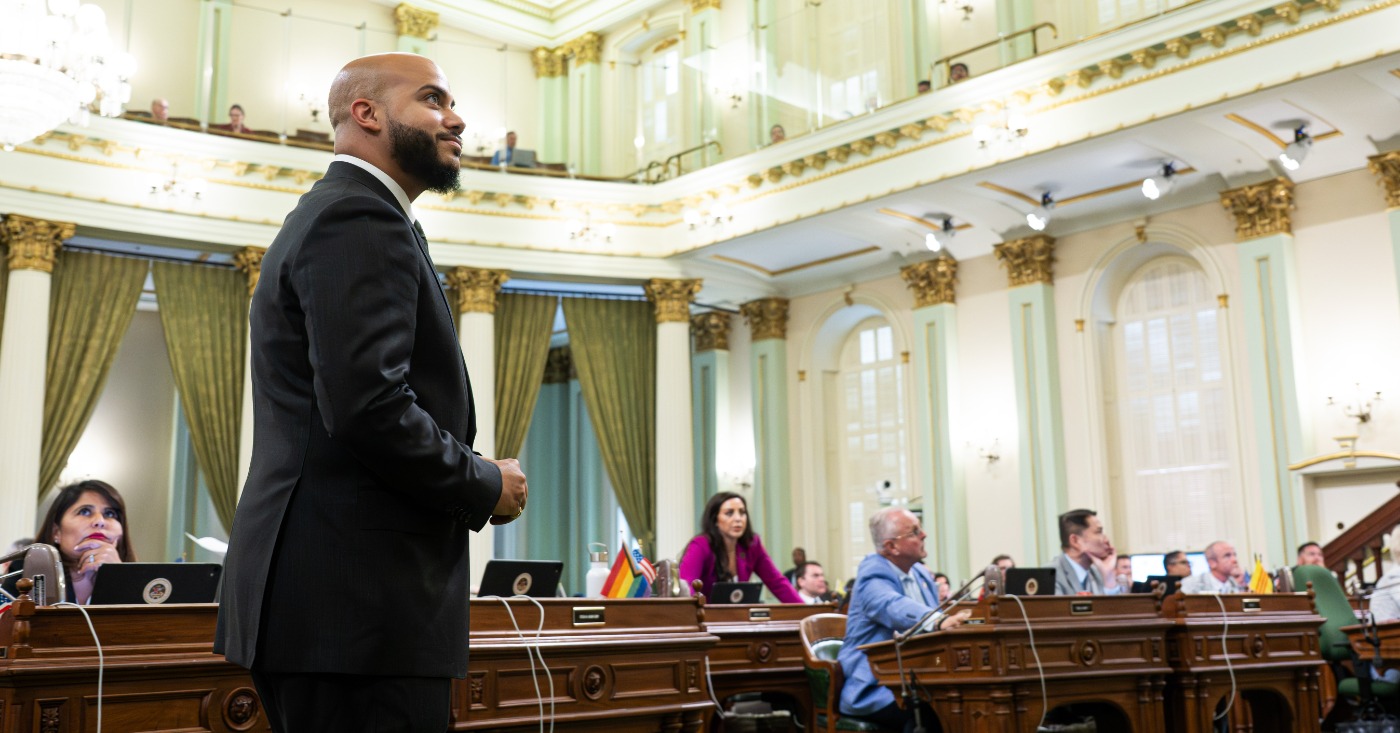
Gov. Gavin Newsom signed legislation on Sept. 27 authored by Assemblymember Isaac Bryan (D-Ladera Heights) that strengthens consumer protections for Californians purchasing tickets to concerts, sporting events and other live entertainment.
Assembly Bill 1349 expands state regulation of original ticket sellers, resellers and online resale marketplaces. The law targets deceptive sales practices, ticket-buying software and speculative listings — tickets advertised for sale by sellers who do not possess them or have authorization to sell them.
“Buying a ticket shouldn’t come with hidden risks or unfair practices,” Newsom wrote on social media after signing the measure.
Under AB 1349, ticket sellers are prohibited from listing tickets before they have been officially released unless they have authorization or a legally enforceable right to receive them. Online marketplaces must also take reasonable steps to prevent speculative ticket sales on their platforms.
The law prohibits sellers from using bots, multiple accounts, email addresses or internet protocol addresses to circumvent ticket limits, presale restrictions, electronic queues and other controls. It also bans websites and advertisements designed to mislead buyers into believing they are purchasing tickets from an authorized seller, venue or event organizer.

Sellers who violate certain provisions and fail to provide a promised ticket may be held liable for twice the ticket’s contracted price. Buyers may also recover nonrefundable expenses incurred while attempting to attend an event, along with reasonable attorney’s fees and court costs.
Pastor Tecoy Porter Sr., president of the National Action Network’s Sacramento chapter, said the law establishes needed accountability.
“Buying a ticket to a concert or show shouldn’t mean entering a marketplace where the rules are stacked against you. This year, we worked with a coalition of consumers, civil rights advocates, community groups, and businesses to make AB 1349 stronger. Consumers deserve enforceable rules that protect them. We thank Assemblymember Bryan for his leadership, and we will keep working to make ticketing fair for every Californian.”
Jose L. Barrera, national vice president for the Far West Region of the League of United Latin American Citizens, also praised the measure.
“Californian families deserve certain protections when they buy tickets. Assemblymember Bryan listened to communities across California and delivered a bill that puts fans first. We thank him and Governor Newsom for making it law.”



WCCUSD Joins Statewide Organic School Food Purchasing Cooperative

Democrats, Community Groups Back Measure EE to Change How Oakland Is Governed

Four Tips to Help You Plan a Holiday “Staycation”

Veterans Housing Project Proposed for South Richmond
PRESS ROOM: Transformative Justice Coalition 2026 Voting Rights Champion Awards Reception ‘Yesterday Is Today: The Battle For Voting Rights

Mayor Lee Delivers 2026 State of the City Address: ‘Oakland Continues to Be on the Move’

Oakland Awarded More than $14 Million in State Funding

Jendayi Arrest Raises Community Concerns Regarding Sheriff’s Chain of Command

Marin County Supes Expand Small Business Options with Home Kitchen Pilot Program

Allen Temple Baptist Church Hosts Free Prostate Cancer Screenings on Oct. 17

AC Transit Labor Unions Back Director Joel Young

Locals Can Get Locally Grown Produce Delivered Through Urban Tilth

‘ICE-Free Marin’ Supporters Press Supervisors as County Drafts Enforcement Restrictions

Oakland Post: Week of October 7 – 13, 2026

Ghana’s Ministry of Foreign Affairs Publishes Global Circle’s Vatican Reparations Call in Special Edition Alongside Heads of State

Misnamed ‘Parent’ PAC Seeks to Influence Oakland School Board Elections

Oakland Post: Week of September 2 – 8, 2026

Oakland Post: Week of September 9 – 15, 2026

Richmond Tiny House Village Farm & Garden Set to Open Gates on Sept. 26

Latest Massacre in Haiti Reveals Cruelty U.S. Deportations

County Office of Education Says OUSD Finances Are Getting Healthier, Materially Stronger

Poll: Becerra Widens His Lead Over Hilton; Californians Split on Wealth Tax

OPINION: Nolan Wells’ Death One of Several Signifying Racial Terror Lives on in U.S. South

Mayor Lee Announces $1 Million Kaiser Permanente Grant for Pilot Program to Address Homelessness, Clean Up Public Spaces throughout Oakland

Democratic Clubs Interview Candidates for Oakland School Board

BLACspace Cooperative Invites Bay Area to Experience Oakland’s Black Cultural Ecosystem Through a BLAC Map Tour + Party

Oakland People’s Arms Embargo Coalition Demands End to Military Shipments Thru Oakland

Oakland Post: Week of September 16 – 22, 2026

Zakiya Jendayi Arrested, Locked Out of Home by Sheriff’s Deputies

Two Looming Threats Every Alameda County Elder Should Know About

The Conversation With Al McFarlane 6/23/26

Media Monday 6/22/26

LIVE! ASK ALMA! — TUES. 6.23.26 7PM EST

Car Buying Secrets: 4 Hidden Checks Before You Sign!

Is This 550 HP Charger Worth YOUR Money? AutoNetwork Review

Celebrating Juneteenth – Frederick Douglass on education and resistance

LIVE! — ASK ALMA! — TUES. 6.19.26 7PM EST

Hyundai Ioniq 5 Parking, Safety, and 360 View #shorts

2025 Ioniq 5 New Wiper & Powerful Performance! #shorts

Electric SUV Range: Is 259 Miles Enough? #shorts

EV Charging: How Fast Can You Charge an Electric Vehicle? #shorts

Biometric Cooling… Messaging Seats…Come on! 2025 Infiniti QX80 Autograph 4WD

Charged Up: Witness the Magic of a Fully Electric Car! #shorts

Range Rover Sport PHEV Included…: See What’s Inside This Luxury SUV! #shorts

Invisible Hood View: Perfect Parking with X-Ray Vision! #shorts
-
 Business3 weeks ago
County Office of Education Says OUSD Finances Are Getting Healthier, Materially Stronger
-
 Economy3 weeks ago
Poll: Becerra Widens His Lead Over Hilton; Californians Split on Wealth Tax
-
 Business4 weeks ago
Mayor Lee Announces $1 Million Kaiser Permanente Grant for Pilot Program to Address Homelessness, Clean Up Public Spaces throughout Oakland
-
 Art3 weeks ago
BLACspace Cooperative Invites Bay Area to Experience Oakland’s Black Cultural Ecosystem Through a BLAC Map Tour + Party
-
 Uncategorized4 weeks ago
Oakland People’s Arms Embargo Coalition Demands End to Military Shipments Thru Oakland
-
 Activism4 weeks ago
Oakland Post: Week of September 16 – 22, 2026
-
 Lead Story2 weeks ago
Zakiya Jendayi Arrested, Locked Out of Home by Sheriff’s Deputies
-
 Community4 weeks ago
Two Looming Threats Every Alameda County Elder Should Know About
