
Politics
Maine Has Nation’s Top Democracy; Alabama Ranks Last


Michele Jawando worries about limited access to democracy in some states.
By Freddie Allen
Senior Washington Correspondent
WASHINGTON (NNPA) – Lawmakers in South Carolina voted last week to remove the Confederate battle flag from the Statehouse grounds, but when it comes to access to democracy, the state still ranks among the worst in the country, according to a recent report by the Center for American Progress Action Fund.
The report by the fund, a sister group of the Center for American Progress, ranked all 50 states and the District of Columbia on 22 different factors that contribute to the overall health of state-level democracy and divided them into three categories: accessibility to the ballot box, representation in state government, and influence in the political system.
South Carolina received an ‘F’ letter grade for accessibility of the ballot, a ‘D+’ for diversity in representation in state government and an ‘F’ for laws that control influence in the political system.
But South Carolina was not the worst – that distinction belongs to Alabama (26.6 percent Black population).
The state with the healthiest democracy is Maine (1.4 percent Black population). North Carolina, Pennsylvania, New York, South Carolina, Mississippi, Indiana, Kentucky, Tennessee, Virginia joined Alabama at the bottom of the list ranking as the worst states when it comes to access to democracy.

Michele Jawando, the vice president of legal progress at the Center for American Progress Action Fund, said that access to the freedoms guaranteed under the Constitution is too often decided by where you live.
“Whether it is access to voting rights, representation in government, or the outsized influence of money in our political system, the opportunity to interact with and participate in democracy is available to some, but blocked for many,” said Jawando. “There are, however, many factors that make up a healthy democracy that should be evaluated in sum, not in silos, if solutions are going to have an overall effect.”
Those factors include availability of pre-registration, in-person early voting, online voter registration, diversity in representation, felony disenfranchisement laws and campaign contribution limits for individual donors.
“In one state, a citizen may have elected officials who are nearly representative of the state’s demographic makeup; in another, some groups may be woefully underrepresented,” the report explained. “One citizen may live in a state where elected officials are beholden to big money, while in the state next door, policymakers could be trying to counteract its influence.”
States that were forced to preclear any changes to their voting laws with the Justice Department prior to the United States Supreme Court decision in Shelby v. Holder which gutted the Voting Rights Act of 1965 also ranked near the bottom in access to the ballot box.
“While several of these states may perform well in other categories, each of the nine states that were covered in total by preclearance requirements performs poorly in accessibility of the ballot: They are ranked in the bottom half of all states in that section, and none gets a grade higher than a D+,” the report said.
In six of the nine states (Alabama, Georgia, Louisiana, Mississippi, South Carolina and Virginia) that were covered by the preclearance formula in Section 4 of the Voting Rights Act, Blacks account for a higher percentage of the population than the national average and are disproportionately affected by laws that block access to the voting booth.
“While several states, including California, Massachusetts, and Louisiana, have taken steps to expand pre-registration, North Carolina eliminated its pre-registration program as part of a package of voter restrictions in advance of the 2014 election, stated the report. “Currently, 14 states and the District of Columbia offer preregistration to 16- and 17-year-olds, while 36 states do not.”
The United States Supreme Court decision in Citizens United v. Federal Election Commission not only made it easier for groups that chose to support a given candidate campaigns to amass huge amounts of cash, the decision also made it harder for states to control the influence of money on the political landscape.
Nebraska had the weakest laws affecting public influence in the political system and Connecticut ranked first. Alabama, Indiana, Missouri, North Dakota, Ohio, South Carolina, Pennsylvania and Wisconsin received an “F” grade for weak policies affecting influence in the political system.
The report recommended that states pass measures making it harder for “lawmakers-turned-lobbyists” to cash in on their time in public office, online voter registration, same day voter registration and expanding early voting options.
“Nationwide, there has been a concerted attack on in-person early voting hours – with a particular focus on evening and weekend hours, the hours most likely to be used by people of color and by voters who do not have the luxury of leaving work to vote during daytime hour,” said the report.
States should also eliminate voter ID laws and pass legislation to restore voting rights to ex-offenders.
“According to The Sentencing Project, ‘denying the right to vote of an entire class of citizens is deeply problematic to a democratic society and counterproductive to effective reentry,’” stated the report. “States should provide either automatic restoration of voting rights or a transparent, affordable, well-publicized process to restore ex-offender voting rights after prison sentences have been served.”
The report concluded that every state had room for improvement, given their relative strengths and weaknesses related to access to the ballot, representation in government, and the political influence wielded by a few wealthy donors compared to the will of the majority.
“The suite of issues that make up an effective democracy are both diverse and inextricably interconnected,” said Lauren Harmon, the voting campaign director at the Center for American Progress Action Fund. “Solutions range from incremental to sweeping, but none is too small to help improve what is a broken system in many states.”
Harmon continued: “We have to ensure that all Americans have full access to their democracy by enacting policies that encourage fairness and engagement.”











Business
OP-ED: Proposition 44 Would Put a Price on Trust
The danger in Proposition 44 is not only its 90 percent figure. It is that the meaning of “qualifying” spending will be worked out later. A clinic preparing a budget today may not know whether a navigator, health educator, transportation program, outreach worker, technology upgrade, or other patient-support service will be counted the way it expects. Yet the financial consequence of getting it wrong could be immediate.




Business
OP-ED: Proposition 40: It’s Time to Play Chess, Not Checkers
Proposition 40 would impose a one-time 5 percent tax on the wealth of Californians with more than $1 billion in assets. Most of that money would go toward health care, with the remainder supporting food assistance and education-related programs.

Activism
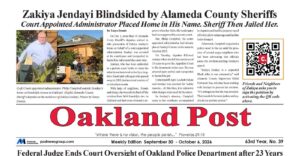
Oakland Post: Week of September 30 – October 6, 2026
The printed Weekly Edition of the Oakland Post: Week of September 30 – October 6, 2026
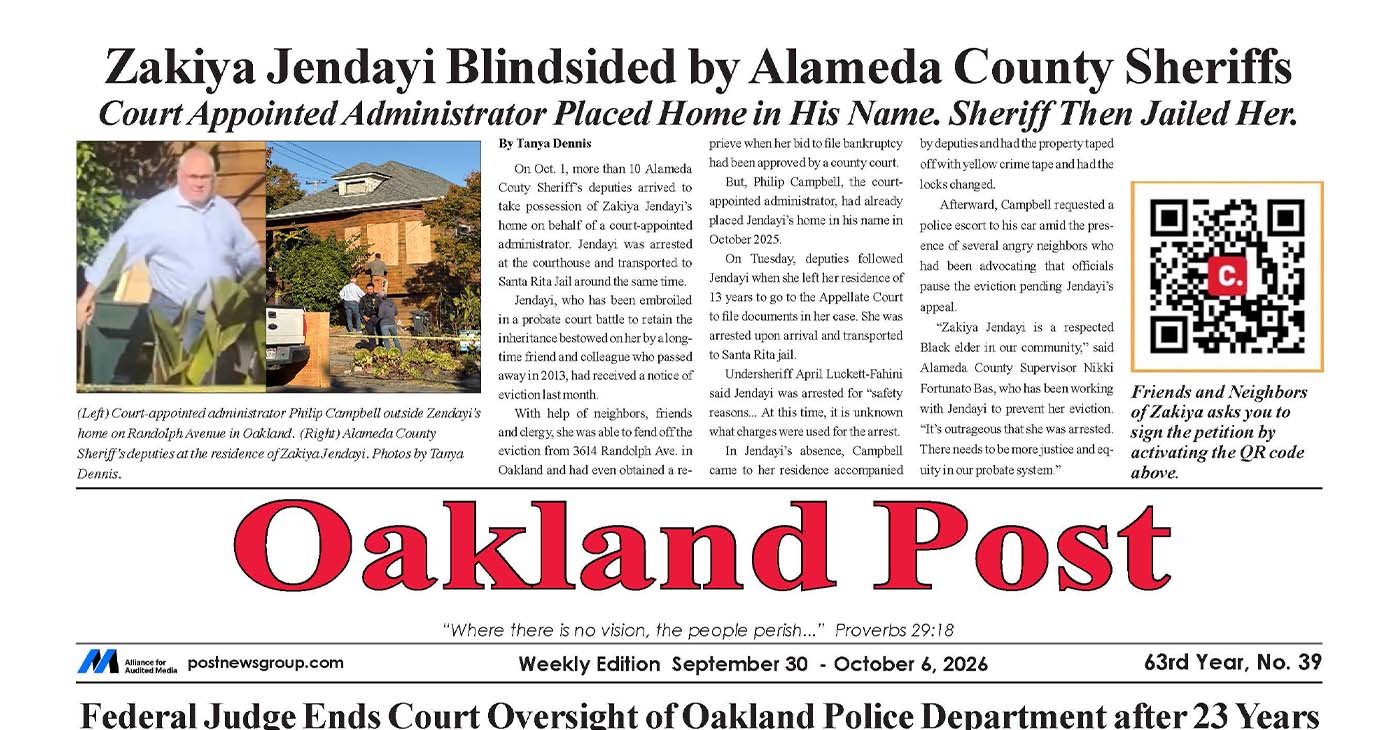
To enlarge your view of this issue, use the slider, magnifying glass icon or full page icon in the lower right corner of the browser window.


OP-ED: Proposition 44 Would Put a Price on Trust

OP-ED: Proposition 40: It’s Time to Play Chess, Not Checkers

Listening as a Lifeline: A Doula’s Witness to Black Maternal Health

New Protections for Ticket Buyers: Gov. Newsom Signs Assemblymember Isaac Bryan’s Bill

‘We Don’t Talk Trash — We Pick Up Trash!’

Zakiya Jendayi Arrested, Locked Out of Home by Sheriff’s Deputies

Oakland Post: Week of September 30 – October 6, 2026

Asm. Corey Jackson Announces Launch of 24-Hour Childcare in His District

IN MEMORIAM: The Rev. Leon “Sonny” Clark, Longtime Orange County Pastor and Community Leader, Dies at 72

Poll: Becerra Widens His Lead Over Hilton; Californians Split on Wealth Tax

From Historic Memories to New Possibilities: Oakland Celebrates Coliseum 60

County Office of Education Says OUSD Finances Are Getting Healthier, Materially Stronger

LIVE FREE Sunday Dinner Brings Faith, Fellowship and Civic Conversation to Oakland

Remembering Chauncey Bailey as Student Journalists Face Threats to Truth-Telling

BLACspace Cooperative Invites Bay Area to Experience Oakland’s Black Cultural Ecosystem Through a BLAC Map Tour + Party

Standoff for Justice: Our Homes Are Worth Fighting For

Oakland Post: Week of August 26 – September 1, 2026

Frontier Airlines’ Return to Oakland Airport Brings Flights, Jobs and Opportunity

Gubernatorial Candidate Steve Hilton Blasts California New Tire Rules; Newsom Hits Back

Chef Sharon Lee Blends Culinary Excellence, Education and Empowerment

Jackie Wright Champions Bay Area Stories, Filmmakers and Cultural Institutions

Misnamed ‘Parent’ PAC Seeks to Influence Oakland School Board Elections

Oakland Coliseum Project Opens Door for Small Businesses to Build Bigger

Big City Mayors Ask for “Yes” Vote on Housing Bond Measure; Conservatives Say “No”

Gov. Newsom’s Latest Appointees Include Sacramento Advocate for Formerly Incarcerated Students; State’s New Tech Chief

Longtime BWOPA Member Brendalyn Goodall Appointed to California Workforce Development Board

Gov. Newsom Signs Law Shielding Immigration Aid Workers From Doxing Threats

Secretary of State Shirley N. Weber Urges Californians to Vote Early as Voter ID Battle Intensifies

Oakland Post: Week of September 2 – 8, 2026

IN MEMORIAM: Dolly Parton Dead at 80 — How She Built a Legacy of Love and Earned Her Place in Black Culture

The Conversation With Al McFarlane 6/23/26

Media Monday 6/22/26

LIVE! ASK ALMA! — TUES. 6.23.26 7PM EST

Car Buying Secrets: 4 Hidden Checks Before You Sign!

Is This 550 HP Charger Worth YOUR Money? AutoNetwork Review

Celebrating Juneteenth – Frederick Douglass on education and resistance

LIVE! — ASK ALMA! — TUES. 6.19.26 7PM EST

Hyundai Ioniq 5 Parking, Safety, and 360 View #shorts

2025 Ioniq 5 New Wiper & Powerful Performance! #shorts

Electric SUV Range: Is 259 Miles Enough? #shorts

EV Charging: How Fast Can You Charge an Electric Vehicle? #shorts

Biometric Cooling… Messaging Seats…Come on! 2025 Infiniti QX80 Autograph 4WD

Charged Up: Witness the Magic of a Fully Electric Car! #shorts

Range Rover Sport PHEV Included…: See What’s Inside This Luxury SUV! #shorts

Invisible Hood View: Perfect Parking with X-Ray Vision! #shorts
-
 Community3 weeks ago
Misnamed ‘Parent’ PAC Seeks to Influence Oakland School Board Elections
-
 Activism4 weeks ago
Oakland Post: Week of September 2 – 8, 2026
-

 Activism3 weeks ago
Oakland Post: Week of September 9 – 15, 2026
-

 Community3 weeks ago
Richmond Tiny House Village Farm & Garden Set to Open Gates on Sept. 26
-

 Black History3 weeks ago
Latest Massacre in Haiti Reveals Cruelty U.S. Deportations
-

 Black History3 weeks ago
OPINION: Nolan Wells’ Death One of Several Signifying Racial Terror Lives on in U.S. South
-

 Business2 weeks ago
Mayor Lee Announces $1 Million Kaiser Permanente Grant for Pilot Program to Address Homelessness, Clean Up Public Spaces throughout Oakland
-

 Community3 weeks ago
Democratic Clubs Interview Candidates for Oakland School Board
