Black History
Madeline M. Turner: The Inventor Who Made Juicing Easier
Turner lived in Oakland during the early twentieth century, a period when opportunities for both women and African Americans in engineering, manufacturing, and invention were extremely limited. Nevertheless, she designed a sophisticated mechanical fruit press that could process citrus fruits much more efficiently than squeezing them by hand.

More than a century before juice bars, smoothie shops, and freshly pressed beverages became commonplace, an African American woman in Oakland, California, developed an ingenious machine for extracting juice from fruit.
Her name was Madeline M. Turner, and although little is known about her personal life, her remarkable invention earned her an important place in the history of American innovation.
Turner lived in Oakland during the early twentieth century, a period when opportunities for both women and African Americans in engineering, manufacturing, and invention were extremely limited. Nevertheless, she designed a sophisticated mechanical fruit press that could process citrus fruits much more efficiently than hand squeezing.
On July 26, 1915, Turner filed an application with the United States Patent Office for what she described as improvements to machines designed to extract juice from fruits such as oranges and lemons. On April 25, 1916, she received U.S. Patent No. 1,180,959 for her “Fruit-Press.”


Turner’s machine was much more complicated than a simple handheld juicer. Fruit entered the machine through an opening at the top and was fed individually into a pressing chamber. Inside, a cutting mechanism divided the fruit. Two plungers then moved toward one another, using specially shaped concave and convex pressing surfaces to squeeze the fruit and extract its juice.


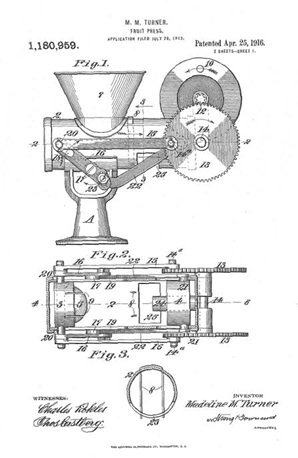

One particularly clever feature was the way the two plungers moved at different speeds and traveled different distances. Their coordinated movement allowed the machine to feed, cut, compress, and eventually release the fruit’s remains. She designed the apparatus to accomplish several steps mechanically rather than requiring a person to perform each operation by hand.
In her patent application, she also emphasized practicality. She explained that the machine was effective for its intended purpose and designed so that its parts could be kept clean—an especially important consideration for equipment used to prepare food and beverages.
Turner’s invention appeared during an era when the American food industry was rapidly becoming more mechanized. Machines were increasingly being developed to process, package, and distribute foods in larger quantities. Her fruit press demonstrated how mechanical engineering could make juice extraction faster and more efficient.
Unfortunately, historical records reveal little about what happened to Turner after her patent was issued. Her birth and death dates, education, family life, and later career have not been reliably documented. Even so, the surviving patent provides powerful evidence of her mechanical creativity and technical ability.
Today, Turner is remembered as one of the African American inventors whose innovations helped transform everyday life. Modern commercial juicing equipment is far more advanced than her 1916 machine, but the basic challenge Madeline tackled—automatically feeding, cutting, pressing, and extracting juice from fruit—remains central to food-processing technology.
Turner’s story reminds us that important inventors are sometimes nearly lost to history. However, thank goodness her patent will ensure that her creativity and contribution to American innovation will not be forgotten.

