
Activism
‘Let’s Glow SF,’ ‘Paints’ Holiday-Themed Light Shows on Landmark Buildings in Downtown San Francisco
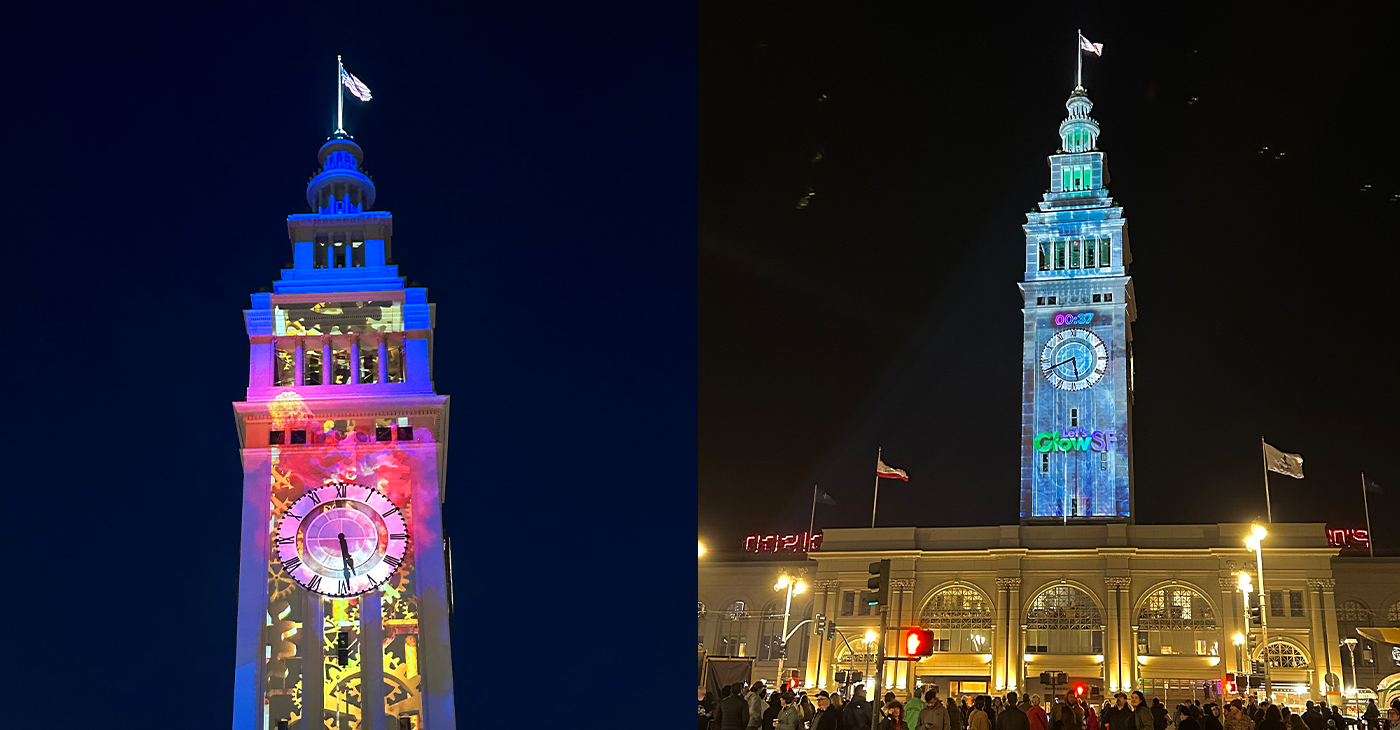
The ‘canvases’ for Let’s Glow SF, which began on Dec. 6 and continues through Dec. 13, include 101 California St., Annie Alley, the Crossings at East Cut, the Ferry Building, One Bush Plaza, Pacific Coast Stock Exchange, Salesforce Tower, and the PG&E Substation.

By Anka Lee, Post Intern
San Francisco has outdone itself again with the return of Let’s Glow SF, an abstract digital art projected brilliantly on various landmark buildings downtown for the holiday season.
Produced by the partnership of Downtown SF Partnership and A3 Visual, SF Glow began in 2021 with the intent to bring life back to downtown after the COVID-19 outbreak left its streets desolate.
Accompanied by different genres of music, the largest holiday projection arts festival in the U.S. is described on its web site as “a stunning journey of light” and “a striking marriage of art and technology …that elevates the city’s art scene.”
The ‘canvases’ for Let’s Glow SF, which began on Dec. 6 and continues through Dec. 13, include 101 California St., Annie Alley, the Crossings at East Cut, the Ferry Building, One Bush Plaza, Pacific Coast Stock Exchange, Salesforce Tower, and the PG&E Substation.
‘Painting’ the light installations onto buildings starts at 5:30 p.m. and ends at 10 p.m.
At the Ferry Building on Dec. 7, the animated light display was by featuring art by Spectre Lab, Maxin10sity, and Ryan Uzilevsky of Light Harvest Studio. Across from the Embarcadero, plastic chairs were put out for front-row seating to the upcoming projection.
Families dressed in matching sweaters chatted animatedly among themselves, couples cuddled up against the bitter wind, and the ringing of the trolley’s distant approach all served to brighten the street. Holiday-special drinks like hot chocolate and themed cocktails were sold and participating eateries like Avotoasty, Barcha Restaurant came together to bring to San Francisco America’s largest annual Christmas projection event.
The eight-day event will close on Dec. 13, with “Glow on Front: A Neon Block Party” from 5 p.m. to 10 p.m. at 240 Front St.
Ervin, one of the Block by Block Downtown SF Partnership safety workers for the event, said he’s “looking at a record amount this year,” nearing around half a million attendees in total. But that evening, a lively community evolved from the original trickle of people waiting for the art show to start.
Vendors set up displays and sold jewelry, notebooks, and handmade hairbands. Seats filled up as the day’s light faded, the chill of the air increasing with the flow of people. The excitement among the crowd was palpable and contagious. It was a welcome feeling, electrifying the ever-growing holiday cheer.
Chatter quieted and adventurous music blasted from speakers that were behind the seating area. A projection by Spectre Lab shone directly at the Ferry Building, the abstract graphics of candlelight, lanterns, and disco balls ‘dancing’ to the beat of the music that transformed the clock tower into something alive. The illusory animation spun and stretched the tower with enthusiasm—this writer was in awe.
A newcomer to Let’s Glow SF thought it was really cool how it “utilizes space that we have and…adds something new…for us to enjoy.”
One family only learned about the lights show on their way home after arriving by ferry, and “[they’d] seen it on the billboard with all the artists…. It’s a very positive thing for San Francisco after everything that’s gone on [with COVID].”
Attend the Let’s Glow SF projection event today through Dec.13 for free, at any of their eight locations: 101 California St., Annie Alley, the Crossings at East Cut, the Ferry Building, One Bush Plaza, Pacific Coast Stock Exchange, Salesforce Tower, and PG&E Substation. Food and drink are sold at different participating businesses respective to each projection location. For more information, visit downtownsf.org.




Activism
Oakland Post: Week of September 30 – October 6, 2026
The printed Weekly Edition of the Oakland Post: Week of September 30 – October 6, 2026
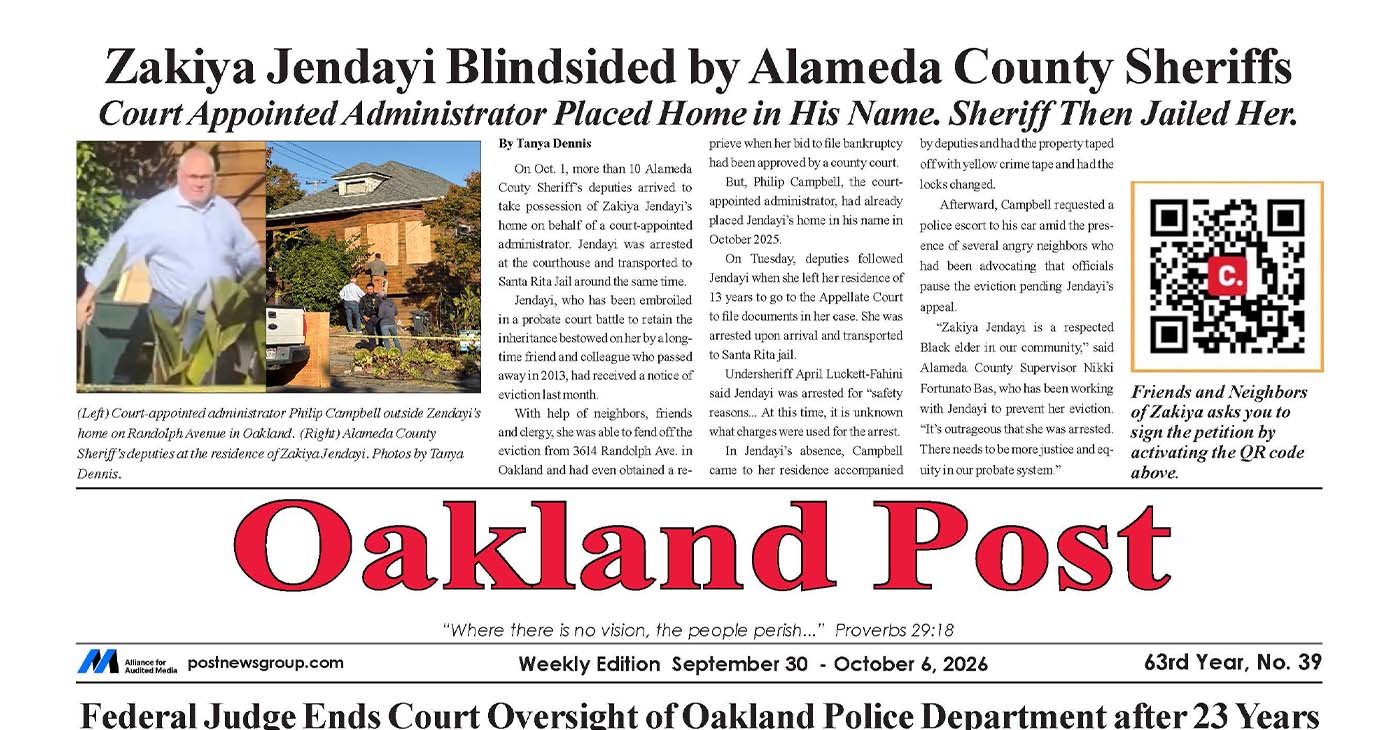
To enlarge your view of this issue, use the slider, magnifying glass icon or full page icon in the lower right corner of the browser window.

Activism
Oakland Post: Week of September 23 – 29, 2026
The printed Weekly Edition of the Oakland Post: Week of September 23 – 29, 2026

To enlarge your view of this issue, use the slider, magnifying glass icon or full page icon in the lower right corner of the browser window.
Activism
Oakland Post: Week of September 16 – 22, 2026
The printed Weekly Edition of the Oakland Post: Week of September 16 – 22, 2026

To enlarge your view of this issue, use the slider, magnifying glass icon or full page icon in the lower right corner of the browser window.


OP-ED: Proposition 44 Would Put a Price on Trust

OP-ED: Proposition 40: It’s Time to Play Chess, Not Checkers

Listening as a Lifeline: A Doula’s Witness to Black Maternal Health

New Protections for Ticket Buyers: Gov. Newsom Signs Assemblymember Isaac Bryan’s Bill

‘We Don’t Talk Trash — We Pick Up Trash!’

Zakiya Jendayi Arrested, Locked Out of Home by Sheriff’s Deputies

Oakland Post: Week of September 30 – October 6, 2026

Asm. Corey Jackson Announces Launch of 24-Hour Childcare in His District

IN MEMORIAM: The Rev. Leon “Sonny” Clark, Longtime Orange County Pastor and Community Leader, Dies at 72

Poll: Becerra Widens His Lead Over Hilton; Californians Split on Wealth Tax

From Historic Memories to New Possibilities: Oakland Celebrates Coliseum 60

County Office of Education Says OUSD Finances Are Getting Healthier, Materially Stronger

LIVE FREE Sunday Dinner Brings Faith, Fellowship and Civic Conversation to Oakland

Remembering Chauncey Bailey as Student Journalists Face Threats to Truth-Telling

BLACspace Cooperative Invites Bay Area to Experience Oakland’s Black Cultural Ecosystem Through a BLAC Map Tour + Party

Standoff for Justice: Our Homes Are Worth Fighting For

Oakland Post: Week of August 26 – September 1, 2026

Frontier Airlines’ Return to Oakland Airport Brings Flights, Jobs and Opportunity

Gubernatorial Candidate Steve Hilton Blasts California New Tire Rules; Newsom Hits Back

Chef Sharon Lee Blends Culinary Excellence, Education and Empowerment

Jackie Wright Champions Bay Area Stories, Filmmakers and Cultural Institutions

Misnamed ‘Parent’ PAC Seeks to Influence Oakland School Board Elections

Oakland Coliseum Project Opens Door for Small Businesses to Build Bigger

Big City Mayors Ask for “Yes” Vote on Housing Bond Measure; Conservatives Say “No”

Gov. Newsom’s Latest Appointees Include Sacramento Advocate for Formerly Incarcerated Students; State’s New Tech Chief

Longtime BWOPA Member Brendalyn Goodall Appointed to California Workforce Development Board

Gov. Newsom Signs Law Shielding Immigration Aid Workers From Doxing Threats

Oakland Post: Week of September 2 – 8, 2026

Secretary of State Shirley N. Weber Urges Californians to Vote Early as Voter ID Battle Intensifies

IN MEMORIAM: Dolly Parton Dead at 80 — How She Built a Legacy of Love and Earned Her Place in Black Culture

The Conversation With Al McFarlane 6/23/26

Media Monday 6/22/26

LIVE! ASK ALMA! — TUES. 6.23.26 7PM EST

Car Buying Secrets: 4 Hidden Checks Before You Sign!

Is This 550 HP Charger Worth YOUR Money? AutoNetwork Review

Celebrating Juneteenth – Frederick Douglass on education and resistance

LIVE! — ASK ALMA! — TUES. 6.19.26 7PM EST

Hyundai Ioniq 5 Parking, Safety, and 360 View #shorts

2025 Ioniq 5 New Wiper & Powerful Performance! #shorts

Electric SUV Range: Is 259 Miles Enough? #shorts

EV Charging: How Fast Can You Charge an Electric Vehicle? #shorts

Biometric Cooling… Messaging Seats…Come on! 2025 Infiniti QX80 Autograph 4WD

Charged Up: Witness the Magic of a Fully Electric Car! #shorts

Range Rover Sport PHEV Included…: See What’s Inside This Luxury SUV! #shorts

Invisible Hood View: Perfect Parking with X-Ray Vision! #shorts
-
 Community3 weeks ago
Misnamed ‘Parent’ PAC Seeks to Influence Oakland School Board Elections
-
 Activism4 weeks ago
Oakland Post: Week of September 2 – 8, 2026
-

 Activism3 weeks ago
Oakland Post: Week of September 9 – 15, 2026
-

 Community3 weeks ago
Richmond Tiny House Village Farm & Garden Set to Open Gates on Sept. 26
-

 Black History3 weeks ago
Latest Massacre in Haiti Reveals Cruelty U.S. Deportations
-

 Black History3 weeks ago
OPINION: Nolan Wells’ Death One of Several Signifying Racial Terror Lives on in U.S. South
-

 Business2 weeks ago
Mayor Lee Announces $1 Million Kaiser Permanente Grant for Pilot Program to Address Homelessness, Clean Up Public Spaces throughout Oakland
-

 Community3 weeks ago
Democratic Clubs Interview Candidates for Oakland School Board
