
Black History
If Beale Street could talk, it would tell Memphis to ‘copyright me’
NNPA NEWSWIRE — I will never forget the colorful characters of Beale Street: Men wearing coordinated suits, shoes and hats, with processed hair; curvaceous women walking with advertising gaits and long eye lashes; impromptu street concerts by bands and musicians; “barkers” pleading for customers to enter their stores and shops; shoe shine boys with their mobile shine parlors and the bustling crowds.

By Dr. L. LaSimba M. Gray Jr., Special to The New Tri-State Defender
When I first heard of the movie “If Beale Street Could Talk” I got excited about the possibility of seeing the legendary Beale Street of Memphis on the big screen. To my utter disappointment this movie has nothing to do with the 1.8-mile long street in Memphis.
My disappointment is rooted in my personal “Beale Street Experience.”
I was introduced to Beale Street by my father, the late Rev. Leo M. Gray Sr. Periodically, he would take my two brothers and myself to the New Daisy Theatre on Beale. I remember asking him why we were not going to the Princess on Main Street.
“At the New Daisy we don’t have to sit in the balcony, we can sit on the main floor,” he said.
Mr. Robert Morris managed the New Daisy Theatre and was my school principal. En route to the New Daisy, we were enthralled by the carnival atmosphere, the aroma of soul food and the eccentric characters of Beale Street. The music pouring out of the juke joints and cafes was captivating. The bass guitar and drums moved us to walk with a bounce. We had swag before we knew what swag was.

In 1956, an African-American entrepreneur called “Mr. Buck” would hire boys from our neighborhood to work the Cotton Carnival Parade on Main St. We sold popcorn and cotton candy from Main and Poplar to Main and Beale. Mr. Buck would meet us half way to collect the money and replenish our trays. When we reached Beale Street, we turned east and walked down to Fourth Street, where he would pick us up.
The Beale Street Experience began the minute we turned on Beale. On Main St., we could not walk on the sidewalk or look our customers in the face as we sold them our goods.
Mr. Buck was very stern as he taught the acceptable behavior for Main Street. We were to avoid prolonged encounters with white females and we were drilled on saying “yes sir” and “no ma’am.”
“Y’all do remember Emmett Till, don’t you?” he would ask.
Free on Beale Street, we joked and played with each other. We looked into people’s faces, walked on the sidewalks and popped our fingers to the hard-hitting rhythm and blues songs. We took advantage of the hot-dog specials and had plenty of the sizzling hamburgers, chitterlings and bar-b-que.
The Cotton Makers Jubilee Parade rolled down Beale Street. We saw African-Americans on floats and in fine decorated cars. On Main Street, African Americans pulled floats or swept up behind the horses.
On Beale Street, the Cotton Makers Jubilee Parade was an all African-American thing. The marching bands of local high schools competed. Their sonic sounds and high-stepping majorettes kept the parade-goers spellbound. The legendary Nat D. Williams, the first radio personality at WDIA Radio, amplified the excitement with commentary.
I will never forget the colorful characters of Beale Street: Men wearing coordinated suits, shoes and hats, with processed hair; curvaceous women walking with advertising gaits and long eye lashes; impromptu street concerts by bands and musicians; “barkers” pleading for customers to enter their stores and shops; shoe shine boys with their mobile shine parlors and the bustling crowds.
Along the eastward journey, professional blacks punctuated the landscape. There were lawyers, doctors, and dentists, printing shops, photographers, banks, insurance companies and benevolent organizations.
A massive and magnificent church, First Baptist Beale, greeted us at Fourth St. Neighboring to the east was Church Park and Church Auditorium. We could go into the park, which was revolutionary to me. I lived across the street from the Winchester Park and could not enter.
When our ride showed up, we scampered on to the truck and claimed our seats. Mr. Buck would collect from each worker and pay off. My first experience on Beale Street far exceeded my compensation; Beale Street had given me a sense of “somebodiness.”
As we drove off, a sense of longing for more filled my spirit from that day to now. I love Beale Street.
Through the annals of history, we realize that Beale Street does talk. It was a mecca for African Americans all over the South.
“Beale Street is a composite of colorful incidents,” the legendary Lt. George W. Lee once said.
Lee collaborated with W. C. Handy and Robert Church to make Beale Street the epic experience of African Americans. Hearing the moans and groans of African Americans vented in song and dance, Handy put pen to scale, the blues was born, and he became known as its father.
Church, the first millionaire of African descent in the South, was at home on Beale Street. He controlled political patronage for the “Negro: in the Mid-South from reconstruction through World War I. He was the go-to-person to mobilize the “negro vote” and to get a true reading of the temperament of the “negro.”
Church built a park and auditorium for his people when city fathers continued to make empty promises. In 1899, without a dime of tax money, he built a recreational oasis – second to none – in the midst of the desert of segregation. In “The Bright Side of Memphis,” G.P. Hamilton wrote this about Church Park: “lighted up at night, it looked like a fairy land or garden for the gods.”
Developed for African-Americans, Church Park was opened to all. President Theodore Roosevelt spoke there while Memphis was totally segregated.
Advocacy journalism was born on Beale Street when W.E.B. Dubois partnered with Henry Pace to organize and publish the Crisis Magazine that became the official journal of the NAACP. Ida B. Wells published the Memphis Free Press on Beale Street as she sought to expose the lynching of African Americans and to end the bastard acts of violence.
Run out of Memphis by daily threats on her life, Wells reemerged as a national leader and charter member of the National Association for the Advancement of Colored People.
And in 1892, Dr. M.V. Lynk published the Medical and Surgical Observer, the first medical journal for “Negro” physicians, on Beale Street.
Beale Street was an incubator for business development by and for African Americans – Universal Life Insurance Company, Hooks Brothers Photography, Robert Henry Promotions, the Solvent Savings Bank of Memphis and more.
On Beale Street, African Americans found a soul force to endure the pathos of a toxic society and the residue of slavery. That “soul force” is “somebodiness” and a positive self-regard.
In the aftermath of the assassination of Dr. Martin L. King Jr. in Memphis in 1968, Beale Street was dealt a morbid wound by the concepts of urban renewal in the 1970s. Buildings were gutted and abandoned. Bustling crowds were diminished to a scarce few.
The music stopped on Beale and relocated. The legendary Gate Mouth Moore visited his old stomping grounds in the early 70’s and wrote a song: “Beale Street is gone and Beale Street ain’t Beale Street no more.”
The kitchens were closed, lights were turned off and Memphis – erroneously – announced the death of Beale Street. The premature obituary notwithstanding, tourists kept coming and inquiring.
“What happened to Beale Street?”
Abe Schwab resolved to keep his dry goods store open and serve his loyal customers base. He was asked why.
“You have to understand, Beale Street is more than a destination,” he said. “Beale Street is an attitude.”
The attitude of defiance and determination sustained Beale Street through its most challenging time. In many instances, some of the city’s leaders acted like modern day Pontius Pilates. Like the biblical figure, they seemed to be trying to wash themselves of a martyr’s blood, in this case using urban removal.
However, the essence of Beale Street was not in the buildings. It was in the souls of all who drank from the refreshing waters of affirmation and transformation. That fountain was only on Beale Street for African Americans of the Greater Mid-South.
Beale Street still is talking. Today it stands with opened arms, beckoning the world to come, see and taste “Soul.”
Beale Street is too important to the history of African Americans to be trivialized in a movie title.
The false expectations created by the movie title, “If Beale Street Could Talk,” lead me to seriously propose to City Fathers and all stakeholders that the brand “Beale Street” be copyrighted – immediately.









Activism
Oakland Post: Week of March 18 – 24, 2026
The printed Weekly Edition of the Oakland Post: Week of March 18 – 24, 2026
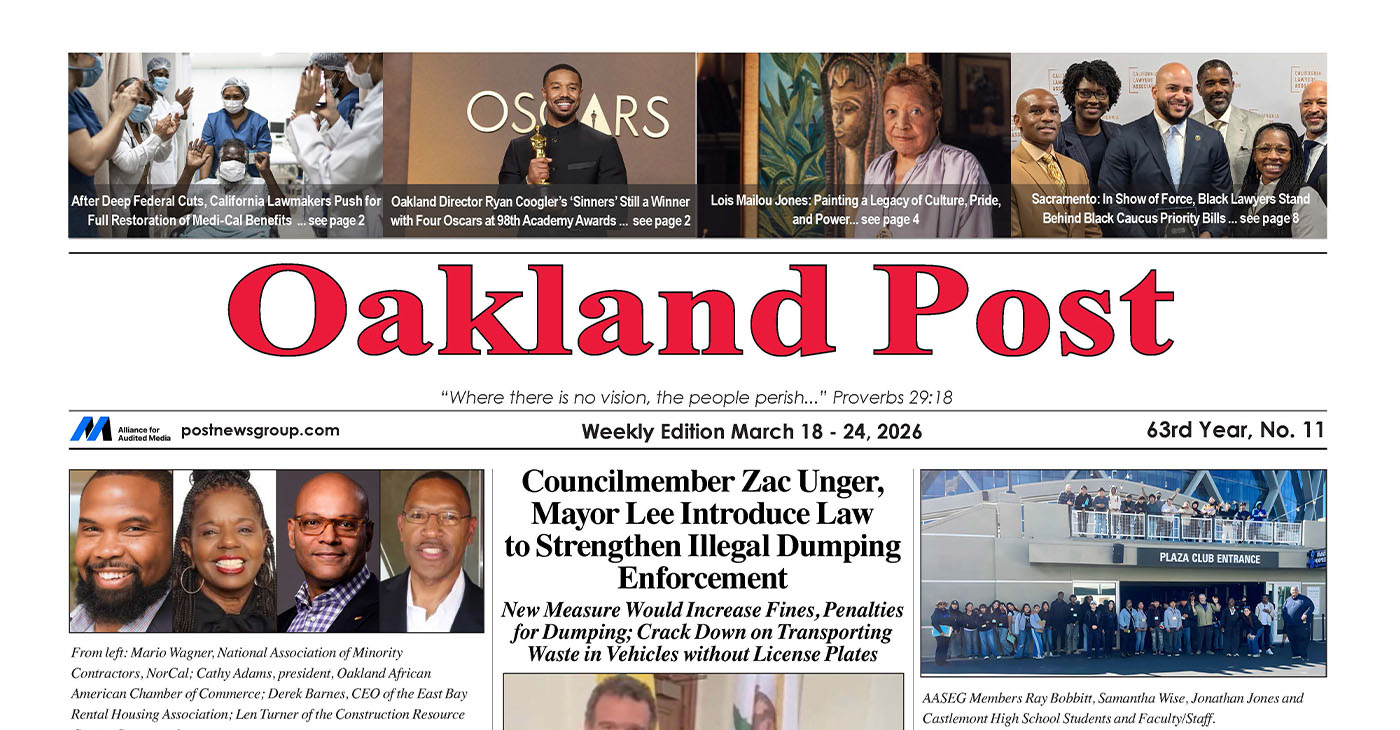
To enlarge your view of this issue, use the slider, magnifying glass icon or full page icon in the lower right corner of the browser window.
Activism
Oakland Post: Week of March 11 -17, 2026
The printed Weekly Edition of the Oakland Post: Week of March 11 – 17, 2026
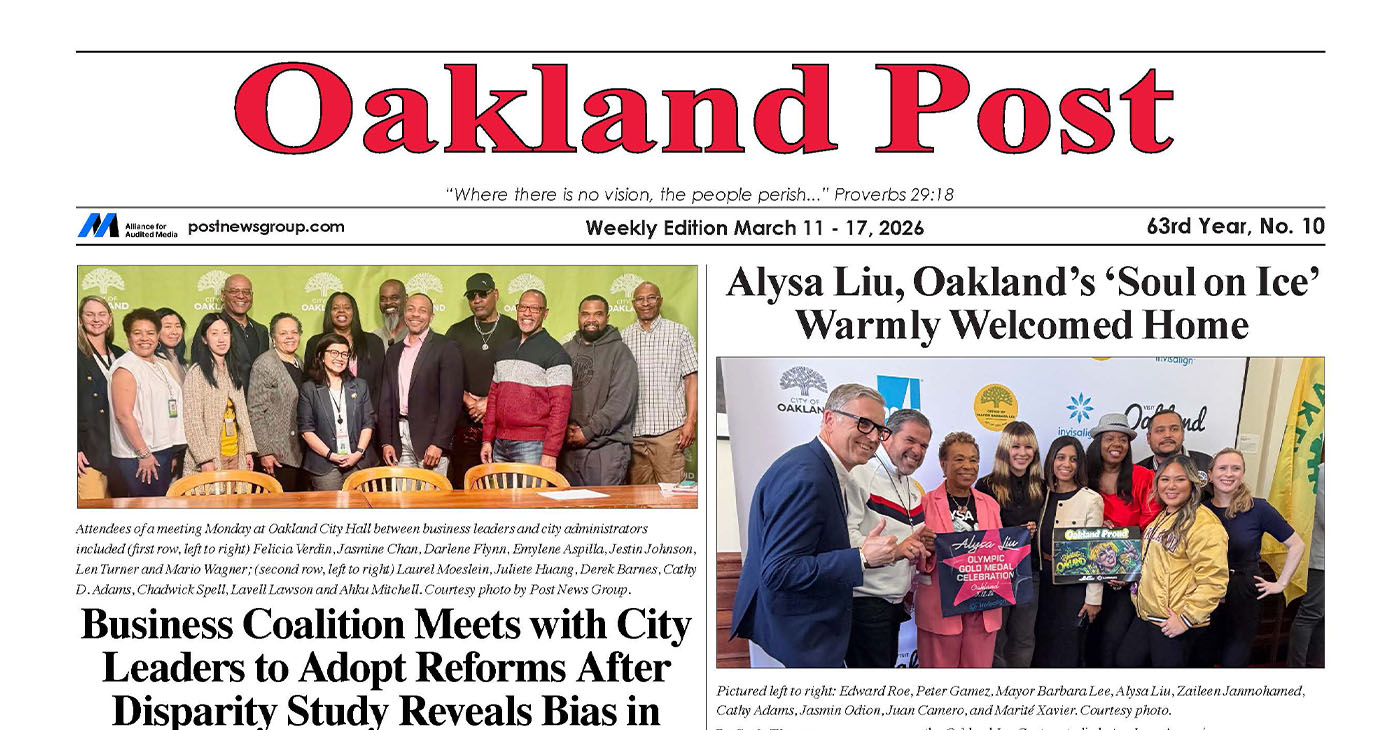
To enlarge your view of this issue, use the slider, magnifying glass icon or full page icon in the lower right corner of the browser window.
Activism
Oakland Post: Week of March 4 – 10, 2026
The printed Weekly Edition of the Oakland Post: Week of March 4 – 10, 2026
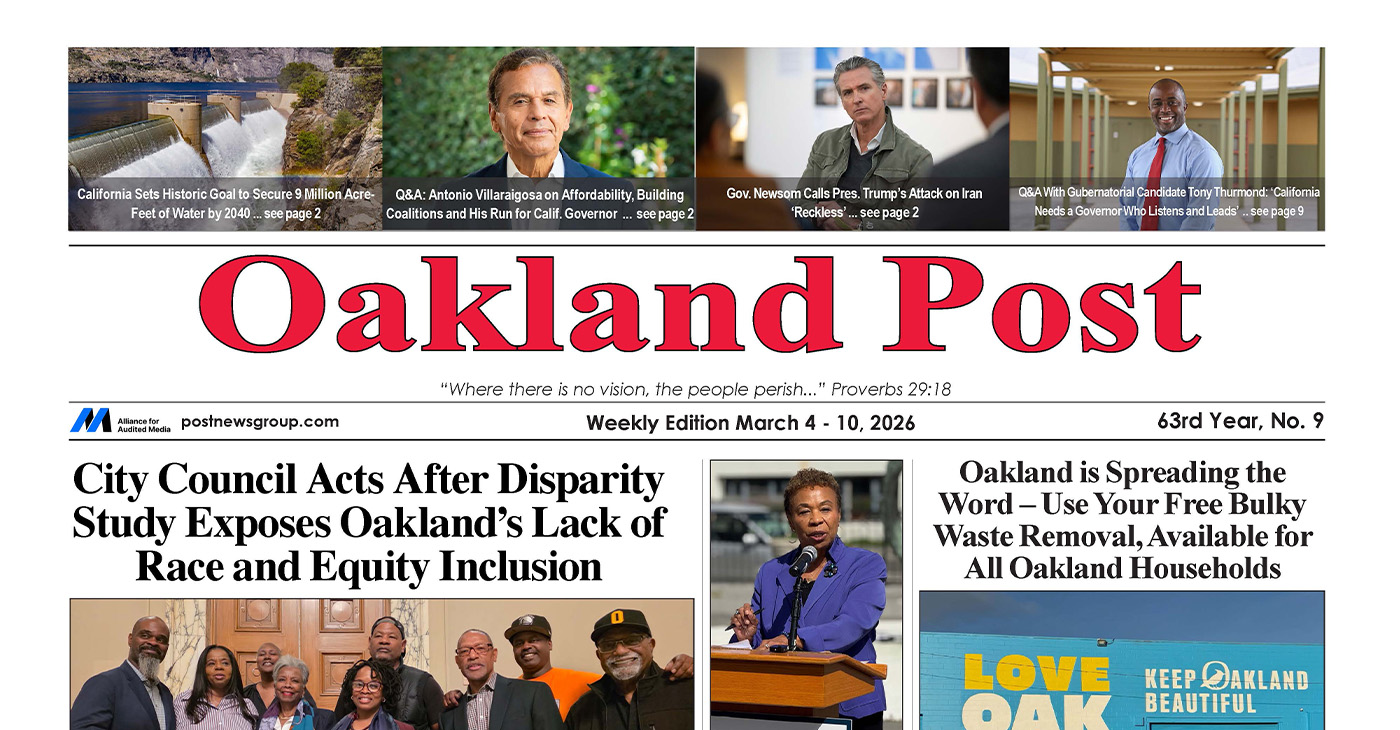
To enlarge your view of this issue, use the slider, magnifying glass icon or full page icon in the lower right corner of the browser window.

WORK FROM HOME
Home-based business with potential monthly income of $10K+ per month. A proven training system and website provided to maximize business effectiveness. Perfect job to earn side and primary income. Contact Lynne for more details: Lynne4npusa@gmail.com 800-334-0540


Black Artists in America, Installation Three Wraps at the Dixon Gallery and Gardens

Grief, Advocacy, and Education: A Counselor Reflects on Black Maternal Health

Future of Florida’s Black History Museum in Limbo

New Research Shows the Many Benefits of Early Learning

South Hampton K-8 Students Among Top 10 Finalists for Samsung’s ‘Solve for Tomorrow’ Competition

Cuba: No Negotiation with US on the President or Political System

Brooklyn Academy of Music Names Jamaican-Born Tamara McCaw as President

Trinidad & Tobego – U.S. Launches WhatsApp Channel for American Citizens in the Country

Oakland Post: Week of March 18 – 24, 2026

AI Innovation vs. Ethics and Environmental Impact

AI, Web3, and Digital Reparations

What If You Owned Your AI Agent?

Season 7, Episode 3 – January Reporter’s Roundtable 📱

Season 7, Episode 3 – January Reporter’s Roundtable

AI, Media, and Power | Part 2, Real-World Impacts and Tradeoffs

Discrimination in City Contracts

Oakland Post: Week of February 11 – 17, 2026

Reflecting on Black History Milestones in Birmingham AL

Rising Optimism Among Small And Middle Market Business Leaders Suggests Growth for California

CITY OF SAN LEANDRO STATE OF CALIFORNIA PUBLIC WORKS DEPARTMENT ENGINEERING DIVISION NOTICE TO BIDDERS FOR ANNUAL STREET OVERLAY/REHABILITATION 2019-21 – PHASE III

Oakland Post: Week of February 18 – 24, 2026

PRESS ROOM: NBA Hall of Fame Nominee Terry Cummings Joins 100 Black Men of DeKalb County to Launch Victory & Values Initiative

Oakland Post: Week of February 25 – March 3, 2026

U.S. manufacturing rebounds – how foundry services are adapting to rising demand

Trump’s MAGA Allies are Creating Executive Order Plan to Steal the 2026 Midterms

OP-ED: One Hundred Years of Black Workers Telling the Truth

Advancements in solar technology that are changing the way we power the world

Chase Oakland Community Center Hosts Alley-Oop Accelerator Building Community and Opportunity for Bay Area Entrepreneurs

PRESS ROOM: Civil Rights TV Launches in Selma as the World’s First 24/7 Civil Rights Television Network

Poll Shows Support for Policies That Help Families Afford Child Care

Hyundai Ioniq 5 Parking, Safety, and 360 View #shorts

2025 Ioniq 5 New Wiper & Powerful Performance! #shorts

Electric SUV Range: Is 259 Miles Enough? #shorts

EV Charging: How Fast Can You Charge an Electric Vehicle? #shorts

Biometric Cooling… Messaging Seats…Come on! 2025 Infiniti QX80 Autograph 4WD

Charged Up: Witness the Magic of a Fully Electric Car! #shorts

Range Rover Sport PHEV Included…: See What’s Inside This Luxury SUV! #shorts

Invisible Hood View: Perfect Parking with X-Ray Vision! #shorts

AI Is Reshaping Black Healthcare: Promise, Peril, and the Push for Improved Results in California

ESSAY: Technology and Medicine, a Primary Care Point of View

Sanctuary Cities

The RESISTANCE – FREEDOM NOW

STATE OF THE PEOPLE: Freddie

ECONOMIC BOYCOTT DAY!!!!!

I told You So
-
 #NNPA BlackPress4 weeks ago
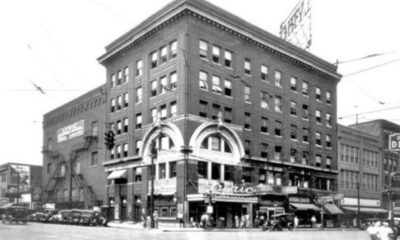
Reflecting on Black History Milestones in Birmingham AL
-
 #NNPA BlackPress4 weeks ago
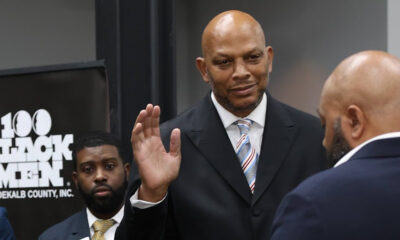
PRESS ROOM: NBA Hall of Fame Nominee Terry Cummings Joins 100 Black Men of DeKalb County to Launch Victory & Values Initiative
-
 Activism4 weeks ago
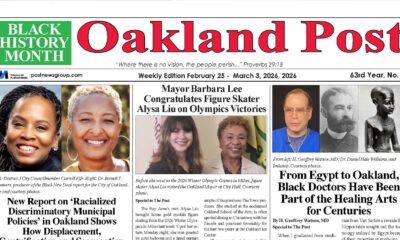
Oakland Post: Week of February 25 – March 3, 2026
-
 #NNPA BlackPress4 weeks ago
Trump’s MAGA Allies are Creating Executive Order Plan to Steal the 2026 Midterms
-
 #NNPA BlackPress4 weeks ago
OP-ED: One Hundred Years of Black Workers Telling the Truth
-
 #NNPA BlackPress4 weeks ago
Poll Shows Support for Policies That Help Families Afford Child Care
-
 Activism3 weeks ago
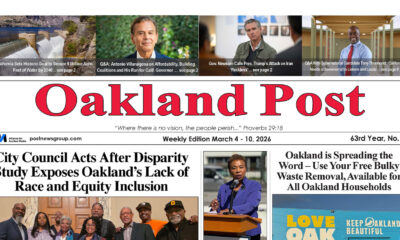
Oakland Post: Week of March 4 – 10, 2026
-

 #NNPA BlackPress3 weeks ago
Woman’s Search for Family’s Roots Leads to Ancestor John T. Ward – A Successful Entrepreneur and Conductor on the Underground Railroad
