
Activism
How to Help Black Organizing Project’s Fight to Remove Police from OUSD

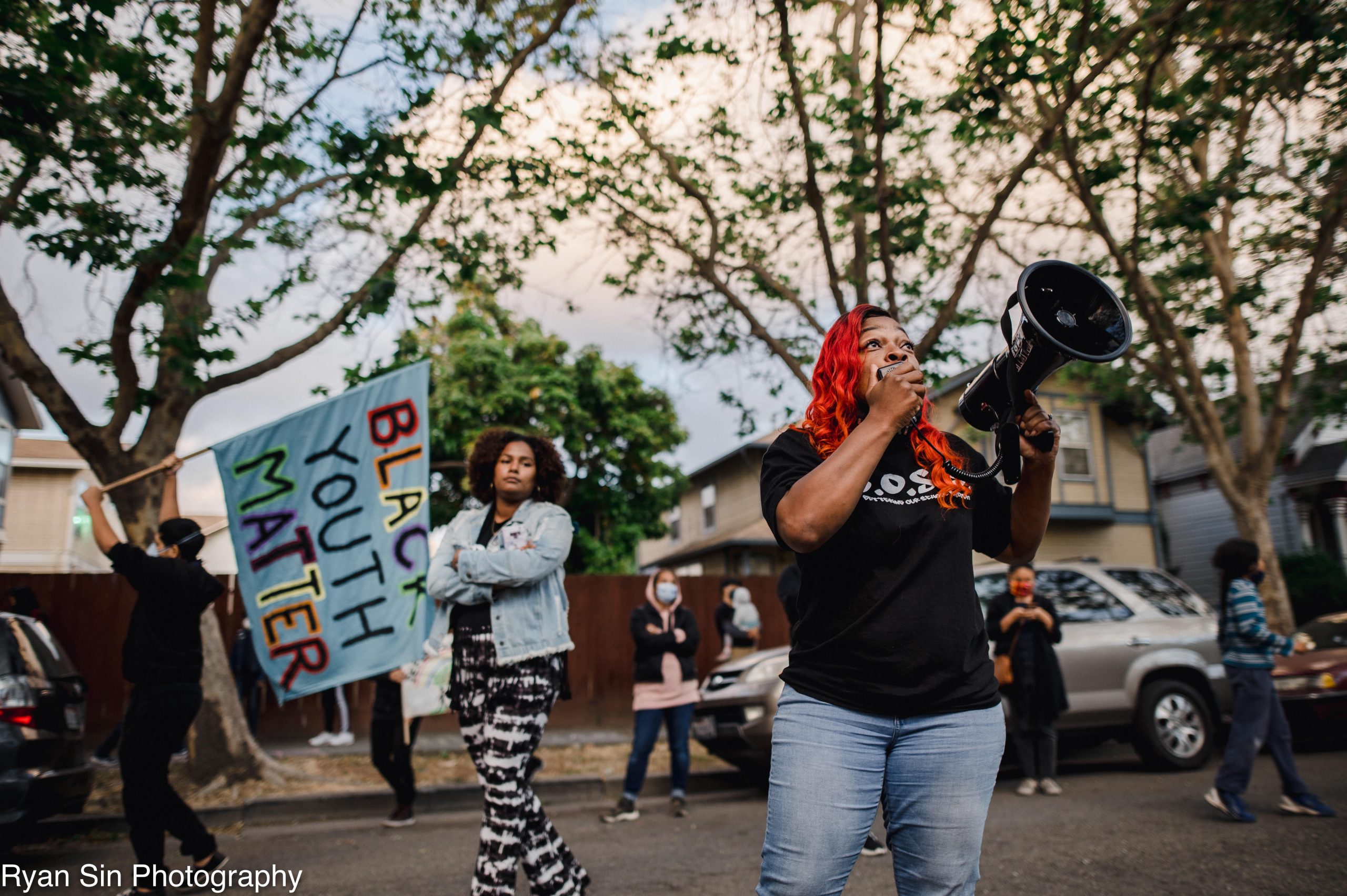
Black Organizing Project (BOP) could reach a goal on June 24 that they have worked toward since 2011: eliminating school police in Oakland’s Unified School District (OUSD), the only district in Alameda County with its own police force.
They are calling on Oakland residents to help them in their final push.
“What is it going to take for this school district to realize the murders [by police] that we are witnessing of our people in the streets are the same police who are in the schools?” asked BOP Director of organizing, Jessica Black, speaking to uproarious cheers from a crowd of around 8,000 at an Oakland protest against policing and a city and county imposed a curfew on June 3.
Black then said just three months earlier, on March 3, Oakland’s school board rejected a measure by one vote that would have drastically cut Oakland Schools Police Department’s (OSPD) budget.
Board members Amy Eng, Shanti Gonzales, and Roseann Torres voted to approve the measure, but Gary Yee, James Harris, Jody London and Jumoke Hinton Hodge voted against it.
Since police officer Derek Chauvin’s killing of George Floyd sparked protests, riots, and rebellions in Minneapolis which brought defunding and even dismantling police forces into the mainstream national conversation, BOP’s mission has found much wider, louder support.
The Oakland Education Association, Asians for Black Lives, Oakland Not for Sale, the Anti-Police Terror Project, Gender and Sexualities Alliance Network, Critical Resistance, Oakland Public Education Network and many Oakland residents, especially teachers, counselors and social workers, have been vocal in their support of BOP’s mission lately.
BOP is now calling on Oaklanders to call, e-mail, and write letters to school board members, especially the four who voted against the previous measure and OUSD Superintendent Kyla Johnson-Trammell, before the final school board meeting on June 24 to demand that they approve a new, more radical measure submitted by Torres and Gonzales called George Floyd Resolution to Eliminate OSPD.
“We can’t let off pressure,” said BOP Executive Director Jackie Byers. “We need those votes. And then on the 24th…[we need people] to get on the Zoom meeting, make public comments or speak to the agenda item.”
Readers can also submit comments during the school board meeting today, June 10.
Torres, who co-wrote the resolution, suggests people should sign up at 5:30 p.m. for public comment and then can watch the meeting or log off till 7:30 p.m. when comments can be heard.
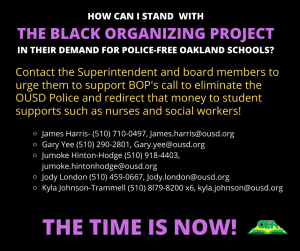
Courtesy of Oakland Education Association.
She says readers can sign up again at 5:30 p.m. on June 24 to speak at 7:30 p.m. for public comment, but they will also have the ability to speak directly to the agenda item that night.
It is unclear at this point when that agenda item will come up, but readers can link with BOP’s Facebook, Twitter or Instagram accounts for the latest info on how to help.
The bill would eliminate OSPD, removing police officers entirely from Oakland schools. It would be the culmination of a nearly decade-long battle that was sparked by the killing of Raheim Brown, Jr. on Jan 22, 2011, by OSPD Sgt. Barhim Bhatt outside of a school dance at Skyline High School. Bhatt claimed he shot Brown five times because Brown attacked another sergeant at the scene, Johnathan Bellusa, with a screwdriver. But Bellusa later claimed Bhatt may have fired unnecessarily and that OUSD prevented a proper investigation.
OSPD’s website lists that it has around 20 police officers and around 120 school security officers (SSO) but BOP says due to cuts in recent years, that number is now around 10 police officers and 60 SSOs.
All of these employees serve under Police Chief Jeff Godown, an officer who served in Los Angeles during the Rodney King riots.
SSOs have some documented history of use-of-force on minors.
In 2014, there were two separate incidents caught on camera. At Oakland High School an SSO punched a student four times who uses a wheelchair and has cerebral palsy after an altercation over the student possibly skipping class. The SSO was later convicted on one felony count of assault.
SSO officers in Fremont High School put another 15-year-old student in a chokehold, dragged him, and exchanged punches with him.
But BOP says overt acts of violence are not the only threat to students that police systems in schools pose.
Black students, especially, experience more subtle forms of damage from the punitive system that police-based models foster. While suspension rates for Black students have fallen in recent years, they still get suspended at a rate about three times higher than non-Black students.
“Black students aren’t seen in the way that white children are,” said Byers. “They’re seen as a threat from a very early age.”
Byers said the very presence of police brings trauma to Black students.
“Our students don’t feel safe when they’re around law enforcement in the way white students might feel safe,’ she said. “[They’re] constantly barraged with a reality and imagery of law enforcement murdering Black people, including young people…those images are in the psyche of Black students.”
Byers also said many Black students who live in public housing and use public transportation more often than white students are forced to interact with law enforcement constantly, as both BART and the public housing authority have their own police force.
When police are in schools as well, it becomes yet another site of trauma.
Jasmine Williams, BOP’s communications manager, said eliminating OSPD would mean eliminating all police officers and the school police chief. Funding from those cuts could be used “for hiring additional school-based counseling/mental/behavior health staff,” according to BOP’s People’s Plan for Police Free Schools.
“Counselors and therapists won’t have to rely on security to react to adolescent behavior,” said Williams.
SSOs would be retrained and transformed into peacekeepers, or school climate specialists. They would no longer wear uniforms. They have never been armed and they would continue not to be armed.
Williams said she’s heard reports from principals, teachers and students that some current SSOs have positive relationships with students and act as mentions. But the structure is not in place to encourage those relationships in a widespread way.
“If you say these people can act as mentors let’s support that and not create a punitive model,” said Williams.










Activism
Oakland Post: Week of March 11 -17, 2026
The printed Weekly Edition of the Oakland Post: Week of March 11 – 17, 2026

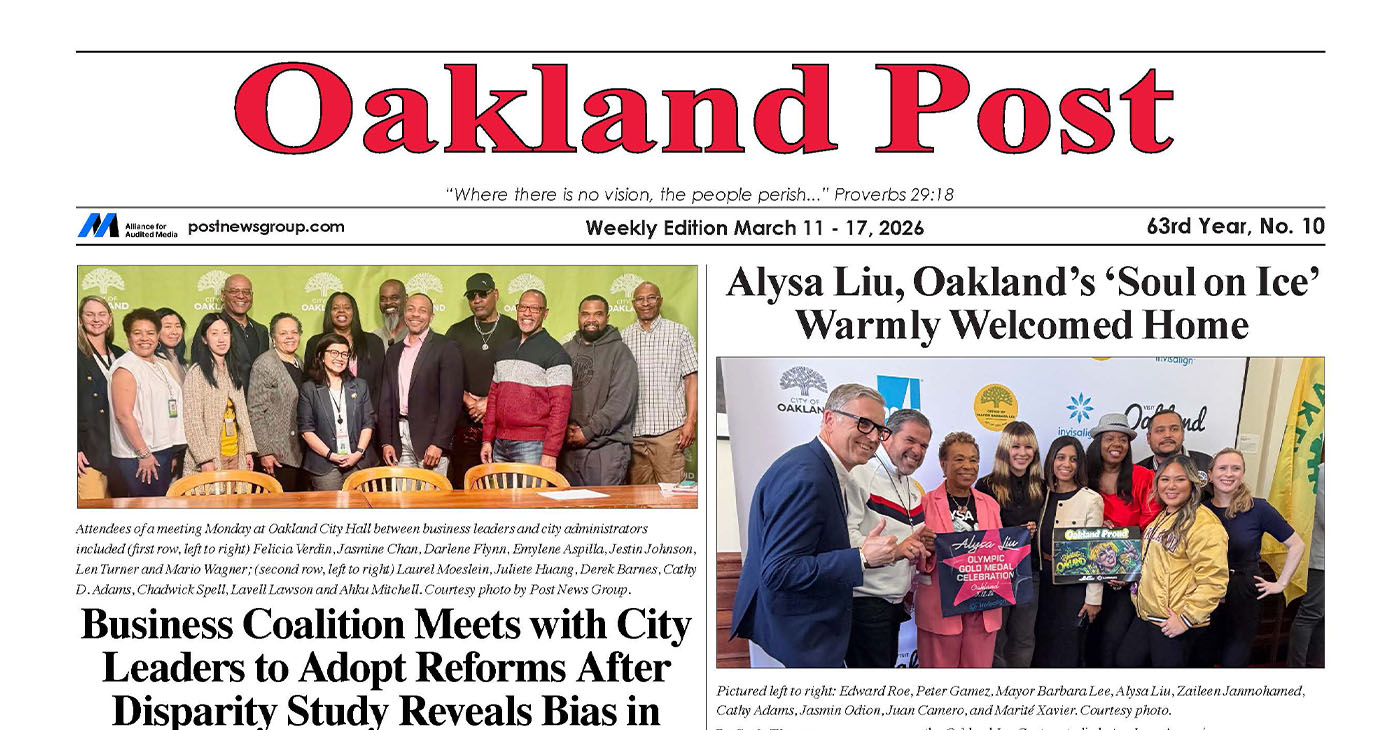
To enlarge your view of this issue, use the slider, magnifying glass icon or full page icon in the lower right corner of the browser window.

Activism
Oakland Post: Week of March 4 – 10, 2026
The printed Weekly Edition of the Oakland Post: Week of March 4 – 10, 2026

To enlarge your view of this issue, use the slider, magnifying glass icon or full page icon in the lower right corner of the browser window.
Activism
Oakland Post: Week of February 25 – March 3, 2026
The printed Weekly Edition of the Oakland Post: Week of – February 25 – March 3, 2026

To enlarge your view of this issue, use the slider, magnifying glass icon or full page icon in the lower right corner of the browser window.

WORK FROM HOME
Home-based business with potential monthly income of $10K+ per month. A proven training system and website provided to maximize business effectiveness. Perfect job to earn side and primary income. Contact Lynne for more details: Lynne4npusa@gmail.com 800-334-0540


Financial Wellness and Mental Health: Managing Money Stress in College

Oakland Post: Week of March 11 -17, 2026

Women & Wealth: Tips for Navigating Your Lifelong Financial Journey

COMMENTARY: Women of Color Shape Our Past and Future

Woman’s Search for Family’s Roots Leads to Ancestor John T. Ward – A Successful Entrepreneur and Conductor on the Underground Railroad

Advocates Raise Alarm Over ICE Operation, MOU and Detention Risks in Baltimore County

Pete Buttigieg to Join Mayor Randall Woodfin for Community Town Hall in Birmingham

WATCH: Week One – NNPA’s “Leadership Matters” Video Series

Oakland Post: Week of March 4 – 10, 2026

OP-ED: NNPA Launches 2026 “Leadership Matters” Video Series

PRESS ROOM: PMG and Cranbrook Horizons-Upward Bound Launch Journey Fellowship Cohort 2

Los Angeles Summit Brings Together Leaders to Tackle Poverty and Affordability

Civil Rights TV Launches 24/7 Network Focused on Black History, Education and Equity

REVIEW: The Ultimate Hot Girl Summer Getaway: Sunseeker Resort Florida

COMMENTARY: How You Stop a Prescription Medicine is as Important as How You Start

Book Review: Books on Black History and Black Life for Kids

Community Celebrates Turner Group Construction Company as Collins Drive Becomes Turner Group Drive

Discrimination in City Contracts

California Launches Study on Mileage Tax to Potentially Replace Gas Tax as Republicans Push Back

COMMENTARY: The Biases We Don’t See — Preventing AI-Driven Inequality in Health Care

Post Newspaper Invites NNPA to Join Nationwide Probate Reform Initiative

Black History Events in the East Bay

Art of the African Diaspora Celebrates Legacy and Community at Richmond Art Center

New Bill, the RIDER Safety Act, Would Support Transit Ambassadors and Safety on Public Transit

COMMENTARY: The National Protest Must Be Accompanied with Our Votes

Oakland Post: Week of February 4 – 10, 2026

Oakland Post: Week of February 11 – 17, 2026

Dorothy Lee Bolden: Uniting Domestic Workers

After Don Lemon’s Arrest, Black Officials Raise Concerns About Independent Black Media

Reflecting on Black History Milestones in Birmingham AL

Hyundai Ioniq 5 Parking, Safety, and 360 View #shorts

2025 Ioniq 5 New Wiper & Powerful Performance! #shorts

Electric SUV Range: Is 259 Miles Enough? #shorts

EV Charging: How Fast Can You Charge an Electric Vehicle? #shorts

Biometric Cooling… Messaging Seats…Come on! 2025 Infiniti QX80 Autograph 4WD

Charged Up: Witness the Magic of a Fully Electric Car! #shorts

Range Rover Sport PHEV Included…: See What’s Inside This Luxury SUV! #shorts

Invisible Hood View: Perfect Parking with X-Ray Vision! #shorts

AI Is Reshaping Black Healthcare: Promise, Peril, and the Push for Improved Results in California

ESSAY: Technology and Medicine, a Primary Care Point of View

Sanctuary Cities

The RESISTANCE – FREEDOM NOW

STATE OF THE PEOPLE: Freddie

ECONOMIC BOYCOTT DAY!!!!!

I told You So

-
 #NNPA BlackPress3 weeks ago
Reflecting on Black History Milestones in Birmingham AL
-
 #NNPA BlackPress3 weeks ago
PRESS ROOM: NBA Hall of Fame Nominee Terry Cummings Joins 100 Black Men of DeKalb County to Launch Victory & Values Initiative
-

 #NNPA BlackPress4 weeks ago
U.S. manufacturing rebounds – how foundry services are adapting to rising demand
-

 #NNPA BlackPress3 weeks ago
OP-ED: One Hundred Years of Black Workers Telling the Truth
-

 #NNPA BlackPress4 weeks ago
Advancements in solar technology that are changing the way we power the world
-

 Activism3 weeks ago
Oakland Post: Week of February 25 – March 3, 2026
-

 #NNPA BlackPress3 weeks ago
Trump’s MAGA Allies are Creating Executive Order Plan to Steal the 2026 Midterms
-
 #NNPA BlackPress4 weeks ago
PRESS ROOM: Civil Rights TV Launches in Selma as the World’s First 24/7 Civil Rights Television Network
