
Activism
Anchoring Organizations for Reparations Task Force Hold Public ‘Listening Sessions’
“This is one of two, free official-sponsored listening sessions that the task force has asked us to do,” said Chris Lodgson, an Elk Grove resident and CJEC member. “This will definitely help us get an accurate account (of the harms) done to Black people in this state.” CJEC is a state-wide coalition of organizations, associations, and community members united for reparations for the descendants of enslaved Black American men and women.

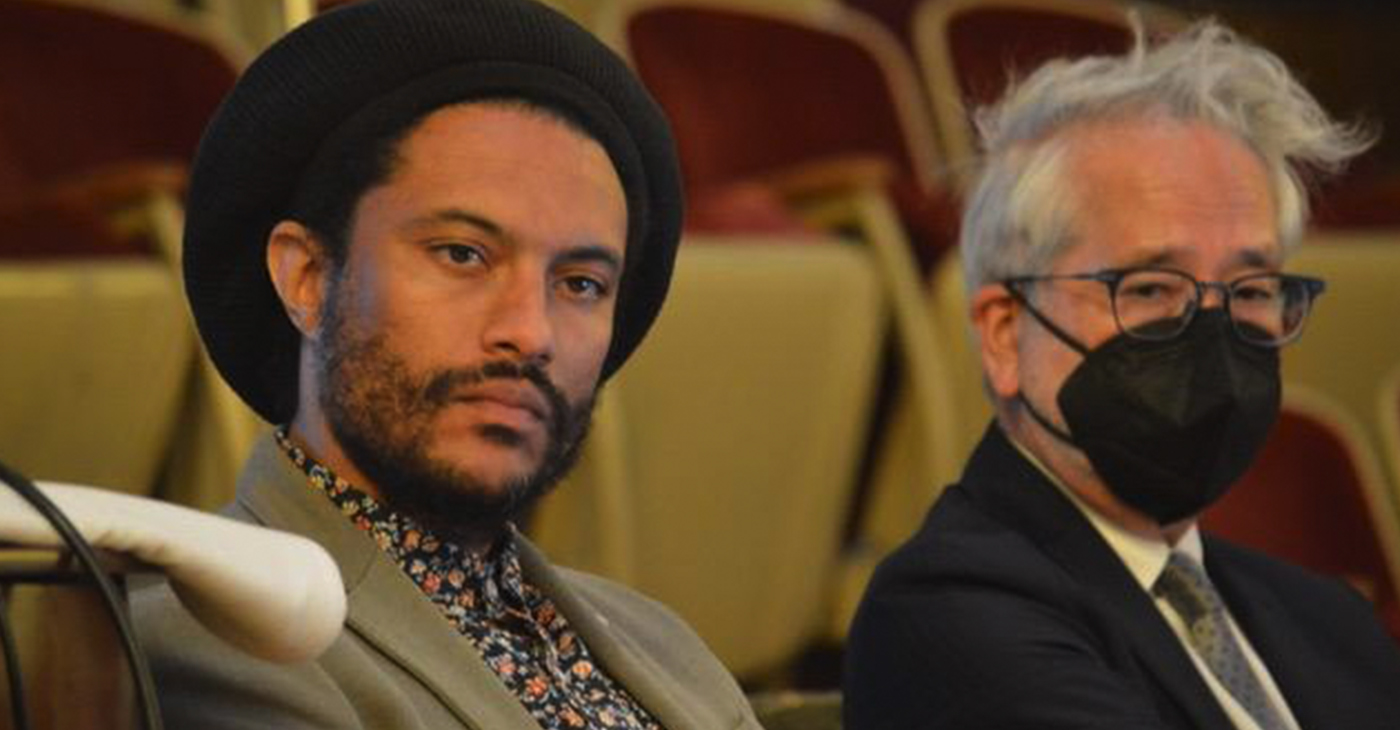
By Antonio Ray Harvey, California Black Media
The Coalition for a Just and Equitable California (CJEC), a reparations advocacy group, is inviting residents of Northern California to attend a “Listening Session” to discuss reparations.
The meeting will be held in Oakland on Saturday, May 28 from 1 p.m. to 4 p.m.
With the support of the California Task Force to Study and Develop Reparations Proposals for African Americans and the state’s Department of Justice (DOJ), the event, open to the public, will be held at the California Ballroom, located at 1736 Franklin St.
“This is one of two, free official-sponsored listening sessions that the task force has asked us to do,” said Chris Lodgson, an Elk Grove resident and CJEC member. “This will definitely help us get an accurate account (of the harms) done to Black people in this state.”
CJEC is a state-wide coalition of organizations, associations, and community members united for reparations for the descendants of enslaved Black American men and women.
The Oakland meeting is one of a series of listening sessions that will be hosted by Reparations Task Force anchor organizations across the state. Seven “anchor organizations” have been selected to partner and host the gatherings in conjunction with the task force.
The listening sessions are designed to ensure certain communities in the state provide their thoughts and concerns about the work the task force is doing.
Each organization will help the task force evaluate California’s role in slavery and Jim Crow discrimination — and follow that work up with developing resolutions to compensate African Americans for past and ongoing race-based injustices.
Task force members expected to attend the Oakland session are Dr. Jovan Scott Lewis, chair of the Department of Geography at the University of California Berkeley and vice-chair Dr. Amos Brown, a civil rights leader and pastor of Third Baptist Church in San Francisco whose journey to leadership started under the tutelage of Dr. Martin Luther King Jr. in the 1960s.
Lewis has just published the book, “Violent Utopia: Dispossession and Black Restoration in Tulsa.” Lewis, a Jamaican-born scholar, retells details of the 1921 Tulsa race massacre and paints a picture of its aftermath. His book traces the history of Black Oklahomans from the post-Reconstruction migration of formerly enslaved people to that state’s Indian Territory to contemporary efforts to rebuild Black prosperity.
The monograph focuses on how the massacre in Tulsa’s Greenwood neighborhood, colloquially known as “Black Wall Street,” diminished the spirit of freedom and derailed progress African Americans had begun to make.
Scott told Los Angeles-based Politics in Black, a podcast hosted by reparations advocates Chad Brown and Friday Jones, that his purpose is to listen to the residents of Oakland and supply them with background information about the Task Force.
The Task Force will submit its first report to the California Legislature in June. The 13-chapter document will detail the committee’s findings thus far and include recommendations related to them.
“It’s important to know that these are preliminary recommendations. The actual work of coming up with reparations recommendations is what we’re going to be doing for all the issues (for the final report in 2023),” Scott told Brown and Jones. “I am really looking forward to having the conversations that we will have over the next several months around compensation. Reparations are compensation, and from day one, my position has been cash-based reparations.”
Gov. Gavin Newsom signed Assembly Bill (AB) 3121 into law in 2020. California Secretary of State Shirley Weber authored the legislation establishing the task force when she was a member of the State Legislature. The committee is charged with studying slavery and its lingering effects on African Americans with a “special consideration” for descendants of persons enslaved in the United States, the bill language instructs.
AB 3121 also requires members to recommend what compensation should be, who should receive it, and how it should be paid. A panel of economists contracted by the task force will provide their perspective on the financial aspects of compensation and its impacts.
Lodgson also urges members of the community to “share their experiences” with anchor organizations such as the Black Equity Collective, Afrikan Black Coalition, Black Power Network, Congregations Organized for Prophetic Engagement (COPE), and Othering and Belonging Institute.
Marcus Champion, a board member for the National Assembly of American Slavery Descendants Los Angeles (NAASDLA) and CJEC will also speak at the listening session in Oakland.
Kellie Farrish, a professional Bay Area genealogist and member of the Association of Professional Genealogists, will join Champion at the session. She has 20 years of experience working with African American families descended from slavery, piecing together their broken family histories.
“These listening sessions are important and probably the center, the core part, of the task force’s community engagement process,” Lodgson said. “This is one of the more important ways that the community can learn about reparations in California. This is the way to get the word out to the people from seven organizations.”
The Listening Session at the California Ballroom is free. For more information, visit TWITTER: @cjecofficial or inquire at CJECOfficial@gmail.com











Activism
Oakland Post: Week of March 11 -17, 2026
The printed Weekly Edition of the Oakland Post: Week of March 11 – 17, 2026
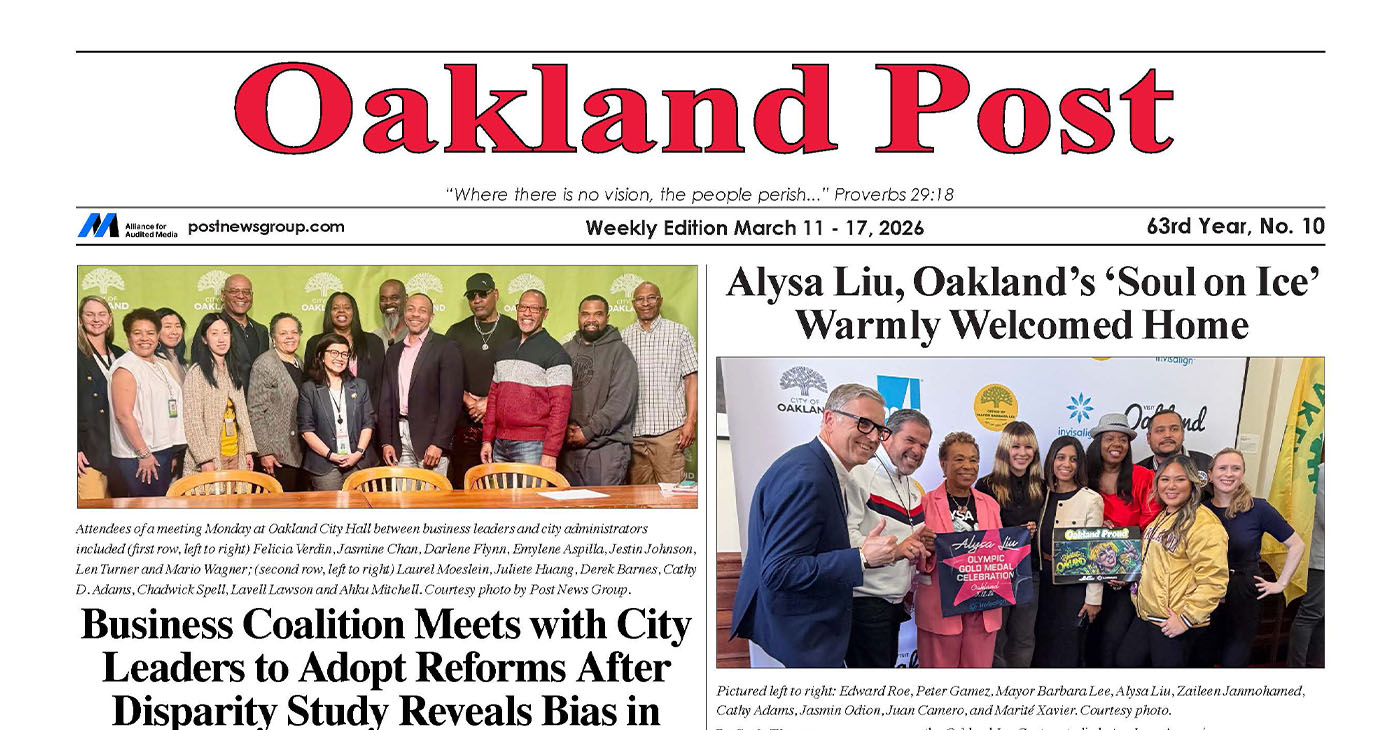
To enlarge your view of this issue, use the slider, magnifying glass icon or full page icon in the lower right corner of the browser window.
Activism
Oakland Post: Week of March 4 – 10, 2026
The printed Weekly Edition of the Oakland Post: Week of March 4 – 10, 2026

To enlarge your view of this issue, use the slider, magnifying glass icon or full page icon in the lower right corner of the browser window.
Activism
Oakland Post: Week of February 25 – March 3, 2026
The printed Weekly Edition of the Oakland Post: Week of – February 25 – March 3, 2026

To enlarge your view of this issue, use the slider, magnifying glass icon or full page icon in the lower right corner of the browser window.

WORK FROM HOME
Home-based business with potential monthly income of $10K+ per month. A proven training system and website provided to maximize business effectiveness. Perfect job to earn side and primary income. Contact Lynne for more details: Lynne4npusa@gmail.com 800-334-0540


Financial Wellness and Mental Health: Managing Money Stress in College

Oakland Post: Week of March 11 -17, 2026

Women & Wealth: Tips for Navigating Your Lifelong Financial Journey

COMMENTARY: Women of Color Shape Our Past and Future

Woman’s Search for Family’s Roots Leads to Ancestor John T. Ward – A Successful Entrepreneur and Conductor on the Underground Railroad

Advocates Raise Alarm Over ICE Operation, MOU and Detention Risks in Baltimore County

Pete Buttigieg to Join Mayor Randall Woodfin for Community Town Hall in Birmingham

WATCH: Week One – NNPA’s “Leadership Matters” Video Series

Oakland Post: Week of March 4 – 10, 2026

OP-ED: NNPA Launches 2026 “Leadership Matters” Video Series

PRESS ROOM: PMG and Cranbrook Horizons-Upward Bound Launch Journey Fellowship Cohort 2

Los Angeles Summit Brings Together Leaders to Tackle Poverty and Affordability

Civil Rights TV Launches 24/7 Network Focused on Black History, Education and Equity

REVIEW: The Ultimate Hot Girl Summer Getaway: Sunseeker Resort Florida

COMMENTARY: How You Stop a Prescription Medicine is as Important as How You Start

Book Review: Books on Black History and Black Life for Kids

Community Celebrates Turner Group Construction Company as Collins Drive Becomes Turner Group Drive

Discrimination in City Contracts

California Launches Study on Mileage Tax to Potentially Replace Gas Tax as Republicans Push Back

COMMENTARY: The Biases We Don’t See — Preventing AI-Driven Inequality in Health Care

Black History Events in the East Bay

Post Newspaper Invites NNPA to Join Nationwide Probate Reform Initiative

Art of the African Diaspora Celebrates Legacy and Community at Richmond Art Center

New Bill, the RIDER Safety Act, Would Support Transit Ambassadors and Safety on Public Transit

COMMENTARY: The National Protest Must Be Accompanied with Our Votes

Oakland Post: Week of February 4 – 10, 2026

Oakland Post: Week of February 11 – 17, 2026

Dorothy Lee Bolden: Uniting Domestic Workers

After Don Lemon’s Arrest, Black Officials Raise Concerns About Independent Black Media

Reflecting on Black History Milestones in Birmingham AL

Hyundai Ioniq 5 Parking, Safety, and 360 View #shorts

2025 Ioniq 5 New Wiper & Powerful Performance! #shorts

Electric SUV Range: Is 259 Miles Enough? #shorts

EV Charging: How Fast Can You Charge an Electric Vehicle? #shorts

Biometric Cooling… Messaging Seats…Come on! 2025 Infiniti QX80 Autograph 4WD

Charged Up: Witness the Magic of a Fully Electric Car! #shorts

Range Rover Sport PHEV Included…: See What’s Inside This Luxury SUV! #shorts

Invisible Hood View: Perfect Parking with X-Ray Vision! #shorts

AI Is Reshaping Black Healthcare: Promise, Peril, and the Push for Improved Results in California

ESSAY: Technology and Medicine, a Primary Care Point of View

Sanctuary Cities

The RESISTANCE – FREEDOM NOW

STATE OF THE PEOPLE: Freddie

ECONOMIC BOYCOTT DAY!!!!!

I told You So
-
 #NNPA BlackPress3 weeks ago
Reflecting on Black History Milestones in Birmingham AL
-
 #NNPA BlackPress3 weeks ago
PRESS ROOM: NBA Hall of Fame Nominee Terry Cummings Joins 100 Black Men of DeKalb County to Launch Victory & Values Initiative
-

 #NNPA BlackPress4 weeks ago
U.S. manufacturing rebounds – how foundry services are adapting to rising demand
-

 #NNPA BlackPress4 weeks ago
OP-ED: One Hundred Years of Black Workers Telling the Truth
-

 Activism3 weeks ago
Oakland Post: Week of February 25 – March 3, 2026
-

 #NNPA BlackPress4 weeks ago
Advancements in solar technology that are changing the way we power the world
-

 #NNPA BlackPress3 weeks ago
Trump’s MAGA Allies are Creating Executive Order Plan to Steal the 2026 Midterms
-
 #NNPA BlackPress4 weeks ago
PRESS ROOM: Civil Rights TV Launches in Selma as the World’s First 24/7 Civil Rights Television Network
