
Politics
Gov. Cuomo Eulogizes Dad Mario as a Crusader, Poet, Friend


New York Governor Andrew Cuomo and his mother Matilda Cuomo follow a casket containing the body of Mario Cuomo as it is carried from the church during his funeral in New York, Tuesday, Jan. 6, 2015. (AP Photo/Seth Wenig)
DAVID KLEPPER, Associated Press
JONATHAN LEMIRE, Associated Press
NEW YORK (AP) — Former Gov. Mario Cuomo’s legacy as a liberal champion and powerful orator was remembered at his funeral Tuesday by one who knew him best — Gov. Andrew Cuomo, his son.
“At his core, he was a philosopher. He was a poet. He was an advocate. He was a crusader. Mario Cuomo was the keynote speaker for our better angels,” the younger Cuomo said in a eulogy that spanned his father’s background as the son of immigrants, his biggest speeches and his basketball prowess.
The former three-term governor — who flirted with but never made a presidential run and turned down an opportunity to be nominated for the U.S. Supreme Court — died Thursday, hours after his son was inaugurated for a second term.
Dignitaries including Bill and Hillary Rodham Clinton and Mayor Bill de Blasio gathered to mourn the 82-year-old Democratic Party icon and to honor his legacy.
Dozens of police officers stood at attention in front of St. Ignatius Loyola Church, and a pipe and drum corps played solemnly as Cuomo’s casket was carried inside. Pallbearers included Cuomo’s younger son, CNN newscaster Chris Cuomo.
On Monday, hundreds waited in a line that stretched more than a block at Cuomo’s wake. Vice President Joe Biden, House Minority Leader Nancy Pelosi and actor Alan Alda were among those who paid tribute.
As governor from 1983 to 1994, Cuomo was recognized for his eloquence and for powerful appeals for social justice that blended liberal ideals with his life experience as the son of an Italian immigrant grocer.
He was known for his deliberations over running for president, which earned him the nickname “Hamlet on the Hudson.” He came close to running in 1988 and 1992 but decided against it.
Why? “Because he didn’t want to” and loved being governor, Andrew Cuomo said in a heartfelt speech that mixed political legacy, personal memories of his “Pops” and calls to move the state forward in his father’s footsteps.
Cuomo was most remembered for a speech at the 1984 Democratic National Convention in San Francisco, where he focused on an America divided between haves and have-nots and scolded Republican President Ronald Reagan for not working to close that gap.
Cuomo “had a natural connection with the outsider looking in,” Andrew Cuomo said. “He was always the son of an immigrant. He was always the outsider. And that was his edge.”
As governor, the elder Cuomo cut taxes and trimmed the state workforce, Andrew Cuomo noted.
“My father called himself a progressive pragmatist. … His goals were progressive, but his means were pragmatic,” he said.
Andrew Cuomo recalled his father’s drive, which he said was on full display on the basketball court. “It was his liberation,” Cuomo recalled. “He was competitive by nature. You opposed him at your own peril.”
The younger Cuomo shares much of his father’s competitiveness and is known as a guarded, calculating leader. Tuesday’s eulogy provided a much more personal glimpse of a man mourning his father.
“There were moments when there wasn’t a dry eye in the church,” said Democratic U.S. Rep. Eliot Engel.
Cuomo said he regrets not leaving Washington, where he was then an assistant secretary of housing and urban development, to help on his father’s unsuccessful bid for a fourth term in 1994. Winning that office for himself in 2010 was a victory he cherished more for his father’s sake than his own, Andrew Cuomo said.
Mario Cuomo joined his son on the stage at the party celebrating his re-election last fall, but he was too ill to attend his inaugural the day he died. Andrew Cuomo ended the eulogy by vowing to follow his father’s example.
“We know what we have to do, and we will do it: We will make this state a better state, and we will do it together,” he said. “On that, you have my word as your son.”
___
Associated Press writer Jennifer Peltz contributed to this report.
Copyright 2015 The Associated Press. All rights reserved. This material may not be published, broadcast, rewritten or redistributed.


Business
OP-ED: Proposition 44 Would Put a Price on Trust
The danger in Proposition 44 is not only its 90 percent figure. It is that the meaning of “qualifying” spending will be worked out later. A clinic preparing a budget today may not know whether a navigator, health educator, transportation program, outreach worker, technology upgrade, or other patient-support service will be counted the way it expects. Yet the financial consequence of getting it wrong could be immediate.



Business
OP-ED: Proposition 40: It’s Time to Play Chess, Not Checkers
Proposition 40 would impose a one-time 5 percent tax on the wealth of Californians with more than $1 billion in assets. Most of that money would go toward health care, with the remainder supporting food assistance and education-related programs.

Activism
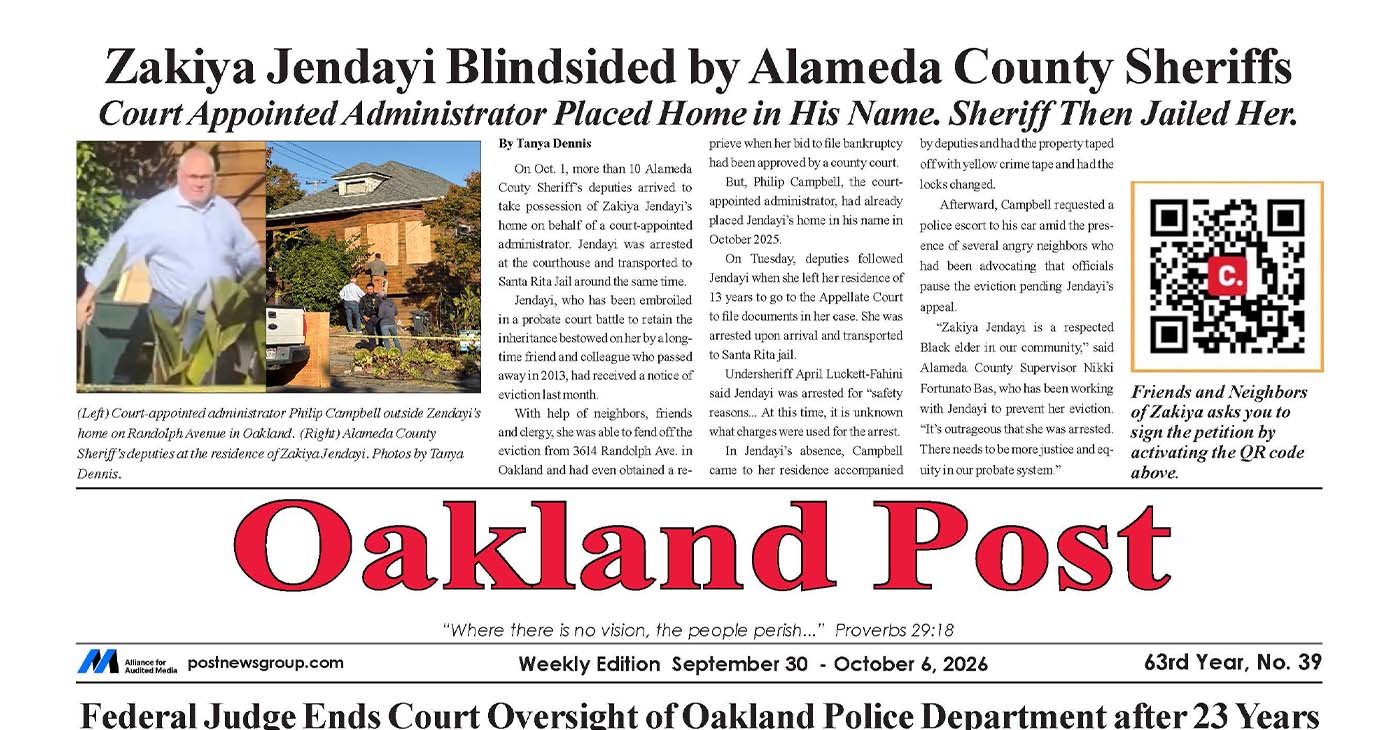
Oakland Post: Week of September 30 – October 6, 2026
The printed Weekly Edition of the Oakland Post: Week of September 30 – October 6, 2026
To enlarge your view of this issue, use the slider, magnifying glass icon or full page icon in the lower right corner of the browser window.


OP-ED: Proposition 44 Would Put a Price on Trust

OP-ED: Proposition 40: It’s Time to Play Chess, Not Checkers

Listening as a Lifeline: A Doula’s Witness to Black Maternal Health

New Protections for Ticket Buyers: Gov. Newsom Signs Assemblymember Isaac Bryan’s Bill

‘We Don’t Talk Trash — We Pick Up Trash!’

Zakiya Jendayi Arrested, Locked Out of Home by Sheriff’s Deputies

Oakland Post: Week of September 30 – October 6, 2026

Asm. Corey Jackson Announces Launch of 24-Hour Childcare in His District

IN MEMORIAM: The Rev. Leon “Sonny” Clark, Longtime Orange County Pastor and Community Leader, Dies at 72

Poll: Becerra Widens His Lead Over Hilton; Californians Split on Wealth Tax

From Historic Memories to New Possibilities: Oakland Celebrates Coliseum 60

County Office of Education Says OUSD Finances Are Getting Healthier, Materially Stronger

LIVE FREE Sunday Dinner Brings Faith, Fellowship and Civic Conversation to Oakland

Remembering Chauncey Bailey as Student Journalists Face Threats to Truth-Telling

BLACspace Cooperative Invites Bay Area to Experience Oakland’s Black Cultural Ecosystem Through a BLAC Map Tour + Party

Standoff for Justice: Our Homes Are Worth Fighting For

Oakland Post: Week of August 26 – September 1, 2026

Frontier Airlines’ Return to Oakland Airport Brings Flights, Jobs and Opportunity

Jackie Wright Champions Bay Area Stories, Filmmakers and Cultural Institutions

Gubernatorial Candidate Steve Hilton Blasts California New Tire Rules; Newsom Hits Back

Chef Sharon Lee Blends Culinary Excellence, Education and Empowerment

Misnamed ‘Parent’ PAC Seeks to Influence Oakland School Board Elections

Oakland Coliseum Project Opens Door for Small Businesses to Build Bigger

Big City Mayors Ask for “Yes” Vote on Housing Bond Measure; Conservatives Say “No”

Gov. Newsom’s Latest Appointees Include Sacramento Advocate for Formerly Incarcerated Students; State’s New Tech Chief

Oakland Post: Week of September 2 – 8, 2026

Longtime BWOPA Member Brendalyn Goodall Appointed to California Workforce Development Board

Gov. Newsom Signs Law Shielding Immigration Aid Workers From Doxing Threats

Secretary of State Shirley N. Weber Urges Californians to Vote Early as Voter ID Battle Intensifies

Oakland Post: Week of September 9 – 15, 2026

The Conversation With Al McFarlane 6/23/26

Media Monday 6/22/26

LIVE! ASK ALMA! — TUES. 6.23.26 7PM EST

Car Buying Secrets: 4 Hidden Checks Before You Sign!

Is This 550 HP Charger Worth YOUR Money? AutoNetwork Review

Celebrating Juneteenth – Frederick Douglass on education and resistance

LIVE! — ASK ALMA! — TUES. 6.19.26 7PM EST

Hyundai Ioniq 5 Parking, Safety, and 360 View #shorts

2025 Ioniq 5 New Wiper & Powerful Performance! #shorts

Electric SUV Range: Is 259 Miles Enough? #shorts

EV Charging: How Fast Can You Charge an Electric Vehicle? #shorts

Biometric Cooling… Messaging Seats…Come on! 2025 Infiniti QX80 Autograph 4WD

Charged Up: Witness the Magic of a Fully Electric Car! #shorts

Range Rover Sport PHEV Included…: See What’s Inside This Luxury SUV! #shorts

Invisible Hood View: Perfect Parking with X-Ray Vision! #shorts
-
 Community4 weeks ago
Misnamed ‘Parent’ PAC Seeks to Influence Oakland School Board Elections
-
 Activism4 weeks ago
Oakland Post: Week of September 9 – 15, 2026
-

 Community4 weeks ago
Richmond Tiny House Village Farm & Garden Set to Open Gates on Sept. 26
-

 Black History4 weeks ago
Latest Massacre in Haiti Reveals Cruelty U.S. Deportations
-

 Black History4 weeks ago
OPINION: Nolan Wells’ Death One of Several Signifying Racial Terror Lives on in U.S. South
-

 Business3 weeks ago
Mayor Lee Announces $1 Million Kaiser Permanente Grant for Pilot Program to Address Homelessness, Clean Up Public Spaces throughout Oakland
-

 Community4 weeks ago
Democratic Clubs Interview Candidates for Oakland School Board
-
 Business2 weeks ago
County Office of Education Says OUSD Finances Are Getting Healthier, Materially Stronger
