
Crime
Despite fewer murders, N.O. still among Top 5 deadliest U.S. cities
LOUISIANA WEEKLY — Despite closing out 2018 with 145 homicides, the lowest murder total in nearly five decades, New Orleans remains one of the nation’s Top 5 deadliest cities

By The Louisiana Weekly
Despite closing out 2018 with 145 homicides, the lowest murder total in nearly five decades, New Orleans remains one of the nation’s Top 5 deadliest cities.
Late last month, NOPD Supt. Michael Harrison attributed the drop in violent crime to the use of a Real Time Crime Center that utilizes a network of surveillance cameras across the city, the NOPD’s TIGER program which targets repeat violent offenders and improved police-community relations.
LSU criminologist Dr. Peter Sharf told FOX 8 News that crime cameras and stability in police hierarchy deserve credit for a historic low when it came to murders in 2018.
However he says the city still has a long way to go.
The year 2018 was a year that started out on the wrong foot when it came to murders.
“Much of the carnage this year was in the first two months, and it’s gone down consistently,” said LSU Health criminologist, Peter Scharf, PhD.
For example, Mardi Gras day in February, four people were killed in three separate shootings, Uptown, in the CBD and in Treme, and some were predicting a violent year.
That didn’t happen, and the city’s chronic murder problem settled down.
New Orleans finished out 2018 with 145 murders, a 47-year low, with the murder of Marla Belin, one of the last, and the arrest of Tyrone Fountain last night.

Dr. Scharf says the increased use of crime cameras and technology deserves much of the credit for the overall drop in murders.
“My suspicion in the short term is the cameras, and pro active patrol, the public health things will take a longer time to develop,” said Scharf.
Scharf also credits stability in NOPD leadership, and superintendent Michael Harrison.
“Absolutely, Michael like all of us had a mixed reputation, he’s built a good team, and has a sound strategy,” said Scharf.
Scharf says murders are down nationally, and he cautions, though the trends are good in New Orleans, it is still one of the most violent cities in the country.
“When you look at murder in 2018, New York is 3.5 per 100,000, we’re at 36 or 37, so we’re 10 times more dangerous for violent crime than New York,” said Scharf.
Dr. Scharf says the city has all but abandoned its old goal of 1,600 police officers.
He said crime cameras, and more “intelligent” policing are helping to achieve crime reductions at lower troop strength.
Despite the significant drop in homicides, an analyst notes that the murder rate remains among the nation’s highest.
The 145 homicides in the city in 2018 marked the lowest total since 116 in 1971. It also marked the second drop in a row: from 174 in 2016 to 157 in 2017 and 145 last year.
The murder rate is about 37 per 100,000 residents. That’s at best fourth-highest and might be No. 3, crime analyst and City Council consultant Jeff Asher told The New Orleans Advocate. St. Louis and Baltimore have the highest rates, and either Detroit and New Orleans will be next, he said.
It would take a further significant reduction for New Orleans to drop to No. 5, he said.
New Orleans’ murder rate has been flat for four years, Scharf told WVUE-TV.
“I think we need to try some of these new initiatives, public health approaches and see if we can get it so that New Orleans is kind of like other cities in the United States, it’s not now,” Scharf said. “So the question is, you have pockets of extreme at-risk kids who are armed and they’re in the drug culture – how do you intervene effectively with those kids way prior to anybody shooting anybody?”
New Orleans’ 47-year low in murders was accompanied by a drop of about 28 percent in the number of non-deadly shooting incidents from 2017, the newspaper reported. Armed robberies fell for the third year in a row, and the number of carjackings came down as well in 2018, according to statistics kept by the New Orleans City Council’s Criminal Justice Committee.
Asher said police work could be part of the reasons, but other factors are almost certainly at play.
Violent crime is trending downward nationally, and communities frequently see cooler periods in the wake of a spike in violence, which New Orleans endured when there were about two shootings daily for a year beginning in the middle of 2016.
“We don’t necessarily know what the drivers of gun violence (rates) are from day to day, month to month, or year to year,” Asher said. “More than likely, it’s not a single explanation, but it would be logical to say one of those things could be enforcement.”
Asher also noted that while 2018 saw the fewest murders in New Orleans since 1971, the city had a lower murder rate in 1985, when there were 152 slayings and more than 500,000 residents.
Harrison, who always points out that even a single murder is too many, concedes that plenty of work remains to be done.
But he said he’s optimistic. For one thing, he said, his agency is closing in on substantial compliance with a 492-point federally mandated consent decree aimed at bringing the department up to federal standards for constitutional policing that has improved performance, most notably by slashing the rate at which its 1,200 officers resort to force.
Implementation of the NOPD consent decree began in August 2013.
“The whole city needs to know it was the 1,200 officers who executed (the strategies) and willingly transformed” the agency, Harrison said. “They should recognize it’s the officers who made the culture change, and I’m honored it’s under my leadership.”
This article originally appeared in the Louisiana Weekly.








Activism
Oakland Post: Week of March 18 – 24, 2026
The printed Weekly Edition of the Oakland Post: Week of March 18 – 24, 2026

To enlarge your view of this issue, use the slider, magnifying glass icon or full page icon in the lower right corner of the browser window.
Activism
Oakland Post: Week of March 11 -17, 2026
The printed Weekly Edition of the Oakland Post: Week of March 11 – 17, 2026
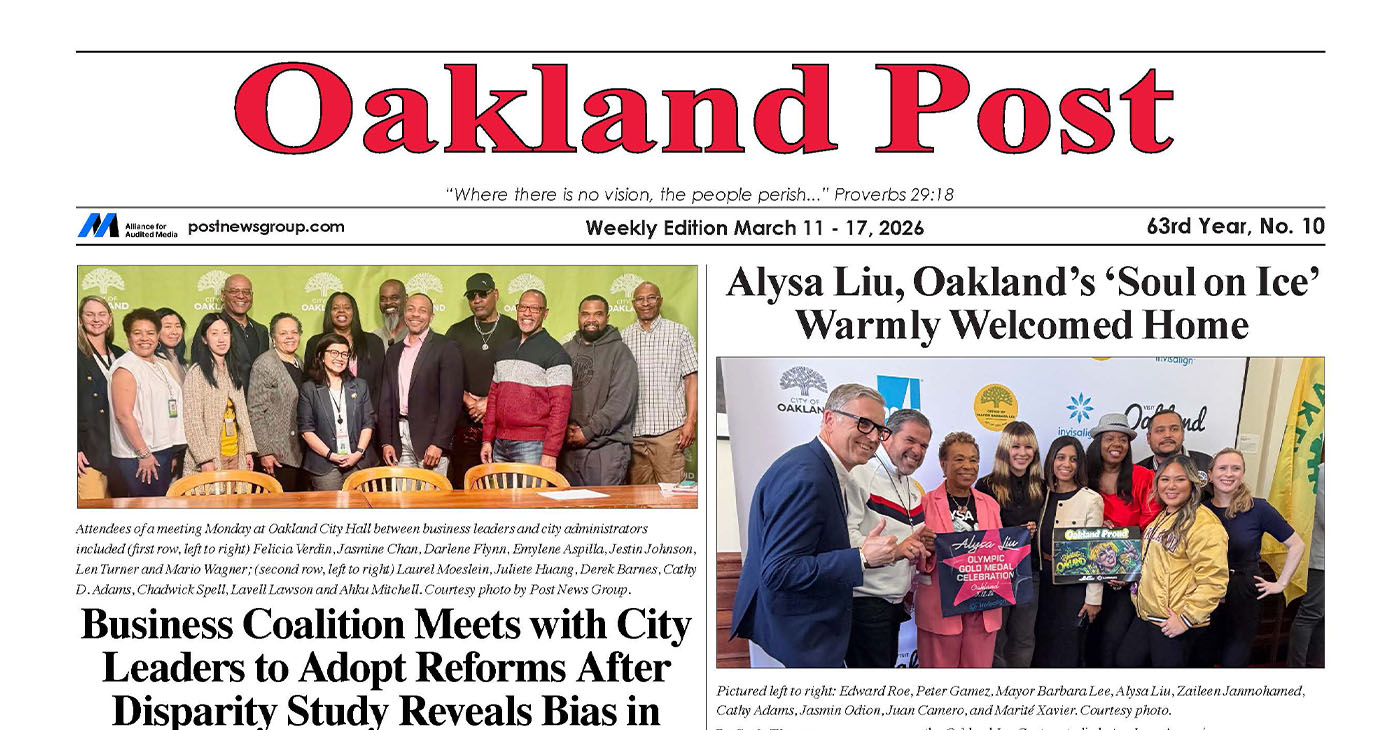
To enlarge your view of this issue, use the slider, magnifying glass icon or full page icon in the lower right corner of the browser window.
Activism
Oakland Post: Week of March 4 – 10, 2026
The printed Weekly Edition of the Oakland Post: Week of March 4 – 10, 2026

To enlarge your view of this issue, use the slider, magnifying glass icon or full page icon in the lower right corner of the browser window.


WORK FROM HOME
Home-based business with potential monthly income of $10K+ per month. A proven training system and website provided to maximize business effectiveness. Perfect job to earn side and primary income. Contact Lynne for more details: Lynne4npusa@gmail.com 800-334-0540


Black Artists in America, Installation Three Wraps at the Dixon Gallery and Gardens

Grief, Advocacy, and Education: A Counselor Reflects on Black Maternal Health

Future of Florida’s Black History Museum in Limbo

New Research Shows the Many Benefits of Early Learning

South Hampton K-8 Students Among Top 10 Finalists for Samsung’s ‘Solve for Tomorrow’ Competition

Cuba: No Negotiation with US on the President or Political System

Brooklyn Academy of Music Names Jamaican-Born Tamara McCaw as President

Trinidad & Tobego – U.S. Launches WhatsApp Channel for American Citizens in the Country

Oakland Post: Week of March 18 – 24, 2026

AI Innovation vs. Ethics and Environmental Impact

AI, Web3, and Digital Reparations

What If You Owned Your AI Agent?

Season 7, Episode 3 – January Reporter’s Roundtable 📱

Season 7, Episode 3 – January Reporter’s Roundtable

AI, Media, and Power | Part 2, Real-World Impacts and Tradeoffs

Oakland Post: Week of February 11 – 17, 2026

Reflecting on Black History Milestones in Birmingham AL

CITY OF SAN LEANDRO STATE OF CALIFORNIA PUBLIC WORKS DEPARTMENT ENGINEERING DIVISION NOTICE TO BIDDERS FOR ANNUAL STREET OVERLAY/REHABILITATION 2019-21 – PHASE III

Oakland Post: Week of February 18 – 24, 2026

PRESS ROOM: NBA Hall of Fame Nominee Terry Cummings Joins 100 Black Men of DeKalb County to Launch Victory & Values Initiative

Oakland Post: Week of February 25 – March 3, 2026

Trump’s MAGA Allies are Creating Executive Order Plan to Steal the 2026 Midterms

U.S. manufacturing rebounds – how foundry services are adapting to rising demand

OP-ED: One Hundred Years of Black Workers Telling the Truth

Chase Oakland Community Center Hosts Alley-Oop Accelerator Building Community and Opportunity for Bay Area Entrepreneurs

Poll Shows Support for Policies That Help Families Afford Child Care

Oakland Post: Week of March 4 – 10, 2026

Advancements in solar technology that are changing the way we power the world

PRESS ROOM: Civil Rights TV Launches in Selma as the World’s First 24/7 Civil Rights Television Network

Woman’s Search for Family’s Roots Leads to Ancestor John T. Ward – A Successful Entrepreneur and Conductor on the Underground Railroad

Hyundai Ioniq 5 Parking, Safety, and 360 View #shorts

2025 Ioniq 5 New Wiper & Powerful Performance! #shorts

Electric SUV Range: Is 259 Miles Enough? #shorts

EV Charging: How Fast Can You Charge an Electric Vehicle? #shorts

Biometric Cooling… Messaging Seats…Come on! 2025 Infiniti QX80 Autograph 4WD

Charged Up: Witness the Magic of a Fully Electric Car! #shorts

Range Rover Sport PHEV Included…: See What’s Inside This Luxury SUV! #shorts

Invisible Hood View: Perfect Parking with X-Ray Vision! #shorts

AI Is Reshaping Black Healthcare: Promise, Peril, and the Push for Improved Results in California

ESSAY: Technology and Medicine, a Primary Care Point of View

Sanctuary Cities

The RESISTANCE – FREEDOM NOW

STATE OF THE PEOPLE: Freddie

ECONOMIC BOYCOTT DAY!!!!!

I told You So
-
 Activism4 weeks ago
Oakland Post: Week of March 4 – 10, 2026
-
 #NNPA BlackPress3 weeks ago
Woman’s Search for Family’s Roots Leads to Ancestor John T. Ward – A Successful Entrepreneur and Conductor on the Underground Railroad
-

 #NNPA BlackPress4 weeks ago
OP-ED: NNPA Launches 2026 “Leadership Matters” Video Series
-

 #NNPA BlackPress3 weeks ago
Advocates Raise Alarm Over ICE Operation, MOU and Detention Risks in Baltimore County
-

 #NNPA BlackPress3 weeks ago
COMMENTARY: Women of Color Shape Our Past and Future
-

 #NNPA BlackPress3 weeks ago
Pete Buttigieg to Join Mayor Randall Woodfin for Community Town Hall in Birmingham
-

 Activism2 weeks ago
Oakland Post: Week of March 11 -17, 2026
-

 #NNPA BlackPress4 weeks ago
PRESS ROOM: PMG and Cranbrook Horizons-Upward Bound Launch Journey Fellowship Cohort 2
