
City Government
Councilmember Gallo Introduces RV Parking Ban Proposal
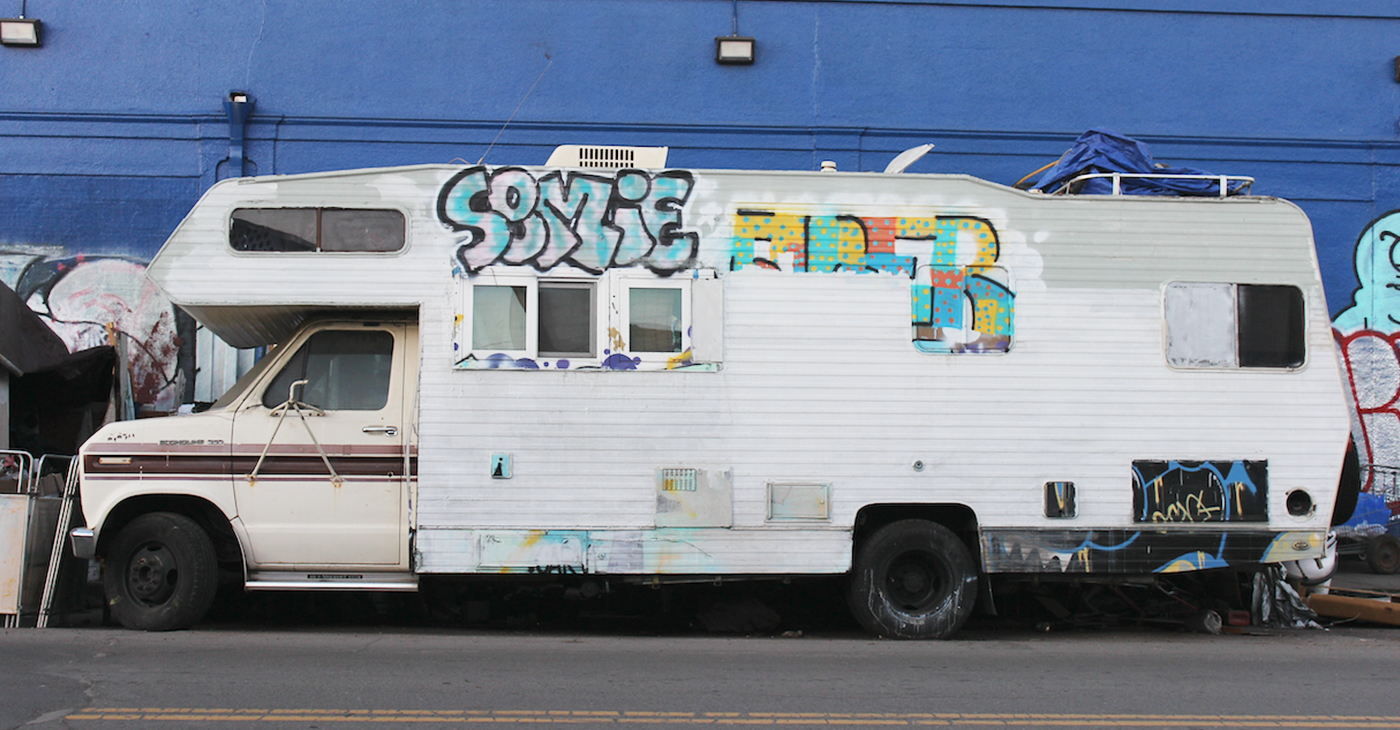
Oakland has 147 total spaces for RV parking in the Safe Parking Programs the city has helped set up through non-profit organizations, according to Citywide Communication Director Karen Boyd. None of these spaces are currently available for residents.

By Zack Haber
During a Public Works Department committee meeting on March 22, Councilmember Noel Gallo introduced an ordinance to amend the city of Oakland’s municipal code to place limitations on large, non-commercial vehicles parking in certain streets.
The proposal would make it illegal to park a vehicle that is longer than 22 feet, wider than 7 feet, and/or taller than 7 feet on any street that is 40 feet wide.
Since the vast majority of RVs and trailers are larger than the dimensions listed, advocates for people that live in such vehicles and vehicle dwellers themselves have labeled the legislation as an RV ban. According to a draft that Oakland’s Department of Transportation shared with The Oakland Post, about 79% of Oakland streets are 40 feet wide or narrower.
“This proposal would give the city authority to tow and impound peoples’ vehicle dwellings leaving them on the street with no shelter,” reads an Instagram post from Love and Justice in the Streets, a grassroots advocacy group for Oakland residents experiencing homelessness. “It does not include any real solutions or offer any housing solutions to Oakland residents who currently find shelter in RVs.”
The language in Gallo’s proposal lists blocking bike lanes, access for emergency vehicles and improving visibility for drivers as reasons for the ban.
“I think the policy is very clear, that I can’t do anything I want in front of (Councilmember) Dan Kalb’s house or park my RV therein and leave my trash and garbage whenever I want to,” said Gallo. “I bring this request to you on behalf of the residents that have been here a lifetime that are trying to send their children to school but cannot walk on the street because they’re being blocked off.”
A little over a dozen residents spoke out against Gallo’s proposal during the meeting, saying it would harm vehicle dwellers by taking their homes without offering solutions, especially as some vehicles that serve as homes are difficult to move as they no longer run.
Judy Elkin said, “people need these vehicles for their homes.”
Oakland unhoused resident Nino Parker said the proposal would “just put more people on the street” and that it was “going to make the problem worse.” The legislation would charge the person living in a vehicle that gets towed for towing and storage fees, although it doesn’t list where vehicles would be stored. Parker suggested that if the proposal passes, vehicle dwellers who have their homes towed should move to District 5, which is Gallo’s district.
Two residents spoke in favor of Gallo’s proposal during the meeting. One of these residents, who identified their self only using their first name, Patricia, said “hopefully the RVs can just go into the lots that have already been set up for parking because they pose a problem when you’re cycling around the city.”
Oakland has 147 total spaces for RV parking in the Safe Parking Programs the city has helped set up through non-profit organizations, according to Citywide Communication Director Karen Boyd. None of these spaces are currently available for residents.
“None of the sites have vacancies right now,” wrote Boyd in an email. “Not all of the sites are full, but they are not able to take new people for various reasons.”
Gallo’s proposal does not add any additional spaces for RV parking.
Ultimately, the Public Works Committee, which in addition to Gallo also includes Councilmembers Loren Taylor, Dan Kalb and Sheng Thao, unanimously decided to delay voting on the proposal until a meeting on May 24. Taylor and Kalb asked for a supplemental report on the proposal that would address how it would be enforced, whether the city could determine which RVs belonged to Oakland residents and/or those who worked in Oakland, and information on other similar ordinances from other nearby cities.
Thao asked for a plan as to where the RVs would go if they were towed.
“If we are removing RVs from streets, where are we bringing them?” she asked. Then stated that she “doesn’t want them just shifting around.”
On May 24, the Public Works Committee is scheduled to receive a supplemental report that aims to address inquiries by Taylor, Kalb and Thao about Gallo’s proposal. The committee is then scheduled to vote on the proposal.
If the majority of the committee votes to pass the proposal, the entire City Council could then vote it into law in a future meeting.






Activism
Oakland Post: Week of April 8 – 14, 2026
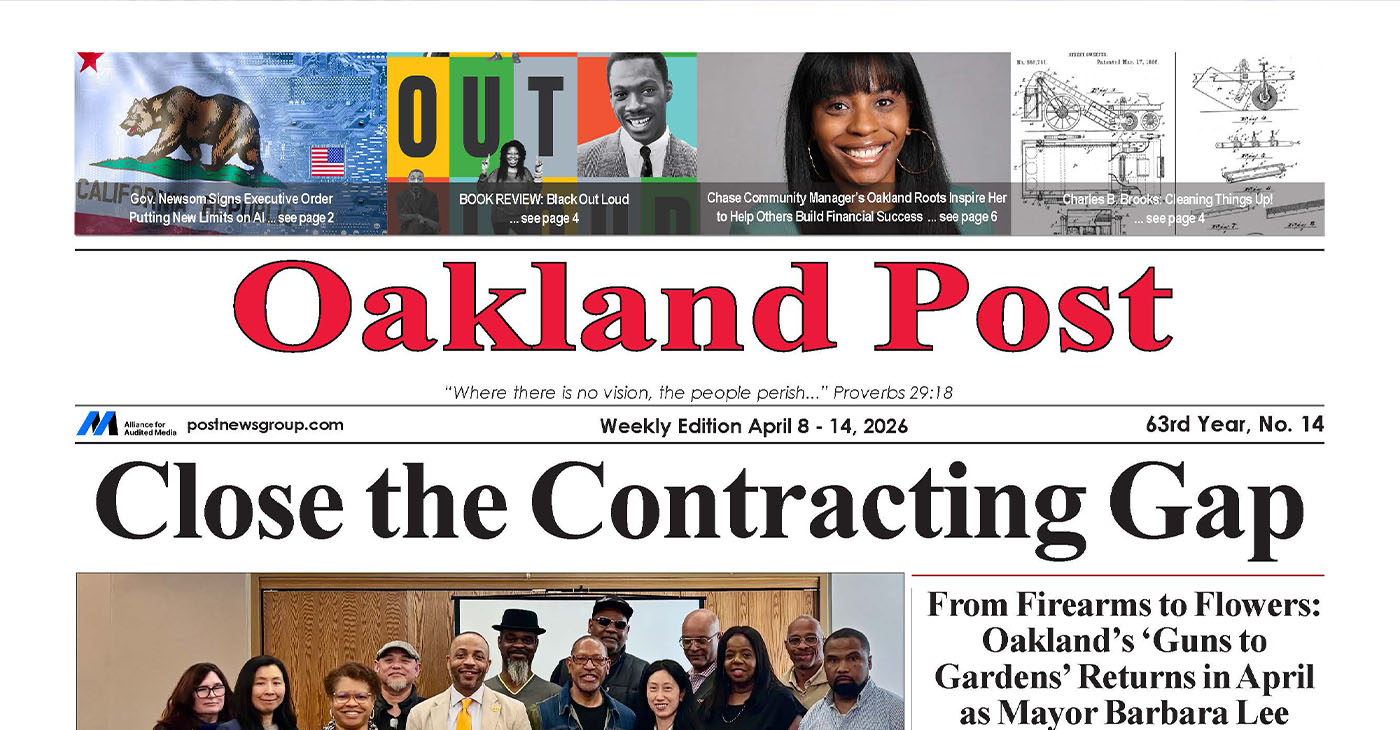
The printed Weekly Edition of the Oakland Post: Week of April 8 – 14, 2026
To enlarge your view of this issue, use the slider, magnifying glass icon or full page icon in the lower right corner of the browser window.
Activism
Oakland Post: Week of April 1 – 7, 2026
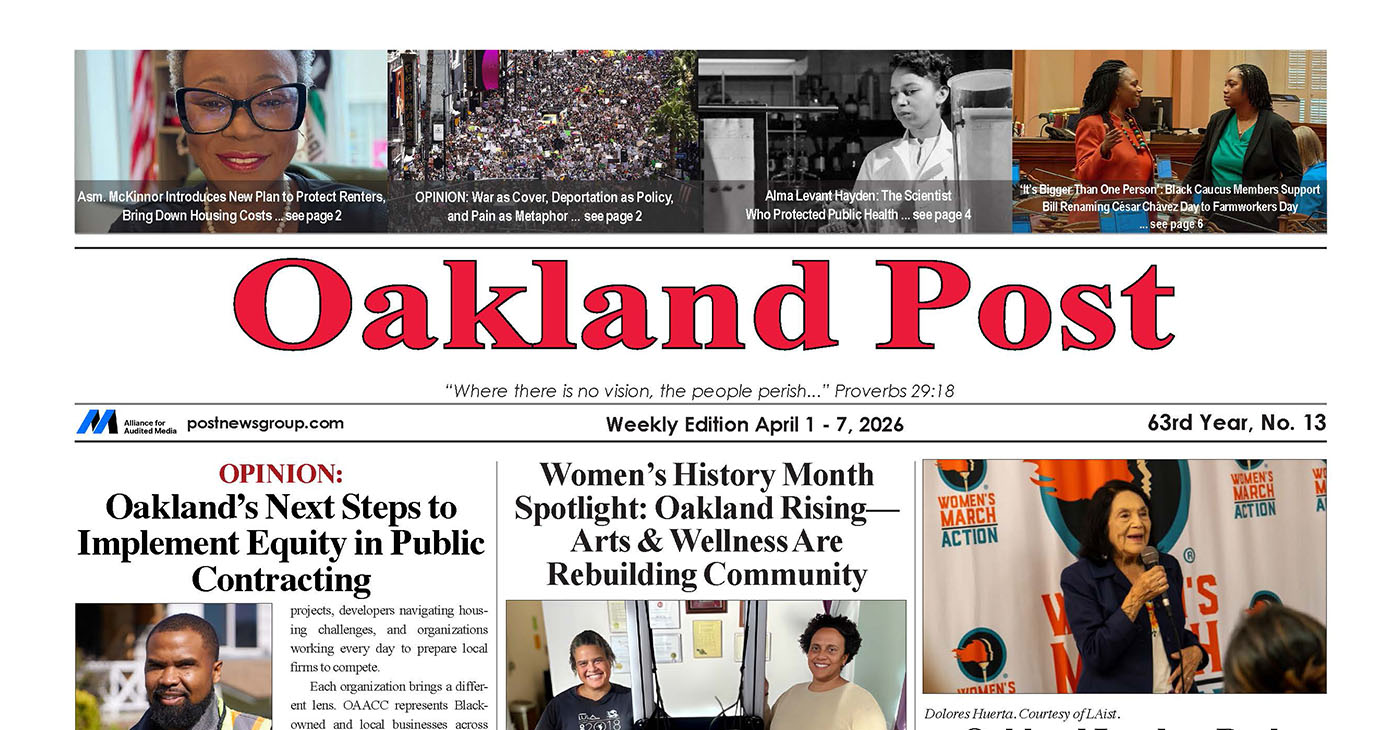
The printed Weekly Edition of the Oakland Post: Week of April 1 – 7, 2026
To enlarge your view of this issue, use the slider, magnifying glass icon or full page icon in the lower right corner of the browser window.
Activism
Oakland Post: Week of March 18 – 24, 2026
The printed Weekly Edition of the Oakland Post: Week of March 18 – 24, 2026
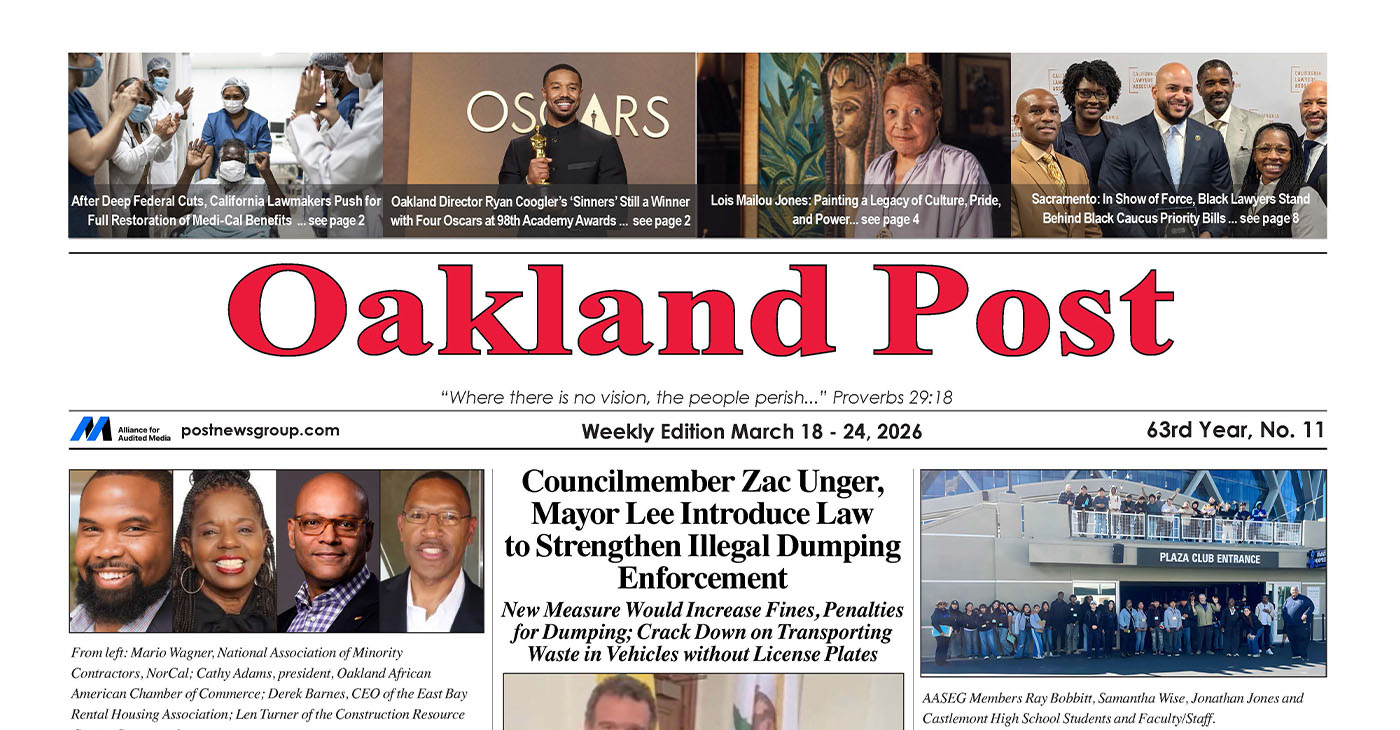
To enlarge your view of this issue, use the slider, magnifying glass icon or full page icon in the lower right corner of the browser window.


WORK FROM HOME
Home-based business with potential monthly income of $10K+ per month. A proven training system and website provided to maximize business effectiveness. Perfect job to earn side and primary income. Contact Lynne for more details: Lynne4npusa@gmail.com 800-334-0540


Oakland Post: Week of April 8 – 14, 2026

Oakland Post: Week of April 1 – 7, 2026

Black Artists in America, Installation Three Wraps at the Dixon Gallery and Gardens

Grief, Advocacy, and Education: A Counselor Reflects on Black Maternal Health

Future of Florida’s Black History Museum in Limbo

New Research Shows the Many Benefits of Early Learning

South Hampton K-8 Students Among Top 10 Finalists for Samsung’s ‘Solve for Tomorrow’ Competition

Cuba: No Negotiation with US on the President or Political System

Brooklyn Academy of Music Names Jamaican-Born Tamara McCaw as President

Trinidad & Tobego – U.S. Launches WhatsApp Channel for American Citizens in the Country

Oakland Post: Week of March 18 – 24, 2026

AI Innovation vs. Ethics and Environmental Impact

AI, Web3, and Digital Reparations

What If You Owned Your AI Agent?

Season 7, Episode 3 – January Reporter’s Roundtable 📱

Reflecting on Black History Milestones in Birmingham AL

Oakland Post: Week of February 25 – March 3, 2026

Oakland Post: Week of March 4 – 10, 2026

PRESS ROOM: NBA Hall of Fame Nominee Terry Cummings Joins 100 Black Men of DeKalb County to Launch Victory & Values Initiative

Trump’s MAGA Allies are Creating Executive Order Plan to Steal the 2026 Midterms
Oakland Post: Week of March 18 – 24, 2026

Oakland Post: Week of March 11 -17, 2026

Poll Shows Support for Policies That Help Families Afford Child Care

OP-ED: One Hundred Years of Black Workers Telling the Truth

Financial Wellness and Mental Health: Managing Money Stress in College

Woman’s Search for Family’s Roots Leads to Ancestor John T. Ward – A Successful Entrepreneur and Conductor on the Underground Railroad

COMMENTARY: Women of Color Shape Our Past and Future
Brooklyn Academy of Music Names Jamaican-Born Tamara McCaw as President
New Research Shows the Many Benefits of Early Learning
Grief, Advocacy, and Education: A Counselor Reflects on Black Maternal Health

Hyundai Ioniq 5 Parking, Safety, and 360 View #shorts

2025 Ioniq 5 New Wiper & Powerful Performance! #shorts

Electric SUV Range: Is 259 Miles Enough? #shorts

EV Charging: How Fast Can You Charge an Electric Vehicle? #shorts

Biometric Cooling… Messaging Seats…Come on! 2025 Infiniti QX80 Autograph 4WD

Charged Up: Witness the Magic of a Fully Electric Car! #shorts

Range Rover Sport PHEV Included…: See What’s Inside This Luxury SUV! #shorts

Invisible Hood View: Perfect Parking with X-Ray Vision! #shorts

AI Is Reshaping Black Healthcare: Promise, Peril, and the Push for Improved Results in California

ESSAY: Technology and Medicine, a Primary Care Point of View

Sanctuary Cities

The RESISTANCE – FREEDOM NOW

STATE OF THE PEOPLE: Freddie

ECONOMIC BOYCOTT DAY!!!!!

I told You So
-
 Activism3 weeks ago
Oakland Post: Week of March 18 – 24, 2026
-
 Activism4 weeks ago
Oakland Post: Week of March 11 -17, 2026
-
 Advice4 weeks ago
Financial Wellness and Mental Health: Managing Money Stress in College
-
 #NNPA BlackPress3 weeks ago
Brooklyn Academy of Music Names Jamaican-Born Tamara McCaw as President
-
 #NNPA BlackPress3 weeks ago
New Research Shows the Many Benefits of Early Learning
-
 #NNPA BlackPress3 weeks ago
Grief, Advocacy, and Education: A Counselor Reflects on Black Maternal Health
-
 #NNPA BlackPress3 weeks ago
Future of Florida’s Black History Museum in Limbo
-
 #NNPA BlackPress3 weeks ago
Black Artists in America, Installation Three Wraps at the Dixon Gallery and Gardens
