
Activism
COMMENTARY: Vote ‘No’ on Props 26 & 27: Both Are Bad for California
In respect for Native sovereignty, voters previously supported the establishment of Indian gaming. However, neither of the current measures have significant Indian support.


By James. E. Vann
Propositions 26 and 27 on the November ballot appear to be related, but their differences are substantial, and both are exceedingly harmful.
Proposition 26 would result in vast expansion of gambling methods within American Indian lands, with a new extension to California racetracks.
Proposition 27 would result in vast expansion of present gaming methods beyond Indian lands, with no limitations, and would add the authorization of ‘online’ gambling.
In respect for Native sovereignty, voters previously supported the establishment of Indian gaming. However, neither of the current measures have significant Indian support.
Proposition 26
This measure, somewhat related but unlike Proposition 27, was initiated by a small group of leaders of the largest tribes. Their motivation is their personal enrichment, not from either demand or need. The currently authorized program of permitted gaming methods at Indigenous casino sites is constitutionally limited. Proposition 26 would remove the present restrictions and permit unlimited gambling methods and selections at casino sites and at California racetracks. Methods would include wagering on sports events, like horse racing, sports teams, auto racing, boxing, wrestling, and a host of events broadcast into casino platforms.
The institution of Indigenous casinos has been a needed boon and supplement to mandated federal and state financial assistance that is perennially insufficient. The result of tribal-sponsored gaming – currently earning hundreds of millions annually — has brought tremendous uplift in the political, economic, health, and social life of Indian tribes and peoples. Casino profits are shared with non-casino tribes and these efforts, though lagging, are continuing and constantly improving.

While Indian casinos are thriving and producing admirable widespread improvements, tribal leaders of some of the largest casinos initiated Proposition 26 with the goal of slyly piggy-backing on the possible success of Proposition 27, solely due to greed, not need for new, unlimited revenue. VOTE ‘NO.’
Proposition 27
Proposition 27 was qualified for the ballot by deceptive propaganda. Paid signature collectors told signers that “this new measure will raise money to end homelessness in California.” Proposition 27 was not initiated, nor promoted by California Indian tribes, but by out-of-state corporations that sought to take advantage of the universal desire of California voters to end homelessness together with the compassion of state voters to lift up the plight of California’s Native peoples from the violent repression of the past.
The Indian Gaming Regulatory Act of 1988 correctly acknowledged the sovereignty of Indigenous people and the right of tribes to operate gambling casinos on tribal land. This Act has successfully improved the quality of life for Indian tribes and produces millions in revenues that is shared among both casino and non-casino tribes, which bureaucratic federal and state government financial assistance could never replicate.
Proposition 27 would astronomically expand to unlimited types of gambling well beyond being confined to casinos on Indian land to online phenomena available to everyone, including minors with a cell phone, or varieties of digital devices. Arguments for the measure blatantly lie in many ways:
- That revenue from online gaming will uplift poorer, non-casino Indian tribes. Impartial analysis shows that at least 90% of revenue from the expansion will go into the pockets of the out-of-state carpetbaggers who wrote the measure specifically for their selfish enrichment;
- That revenue from the measure will end homelessness. Besides there being little revenue to allocate, voters need only to recall that the “selling point” years ago for approving the California State Lottery was the promise that lottery revenue “would forever end the problem of funding education throughout the state;”
- That minors will not be able to gamble online. No procedures are indicated that will weed out anyone with a digital device from online access.
Additionally, because Blacks, people of color, and those of lower income are lured in larger numbers to games of chance with the hope of improving their financial status, Proposition 27 would aggravate economic inequality and insecurity. The availability of unlimited online gaming opportunities will provide increased attractions that will further worsen the already weak financial condition of marginalized people.
Practically all California Indian Council tribes oppose Proposition 27 as a boondoggle that will proliferate gambling throughout California life and institutions degrading the lifestyles of minors and the elderly.
Through this new, deceptive measure, the sponsoring out-of-state corporations will realize uncountable wealth with practically nothing positive accruing to California, its residents, or its many intractable issues.
VOTE “NO.”
James E. Vann is a former architect and advocate for social justice housing. He is also a co-founder of the Oakland Tenants Union (OTU) and Coalition of Advocates for Lake Merritt (CALM).














Activism
Oakland Post: Week of September 16 – 22, 2026
The printed Weekly Edition of the Oakland Post: Week of September 16 – 22, 2026

To enlarge your view of this issue, use the slider, magnifying glass icon or full page icon in the lower right corner of the browser window.
Activism
Oakland Post: Week of September 9 – 15, 2026
The printed Weekly Edition of the Oakland Post: Week of September 9 – 15, 2026

To enlarge your view of this issue, use the slider, magnifying glass icon or full page icon in the lower right corner of the browser window.
Activism
Oakland Post: Week of September 2 – 8, 2026
The printed Weekly Edition of the Oakland Post: Week of September 2 – 8, 2026
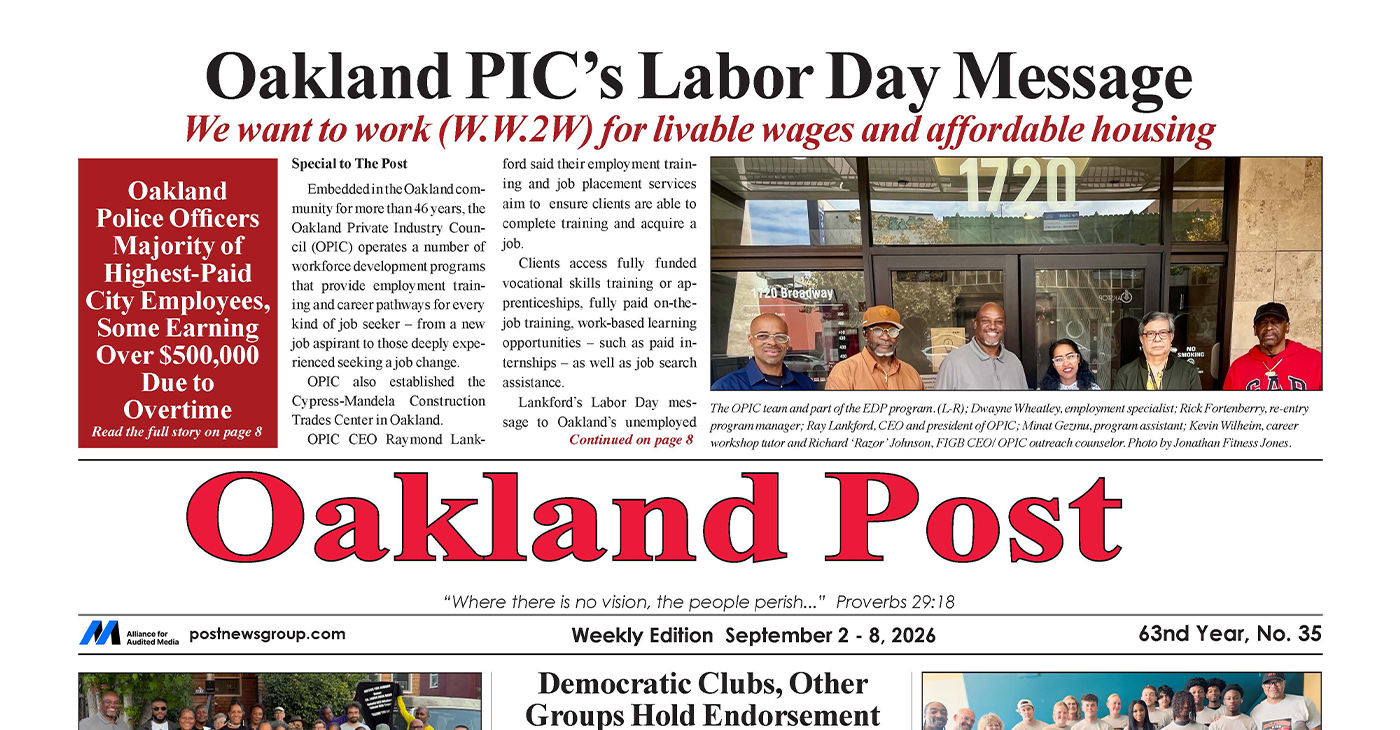
To enlarge your view of this issue, use the slider, magnifying glass icon or full page icon in the lower right corner of the browser window.



Doulas Are Helping Black California Moms Navigate Pregnancy–Even as High Mortality Rates Persist

Newsom Signs Addictive Social Media Law to Protect Kids

On Your November Ballot: Prop 38 Would Allocate $8.4 Billion to Immunology and Immunotherapy Funding

Ask California: Golden State Releases New AI Chatbot

Asm. Isaac Bryan’s Bill Banning California Police From ICE Side Jobs Reaches Newsom’s Desk

Assemblymember LaShae Sharp-Collins’s Bill Would Pause Law Enforcement’s Use of Shock Gloves Pending Study

BOOK REVIEW: ‘Laws of Solomon’ Reveals Tender Heart of Former Child Soldier

OPINION: The New American Fear – From 9-11 to AI

Passing for White, Fighting for Black America: The Courage of Walter White

Oakland People’s Arms Embargo Coalition Demands End to Military Shipments Thru Oakland

Barbara Lee Mourns Gloria Steinem, Remembers a Friendship Rooted in Equality

Event Preview: ‘Fashion v. Fascism’ – A Runway Revolution Is Coming to the Bay Area

Two Looming Threats Every Alameda County Elder Should Know About

Oakland Mayor Reads to Children at Bookout Block Party at Marcus Books Store

Tradition Comes to the Streets in 11th Annual Black-Eyed Pea Festival at the Freedom Farmers Market

Less Affluent School Districts, Including Sacramento City, Face Threat of State Takeover

ESSAY: California Can Close Its Colorectal Cancer Gap

California Hispanic Chambers of Commerce Unveils: ‘Powering the Future’ Theme for 47th Annual Statewide Convention

Four Candidates, Including Incumbent Barbara Lee, Qualify for Oakland Mayor’s Race

Oakland Post: Week of August 12 – 18, 2026

From Blueprint to Breakthrough: Tackling Affordable Housing in Oakland

Oakland Observes Black August with Block Parties, Film Showings, Workshops

COMMENTARY: Why Local School Tax Measure G1 Will Not Be on the November Ballot

Standoff for Justice: Our Homes Are Worth Fighting For

Returning to Its Roots, the Oakland Black-Eyed Pea Festival Partners with the Freedom Farmers Market Sept. 12

NPRC Scores First Advocacy Victory: David Shaw Finally Gets His Wish to ‘Go Home’

Oakland Post: Week of August 26 – September 1, 2026

Frontier Airlines’ Return to Oakland Airport Brings Flights, Jobs and Opportunity

Gubernatorial Candidate Steve Hilton Blasts California New Tire Rules; Newsom Hits Back

Chef Sharon Lee Blends Culinary Excellence, Education and Empowerment

The Conversation With Al McFarlane 6/23/26

Media Monday 6/22/26

LIVE! ASK ALMA! — TUES. 6.23.26 7PM EST

Car Buying Secrets: 4 Hidden Checks Before You Sign!

Is This 550 HP Charger Worth YOUR Money? AutoNetwork Review

Celebrating Juneteenth – Frederick Douglass on education and resistance

LIVE! — ASK ALMA! — TUES. 6.19.26 7PM EST

Hyundai Ioniq 5 Parking, Safety, and 360 View #shorts

2025 Ioniq 5 New Wiper & Powerful Performance! #shorts

Electric SUV Range: Is 259 Miles Enough? #shorts

EV Charging: How Fast Can You Charge an Electric Vehicle? #shorts

Biometric Cooling… Messaging Seats…Come on! 2025 Infiniti QX80 Autograph 4WD

Charged Up: Witness the Magic of a Fully Electric Car! #shorts

Range Rover Sport PHEV Included…: See What’s Inside This Luxury SUV! #shorts

Invisible Hood View: Perfect Parking with X-Ray Vision! #shorts
-
 Commentary4 weeks ago
Standoff for Justice: Our Homes Are Worth Fighting For
-
 Activism4 weeks ago
Oakland Post: Week of August 26 – September 1, 2026
-
 Business4 weeks ago
Frontier Airlines’ Return to Oakland Airport Brings Flights, Jobs and Opportunity
-
 Business4 weeks ago
Gubernatorial Candidate Steve Hilton Blasts California New Tire Rules; Newsom Hits Back
-
 Business4 weeks ago
Chef Sharon Lee Blends Culinary Excellence, Education and Empowerment
-

 Education4 weeks ago
Gov. Newsom’s Latest Appointees Include Sacramento Advocate for Formerly Incarcerated Students; State’s New Tech Chief
-

 Community4 weeks ago
Big City Mayors Ask for “Yes” Vote on Housing Bond Measure; Conservatives Say “No”
-

 Business4 weeks ago
Oakland Coliseum Project Opens Door for Small Businesses to Build Bigger
