
Activism
COMMENTARY: No Unity in America? Remember 9/11 Before We all Forget
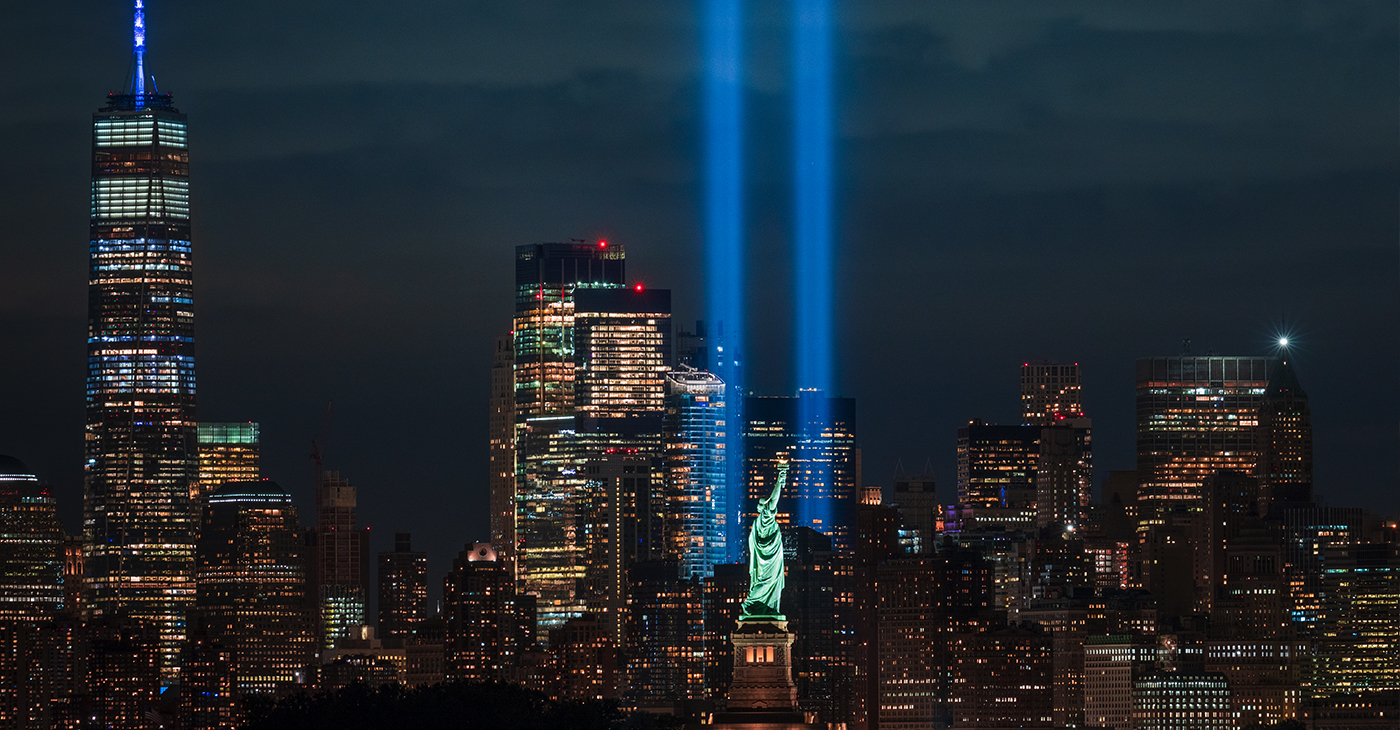
I will never be in doubt again about what to do on Sept. 11. At each time stamp of terror, mark it with a moment of silence to honor the dead and the brave. That’s what they’ve done in New York the last 22 years.

By Emil Guillermo
The politics of the week was as polarizing as it gets. President Biden spoke to the UN General assembly about defending democracy, especially when it comes to giving aide to Ukraine, a sovereign nation invaded by Russia.
That would normally happen without debate, but now polls in the U.S show more than 50% say we’ve given enough to Ukraine. And with already $60 billion given to date, fulfilling the request for another $40 billion may be in doubt.
It’s easy to say, “Gee, wouldn’t it be nice if any of that could be used to fix our local problems.” But we’re talking about a threat of a different level. Gang bangers shooting up neighborhoods and local smash-and-grabs are one thing. A superpower like Russia smash-and-grabbing a free country like Ukraine, we all need to care about.
That’s not how democracy works.
And then there is the weaponizing of government by Republicans in Congressional hearings, on full display when the GOP lead Justice Committee member badgered Attorney General Merrick Garland for hours on irrelevancies like Hunter Biden.
“…They do that at the expense of millions of Americans who need the government to stay open and want their kids safe in school, and like to see Ukraine stay in the fights that don’t help Russia,” said California District 14 Congressman Eric Swalwell, who called the hearings a clown show. “Except they actually have real responsibilities that affect real Americans.”

That hearing was on Sept. 20, nine days after the 9/11 anniversary.
When I think of an America United I like to think of that day.
Where Were You on 9/11?
I was in the San Francisco Bay Area, thinking about trading the markets, so I was up way early with CNBC at 5.46 a.m. Pacific time when the first plane flew into the North Tower.
Then the second plane at 6:03 a.m. Pacific time struck the South Tower.
And then the third plane struck the Pentagon at 6:37 a.m Pacific time.
It’s too early for all this, I recall thinking, my head spinning from the news. But then the South Tower fell at 6:59 a.m. Pacific.
OMFG wasn’t an acronym back then.
I would need something stronger at 10:03 a.m. Pacific, when a fourth plane crashed in Shanksville, Pa.
Within the half hour at 10:28 a.m. Pacific, the North Tower fell.
I will never be in doubt again about what to do on Sept. 11. At each time stamp of terror, mark it with a moment of silence to honor the dead and the brave. That’s what they’ve done in New York the last 22 years.
It’s the timeline of when the terrorists’ war came to us. It was in Lower Manhattan. But I felt it instantly via television in California while still in my pajamas.
It was also a day I lost my taste for the markets and the mindless chase of the almighty dollar. Sept. 11 made me sense something more was at stake, our sense of country, of ourselves, and of our America.
There were shattered buildings in New York, but was there ever a moment when the country was more united?
Remember that, America. Because there have been so many times since then when we forget what it’s like to be on the same side, always, together.
It shouldn’t take an act of terrorism to get back that feeling. Just think of what we did for each other when our real patriotism emerged Sept. 12, 2001.
The Last Thing I Did on Sept. 11
After 2001, my life really did take a different path. I went from television and radio to newspapers. This is not unlike saying to the modern world that you prefer communicating through cave drawings.
But I survived.
One of my friends became a big-time corporate lawyer and is now retired. Our politics are polar opposites, but we’re still buddies. We have history together. We both graduated from San Francisco’s Lowell High School. He moans about the Cal Bears.
If Sept. 11 can have a unifying effect, would it happen when I had dinner with my friend?
The answer is at least on the surface, yes. We were in New York, at, coincidentally, a Ukrainian restaurant with few vegan options. But I made do.
We disagreed on everything. Especially on affirmative action. He sided with the Supreme Court against Harvard. I didn’t. He brought up the historical discrimination against Jews. “There were some law firms that wouldn’t even talk to me when I graduated,” said my friend, who is Jewish.
We agreed that was wrong. But he couldn’t get past his belief that discrimination happens to everyone. You deal with it and get over it, he said.
Easier said than done, if you happen to be a darker shade.
But we’re friends and respect each other.
On the matter of 9/11, he told me where he was that day. His office was a few blocks from the World Trade Center. But he came to work shortly after the first tower fell.
He remembers seeing people walking up FDR Drive from Lower Manhattan covered in soot, their faces in shock.
I told him about my theory of 9/12, how it sparked a feeling of unity that is so rare these days.
He said it was still there, though admittedly, it’s gotten worse. “It doesn’t matter about your politics,” he said, adding how he didn’t care about my point of view. We went to high school together. I called him. He saw my show in New York and now we’re having dinner.
“So, you’re a crazy guy, but so what, I am too,” he said. “You’re my friend and if you need anything, you just ask me.”
Maybe that’s the best we can hope for in a polarized America.
To have a meal together. Laugh. Then fight over the check. Not politics.
But making the feeling last beyond 9/12 is getting tougher and tougher in America.
Emil Guillermo is a journalist and commentator. See his Emil Amok videos on YouTube, Instagram and Facebook.








Activism
Oakland Post: Week of September 16 – 22, 2026
The printed Weekly Edition of the Oakland Post: Week of September 16 – 22, 2026

To enlarge your view of this issue, use the slider, magnifying glass icon or full page icon in the lower right corner of the browser window.
Activism
Oakland Post: Week of September 9 – 15, 2026
The printed Weekly Edition of the Oakland Post: Week of September 9 – 15, 2026

To enlarge your view of this issue, use the slider, magnifying glass icon or full page icon in the lower right corner of the browser window.
Activism
Oakland Post: Week of September 2 – 8, 2026
The printed Weekly Edition of the Oakland Post: Week of September 2 – 8, 2026
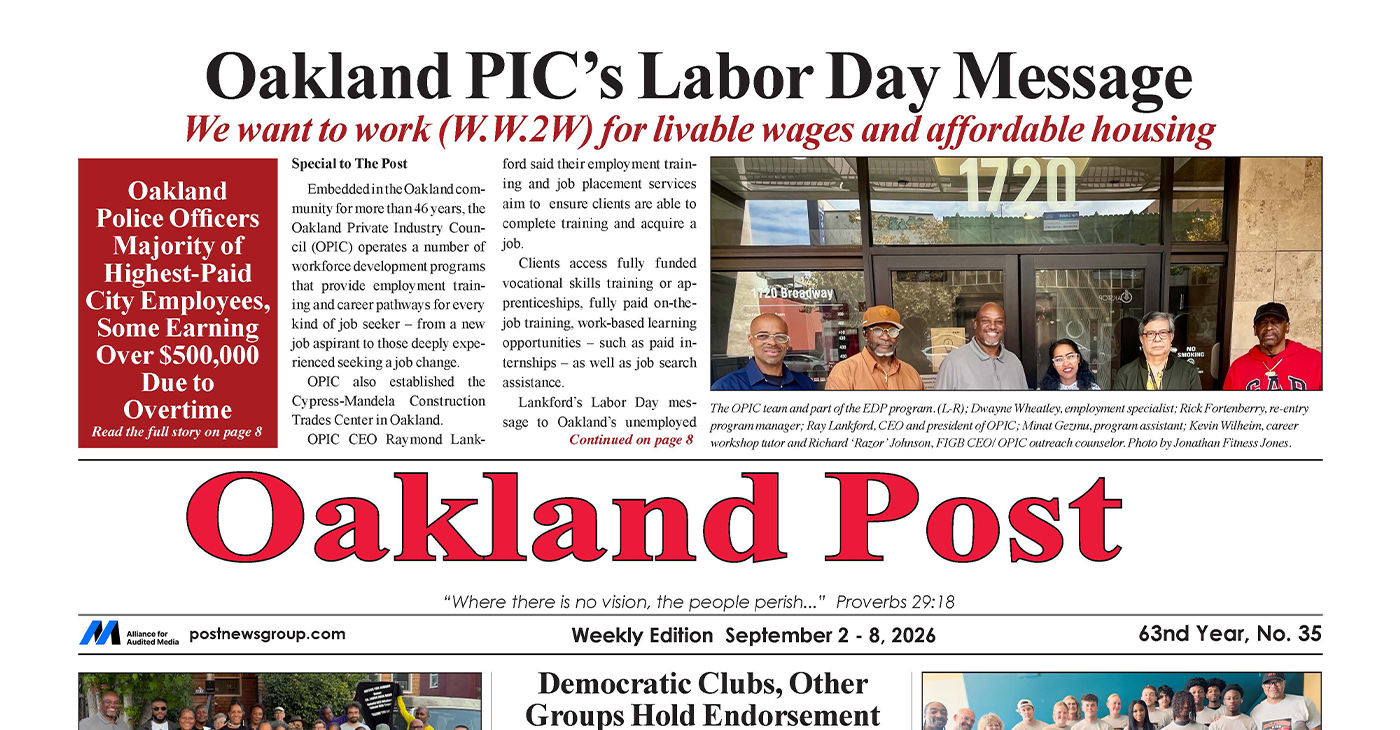
To enlarge your view of this issue, use the slider, magnifying glass icon or full page icon in the lower right corner of the browser window.


Doulas Are Helping Black California Moms Navigate Pregnancy–Even as High Mortality Rates Persist

Newsom Signs Addictive Social Media Law to Protect Kids

On Your November Ballot: Prop 38 Would Allocate $8.4 Billion to Immunology and Immunotherapy Funding

Ask California: Golden State Releases New AI Chatbot

Asm. Isaac Bryan’s Bill Banning California Police From ICE Side Jobs Reaches Newsom’s Desk

Assemblymember LaShae Sharp-Collins’s Bill Would Pause Law Enforcement’s Use of Shock Gloves Pending Study

BOOK REVIEW: ‘Laws of Solomon’ Reveals Tender Heart of Former Child Soldier

OPINION: The New American Fear – From 9-11 to AI

Passing for White, Fighting for Black America: The Courage of Walter White

Oakland People’s Arms Embargo Coalition Demands End to Military Shipments Thru Oakland

Barbara Lee Mourns Gloria Steinem, Remembers a Friendship Rooted in Equality

Event Preview: ‘Fashion v. Fascism’ – A Runway Revolution Is Coming to the Bay Area

Two Looming Threats Every Alameda County Elder Should Know About

Oakland Mayor Reads to Children at Bookout Block Party at Marcus Books Store

Tradition Comes to the Streets in 11th Annual Black-Eyed Pea Festival at the Freedom Farmers Market

Less Affluent School Districts, Including Sacramento City, Face Threat of State Takeover

ESSAY: California Can Close Its Colorectal Cancer Gap

California Hispanic Chambers of Commerce Unveils: ‘Powering the Future’ Theme for 47th Annual Statewide Convention

Four Candidates, Including Incumbent Barbara Lee, Qualify for Oakland Mayor’s Race

Oakland Post: Week of August 12 – 18, 2026

From Blueprint to Breakthrough: Tackling Affordable Housing in Oakland

Oakland Observes Black August with Block Parties, Film Showings, Workshops

COMMENTARY: Why Local School Tax Measure G1 Will Not Be on the November Ballot

Standoff for Justice: Our Homes Are Worth Fighting For

Returning to Its Roots, the Oakland Black-Eyed Pea Festival Partners with the Freedom Farmers Market Sept. 12

Oakland Post: Week of August 26 – September 1, 2026

NPRC Scores First Advocacy Victory: David Shaw Finally Gets His Wish to ‘Go Home’

Frontier Airlines’ Return to Oakland Airport Brings Flights, Jobs and Opportunity

Gubernatorial Candidate Steve Hilton Blasts California New Tire Rules; Newsom Hits Back

Chef Sharon Lee Blends Culinary Excellence, Education and Empowerment

The Conversation With Al McFarlane 6/23/26

Media Monday 6/22/26

LIVE! ASK ALMA! — TUES. 6.23.26 7PM EST

Car Buying Secrets: 4 Hidden Checks Before You Sign!

Is This 550 HP Charger Worth YOUR Money? AutoNetwork Review

Celebrating Juneteenth – Frederick Douglass on education and resistance

LIVE! — ASK ALMA! — TUES. 6.19.26 7PM EST

Hyundai Ioniq 5 Parking, Safety, and 360 View #shorts

2025 Ioniq 5 New Wiper & Powerful Performance! #shorts

Electric SUV Range: Is 259 Miles Enough? #shorts

EV Charging: How Fast Can You Charge an Electric Vehicle? #shorts

Biometric Cooling… Messaging Seats…Come on! 2025 Infiniti QX80 Autograph 4WD

Charged Up: Witness the Magic of a Fully Electric Car! #shorts

Range Rover Sport PHEV Included…: See What’s Inside This Luxury SUV! #shorts

Invisible Hood View: Perfect Parking with X-Ray Vision! #shorts
-
 Commentary4 weeks ago
Standoff for Justice: Our Homes Are Worth Fighting For
-
 Activism4 weeks ago
Oakland Post: Week of August 26 – September 1, 2026
-
 Business4 weeks ago
Frontier Airlines’ Return to Oakland Airport Brings Flights, Jobs and Opportunity
-
 Business4 weeks ago
Gubernatorial Candidate Steve Hilton Blasts California New Tire Rules; Newsom Hits Back
-
 Business4 weeks ago
Chef Sharon Lee Blends Culinary Excellence, Education and Empowerment
-

 Community4 weeks ago
Big City Mayors Ask for “Yes” Vote on Housing Bond Measure; Conservatives Say “No”
-
 Black History4 weeks ago
Jackie Wright Champions Bay Area Stories, Filmmakers and Cultural Institutions
-

 Education4 weeks ago
Gov. Newsom’s Latest Appointees Include Sacramento Advocate for Formerly Incarcerated Students; State’s New Tech Chief
