
City Government
City Urges No Action in Tagami’s Failure to Make Payments on $12 Million Loan

Mayor Jean Quan’s staff has recommended that no action be taken against Phil Tagami’s company, Rotunda Partners II, which is currently four months behind on its a 20-year $12 million loan with the City of Oakland to develop a parking garage, retail space, and temporary parking lot at the Rotunda building next to City Hall, according to city officials.
According to reports, Tagami’s company owes $80,000 in loan payments dating back to November, as of last week’s Community and Economic Development (CED) Committee meeting.
“Staff recommends that the (city) not exercise its rights” at this time to declare the project “in default for non-performance,” according to the Feb. 4 informational report prepared by city staff, which is ultimately responsible to the mayor,
The company should only be declared in default “if there is reasonable likelihood that such action will facilitate the development and is in the best interest of the city,” the report added.
At the CED meeting last week, Councilmember Lynette McElhaney said, “I would want to see staff put really strong timelines that are transparent and can be monitored with respect to getting people on track and to respond timely.”
Asserting that the city staff report and McElhaney’s statements are “inaccurate,” a managing partner of Rotunda Partners says the company is current on the loan and has made all its monthly payments on time.

At the same time that Tagami’s company allegedly has failed to make payments on its loan, he is being paid for multiple roles with the city as property manager, master developer, project manager, rail operator and finance broker on the Oakland Army Base development project.
Asked to speak to the Oakland Post about the Tagami’s failure to pay, Mayor Quan has remained silent. The Post has also asked the other mayoral candidates what their position is on the issue.
Not addressing the failure to pay, mayoral candidate Bryan Parker said, “As long as they’re performing, being transparent, and being inclusive, I’m for continuing with those partners.”
“We can ensure transparency by using objective metrics to measure results and making sure the contracts include strong audit provisions,” he said.
In fact, I have already started organizing meetings to ensure these goals are met, Parker said, adding, “My understanding is that the [Rotunda] loan payments are current according to confirmation from a city official.”
Mayoral candidate Dan Siegel said he is “concerned about conflicts of interest” with Tagami holding multiple roles in his partnership with the city.
“City employees and paid consultants should not also receive city grants and contracts,” said Siegel. “I think the city should demand that Tagami become current on his contractual obligations immediately. If he cannot do so, appropriate legal action should be taken.”
“The city should insist that he appear at a public meeting to answer concerns about his agreements with the city,” Siegel said.
While not answering the Post’s questions this week, candidate Libby Schaaf has said she expects transparency in the city’s financial agreements with Tagami.
“I always believe the public is entitled to detailed information about how the city is spending public money,” she said.
Candidate Joe Tuman did not respond to the Post’s questions.
In a letter sent to The Post Thursday, on deadline, Mark Moss, a managing member at Rotunda Partners, said, “Rotunda Partners has made each payment on time.”
“The article repeated a councilmember’s allegation that the company is currently technically in default. Wrong – Rotunda Partners has made each payment on time and of course, is NOT in default,” Moss said, who did not explain why the company did not send a representative to speak at last week’s CED meeting where the default was discussed as part of the public agenda.
Disputing the public statements by another city councilmember who called for transparency in the city’s agreement s with Rotunda Partners, Moss said, “All Rotunda documents are public and available.”
“The city’s loan/equity partnership with Rotunda Partners is actually one of the best real estate deals the city has ever made,” he said in letter.


Activism
Oakland Post: Week of March 18 – 24, 2026
The printed Weekly Edition of the Oakland Post: Week of March 18 – 24, 2026
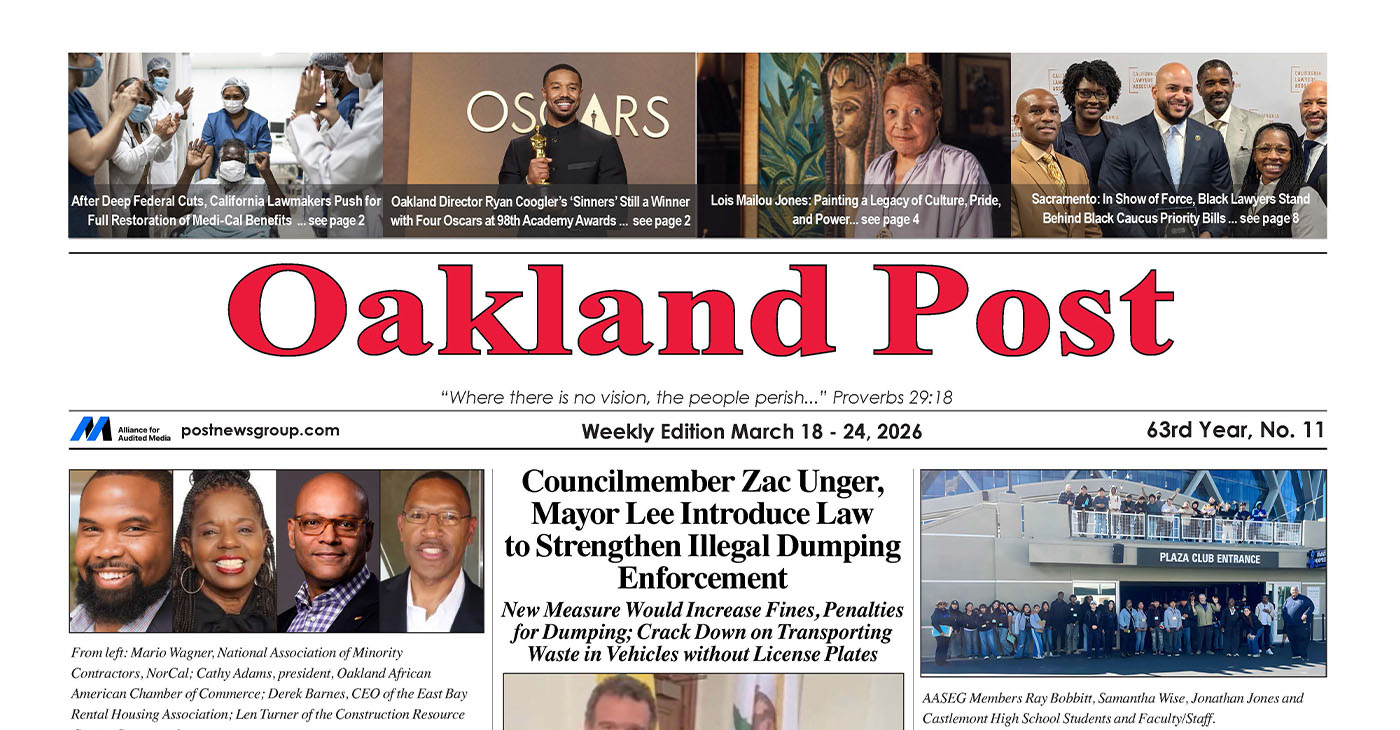
To enlarge your view of this issue, use the slider, magnifying glass icon or full page icon in the lower right corner of the browser window.
Activism
Oakland Post: Week of March 11 -17, 2026
The printed Weekly Edition of the Oakland Post: Week of March 11 – 17, 2026
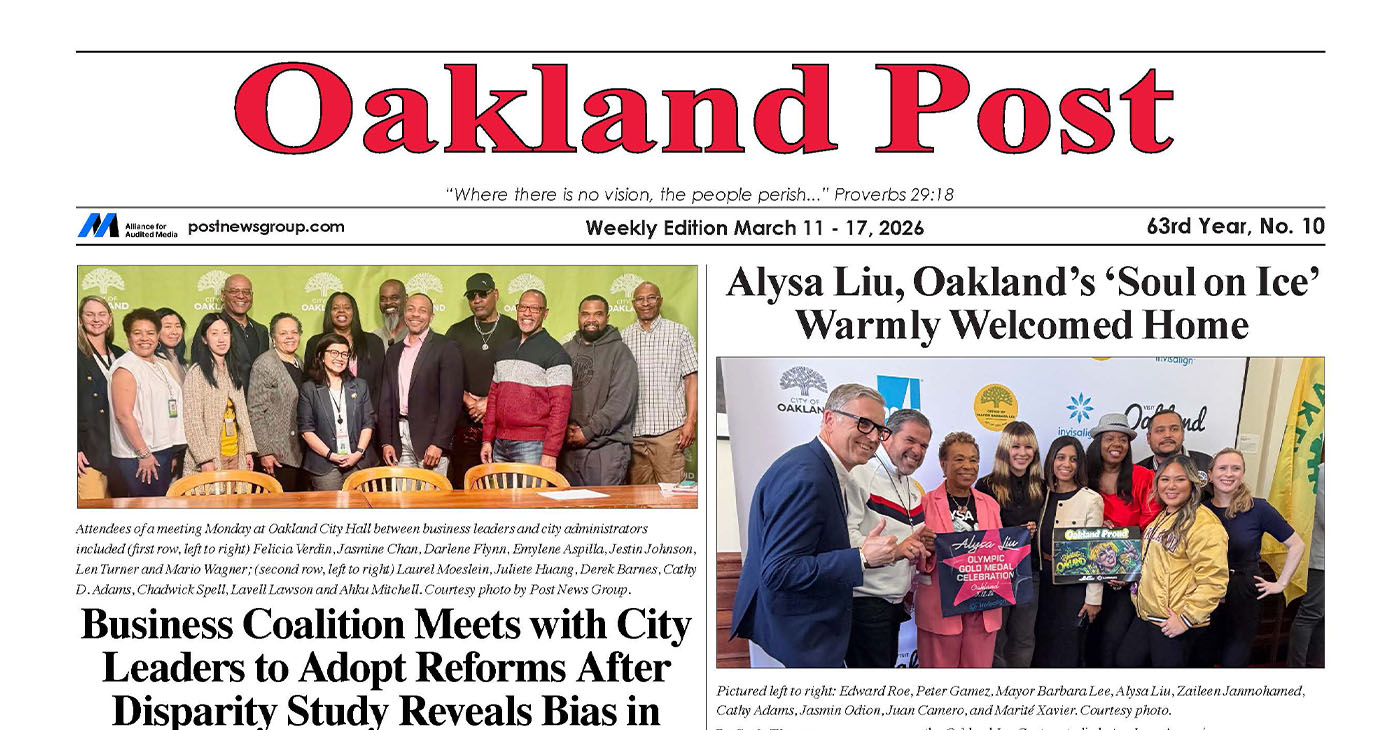
To enlarge your view of this issue, use the slider, magnifying glass icon or full page icon in the lower right corner of the browser window.
Activism
Oakland Post: Week of March 4 – 10, 2026
The printed Weekly Edition of the Oakland Post: Week of March 4 – 10, 2026

To enlarge your view of this issue, use the slider, magnifying glass icon or full page icon in the lower right corner of the browser window.


WORK FROM HOME
Home-based business with potential monthly income of $10K+ per month. A proven training system and website provided to maximize business effectiveness. Perfect job to earn side and primary income. Contact Lynne for more details: Lynne4npusa@gmail.com 800-334-0540


Black Artists in America, Installation Three Wraps at the Dixon Gallery and Gardens

Grief, Advocacy, and Education: A Counselor Reflects on Black Maternal Health

Future of Florida’s Black History Museum in Limbo

New Research Shows the Many Benefits of Early Learning

South Hampton K-8 Students Among Top 10 Finalists for Samsung’s ‘Solve for Tomorrow’ Competition

Cuba: No Negotiation with US on the President or Political System

Brooklyn Academy of Music Names Jamaican-Born Tamara McCaw as President

Trinidad & Tobego – U.S. Launches WhatsApp Channel for American Citizens in the Country

Oakland Post: Week of March 18 – 24, 2026

AI Innovation vs. Ethics and Environmental Impact

AI, Web3, and Digital Reparations

What If You Owned Your AI Agent?

Season 7, Episode 3 – January Reporter’s Roundtable 📱

Season 7, Episode 3 – January Reporter’s Roundtable

AI, Media, and Power | Part 2, Real-World Impacts and Tradeoffs

Reflecting on Black History Milestones in Birmingham AL

CITY OF SAN LEANDRO STATE OF CALIFORNIA PUBLIC WORKS DEPARTMENT ENGINEERING DIVISION NOTICE TO BIDDERS FOR ANNUAL STREET OVERLAY/REHABILITATION 2019-21 – PHASE III

Oakland Post: Week of February 18 – 24, 2026

Oakland Post: Week of February 25 – March 3, 2026

PRESS ROOM: NBA Hall of Fame Nominee Terry Cummings Joins 100 Black Men of DeKalb County to Launch Victory & Values Initiative

Trump’s MAGA Allies are Creating Executive Order Plan to Steal the 2026 Midterms

Oakland Post: Week of March 4 – 10, 2026

Chase Oakland Community Center Hosts Alley-Oop Accelerator Building Community and Opportunity for Bay Area Entrepreneurs

U.S. manufacturing rebounds – how foundry services are adapting to rising demand

Poll Shows Support for Policies That Help Families Afford Child Care

OP-ED: One Hundred Years of Black Workers Telling the Truth

Advancements in solar technology that are changing the way we power the world

Woman’s Search for Family’s Roots Leads to Ancestor John T. Ward – A Successful Entrepreneur and Conductor on the Underground Railroad

Oakland Post: Week of March 11 -17, 2026

PRESS ROOM: Civil Rights TV Launches in Selma as the World’s First 24/7 Civil Rights Television Network

Hyundai Ioniq 5 Parking, Safety, and 360 View #shorts

2025 Ioniq 5 New Wiper & Powerful Performance! #shorts

Electric SUV Range: Is 259 Miles Enough? #shorts

EV Charging: How Fast Can You Charge an Electric Vehicle? #shorts

Biometric Cooling… Messaging Seats…Come on! 2025 Infiniti QX80 Autograph 4WD

Charged Up: Witness the Magic of a Fully Electric Car! #shorts

Range Rover Sport PHEV Included…: See What’s Inside This Luxury SUV! #shorts

Invisible Hood View: Perfect Parking with X-Ray Vision! #shorts

AI Is Reshaping Black Healthcare: Promise, Peril, and the Push for Improved Results in California

ESSAY: Technology and Medicine, a Primary Care Point of View

Sanctuary Cities

The RESISTANCE – FREEDOM NOW

STATE OF THE PEOPLE: Freddie

ECONOMIC BOYCOTT DAY!!!!!

I told You So
-
 Activism4 weeks ago
Oakland Post: Week of March 4 – 10, 2026
-
 #NNPA BlackPress4 weeks ago
Woman’s Search for Family’s Roots Leads to Ancestor John T. Ward – A Successful Entrepreneur and Conductor on the Underground Railroad
-
 Activism3 weeks ago
Oakland Post: Week of March 11 -17, 2026
-

 #NNPA BlackPress4 weeks ago
COMMENTARY: Women of Color Shape Our Past and Future
-

 #NNPA BlackPress4 weeks ago
OP-ED: NNPA Launches 2026 “Leadership Matters” Video Series
-

 #NNPA BlackPress4 weeks ago
Advocates Raise Alarm Over ICE Operation, MOU and Detention Risks in Baltimore County
-

 #NNPA BlackPress4 weeks ago
Pete Buttigieg to Join Mayor Randall Woodfin for Community Town Hall in Birmingham
-

 Advice3 weeks ago
Financial Wellness and Mental Health: Managing Money Stress in College
